









Executive Overview
Valenciaport, one of the Mediterranean’s premier maritime trade hubs, has experienced a nuanced and challenging operational landscape during the first seven months of 2026. According to the latest trade statistics released by the Port Authority of Valencia, the port handled a cumulative 3.28 million TEUs (Twenty-Foot Equivalent Units) between January and July 2026. This figure represents a slight year-on-year contraction of 1.34 per cent compared to the same period in 2025.
A closer examination of the data reveals a fundamental structural shift in the port’s cargo profile: while domestic consumer and industrial demand has driven a substantial expansion in inbound shipments, flagging export performance has weighed heavily on overall throughput.
The downward pressure was particularly acute during the peak of the summer season. Container traffic for the month of July 2026 plummeted by 9.84 per cent, dropping to 459,517 TEUs from the 509,685 TEUs recorded in July 2025. This sharp monthly contraction accentuates the volatility currently characterizing global supply chains and European maritime logistics.
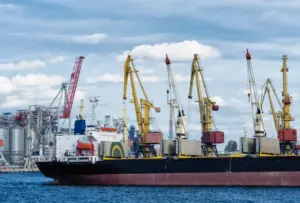
Nevertheless, beneath the headline container figures lie pockets of exceptional resilience and growth. Valenciaport’s annualized performance over the past 12 months remains in positive territory at 5.61 million TEUs (up 0.16 per cent), demonstrating that the port’s long-term baseline volume remains stable. Furthermore, stellar performances in specialized sectors—most notably automotive logistics and intermodal rail freight—have provided a vital counterweight to maritime export sluggishness. As Valenciaport simultaneously accelerates its green transition, including multi-million-euro investments in net-zero electrical infrastructure, port stakeholders are being forced to balance immediate macroeconomic headwinds with long-term strategic evolution.
Detailed Chronology & Temporal Trade Analysis
The January–July 2026 Trajectory
The opening seven months of 2026 have tested the operational agility of Valenciaport’s terminal operators. The period began with cautious optimism, as lingering post-pandemic demand patterns and shifting Red Sea routing strategies continued to redraw Mediterranean shipping lanes. However, as the months progressed, a clear divergence emerged between import and export dynamics.
- Export Contraction: Spanish outbound logistics faced sustained pressure throughout the first half of the year, with total exports handled by Valenciaport falling by 1.34 per cent year-on-year. Industry analysts attribute this trend to softening industrial demand in key European partner economies, high energy costs affecting domestic manufacturing competitiveness, and persistent geopolitical friction along major global trade corridors.
- Import Expansion: Conversely, inbound maritime logistics experienced a boom. Spanish imports surging through Valenciaport registered a remarkable 10.33 per cent increase between January and July 2026. This influx points to robust domestic consumption and inventory restocking by retail and manufacturing sectors, even as broader macroeconomic indicators flashed warning signs.
The July Shock: A 9.84 Per Cent Monthly Decline
The most alarming data point in the recent report is the performance registered in July 2026. Total container traffic fell to 459,517 TEUs, a steep decline of 9.84 per cent compared to July 2025 (509,685 TEUs).
Port authorities note that July traditionally marks the ramp-up of late-summer shipping ahead of the autumn retail season. However, this year’s mid-summer slump suggests that cargo owners may have pulled forward their shipping schedules into the spring to mitigate ongoing supply chain disruptions, or that European consumer demand cooled more rapidly than anticipated. This contraction serves as a critical inflection point for port planners as they look toward the final quarter of the year.

Supporting Context & Metrics: Global Markets, Sectoral Shifts, and Intermodal Growth
Bilateral Trade Dynamics: The Dominance of China and Shifting Partners
Valenciaport’s international trade matrix in 2026 highlights both the enduring dominance of Asian manufacturing hubs and significant realignments across secondary and regional markets.
- China: China remains unequivocally Valenciaport’s largest and most vital international trading partner. Between January and July 2026, containerized trade with China reached 546,966 TEUs, representing an impressive 18.39 per cent year-on-year increase. Measured by cargo weight, Chinese trade accounted for 5.94 million tonnes, up 19.49 per cent. This expansion underscores the deep structural integration of Chinese supply chains within the Iberian Peninsula’s industrial and retail ecosystems, defying broader Western efforts toward economic decoupling or near-shoring.
- The United States: The U.S. retained its position as Valenciaport’s second-largest partner by container volume, but experienced a notable contraction. Volumes fell to 193,179 TEUs, marking a 16.22 per cent decline compared to the previous year. By cargo weight, the U.S. followed closely as a major market, handling 3.35 million tonnes, down 7.09 per cent.
- North Africa and the Mediterranean: Trade performance across the Mediterranean basin was mixed. Algeria recorded 177,776 TEUs, down 5.27 per cent. Türkiye experienced a sharper drop, handling 112,110 TEUs, representing a 23.98 per cent decrease. Italy similarly contracted in container terms, recording 61,149 TEUs (down 19.73 per cent), though Italy maintained its heavy-weight status with 3.66 million tonnes of total cargo (down 13.20 per cent).
- Emerging Growth Markets: Amid these declines, several trade lanes exhibited stellar expansion. Brazil emerged as one of the most dynamic growth markets, with container volumes soaring 16.49 per cent to reach 83,124 TEUs. Neighboring African markets also posted solid gains, with Morocco and Egypt registering volumetric increases of 9.18 per cent and 11.15 per cent, respectively.
Automotive Boom: Vehicle Traffic Breaks Records
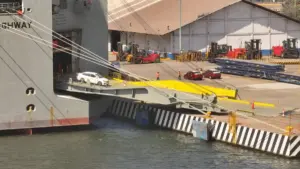
While containerized freight experienced mixed fortunes, Valenciaport’s roll-on/roll-off (Ro-Ro) and vehicle logistics sectors experienced an undeniable boom, reflecting strong vehicle manufacturing output and export demand.
- Monthly Surge: In July 2026 alone, Valenciaport handled 48,405 vehicles, a staggering 19.09 per cent increase over July 2025.
- Year-to-Date Totals: Between January and July, cumulative vehicle throughput reached 325,335 units, up 10.68 per cent year-on-year.
- Annualized Strength: Over the trailing 12-month period, total vehicle throughput climbed to 555,878 units, reflecting a healthy 6.21 per cent growth rate. This sector has proven to be a vital financial and operational buffer for terminal operators experiencing containerized headwinds.
Intermodal Connectivity: Rail Freight Gains Traction
In alignment with European Union decarbonization mandates and strategic goals to shift freight off highways and onto sustainable corridors, Valenciaport’s rail statistics for the first seven months of 2026 demonstrated exceptional progress.
- Tonnage Growth: Between January and July, 2.30 million tonnes of cargo were transported by rail through the port’s intermodal terminals, representing a remarkable 19.31 per cent increase compared to the same period in 2025.
- Container Rail Traffic: Containerized rail movements mirrored this upward trajectory. By July 31, 2026, rail container traffic had reached 172,328 TEUs, a 17.97 per cent year-on-year jump.
These figures validate ongoing investments in rail infrastructure, terminal connectivity, and inland intermodal hubs designed to expand Valenciaport’s logistical hinterland well beyond the coastal strip.
Official Statements & Strategic Perspectives
While the Port Authority of Valencia releases raw operational metrics monthly, executive commentary has increasingly emphasized structural adaptation, modal shift, and environmental sustainability.
In recent strategic briefings, port leadership has underscored that volume fluctuations—such as the July contraction—are symptomatic of a broader, highly volatile macroeconomic environment shaped by fluctuating energy prices, shifting global manufacturing centers, and the ongoing recalibration of deep-sea liner alliances.
Rather than viewing the 1.34 per cent year-to-date dip in container traffic as an existential threat, management has framed it as a natural phase in a transitional year. Port executives have repeatedly emphasized that Valenciaport’s long-term viability depends less on chasing short-term volume peaks and more on cementing its status as an efficient, technologically advanced, and environmentally sustainable logistics node.
This philosophy is vividly illustrated by the port’s heavy capital allocation toward green infrastructure. A prime example is Valenciaport’s recent endorsement and financial backing of a €15.6 million electrical substation. This critical project is designed to supply high-voltage shore connection (OPS – Onshore Power Supply) to docked vessels, allowing ships to shut down their auxiliary diesel engines while in port. This initiative is a cornerstone of the port’s ambitious roadmap toward achieving net-zero carbon emissions, proving that environmental compliance and operational efficiency are increasingly intertwined in modern maritime strategy.
Future Outlook: Navigating the Remainder of 2026 and Beyond
As Valenciaport enters the final stretch of 2026, the port faces a complex set of challenges and opportunities that will dictate its year-end financial and operational standing.
Macroeconomic and Geopolitical Uncertainties
The immediate outlook for the global shipping industry remains clouded by macroeconomic uncertainty. Persistent inflation, fluctuating interest rates across the Eurozone, and fragile consumer confidence threaten to dampen import demand in the fourth quarter. Furthermore, geopolitical tensions in the Middle East and Eastern Europe continue to force carriers to navigate longer routes around the Cape of Good Hope, impacting vessel turnaround times, scheduling reliability, and operating costs for liners calling at Mediterranean ports.
Strategic Priorities for Terminal Operators
To maintain its competitive edge against rival Mediterranean hubs like Algeciras, Tangier Med, and Piraeus, Valenciaport must focus on several core strategic pillars:
- Export Revitalization: Collaborative initiatives between regional government bodies, industrial associations, and port operators will be essential to assist Spanish exporters in regaining international competitiveness. Addressing logistics bottlenecks and streamlining customs procedures can help reverse the export contraction seen in the first seven months.
- Expanding Intermodal Horizons: The impressive double-digit growth in rail freight (+19.31% in tonnage) must be sustained and expanded. Further integration with central and northern Spanish industrial centers via high-capacity freight rail corridors will secure captive cargo volumes independent of maritime volatility.
- Accelerating Decarbonization: With regulatory pressure from the European Union—including the inclusion of maritime transport in the EU Emissions Trading System (ETS)—intensifying daily, Valenciaport’s investments in green infrastructure like the €15.6 million substation will become key competitive differentiators. Shippers and shipping lines are increasingly prioritizing ports that offer robust green energy solutions and shore-power capabilities.
- Capitalizing on Niche Sectors: The continued strength of automotive logistics (+10.68% year-to-date) proves that specialized cargo handling can offset general container volatility. Expanding specialized storage, handling facilities, and digital documentation systems for Ro-Ro and break-bulk traffic will safeguard revenues through the remainder of the decade.
Conclusion
Valenciaport’s performance through July 2026 encapsulates the broader state of global maritime trade: resilient yet reactive, caught between booming consumer import appetite and stubborn industrial export stagnation. While container throughput has dipped slightly, the port’s structural strengths—exemplified by surging vehicle shipments, soaring rail cargo volumes, and proactive decarbonization investments—position it firmly to weather current headwinds. As the port navigates the final months of 2026, its ability to marry operational efficiency with green transition milestones will determine its long-term success as the gateway to Southern Europe.