









Executive Overview
The Port of Lázaro Cárdenas, Mexico’s premier deep-water Pacific trade gateway, has officially recorded a phenomenal operational performance for the first seven months of the year, closing out July 2026 with a total commercial cargo throughput of 17.48 million tonnes. This stellar performance represents a robust 14 per cent year-on-year increase compared to the corresponding period in 2025, underscoring the port’s expanding capacity, operational resilience, and pivotal role within global and regional supply chains.
Behind this double-digit growth lies a convergence of strategic infrastructural investments, efficient modal connectivity, and a surging demand for transpacific shipping solutions. During the January–July 2026 reporting window, the port welcomed 1,049 commercial vessel arrivals, each managed with high precision by terminal operators and port authorities. The diversification of the cargo base—spanning containerised goods, mineral bulks, automotive units, and fluids—demonstrates the terminal’s versatility and its critical importance to Mexico’s macro-economic stability.
As nearshoring trends continue to reshape North American supply chains and transpacific trade lanes experience shifting dynamics, Lázaro Cárdenas has firmly established itself as an indispensable alternative to congested North American West Coast hubs. The port’s latest metrics not only validate ongoing multi-billion-peso infrastructure developments but also highlight its growing status as a dominant transhipment nexus for Latin America and the broader Pacific Rim.
Detailed Chronology: The Road to Mid-Year Dominance
The trajectory of the Port of Lázaro Cárdenas throughout the first seven months of 2026 has been characterized by consistent month-on-month volume expansion, setting new benchmarks for efficiency and cargo handling capabilities.
Q1 2026: Setting a Fast Pace
The operational year began with aggressive momentum. By the close of the first quarter, Lázaro Cárdenas reported unprecedented container and bulk volumes, fueled by an early surge in Asian imports and robust manufacturing supply demands across North America. Terminal operators noted an immediate uptick in vessel turnaround times, driven by advanced yard management systems and newly upgraded gantry cranes. The steady cadence of maritime traffic established a baseline of more than 150 vessel arrivals per month, laying a solid foundation for the record-breaking milestones that would follow.
April to June 2026: Absorbing Transpacific Shifts
As global shipping routes adjusted to shifting geopolitical landscapes and environmental regulations affecting major global lanes, Lázaro Cárdenas absorbed a significant share of diverted transpacific traffic. During this second quarter, the port successfully managed major influxes of mineral bulk and containerised cargo without experiencing the severe congestion bottlenecks that historically plagued coastal trade hubs. Strategic rail and road evacuation protocols were tested and proven during this period, ensuring that cargo moved fluidly from shipside to hinterland distribution centers.
July 2026: Reaching the 17.48 Million Tonne Milestone
The culmination of these efforts crystallized at the end of July 2026, when cumulative cargo throughput officially touched 17.48 million tonnes—a 14 per cent leap over the same timeframe in 2025. The handling of 1,049 vessels over these seven months proved that the port’s marine infrastructure, pilotage services, and berthing capacities are scaling in direct proportion to international demand. This milestone month also solidified ongoing regional investments, most notably the recent allocation of 1.73 billion pesos toward upgrading critical port access roads and arterial infrastructure.

Supporting Context & Metrics: A Comprehensive Data Breakdown
A granular analysis of the operational data from the Port of Lázaro Cárdenas reveals a highly diversified ecosystem where containerized traffic, bulk commodities, and automotive shipments intersect to drive extraordinary economic value.
Cargo Composition and Volume Distribution
The port’s impressive 17.48 million tonne total is distributed across several key commodity sectors:
- Containerised Cargo (49%): Dominating the port’s portfolio, containerised goods accounted for nearly half of all volume handled. Total container throughput reached an astounding 1.58 million TEUs (Twenty-Foot Equivalent Units), representing a solid 7 per cent increase compared to July 2025. This growth reflects strong consumer demand and efficient container handling protocols across the port’s specialized terminals.
- Mineral Bulk (36%): Representing the second-largest share of cargo volume, mineral bulk shipments totalled a substantial portion of the overall tonnage. This commodity class remains vital for feeding domestic industrial manufacturing, steel production, and regional infrastructure projects.
- General Cargo (5%): Traditional break-bulk and general commercial goods maintained a steady 5 per cent share, accommodating project cargo, heavy machinery, and non-standard shipments.
- Other Fluids, Vehicles, and Agricultural Bulk (10%): The remaining share of the cargo mix was shared amongst automotive units, agricultural bulks, petroleum fluids, and chemical liquids, highlighting the terminal’s multi-purpose operational architecture.
Port of Lázaro Cárdenas Cargo Composition (Jan-Jul 2026)
--------------------------------------------------------
[████████████████████] Containerised Cargo (49%)
[███████████████     ] Mineral Bulk (36%)
[██                  ] General Cargo (5%)
[████                ] Vehicles, Agri-Bulk & Fluids (10%)
Trade Flow Dynamics: Imports, Exports, and Transhipment
The directional flow of goods through Lázaro Cárdenas illustrates its dual function as a national gateway and an international transhipment hub:
- Transhipment (50%): In a remarkable testament to its strategic positioning along the Pacific coast, fully half of all cargo volume (50%) handled at the port was classified as transhipment. Lázaro Cárdenas acts as a central sorting and redistribution node, receiving mega-container vessels from Asia and transferring goods onto feeder networks serving the west coast of Central and South America.
- Imports (25%): Inbound shipments accounted for a quarter of the total volume, encompassing consumer electronics, industrial inputs, textiles, and manufactured goods destined for the Mexican consumer market and the wider North American industrial corridor.
- Exports (28% cumulative across sectors): Outbound trade represented a vital component of the port’s balance, showcasing Mexico’s manufacturing export power, particularly in finished automobiles and industrial components.
Hinterland Connectivity: Road vs. Rail Modal Split
The efficient evacuation of 17.48 million tonnes of cargo requires robust, multimodal transport infrastructure. During the first seven months of 2026, the modal split for cargo evacuation demonstrated the heavy reliance on highway networks complemented by heavy rail capabilities:
- Road Transport (72%): Trucks and commercial haulage fleets accounted for 72 per cent of cargo movement out of the port. This high percentage emphasizes the critical importance of regional roadways and justifies the strategic 1.73 billion peso investment dedicated to expanding and modernizing port access roads to eliminate potential highway bottlenecks.
- Rail Transport (28%): Intermodal rail services moved the remaining 28 per cent of cargo. Rail remains an indispensable artery for high-volume, long-distance corridors, connecting Lázaro Cárdenas directly to major inland manufacturing hubs and industrial centers across central Mexico and the United States border.
Automotive Sector Dominance
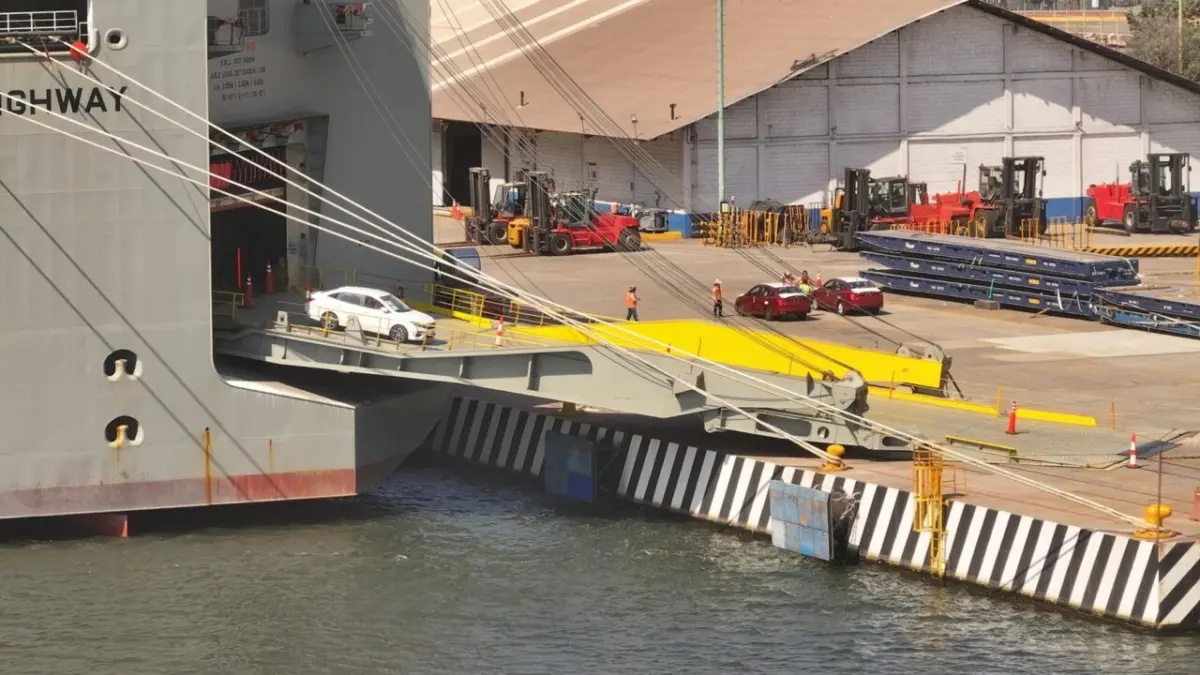
The automotive sector at Lázaro Cárdenas continues to shatter performance expectations, cementing the port’s reputation as Mexico’s preeminent vehicle logistics hub. Total automotive cargo reached an impressive 378,347 units by the end of July 2026.
The structural distribution of these automotive shipments highlights the port’s multi-layered utility:
- Imports (70%): Inbound vehicles from Asian and European manufacturing plants made up the vast majority of automotive throughput, satisfying growing domestic appetite for foreign passenger and commercial vehicles.
- Exports (28%): Vehicles manufactured within Mexico’s sophisticated automotive assembly plants utilized Lázaro Cárdenas as a launchpad to global markets, accounting for well over a quarter of total port vehicle traffic.
- Transhipment (2%): Regional transhipment accounted for the remaining 2% of vehicle movements, optimizing regional supply chains for major global automotive brands.
Official Statements and Industry Perspectives
The record-breaking performance of the Port of Lázaro Cárdenas has elicited enthusiastic commentary from maritime authorities, port administrators, and logistics experts alike, who view these results as vindication of long-term planning and public-private cooperation.
Port authorities released a joint statement emphasizing the transformative impact of recent capital injections:
"The achievement of 17.48 million tonnes by the end of July 2026 is not merely a statistical milestone; it is a clear validation of our strategic vision. By proactively investing in our infrastructure—such as the recent 1.73 billion peso road modernization program—and fostering deep collaboration with terminal operators, shipping lines, and rail partners, we have created an environment of unmatched efficiency. Lázaro Cárdenas is no longer just a regional port; it is a cornerstone of global maritime trade logistics."
Industry analysts observing the Latin American shipping market have similarly lauded the port’s handling of transhipment cargo. A leading maritime logistics consultant noted:
“Achieving a 50 per cent transhipment ratio while simultaneously absorbing a 7 per cent growth in TEUs to hit 1.58 million TEUs is a masterclass in port management. In an era where global supply chain disruptions have become the norm, Lázaro Cárdenas offers predictability, deep-water draft capabilities, and seamless multimodal evacuation that few ports in the Western Hemisphere can match.”
Furthermore, representatives from major automotive manufacturing associations praised the port’s specialized handling facilities:
“With nearly 380,000 units processed in just seven months, Lázaro Cárdenas has proven indispensable to the Mexican automotive industry. The smooth handling of both import models and export fleets ensures that our manufacturing supply chains remain competitive on the global stage.”
Future Outlook: Sustaining Growth and Expanding Horizons
Looking beyond the July 2026 figures, the strategic horizon for the Port of Lázaro Cárdenas is exceptionally bright, though defined by proactive preparations for continued expansion. As global trade volumes are projected to steadily rise through the remainder of the decade, port management is already executing phase-two developments to prevent future capacity constraints.
Infrastructure Modernization and Digital Integration
Central to the port’s future-proofing strategy is the ongoing execution of the 1.73 billion peso road infrastructure investment. By decoupling local traffic from heavy freight corridors and introducing intelligent transportation systems (ITS), the port aims to drive the road transport efficiency rate even higher. Additionally, terminal operators are accelerating digital transformation initiatives, incorporating artificial intelligence-driven predictive analytics for yard management, automated gate processing, and blockchain-secured documentation. These technological upgrades are projected to shave precious hours off vessel turnaround times and enhance overall port velocity.
Capitalizing on Nearshoring Dynamics
The ongoing macro-economic shift toward nearshoring—where North American enterprises relocate manufacturing and assembly operations closer to home—presents an unprecedented growth catalyst for Lázaro Cárdenas. Positioned strategically on the Pacific coast with direct rail and road corridors leading straight into the industrial heartland of Mexico and onward to the U.S. border, the port is uniquely situated to capture inbound raw materials and outbound finished industrial goods resulting from this structural shift.
Environmental Sustainability and Green Shipping Corridors
In alignment with international maritime decarbonization goals mandated by the International Maritime Organization (IMO), port authorities are currently designing green initiatives aimed at reducing the carbon footprint of terminal operations. Plans are underway to expand shore-power (cold-ironing) infrastructure, electrify rubber-tyred gantry (RTG) cranes, and establish zero-emission logistics zones within the port perimeter. These sustainability measures will not only ensure compliance with stringent global environmental standards but also position Lázaro Cárdenas as a preferred port of call for eco-conscious global shipping lines.
Conclusion
The Port of Lázaro Cárdenas’ performance through July 2026—marked by 17.48 million tonnes of cargo, 1.58 million TEUs, and nearly 380,000 automotive units—cements its status as a titan of international maritime commerce. Through a potent mix of strategic geographical positioning, robust multimodal connectivity, and forward-thinking capital investment, the port stands fully equipped to navigate the complexities of modern global trade while driving Mexico’s economic prosperity well into the future.