






Executive Overview
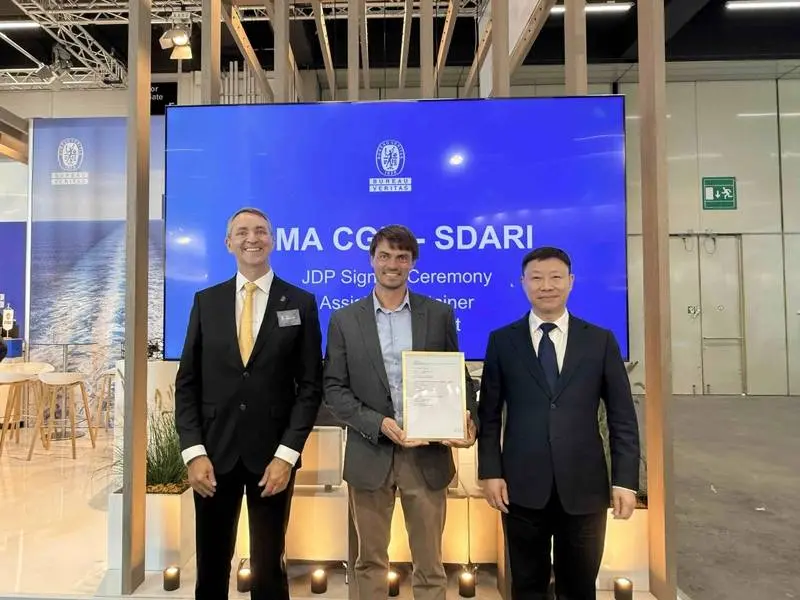
At the SMM maritime trade fair in Hamburg, a landmark Joint Development Project (JDP) agreement was signed, signaling a major shift in the technological trajectory of global shipping. Three industry leaders—French ocean carrier giant CMA CGM, the Shanghai Merchant Ship Design and Research Institute (SDARI), and classification society Bureau Veritas Marine & Offshore (BV)—have joined forces to develop and evaluate an innovative, highly assisted container vessel concept. This initiative is designed to fundamentally reshape onboard operations through advanced digitalization, artificial intelligence (AI), and enhanced decision-support systems.
Rather than pursuing full, unmanned autonomy—a concept that remains legally, ethically, and practically complex for ultra-large container vessels—the JDP focuses on a pragmatic, "human-in-the-loop" model. By integrating AI-driven decision-support architectures directly into the ship’s operational fabric, the project aims to optimize energy efficiency, lower greenhouse gas emissions, enhance cargo and crew safety, and significantly reduce the cognitive workload of seafarers.
The partnership leverages a highly synergistic division of labor. CMA CGM provides real-world operational requirements and the critical shipowner perspective; SDARI brings merchant ship design and smart-systems engineering expertise; and Bureau Veritas delivers the independent classification, safety, risk-assessment, and regulatory frameworks required to bring these advanced concepts to commercial reality.
                    ┌────────────────────────────────────────┐
                    │       SMM Hamburg JDP Agreement        │
                    └───────────────────┬────────────────────┘
                                        │
         ┌──────────────────────────────┼──────────────────────────────┐
         ▼                              ▼                              ▼
┌─────────────────┐            ┌─────────────────┐            ┌─────────────────┐
│     CMA CGM     │            │      SDARI      │            │ Bureau Veritas  │
│  (Shipowner &   │            │  (Ship Design & │            │ (Classification │
│   Operations)   │            │ Smart Systems)  │            │    & Safety)    │
└────────┬────────┘            └────────┬────────┘            └────────┬────────┘
         │                              │                              │
         └──────────────────────────────┼──────────────────────────────┘
                                        ▼
                    ┌────────────────────────────────────────┐
                    │     AI-Assisted Container Vessel       │
                    │      • Enhanced Safety & Efficiency    │
                    │      • Reduced Crew Workload           │
                    │      • Technology-Neutral Concept      │
                    └────────────────────────────────────────┘
Detailed Chronology
The signing of this JDP represents a key milestone in the broader evolution of maritime digitalization and smart ship technology. To understand how the industry arrived at this point, and where this project is headed, it is useful to examine both the historical context of maritime automation and the projected timeline of this specific joint initiative.
The Evolution of Maritime Digitalization (2010–Present)
- 2010–2015: The Sensor Revolution & Connectivity Boom.
The early part of the decade saw the widespread installation of basic sensor networks and satellite communication systems (VSAT) across merchant fleets. Data collection was primarily retrospective, used by shore-based teams to analyze engine performance and fuel consumption weeks after a voyage. - 2015–2019: Real-Time Monitoring and Early Optimization.
The industry transitioned toward real-time data transmission. Early-stage digital twins and weather routing software began to emerge. However, these systems remained isolated silos, and onboard crews were often overwhelmed by fragmented alerts and disjointed user interfaces. - 2020–2023: The Autonomy Trials and Regulatory Awakening.
High-profile trials of fully autonomous, small-scale vessels (such as the Yara Birkeland in Norway) proved that unmanned navigation was technically viable in localized, coastal environments. Concurrently, the International Maritime Organization (IMO) began intensive work on the Maritime Autonomous Surface Ships (MASS) Code, recognizing the need to regulate varying degrees of autonomy. - 2024: The Shift to Pragmatic, AI-Assisted Mega-Vessels.
The industry realized that while fully autonomous transoceanic container ships are decades away due to regulatory, liability, and physical maintenance challenges, the underlying technology could be deployed immediately to assist human crews. The CMA CGM, SDARI, and Bureau Veritas JDP represents the formalization of this pragmatic shift, focusing on scale, safety, and commercial viability.
Project Roadmap and Milestones
The JDP is structured as a multi-phase engineering and regulatory study designed to move systematically from high-level concepts to a commercially viable, class-approved vessel design.
[Phase 1: Functional Assessment] ──► [Phase 2: ConOps & Design] ──► [Phase 3: AiP & Roadmap]
  • Identify priority areas            • Define crew & shore roles       • Technical specs
  • Determine assistance levels        • Risk & human-factor review      • CAPEX/OPEX estimates
Phase 1: Functional Assessment and Priority Mapping
The project begins with a comprehensive audit of onboard systems and operational workflows. The partners will identify key functions—such as navigation, collision avoidance, machinery monitoring, cargo securing, and weather routing—and determine the optimal level of digital assistance required for each.
Phase 2: Concept of Operations (ConOps) and Basis of Design (BoD)
Once priority areas are established, the partners will draft the ConOps and BoD. This phase defines the division of labor between the onboard crew, the digital decision-support systems, and shore-based support centers. Bureau Veritas will lead a rigorous risk-based safety assessment, focusing on human-factor engineering to ensure that AI assistance reduces, rather than increases, cognitive fatigue.
Phase 3: Technical Specifications, AiP, and Commercial Viability
The final phase involves consolidating the design into detailed technical specifications. These will be submitted to Bureau Veritas for an Approval in Principle (AiP). Crucially, the project will also deliver high-level Capital Expenditure (CAPEX) and Operational Expenditure (OPEX) estimates, alongside a commercialization roadmap, ensuring that the technology is economically viable for shipowners.
Supporting Context & Metrics
The push toward AI-assisted container shipping is driven by deep structural challenges in the maritime sector, including strict decarbonization targets, a growing seafarer shortage, and the rising cost of cargo losses.
The Decarbonization Imperative
The shipping industry is under intense pressure to decarbonize. The IMO’s revised greenhouse gas (GHG) strategy targets net-zero emissions by or around 2050, with intermediate check-points in 2030 (at least a 20-30% reduction compared to 2008) and 2040 (at least 70-80%). In parallel, the Carbon Intensity Indicator (CII) regulations penalize inefficiently operated vessels.
| Mitigation Lever | Estimated Fuel/Emissions Savings | Role of AI Decision-Support |
|---|---|---|
| Dynamic Weather Routing | 5% – 12% | Real-time adjustment of speed and heading based on AI wave, wind, and current predictions. |
| Trim & Draft Optimization | 2% – 5% | Continuous calculation of optimal vessel attitude using hull sensor feedback. |
| Just-In-Time (JIT) Arrivals | 4% – 10% | AI coordination with port authorities to eliminate anchoring delays and optimize transit speed. |
| Machinery Health Monitoring | 1% – 3% | Early detection of engine degradation, preventing fuel-inefficient operations. |
By combining these levers into a single, cohesive onboard decision-support platform, operators can target cumulative fuel and emissions savings of 10% to 15% without requiring expensive, unproven alternative propulsion systems.
Human Error and the Crewing Crisis
According to analysis by Allianz Global Corporate & Specialty (AGCS), human error continues to be a primary driver of maritime accidents, contributing to between 75% and 96% of marine casualties.
Contributors to Marine Casualties:
┌─────────────────────────────────────────────────────────┬────────┐
│ Human Error (Fatigue, Distraction, Cognitive Overload)  │ 75-96% │
├─────────────────────────────────────────────────────────┼────────┤
│ Pure Mechanical Failure / Force Majeure                 │ 4-25%  │
└─────────────────────────────────────────────────────────┴────────┘
At the same time, the industry faces a severe talent shortage. The BIMCO/ICS Seafarer Workforce Report warns of a growing deficit of certified officers, projecting a shortfall of tens of thousands of officers by 2026.
Projected Global Officer Shortfall (BIMCO/ICS Trend):
  2021: ── 26,240 Officers Short
  2026: ─────────────────────────── 89,510 Officers Short (Est.)
This shortage exacerbates onboard fatigue, creating a dangerous feedback loop. An AI-assisted vessel addresses this vulnerability by taking over routine monitoring, data aggregation, and preliminary hazard analysis. This allows the crew to focus on high-level decision-making, significantly lowering cognitive strain and reducing the likelihood of accidents.
Cargo Safety and Loss Prevention
Ultra-large container vessels are increasingly vulnerable to catastrophic cargo losses, often caused by parametric rolling, structural stress, or onboard container fires. Over the past decade, high-profile incidents have seen thousands of containers lost at sea or destroyed by fires.
AI-assisted systems can monitor the physical state of the cargo by integrating data from motion sensors, lash-tension monitoring systems, and thermal imaging cameras. By predicting dangerous resonant rolling conditions before they occur, the AI can suggest preventative steering and speed adjustments, protecting both the crew and billions of dollars in cargo.
Official Statements and Collaborative Dynamics
The success of this JDP relies on the integration of three distinct perspectives: the practical shipowner, the technical designer, and the safety regulator.
The Shipowner’s Perspective: CMA CGM
As one of the world’s largest container shipping lines, CMA CGM brings essential operational scale and real-world experience to the project. The company is currently engaged in a multi-billion-dollar fleet renewal program, heavily focused on dual-fuel vessels and energy-saving technologies.
For CMA CGM, this project is not about replacing human crews, but about empowering them. Operational feedback indicates that modern bridge and engine room teams are often inundated with data from disconnected systems. By helping design a unified, AI-driven decision-support interface, CMA CGM aims to streamline shipboard operations, improve retention by reducing stress, and make progress toward its net-zero carbon goals.
The Designer’s Perspective: SDARI
SDARI, a subsidiary of China State Shipbuilding Corporation (CSSC), is a global leader in merchant ship design. The institute has been at the forefront of "smart ship" design, having previously developed early-stage digital twin systems and smart-hull designs.
SDARI’s role in the JDP is to translate operational concepts into physical ship architecture and systems engineering. The institute will focus on integrating edge-computing hardware, distributed sensor arrays, and high-speed data networks into the vessel’s fundamental design. This ensures that the AI systems are built into the ship’s DNA, rather than being bolted on as an afterthought.
The Regulator’s Perspective: Bureau Veritas Marine & Offshore
As a classification society, Bureau Veritas plays a critical role as an independent safety and risk assessor. BV’s task is to ensure that the assisted vessel concept meets or exceeds existing safety standards, even as it introduces novel technologies like machine learning algorithms that do not fit neatly into traditional, prescriptive regulations.
BV will apply its modern, risk-based classification rules to evaluate the human-machine interface (HMI). A key focus will be preventing "automation complacency"—a phenomenon where human operators over-rely on automated systems, leading to a loss of situational awareness. BV’s rigorous human-factor assessments will ensure that the crew remains actively engaged and fully capable of taking manual control at any moment.
Future Outlook: The Human-Machine Synthesis
The joint development project between CMA CGM, SDARI, and Bureau Veritas is a significant step toward the future of ocean transport. By focusing on a technology-neutral, human-assisted model, the partners are charting a realistic path forward that bypasses the legal and technical hurdles of fully autonomous shipping.
                  Traditional Shipping
                           │
                           ▼
             Islands of Automation (Today)
                           │
                           ▼
          ┌──────────────────────────────────┐
          │   Human-Machine Synthesis (JDP)  │
          │   • Human-in-the-loop            │
          │   • AI-driven decision support   │
          │   • Shared shore-ship cognitive  │
          │     workload                     │
          └────────────────┬─────────────────┘
                           │
                           ▼
                 Autonomous Navigation
The Pragmatic Evolution of the IMO MASS Code
While the IMO continues to draft and refine its Maritime Autonomous Surface Ships (MASS) Code, the regulatory framework remains complex. The MASS Code defines four degrees of autonomy, ranging from ships with automated processes and decision support (Degree 1) to fully autonomous ships with no crew onboard (Degree 4).
The CMA CGM/SDARI/BV project sits firmly within Degree 1 and Degree 2. This positioning is strategic: it allows the partners to deploy highly advanced AI systems immediately under existing maritime law, avoiding the diplomatic and legal deadlocks associated with unmanned ocean crossings. It also provides a valuable testbed for generating the real-world safety data that regulators will need to finalize future iterations of the MASS Code.
Redefining the Role of Shore-Based Support
A key element of the JDP’s Concept of Operations is the relationship between the ship and shore-based support centers. As satellite connectivity becomes faster and more reliable through low-Earth orbit (LEO) constellations like Starlink and Eutelsat OneWeb, the distinction between shipboard and shore-side operations is blurring.
The assisted container vessel concept will leverage this connectivity to establish a shared cognitive workload. While the onboard crew retains ultimate command, shore-based experts can use digital twins of the vessel to monitor machinery health, analyze complex weather systems, and assist with challenging port entries. This redundant, multi-layered approach to safety minimizes the risk of single-point failures.
Conclusion: A Blueprint for the Industry
As the maritime sector navigates the dual pressures of decarbonization and a shrinking labor pool, traditional operating models must evolve. The collaboration between CMA CGM, SDARI, and Bureau Veritas provides a practical blueprint for this transition. By combining operational experience, advanced naval architecture, and rigorous safety oversight, the JDP is set to prove that the future of shipping lies not in replacing human expertise, but in augmenting it through intelligent technology. When the final technical specifications and Approval in Principle are delivered, the industry will have a concrete, commercially viable roadmap for the next generation of container shipping.