










Executive Overview
The debate over industrial policy in Canada has once again taken center stage, galvanized by the ambitious policy frameworks associated with Mark Carney. At the heart of this renewed national conversation lies a fundamental question that has persistently haunted modern political economy: When is it appropriate for governments to build, finance, or directly shape productive economic capacity, and when should they step back and let market forces dictate commercial winners and losers?
This tension has been brought into sharp focus by proposals such as the C$25 billion Canada Strong Fund. Under this blueprint, Ottawa would borrow capital to capitalize a massive investment vehicle designed to acquire minority equity positions in strategic sectors, ultimately aiming to generate commercial returns for taxpayers. Yet, this mechanism is more than a simple financial instrument; it is a stress test for how Canada manages public risk, industrial planning, and economic stewardship in an era defined by geopolitical fragmentation, the clean energy transition, and supply chain reconfigurations.
A rigorous evaluation of Carney’s industrial-policy agenda reveals a critical dichotomy. The strategy is at its strongest when public institutions focus on building shared productive capacity—such as foundational infrastructure and electricity transmission grids—while leaving individual firms and competing technologies to fight over how that capacity is deployed. Conversely, the model grows precarious when the state assumes the lion’s share of project risk, progressively shifting financial exposure until a politically favored venture merely looks commercial on paper.

Navigating this terrain requires synthesizing decades of economic philosophy, drawing on the insights of Friedrich Hayek, John Maynard Keynes, and Joseph Schumpeter. By examining electricity grids, critical minerals, housing, natural gas, and carbon capture through this theoretical prism, policymakers can begin to distinguish between prudent public-sector option creation and the dangerous political trap of backing corporate losers long after the commercial thesis has collapsed.
Detailed Chronology: The Evolution of Canada’s Industrial Policy Debate
To understand the current architecture of Mark Carney’s industrial strategy, one must trace the shifting paradigms of Canadian economic policy over the past decade. For years, federal and provincial governments operated under a largely laissez-faire consensus, supplemented by traditional regional development grants and tax incentives. However, global disruptions—including pandemic-era supply chain breakdowns, intensifying trade protectionism, and the accelerating race toward net-zero emissions—fundamentally altered the policy landscape.
Phase 1: The Pandemic Shock and the Pivot to Activism (2020–2022)
In the wake of COVID-19, Canadian policymakers recognized the vulnerability of relying entirely on international markets for critical goods, pharmaceuticals, and green technology components. The federal government began deploying targeted subsidies to attract electric vehicle (EV) battery manufacturing and semiconductor supply chains. This era marked a departure from passive governance, introducing multi-billion-dollar direct production subsidies that forced Ottawa to pick industrial winners in the global battery ecosystem.
Phase 2: The Emergence of Strategic Infrastructure and the Carney Framework (2023–2024)
As the immediate supply shocks subsided, critics and economic architects alike pointed out the unsustainability of endless blank-check subsidies. It was within this context that Mark Carney’s framework gained traction. Rather than focusing solely on subsidizing end-product manufacturers, the discourse shifted toward building overarching economic infrastructure. The introduction of the C$25 billion Canada Strong Fund proposal crystallized this new phase. By utilizing public borrowing power to take minority equity stakes, the state sought a mechanism that could capture upside financial returns for taxpayers while maintaining professional, arm’s-length management.

Phase 3: The Present Reckoning—Balancing Public Value and Market Discipline (2025–Present)
Today, the debate has moved beyond whether industrial policy should exist—as Canada already implicitly utilizes industrial policy through defense procurement, housing initiatives, tax credits, and strategic trade measures—to how it should be executed. The central challenge has become governance: can federal financing systems maintain the institutional discipline to say "no" to politically connected projects when commercial viability evaporates? This tension currently animates discussions across multiple sectors, from critical mineral extraction and West Coast energy projects to nationwide electricity transmission buildouts.
Supporting Context & Metrics: Dissecting the Policy Stack
To evaluate the feasibility and systemic impact of Carney’s proposals, analysts rely on a nuanced framework that maps out where public capital yields genuine economic resilience and where it courts disaster.
The Arena vs. The End-State Fallacy
The most useful distinction in modern industrial strategy is not a simplistic "government versus markets" binary. Instead, it is the difference between:
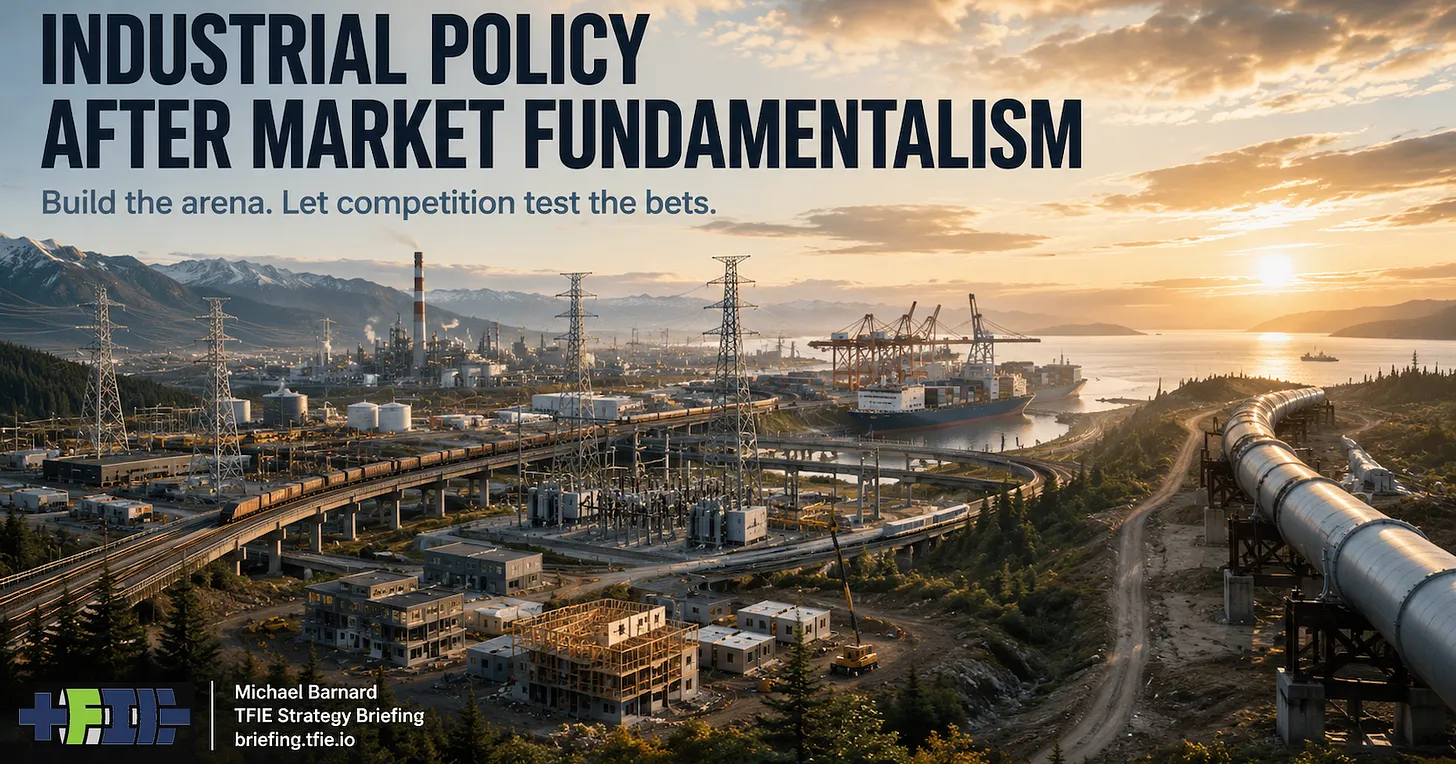
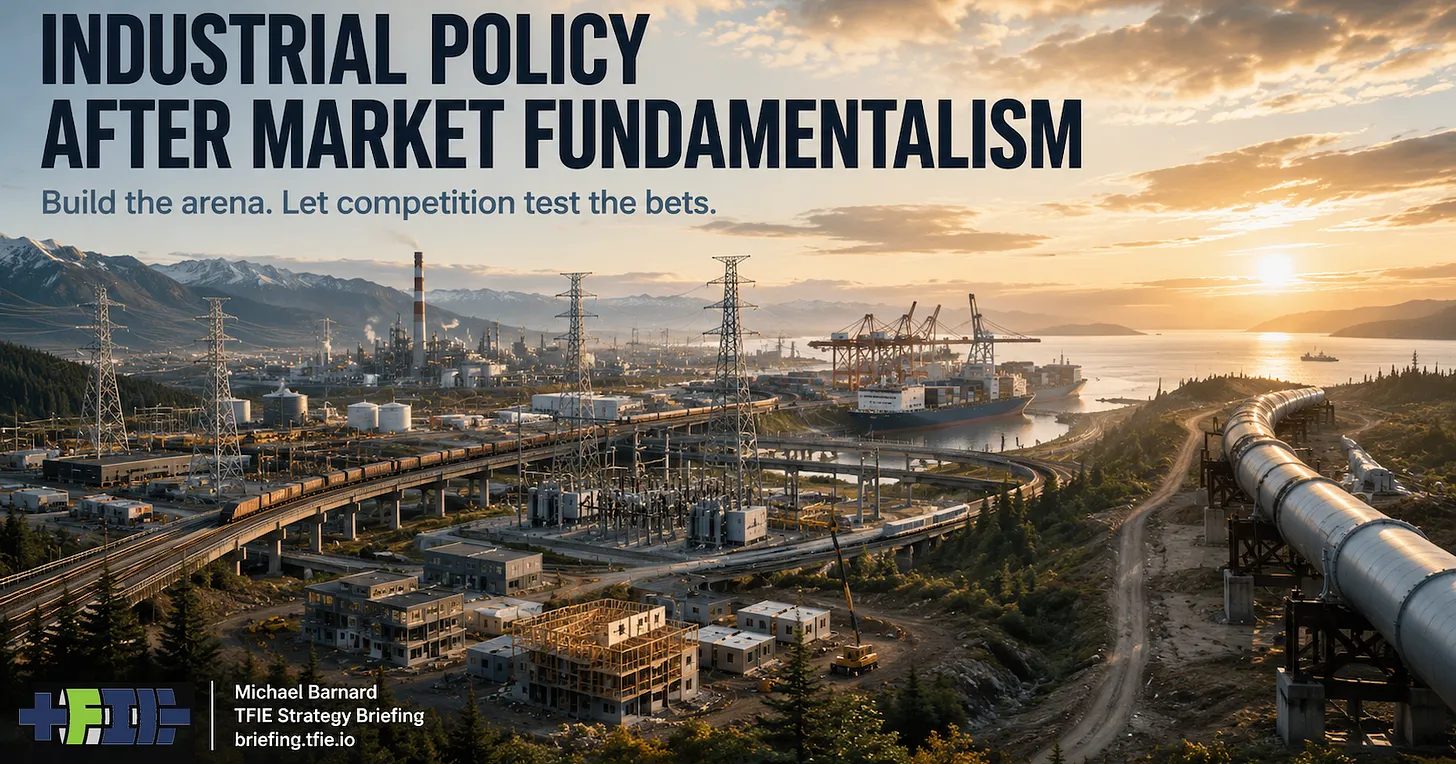
- Building an Arena: Creating foundational public goods where multiple private firms and competing technologies can vie for market share.
- Backing a Specific End-State: Progressively absorbing financial risk and reshaping regulatory environments until a single, politically preferred project appears commercially viable.
Electricity Transmission: A Triumph of Arena-Building
Consider national electricity transmission grids. Upgrading or constructing a major inter-provincial or regional transmission line sits comfortably at the positive end of the industrial policy spectrum. A single high-voltage transmission corridor can serve:
- Industrial mines and regional factories
- Urban centers and burgeoning data centers
- Electric vehicle charging networks and residential heat pumps
- Utility-scale energy storage and diverse, competing generation technologies (wind, solar, hydro, nuclear) for decades to come.
Government planners do not need to possess clairvoyance to know which specific energy company or generation technology will dominate the market in 2040. By funding the transmission line, the state expands the economic arena, mitigates severe coordination failures, and allows private users and energy providers to compete freely for the available capacity.
Single-Asset Projects: The Danger of Narrow Bets
In stark contrast, a single large-scale industrial project—such as a dedicated export pipeline, a liquefied natural gas (LNG) terminal, or an isolated carbon-capture network—presents an entirely different risk profile. While these projects often boast localized strategic value, their long-term economic survival depends on a precarious, highly specific set of assumptions:
- Volatile global construction costs
- Narrow customer bases and locked-in long-term contracts
- Future regulatory changes and fluctuating commodity prices
When the public sector heavily subsidizes or takes major equity in a single asset, the taxpayer assumes immense downside exposure without the compensating "option value" inherent in generalized infrastructure. If the original thesis proves flawed, the state is left holding a stranded asset with very few alternative uses.
The Economics of Creative Destruction and Political Capture
A mature industrial strategy must confront the reality of failure. In unconstrained markets, bankruptcies, obsolete facilities, and failed technologies occur continuously—a process economist Joseph Schumpeter famously termed "creative destruction."
However, public-sector investments frequently operate under a double standard: the public demands flawless success from state-backed ventures while treating private-sector failures as normal, healthy experimentation. A serious industrial policy must expect and budget for commercial losers. The cardinal sin of state-led investment is not experiencing a project failure; rather, it is refinancing the same failed project indefinitely simply because abandoning it has become politically embarrassing.
Official Statements & Theoretical Perspectives
To ground these policy trade-offs, contemporary economists often return to a classical synthesis of three towering figures: Friedrich Hayek, John Maynard Keynes, and Joseph Schumpeter.
Hayek and the Knowledge Problem
Friedrich Hayek remains an indispensable guide, even for those who reject the rigid, market-fundamentalist conclusions often derived from his work. Hayek’s core insight—the knowledge problem—highlights that central planners and government officials can never possess the localized, temporary, and distributed information embedded within real-time market prices, customer preferences, and competing business models.

Rather than serving as an excuse for total government passivity, the knowledge problem is a mandate to design industrial policy around competition, reversible commitments, and transparent evidence. Governments should avoid pretending they can micromanage commercial outcomes, focusing instead on frameworks that allow decentralized actors to process real-world information.
Keynes and Macroeconomic Resilience
Balancing Hayek’s warnings, John Maynard Keynes provides the counter-argument for state intervention during structural failures. Non-intervention is itself an active policy choice. When private markets fail to provide critical infrastructure, macroeconomic resilience, affordable housing, or sustained investment during economic contractions, the state must step in to bridge the gap. Public capital serves as a necessary stabilizing force when private risk appetite evaporates.
Schumpeter and the Dynamics of Discovery
Joseph Schumpeter rounds out the theoretical triad by reminding us that genuine innovation and technological discovery are inherently messy. Failures in public investment portfolios are not automatically proof that industrial policy is fundamentally flawed—just as the bankruptcy of individual private firms does not invalidate the entire capitalist market system. The metric of success is the aggregate dynamism of the portfolio, not the political perfection of every single asset.
Assessing the Canada Strong Fund
Against this theoretical backdrop, the proposed Canada Strong Fund displays moments of sophisticated design. By taking minority equity positions alongside private investors, the fund exposes public coffers to both upside gains and downside risks, aligning state incentives with commercial reality. Furthermore, utilizing professional asset managers can establish a crucial firewall, creating commercial distance between elected ministers and individual investment decisions.
The ultimate test for this vehicle—and for Canadian industrial policy at large—will be institutional integrity: Will the federal financing system retain the courage and independence to say "no" when a struggling project has accrued high political importance?
Future Outlook: The Road Ahead for Canadian Industrial Strategy
As Canada looks toward the latter half of the decade, the credibility and longevity of its industrial policy hinge on disciplined execution and strict adherence to governance boundaries.
- Preserving Post-Intervention Competition: Government intervention must never mutate into permanent corporate protectionism. Once public infrastructure is built or initial equity is deployed, regulatory frameworks must aggressively foster open competition among private operators.
- Institutionalizing Exit Strategies: Policymakers must establish objective, metrics-based off-ramps. If commercial evidence fails to materialize within a predefined window, projects must be wound down rather than perpetually propped up by taxpayer funds.
- Balancing Public Value with Patient Capital: Ottawa can successfully set strategic national directions, price carbon and other externalities, and supply patient capital for transformative green technologies—provided that decision-makers respect the limits of state planning.
Ultimately, industrial policy in the modern global economy is neither a panacea nor a relic of a bygone era. When executed with humility, professional rigor, and an unwavering commitment to market competition, strategies like those embodied in the Carney framework can secure Canada’s economic sovereignty and lead the transition toward a resilient, net-zero future.