









Executive Overview
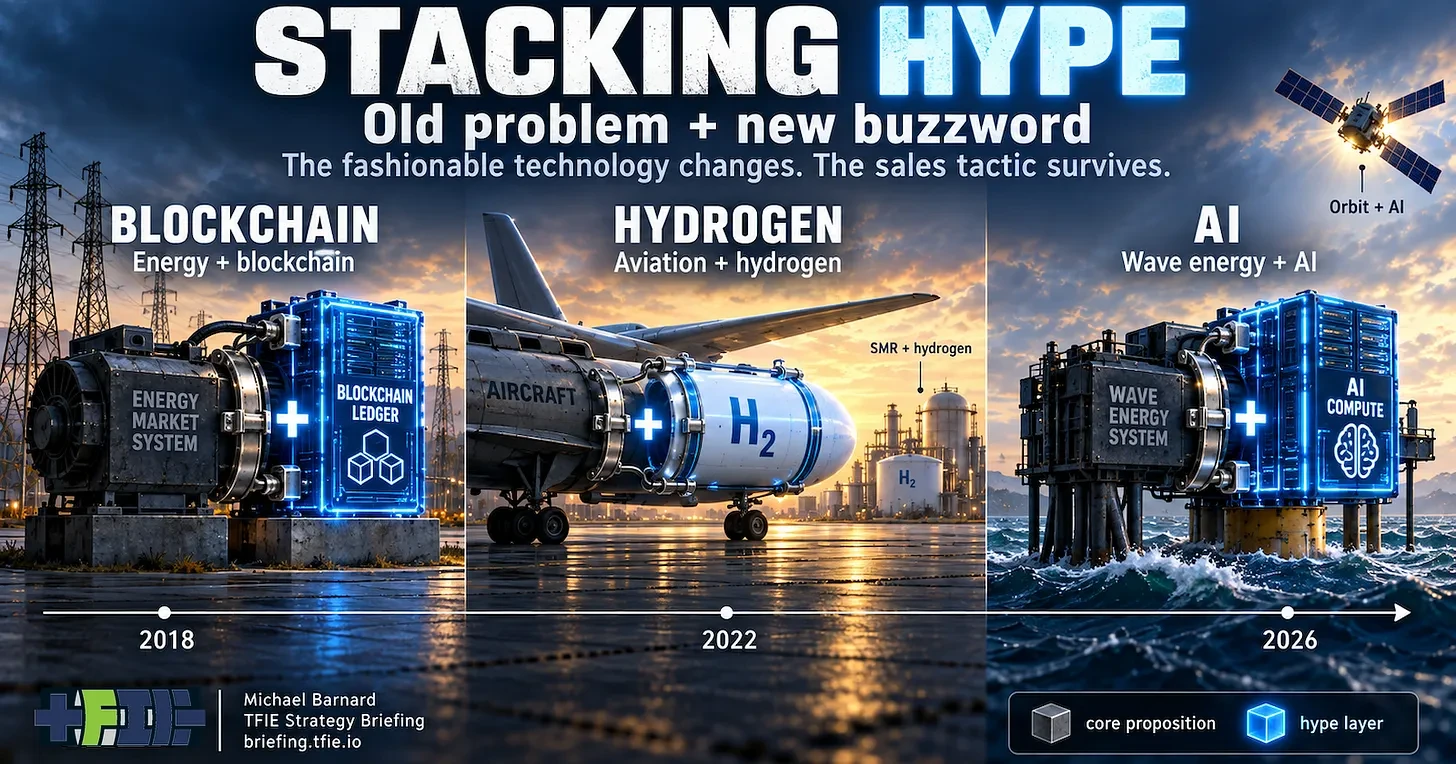
Over the past decade, the playbook for securing venture capital and public acclaim in deep tech and climate tech has remained remarkably consistent, even as the vocabulary shifts. Whether the fashionable technology of the moment is blockchain, hydrogen, or artificial intelligence, the underlying commercialization tactic is identical: attach a fresh, highly capitalized narrative to an unresolved engineering proposition before the complete system has proved its baseline economics.
This phenomenon—what can be termed "hype layering"—relies on multiplying dependencies rather than solving core physical or financial constraints. When startups layer a trendy technology onto a legacy failure, they do not de-risk the venture; they multiply failure modes. Rather than building a simpler, more competitive alternative to existing infrastructure, founders, investors, and media ecosystems frequently reward the promise of a larger, more complex future market.
To understand why this pattern persists across economic cycles, one must look past the brilliance of the individual technologies involved. Artificial intelligence, hydrogen, blockchain, and nuclear power are all undeniably real technologies. However, the critical diligence question is rarely whether a technology works in isolation. Instead, it is whether adding a second speculative layer removes a material operational constraint or simply piles on expensive new dependencies before a single customer derives tangible economic value.
Detailed Chronology: From Blockchain to AI
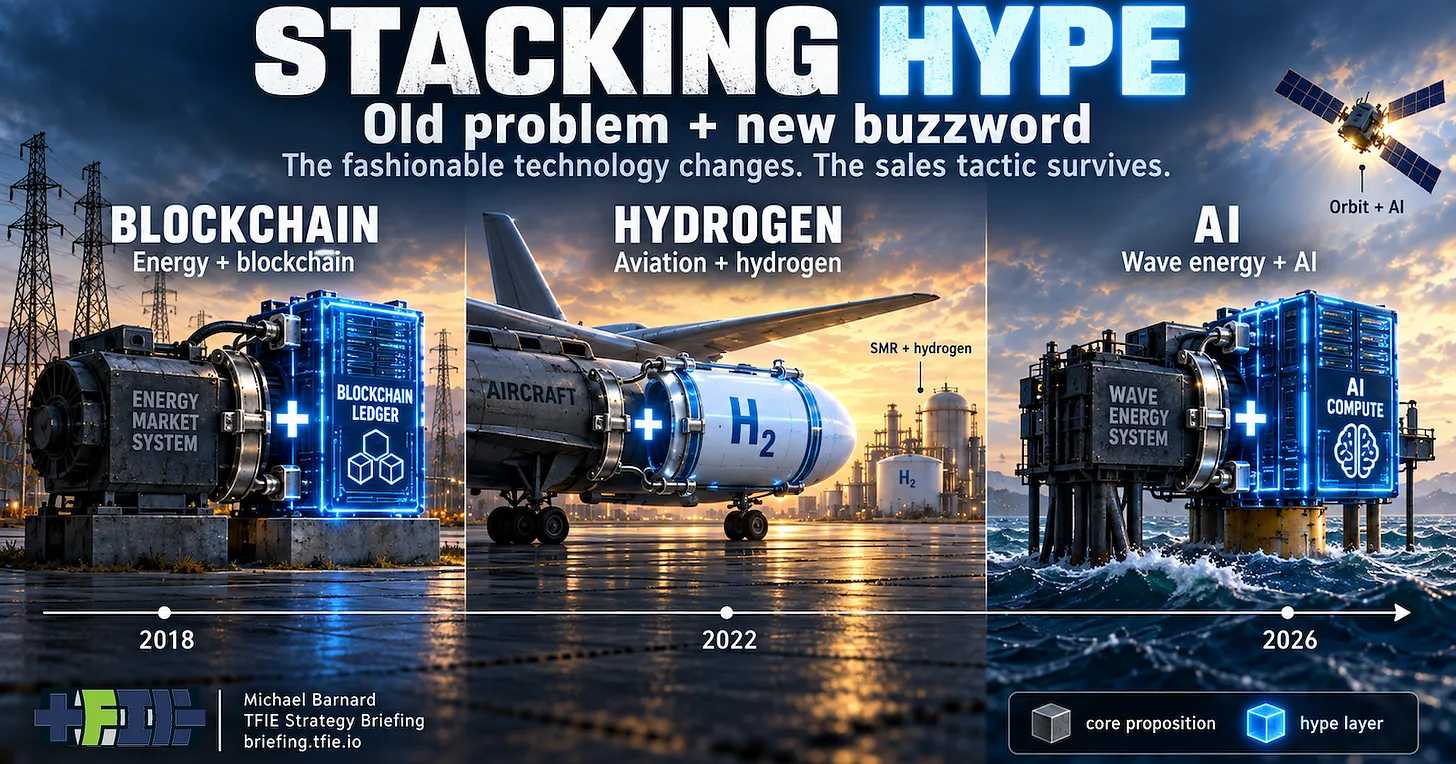
The evolution of tech hype over the last ten years reveals a predictable cycle. The modifiers change to match the dominant Wall Street and Silicon Valley sentiment, but the structural mechanics of capital attraction remain untouched.
The Blockchain Era (c. 2018–2020)
During the height of the blockchain boom, startups attempted to decentralize everything from localized electricity trading to renewable energy certificates and peer-to-peer microgrids. The narrative suggested that distributed ledgers could magically eliminate the friction of physical power grids. In reality, traditional power meters, centralized utility regulations, and fundamental physical network calculations continued to do the essential, unglamorous work. The blockchain layer added administrative complexity without reducing the cost of generation or transmission.
The Hydrogen Wave (c. 2021–2024)
As blockchain fatigue set in, hydrogen became the universal panacea for hard-to-abate sectors. Startups promised hydrogen supersonic passenger aircraft, hydrogen-powered eVTOLs, and massive underground hydrogen storage systems. Companies like Destinus captured headlines with visions of cryogenic hydrogen aviation—combining an already exceptionally difficult commercial aircraft proposition with entirely unproven fuel infrastructure, propulsion, and regulatory pathways.
Similarly, projects like Gravitricity attempted to diversify traditional mine-shaft gravity energy storage by bolting on underground hydrogen storage concepts (H₂FlexiStore). However, managing distinct physical mediums required entirely different equipment, economics, and customer bases. By late 2025, constrained management attention and unvalidated economics caught up with the model, leading to corporate restructuring and voluntary liquidation.

The Artificial Intelligence Inflection (c. 2024–Present)
Today, AI performs the narrative heavy lifting. Because terrestrial data centers face legitimate, acute constraints around electricity availability, land acquisition, cooling capacity, and grid interconnection queues, almost any proposition that promises an alternative power source or an isolated location to run compute sounds revolutionary.
Enter oceanic wave-power data centers. Firms like Panthalassa recently raised $140 million to build autonomous ocean platforms that generate electricity from waves and use it directly for marine-based AI inference computing. Proponents argue this eliminates the need for expensive subsea transmission cables back to shore.
While avoiding a cable solves one localized hurdle, it introduces an entirely new cascade of vulnerabilities. Marine equipment must continuously survive saltwater fatigue, severe storms, biological fouling, corrosion, and dangerous offshore maintenance—all while producing electricity cheaply enough to justify the machinery. By placing high-value electronics, power conditioning, and communication gear into a punishing marine environment, the company trades a grid connection for an exponential increase in hardware degradation and maintenance costs.
Supporting Context & Metrics: Case Studies in Layered Hype
To evaluate how hype-layering manifests in physical products, examining long-running ventures provides a clear picture of the divergence between marketing narratives and operational reality.
Aptera Motors: Two Decades of Solar Promises
Few companies illustrate the endurance of hype-layering quite like Aptera. Promising a revolutionary three-wheeled solar electric vehicle, the company’s body-integrated solar cells do function under optimal conditions—such as an unsheltered Arizona driveway under intense sunlight.
However, the core commercial denominator remains building, validating, and selling an unconventional automobile at mass scale. Regulatory filings indicate that Aptera has continuously required tens of millions of dollars simply to complete tooling and validation for low-volume production, with hundreds of millions more needed to scale manufacturing to viable levels.
Despite having delivered zero production vehicles across a twenty-year history characterized by multiple corporate iterations, restructuring, and intellectual property buybacks, Aptera has successfully accumulated roughly 50,000 vehicle reservations backed by refundable $100 deposits. This generated millions in unearned reservation capital rather than automotive revenue, supplemented by equity investments from enthusiasts trading capital for priority delivery positions.
Throughout this cycle, the company layered on successive technological buzzwords—including AI-assisted generative design, additive manufacturing, advanced driver assistance, and initially in-wheel motors (which ignored well-documented issues regarding unsprung weight at highway speeds)—to sustain press cycles and secure fresh infusions of investor capital.
Destinus: Pivot to Practicality
By contrast, the trajectory of Destinus offers a more pragmatic resolution to the hype cycle. The company’s original public-facing narrative centered entirely on liquid-hydrogen supersonic passenger flight.
Recognizing the insurmountable stack of dependencies inherent in commercial passenger hydrogen aviation, Destinus shifted its commercial center of gravity toward defense, autonomy, and tactical missile systems. In April 2026, the company formalized a strategic joint venture with Rheinmetall to develop advanced missile systems.
This pivot did not validate hydrogen supersonic passenger travel. Instead, it demonstrated that certain underlying engineering capabilities—such as high-speed propulsion, autonomous flight control, and advanced manufacturing—could command a paying market when completely decoupled from the impractical consumer aviation stack.

Official Perspectives and Industry Delineations
Discerning between productive technological integration and destructive hype requires drawing a sharp line based on operational constraints rather than system complexity.
+-------------------------------------------------------------------------+
│                     THE DILIGENCE DIVIDE                                │
├───────────────────────────────────┬─────────────────────────────────────┤
│   Productive Integration          │   Hype Layering                     │
├───────────────────────────────────┼─────────────────────────────────────┤
│ • Addresses a measurable          │ • Multiplies operational            │
│   operational constraint.         │   dependencies.                     │
│ • Components perform complementary│ • Relies on speculative future      │
│   roles (e.g., grids + batteries).│   markets to justify costs.         │
│ • Simplifies overall system       │ • Adds failure modes at every       │
│   economics.                      │   integrated interface.             │
+───────────────────────────────────┴─────────────────────────────────────+
As industry analysts point out, complex systems are not inherently flawed. Modern electricity grids, for example, integrate generation, transmission, storage, and advanced power electronics because every single component performs an identifiable, complementary job. Similarly, pairing residential heat pumps with thermal storage or electric vehicles with managed charging addresses specific, quantifiable constraints in energy demand.
Hype layering operates on an entirely different principle:
- The Core Obstacle: An original engineering proposition remains economically or physically elusive.
- The Modifier: A second immature, highly expensive, or speculative technology is attached to the core.
- The Expansion: The imagined addressable market swells in size, overshadowing the fact that the complete system has become exponentially harder to build, finance, or operate.
Every added dependency introduces a new condition that must be met simultaneously. Hydrogen aircraft require simultaneous breakthroughs in aircraft frames, cryogenic fuel production, airport fueling infrastructure, and international certification. Offshore AI platforms require both marine-energy capture systems and high-availability enterprise computing to function reliably in salt spray. Vehicle-integrated solar arrays only contribute meaningfully when sunlight, parking conditions, and geographical exposure cooperate perfectly.
Future Outlook: A Diligence Framework for Investors
The durability of the hype-layering playbook ensures that founders will continue adapting their pitches to match the prevailing technological zeitgeist. Selection pressure heavily favors this behavior:
- Founders naturally emphasize versions of their enterprise that secure high-level meetings and venture capital.
- Investors seek direct exposure to dominant macroeconomic themes like artificial intelligence or the energy transition.
- Governments prefer allocating grants to projects branded around national security or strategic industrial policy.
- Media Outlets are instinctively drawn to novel technological amalgams rather than incremental, iterative improvements to old engineering problems.
For institutional investors, venture capitalists, and technology journalists, navigating this landscape requires stripping away the narrative veneer to focus on a few fundamental questions:
- What exact operational constraint does the added technology remove?
- How much capital, cost, or operating burden permanently disappears as a result?
- Is the fully integrated system demonstrably more competitive than a simpler, conventional alternative?
When these answers are quantifiable and measurable, technological integration can be genuinely revolutionary. When they rely on vague promises of future market synergies, the new layer is likely doing far more work within the financial slide deck than it is inside the physical product.