








By Amanda Dickinson, Senior Manager, Digital Marketing
Estimated Reading Time: 8 Minutes
Executive Overview
Far beneath the ocean’s sunlit upper layers lies a realm of absolute darkness, crushing hydrostatic pressure, and near-freezing temperatures. In this extreme environment—the deep sea—life has not merely survived; it has evolved in directions so radical, complex, and bizarre that they rival the most imaginative concepts of outer space exploration.
While humanity has successfully mapped the surfaces of Mars and the Moon, the deep ocean remains one of the final true frontiers on Earth. Scientists estimate that an astonishing one million deep-sea species remain entirely undiscovered. Many of the organisms we do know of have been observed only a handful of times, hidden within vast, rugged, and intensely hostile habitats.
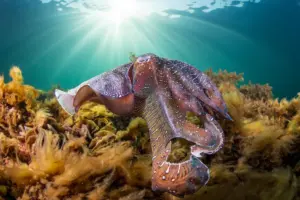
Yet, these strange aquatic entities are very real. They are the architects and inhabitants of a hidden ecosystem that plays a foundational role in planetary health, regulating global climate patterns, sequestering carbon, and driving marine biodiversity. This article explores seven remarkable ocean creatures that shatter our conventional understanding of biology and prove that our home planet’s most mysterious wonders are happening right beneath the waves.
Detailed Chronology: Unlocking the Mysteries of the Abyssal Zone
For centuries, the deep ocean was written off by marine scientists as an "azoic zone"—a desolate wasteland where no life could possibly exist due to the absence of sunlight and the overwhelming pressure. However, technological milestones over the past two centuries have steadily dismantled this misconception, revealing a vibrant, highly adapted biosphere.
- The Mid-19th Century (The Dredging Era): Pioneering expeditions, most notably the Challenger Expedition (1872–1876), began dredging the deep ocean floor. To the shock of the scientific community, nets hauled up living organisms from depths previously thought uninhabitable, proving that life thrives in the abyss.
- The Mid-20th Century (The Rise of Submersibles): The invention of bathyscaphes and advanced research submersibles allowed marine biologists to witness deep-sea animals in their native habitats for the first time, rather than pulling up ruined, decompressed specimens.
- The Late 20th Century (Bioluminescence and Hydrothermal Vents): Discoveries of hydrothermal vents in 1977 introduced science to chemosynthetic ecosystems. Simultaneously, advanced submersibles uncovered the complex mechanisms of bioluminescence used by deep-sea predators and prey alike.
- The 21st Century (ROV Technology and Real-Time Exploration): Modern Remotely Operated Vehicles (ROVs) equipped with ultra-high-definition cameras, such as those deployed by the Monterey Bay Aquarium Research Institute (MBARI) and the National Oceanic and Atmospheric Administration (NOAA), have allowed researchers to solve long-standing biological mysteries—such as the true anatomy of the barreleye fish—in real time.
Seven Ocean Creatures That Defy Explanation
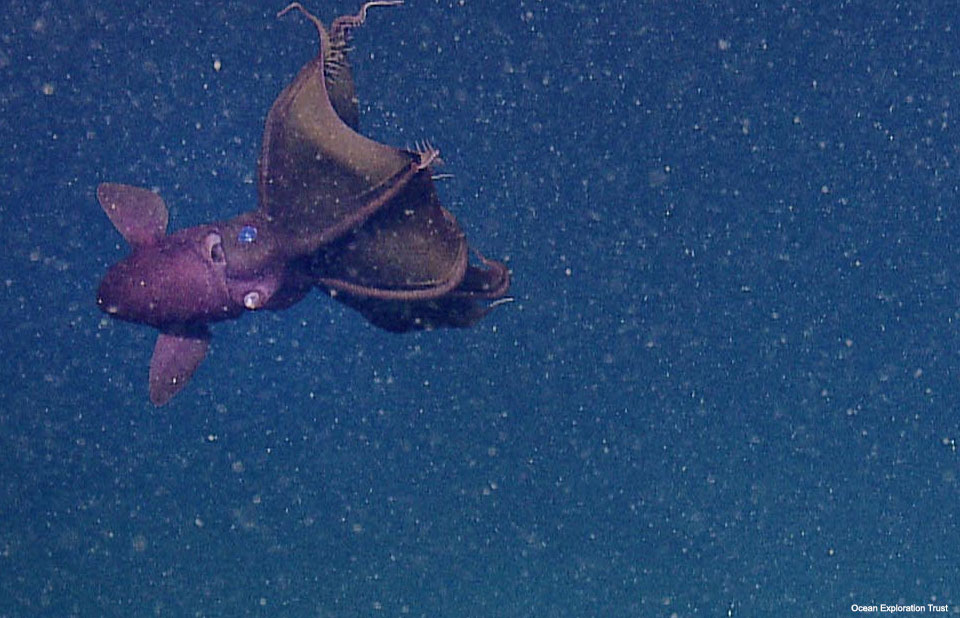
1. The Vampire Squid (Vampyroteuthis infernalis)
Despite its dramatic and slightly menacing moniker, the vampire squid does not seek human blood. Earning its name from its dark coloration, glowing red eyes, and a thick, cloak-like web of skin stretching between its arms, this cephalopod is a gentle resident of the deep.
Unlike its shallow-water relatives that actively chase down evasive prey, the vampire squid utilizes a unique metabolic strategy. It can match the density of the surrounding seawater, allowing it to hang suspended and drift effortlessly without expending energy on swimming. Instead of hunting, it extends two long, filament-like threads to catch "marine snow"—the steady shower of organic detritus, fecal matter, and dead plankton drifting down from the upper ocean. When threatened, it evades predators by deploying brilliant internal light-producing organs called photophores to confuse attackers before slipping away into the ink-black water.

2. The Barreleye Fish (Macropinna microstoma)
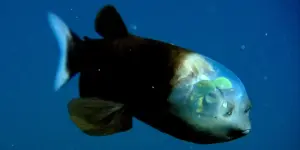
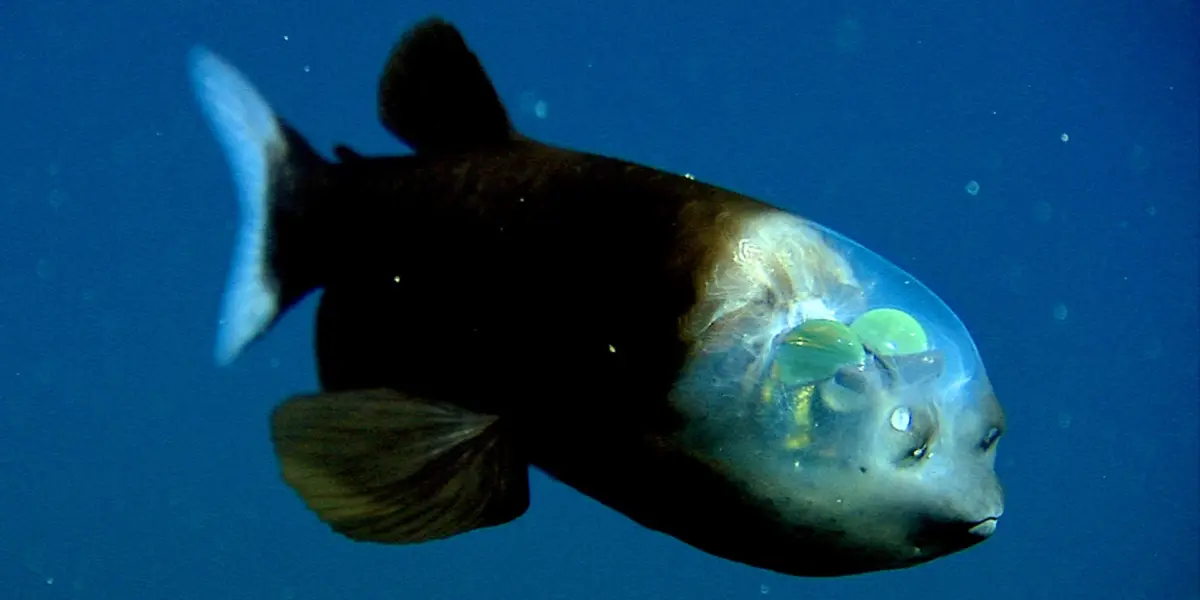
If science fiction writers designed a fish, it might look like the barreleye. This extraordinary creature features a completely transparent, fluid-filled shield over its head, exposing its internal organs and a pair of glowing, tubular green eyes rotating freely inside its skull.
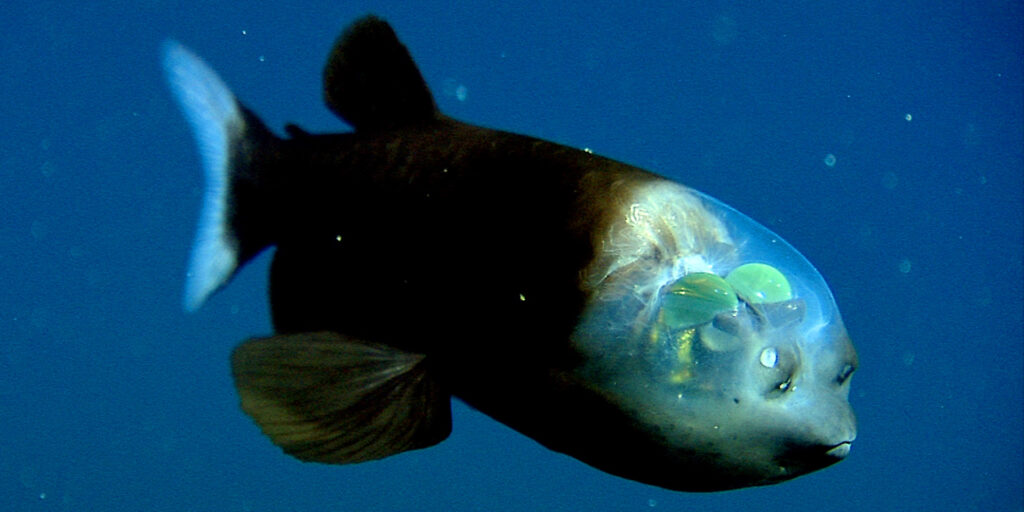
For decades, marine biologists misunderstood the anatomy of the barreleye. Because the delicate transparent dome collapsed or was destroyed when specimens were pulled to the surface in early fishing nets, scientists had no idea what the fish looked like alive. It wasn’t until MBARI researchers captured footage of a living barreleye in its natural habitat that the mystery was solved. The fish’s upward-facing eyes allow it to scan the gloom above for the silhouettes of prey against the faint, filtering rays of surface sunlight, rotating forward when it is time to feed.
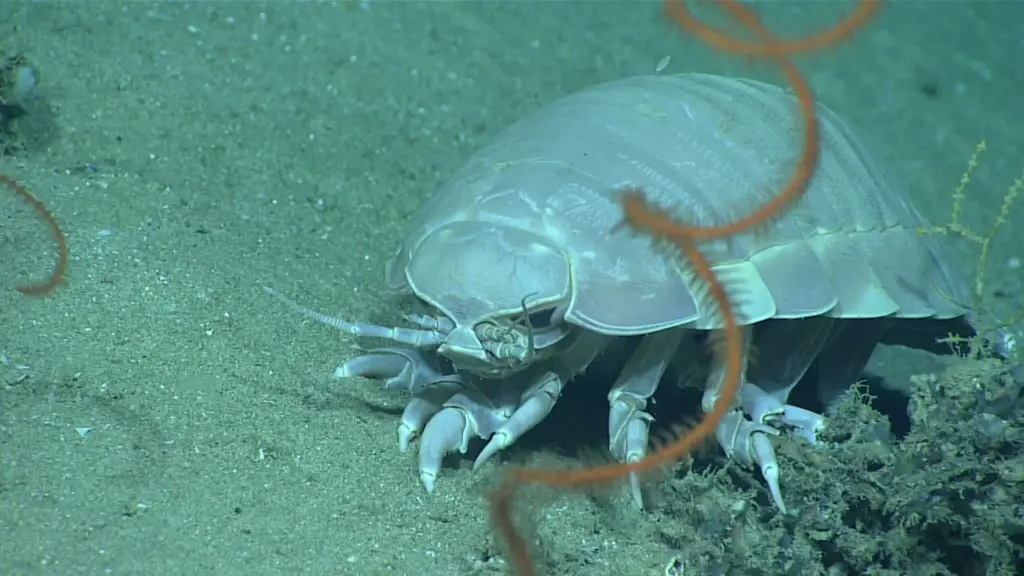
3. The Giant Isopod (Bathynomus giganteus)
Imagine a terrestrial pill bug (roly-poly) scaled up to the size of a housecat, and you have the giant isopod. Growing up to a foot or more in length, these deep-sea crustaceans inhabit the ocean floor at depths reaching 7,000 feet.
As distant relatives of crabs and shrimp, giant isopods sport hard, segmented armor and a prehistoric aesthetic. Their lineage is ancient; fossil records indicate that isopod ancestors have roamed the Earth virtually unchanged for over 300 million years. In the food-scarce abyss, giant isopods are masters of fasting. They can survive for years without a substantial meal, sustaining themselves on the rare carcasses of whales and large fish that sink to the ocean floor.
4. The Anglerfish (Order Lophiiformes)
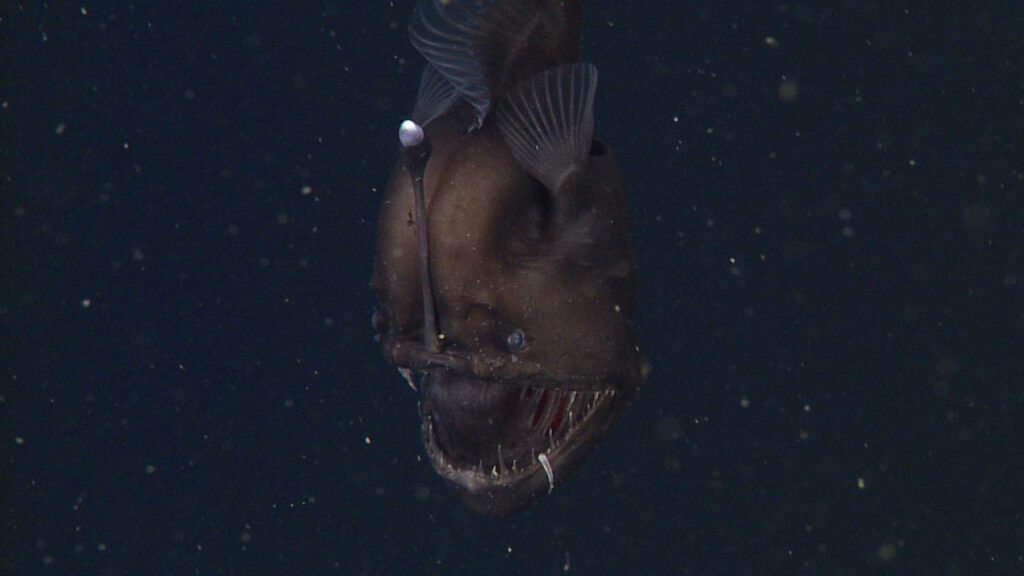
Few creatures embody the uncanny nature of the deep sea quite like the anglerfish. Equipped with needle-sharp, backward-pointing teeth, expandable stomachs capable of swallowing prey larger than themselves, and a dangling, luminescent lure sprouting from their heads, these ambush predators are the ultimate deep-sea hunters.
The glowing tip of the lure relies on symbiotic bacteria that produce bioluminescence, drawing curious prey and potential mates through the pitch-black water. Notably, extreme sexual dimorphism defines this group: only females possess the iconic glowing lure. In the crushing dark where finding a mate is a monumental challenge, some male anglerfish have evolved to fuse permanently to a female’s body as parasitic mates, ensuring a guaranteed reproductive partner whenever the time is right.
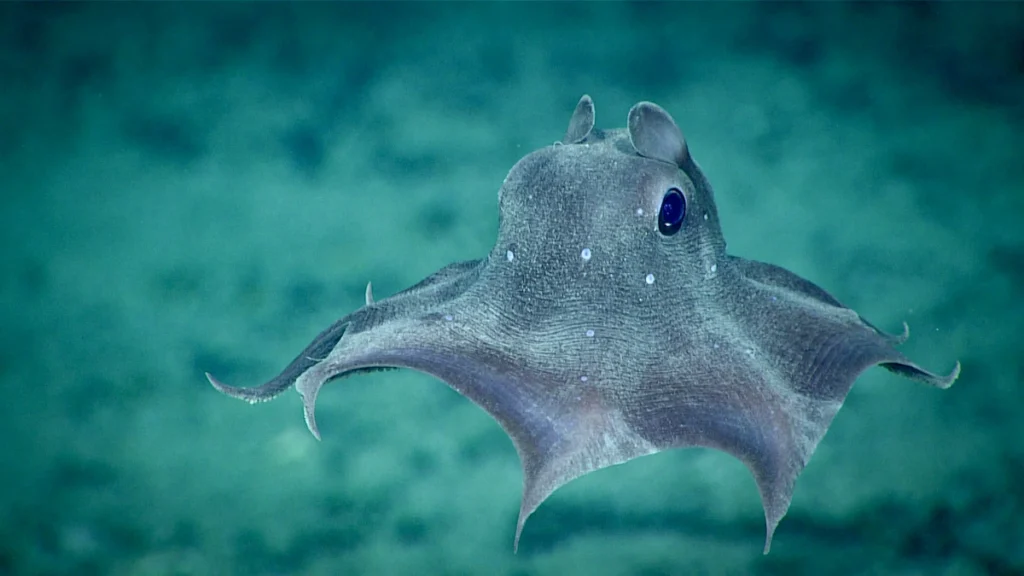
5. The Dumbo Octopus (Genus Grimpoteuthis)
Named affectionately after Walt Disney’s famous flying elephant due to the prominent, ear-like fins protruding from the sides of their heads, Dumbo octopuses are among the most endearing creatures of the abyss. Measuring a modest 8 to 12 inches in length, they inhabit extreme depths ranging from 1,000 to 13,000 feet below the surface.
Unlike shallow-water octopuses that rely on an ink sac to escape predators, the Dumbo octopus lacks this defensive adaptation entirely. Living at pressures that few predators can endure, they have no need for ink. Instead, they gracefully flap their webbed fins to glide through the water column, hunting for small crustaceans and worms living on or near the sea floor.
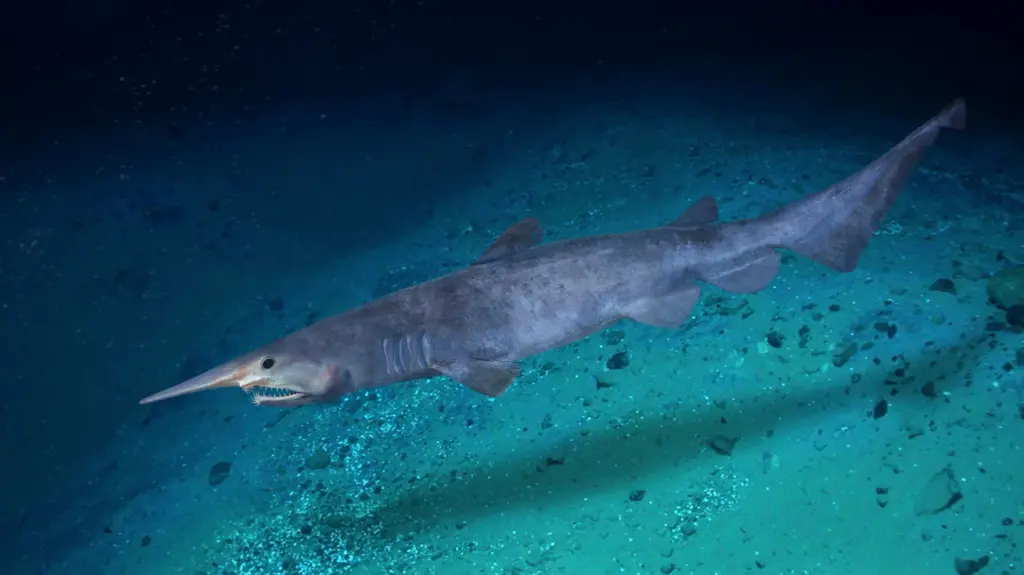
6. The Goblin Shark (Mitsukurina owstoni)
Often termed a "living fossil," the goblin shark is an evolutionary outlier with no close relatives among modern shark species. Featuring semi-translucent skin that reveals an intricate web of blood vessels underneath—giving living specimens a soft pinkish-gray hue—the goblin shark is instantly recognizable by its elongated, flattened snout.
This specialized snout is packed with electro-receptive organs that help the shark detect the electrical fields of hidden prey. When an unfortunate fish or squid comes within range, the goblin shark’s jaw mechanics kick into gear: its jaws can rapidly shoot forward out of its mouth like a mechanical trap before snapping shut and retracting back into place. Encounters with humans are extraordinarily rare, preserving the creature’s eerie, mythic allure.
7. Gelatinous Deep-Sea Organisms (Jellies and Ctenophores)
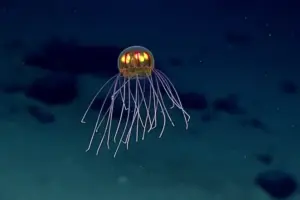
Some of the ocean’s most mesmerizing inhabitants are composed almost entirely of water. Gelatinous organisms—ranging from deep-sea siphonophores and comb jellies to glowing medusae—possess soft bodies that are roughly 95% water.
Lacking brains, bones, hearts, and blood, these ancient creatures have roamed the oceans for at least 500 million years. Many exhibit stunning displays of bioluminescence, flashing neon blues, greens, and purples along their undulating bells or trailing impossibly long tentacles that act as sweeping drift nets in the deep-sea currents.
Supporting Context & Metrics
Understanding the scale and importance of the deep sea requires examining the numbers behind marine exploration and ecological health:
- Depth and Pressure: The deepest part of the ocean, the Challenger Deep in the Mariana Trench, plunges nearly 36,000 feet down. At this depth, the pressure reaches over eight tons per square inch—equivalent to having an elephant standing on your thumb.
- Exploration Deficit: Humanity has better maps of the surfaces of Mars and Venus than we do of Earth’s own ocean floor. Less than 25% of the global seafloor has been mapped using modern high-resolution sonar technology.
- Carbon Sequestration: The deep ocean serves as the planet’s largest active carbon sink, absorbing roughly 25% of all human-generated carbon dioxide emissions and capturing over 90% of the excess heat generated by global climate change.
Official Statements and Conservation Perspective
Conservation leaders emphasize that these bizarre, unfamiliar creatures are not mere curiosities; they are vital indicators of a healthy, functioning planet.
"It’s easy to think of deep-sea creatures as isolated mysteries, but these animals are essential parts of our ocean ecosystem," notes representatives from the Ocean Conservancy. "The deep ocean regulates our climate, stores carbon, and supports biodiversity on a massive scale."
Organizations like the Ocean Conservancy advocate for robust marine protection policies, arguing that safeguarding deep-sea habitats from destructive human activities—such as deep-sea mining and bottom trawling—is paramount. Because so much of the deep sea remains unmapped and unstudied, protecting these fragile ecosystems ensures that future generations can continue to uncover the planet’s most astonishing biological secrets.
Future Outlook
As marine technology advances, the coming decades promise unprecedented access to the ocean’s twilight and abyssal zones. The integration of autonomous underwater vehicles (AUVs), environmental DNA (eDNA) sampling, and deep-diving robotics will undoubtedly reveal thousands of new species currently lurking in the dark.
Ultimately, the bizarre adaptations of the vampire squid, the barreleye fish, and the goblin shark remind us that nature’s ingenuity knows no bounds. The deep sea proves that our most incredible discoveries are not hidden in the distant stars, but rather waiting quietly in the dark, fluid depths of our own blue planet—a reality far stranger, and far more vital, than science fiction.