






Executive Overview: A Paradigm Shift in Inland Vessel Acquisition
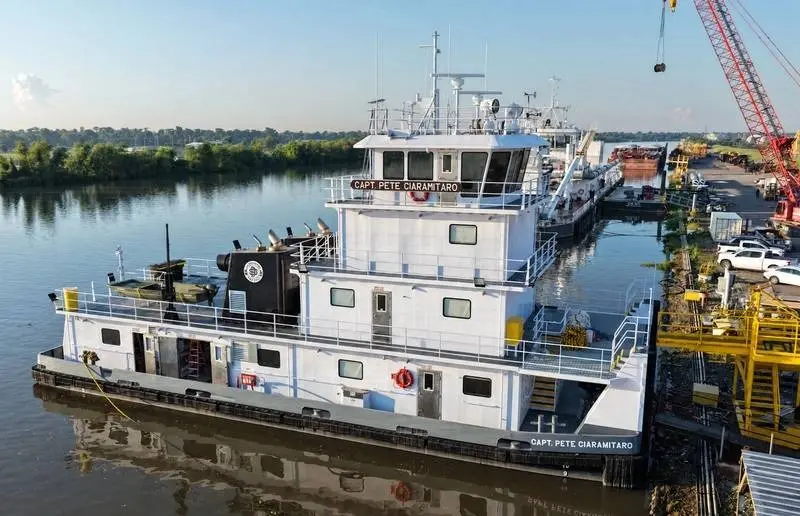
In an era defined by supply chain volatility, labor shortages, and prolonged shipyard backlogs, the U.S. inland maritime sector is undergoing a quiet revolution in how capital assets are built, acquired, and deployed. At the forefront of this shift is the successful delivery of the M/V Capt. Pete Ciaramitaro, a state-of-the-art, 2,600-horsepower inland towboat constructed by C&C Marine and Repair and delivered to Southern Devall.
The transaction represents a significant departure from traditional shipyard procurement models. Rather than waiting for a custom-ordered vessel to progress through years of design, engineering, and construction, Southern Devall was able to acquire a high-spec, modern towboat on an accelerated timeline. This was made possible by C&C Marine’s strategic decision to launch a six-vessel speculative ("spec") building program.
By building high-demand vessel classes in advance of securing buyers, C&C Marine has effectively decoupled fleet expansion from traditional shipyard delays. The M/V Capt. Pete Ciaramitaro stands as the first delivery of this ambitious six-vessel program, signaling to the brownwater industry that immediate capacity expansion is not only possible but highly customizable. For Southern Devall, the acquisition provides a versatile, highly compliant asset capable of bridging the gap between inland river transit and demanding intracoastal operations.
Detailed Chronology: From Speculative Blueprint to Rapid Deployment
The timeline of the M/V Capt. Pete Ciaramitaro highlights the efficiency gains of speculative shipbuilding. In a traditional shipbuilding contract, the period between initial signing and physical delivery frequently spans 12 to 24 months. For the Capt. Pete Ciaramitaro, however, the timeline was condensed into a matter of weeks:
- Pre-Contract Phase: C&C Marine and Repair initiated the design and construction of the 2,600-horsepower towboat series as a speculative venture, leveraging its extensive facilities in Belle Chasse, Louisiana, to advance structural fabrication, machinery installation, and system piping without an active buyer.
- Contract Execution (July 20, 2026): Recognizing an immediate operational need for additional horsepower to support its growing fleet, Southern Devall entered into a formal contract with C&C Marine to purchase the first vessel of the spec series.
- Customization & Outfitting Phase (Late July – September 2026): Because the vessel’s core structural and mechanical components were already completed, the remaining construction window was dedicated to tailoring the final design, electronics, and interior finishes to Southern Devall’s exact operational requirements.
- Delivery (Late September 2026): Just over two months after the contract signing, the completed M/V Capt. Pete Ciaramitaro was officially delivered to Southern Devall, immediately entering active service.
+-------------------------------------------------------------------------+
|                        PROJECT TIMELINE OVERVIEW                        |
+-------------------------------------------------------------------------+
| [Speculative Construction Initiated by C&C Marine]                      |
|       │                                                                 |
|       ▼                                                                 |
| [July 20, 2026: Contract Formally Signed by Southern Devall]            |
|       │                                                                 |
|       ▼                                                                 |
| [Late-Stage Customization & Final Outfitting (Approx. 60 Days)]         |
|       │                                                                 |
|       ▼                                                                 |
| [Late September 2026: Official Delivery of M/V Capt. Pete Ciaramitaro]  |
+-------------------------------------------------------------------------+
With the first hull delivered, C&C Marine’s speculative program moves into its next phases. The remaining five vessels in the series are currently in various stages of construction and remain available for purchase. Deliveries for these subsequent hulls are scheduled to begin in November and will continue at regular, two-month intervals, offering other operators a reliable pipeline of near-immediate tonnage.
Supporting Context & Technical Metrics: Inside the M/V Capt. Pete Ciaramitaro
The M/V Capt. Pete Ciaramitaro is engineered to handle the rigorous demands of the U.S. inland waterway system while remaining versatile enough for coastal and intracoastal transits. Below is an in-depth breakdown of the vessel’s technical specifications, mechanical systems, and operational capabilities.
| Parameter | Specification / Equipment | Manufacturer / Supplier |
|---|---|---|
| Length Overall | 87 feet | C&C Marine and Repair |
| Beam (Width) | 33 feet, 8 inches | C&C Marine and Repair |
| Depth | 11 feet, 3 inches | C&C Marine and Repair |
| Main Propulsion | 2x Mitsubishi S12R (EPA Tier 4) | Laborde Products |
| Total Horsepower | 2,600 HP | Mitsubishi |
| Reduction Gears | Reintjes WAF 665 | Karl Senner, LLC |
| Generator Sets | Dual Generator Package | Laborde Products |
| Regulatory Status | USCG Subchapter M Compliant | United States Coast Guard |
| Accommodation Capacity | 8 Berths | Kern Martin (Joiner System) |
| Primary Deck Machinery | 2x 40-Ton Winches | Wintech |
| Searchlights | 2x 1,000-Watt Searchlights | Carlisle & Finch |
Propulsion, Power, and Environmental Compliance
At the heart of the M/V Capt. Pete Ciaramitaro is a sophisticated propulsion train designed for maximum thermal efficiency, low emissions, and high reliability.
The vessel is powered by twin Mitsubishi S12R main engines, supplied by Laborde Products. These engines are fully compliant with the Environmental Protection Agency’s (EPA) stringent Tier 4 emissions standards. Tier 4 compliance is achieved through advanced combustion technology and Selective Catalytic Reduction (SCR) aftertreatment systems, which drastically reduce nitrogen oxides ($textNO_x$) and particulate matter. This clean-running capability is crucial for operators like Southern Devall, who frequently navigate environmentally sensitive coastal waters and urban inland corridors.
The power from the Mitsubishi engines is transferred to the propellers via Reintjes WAF 665 reduction gears, supplied by Karl Senner, LLC. Reintjes gears are highly regarded in the brownwater sector for their robust casing designs, precise clutch engagement, and durability under heavy backing and flanking maneuvers. Electrical power for the vessel’s auxiliary systems, galley, and electronics is provided by dual generator sets, also packaged and supplied by Laborde Products, ensuring seamless electrical redundancy.
Navigation, Communication, and Bridge Integration
Modern inland towboats require high levels of situational awareness to navigate congested waterways, lock chambers, and narrow channels safely. The wheelhouse of the Capt. Pete Ciaramitaro features a fully integrated navigation and communication suite compiled and installed by GMENI Marine Electronics and Supply.
       +-------------------------------------------------------+
       |             INTEGRATED WHEELHOUSE SYSTEM              |
       +-------------------------------------------------------+
                     │                           │
       ┌─────────────┴─────────────┐   ┌─────────┴─────────┐
       │   Navigation & Steering   │   │   Communication   │
       └─────────────┬─────────────┘   └─────────┬─────────┘
                     ├─ Furuno Radars            ├─ Standard Horizon VHF
                     ├─ Satellite Compass        └─ Loudhailer / Intercom
                     ├─ AIS & Transducer
                     ├─ Radio Zeeland Swingmeter
                     └─ Ritchie Magnetic Compass
The bridge equipment array includes:
- Furuno Radars & Transducer: Providing high-resolution radar imaging and bathymetric data to navigate safely in low-visibility conditions.
- Furuno Satellite Compass & AIS: Delivering precise heading data and automatic identification signals to surrounding commercial traffic.
- Radio Zeeland Swingmeter: An essential tool for inland pilots, allowing them to monitor the precise rate-of-turn (swing) of long, multi-barge tows.
- Standard Horizon VHF Radios & Loudhailer: Providing clear, multi-channel communication with lockmasters, bridge tenders, and other vessels.
- Ritchie Magnetic Compass & Young Weather Sensor: Providing reliable, analog navigation redundancy alongside real-time meteorological monitoring.
For night operations, the vessel is equipped with two Carlisle & Finch 1,000-watt searchlights, allowing the crew to illuminate channel markers, lock walls, and barge rigging from long distances.
Crew Welfare, Accommodations, and Subchapter M Compliance
To address the maritime industry’s ongoing focus on mariner retention and fatigue mitigation, the interior of the Capt. Pete Ciaramitaro was constructed with a strong emphasis on crew comfort and safety.
The vessel features eight spacious berths, utilizing a high-performance marine joiner system designed and installed by Kern Martin. This system is specifically engineered to reduce structural vibration and ambient noise, creating a quieter living environment for off-duty crew members. Additionally, the materials used in the Kern Martin joiner system offer superior fire protection, exceeding standard regulatory baselines to provide an extra layer of safety.
Importantly, the vessel was designed and built from the keel up to meet the United States Coast Guard’s Subchapter M regulations. Subchapter M established comprehensive safety, inspection, and structural integrity standards for U.S. towing vessels. By integrating Subchapter M compliance directly into the spec design, C&C Marine ensured that Southern Devall could integrate the vessel into its fleet safety management system (TSMS) without undergoing costly retrofits or experiencing regulatory delays during the transition from shipyard to active service.
Official Statements: Industry Leadership and Strategic Synergy
The delivery of the M/V Capt. Pete Ciaramitaro underscores a highly collaborative relationship between C&C Marine and Repair and Southern Devall. Leaders from both companies highlighted how the transaction aligns with their respective operational strategies.
Tony Cibilich, owner and president of C&C Marine and Repair, emphasized the value of mutual trust and seamless execution:
"We value the opportunity to work with Southern Devall and are pleased to deliver the Capt. Pete Ciaramitaro. Southern Devall has been an excellent partner throughout the delivery process, and we appreciate the confidence they placed in C&C Marine."
Cibilich’s comments point to a broader operational reality: even with a speculative build, successful delivery requires close cooperation between the shipyard’s engineering teams and the buyer’s technical superintendents to finalize late-stage customizations and conduct successful dock trials.
Representing the buyer, Brandon Devall, Vice-President Engineering of Southern Devall, outlined the strategic benefits of acquiring a spec-built vessel:
"The Capt. Pete Ciaramitaro was available when we needed to add horsepower to our fleet, and its size and 2,600 horsepower are well suited to our operations. The vessel gives us the versatility to support both our river and coastal operations. C&C Marine’s reputation and track record gave us confidence in the purchase, and the quality of craftsmanship is evident throughout the boat."
Devall’s statement highlights the core value proposition of the 2,600-horsepower class. This mid-range horsepower bracket is highly versatile, providing enough power to push multi-barge configurations on major river systems while maintaining a compact, agile draft (87’ x 33’-8” x 11’-3”) that allows for safe operation in shallower canals and intracoastal waterways.
Future Outlook: Speculative Shipbuilding and the Modernization of the Brownwater Fleet
The delivery of the M/V Capt. Pete Ciaramitaro comes at a critical juncture for the U.S. domestic maritime industry. The average age of the U.S. tug and towboat fleet remains high, with many legacy vessels still operating under older, less efficient engine standards. At the same time, the regulatory pressure of Subchapter M and the corporate push toward environmental sustainability are driving a clear need for fleet renewal.
However, many operators are hesitant to commit capital to long-lead-time newbuild projects due to fluctuating interest rates and uncertain economic outlooks. This is where C&C Marine’s speculative building program serves as a disruptive, market-stabilizing force.
       +-------------------------------------------------------+
       |             THE SPECULATIVE BUILD ADVANTAGE           |
       +-------------------------------------------------------+
                                   │
         ┌─────────────────────────┴─────────────────────────┐
         ▼                                                   ▼
┌─────────────────────────────┐                     ┌─────────────────────────────┐
│    For Shipyards (C&C)      │                     │   For Operators (Devall)    │
├─────────────────────────────┤                     ├─────────────────────────────┤
│ • Continuous labor workflow │                     │ • Immediate asset delivery  │
│ • Optimized supply chains   │                     │ • Lower capital risk        │
│ • Volume material pricing   │                     │ • Late-stage custom designs │
└─────────────────────────────┘                     └─────────────────────────────┘
By maintaining a continuous production line of standardized 2,600-horsepower towboats, C&C Marine achieves several key operational advantages:
- Labor and Workflow Optimization: Shipyard labor can be consistently scheduled, avoiding the costly "boom-and-bust" staffing cycles associated with one-off custom builds.
- Supply Chain Efficiencies: Bulk ordering of major components—such as Mitsubishi engines, Reintjes gears, and GMENI electronics suites—allows the shipyard to secure better pricing and guaranteed delivery slots from suppliers.
- De-risking for Operators: Marine transportation providers can bid on new cargo contracts with the confidence that they can acquire high-quality, fully compliant horsepower in a matter of weeks rather than years.
As the remaining five vessels of C&C Marine’s spec program roll off the ways at two-month intervals, the market will watch closely to see how quickly these hulls are absorbed by the industry. If the rapid acquisition and seamless deployment of the M/V Capt. Pete Ciaramitaro is any indication, the demand for immediate, Tier 4-compliant, high-spec towboats will continue to reshape the procurement landscape of the U.S. inland waterways.