






Executive Overview
In the upper echelons of custom yacht building, the intersection of rugged capability and refined luxury has traditionally been reserved for expedition vessels exceeding 100 feet. However, a formidable new collaboration between legendary Maine builder Lyman-Morse and renowned naval architecture firm Ray Hunt Design is rewriting this paradigm. The newly announced Hunt 70 is a meticulously engineered, 70-foot exploration yacht designed specifically to challenge the conventions of long-range cruising.
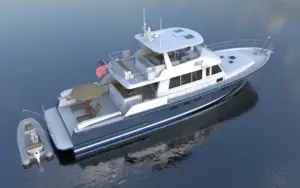
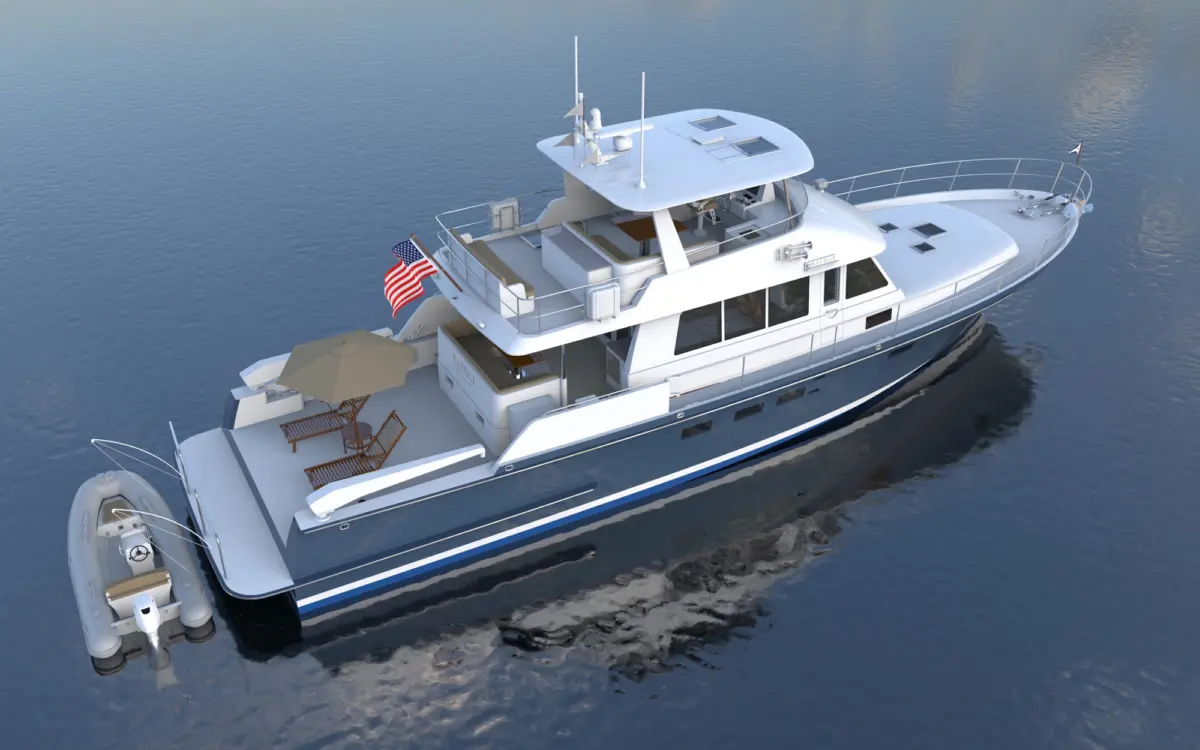
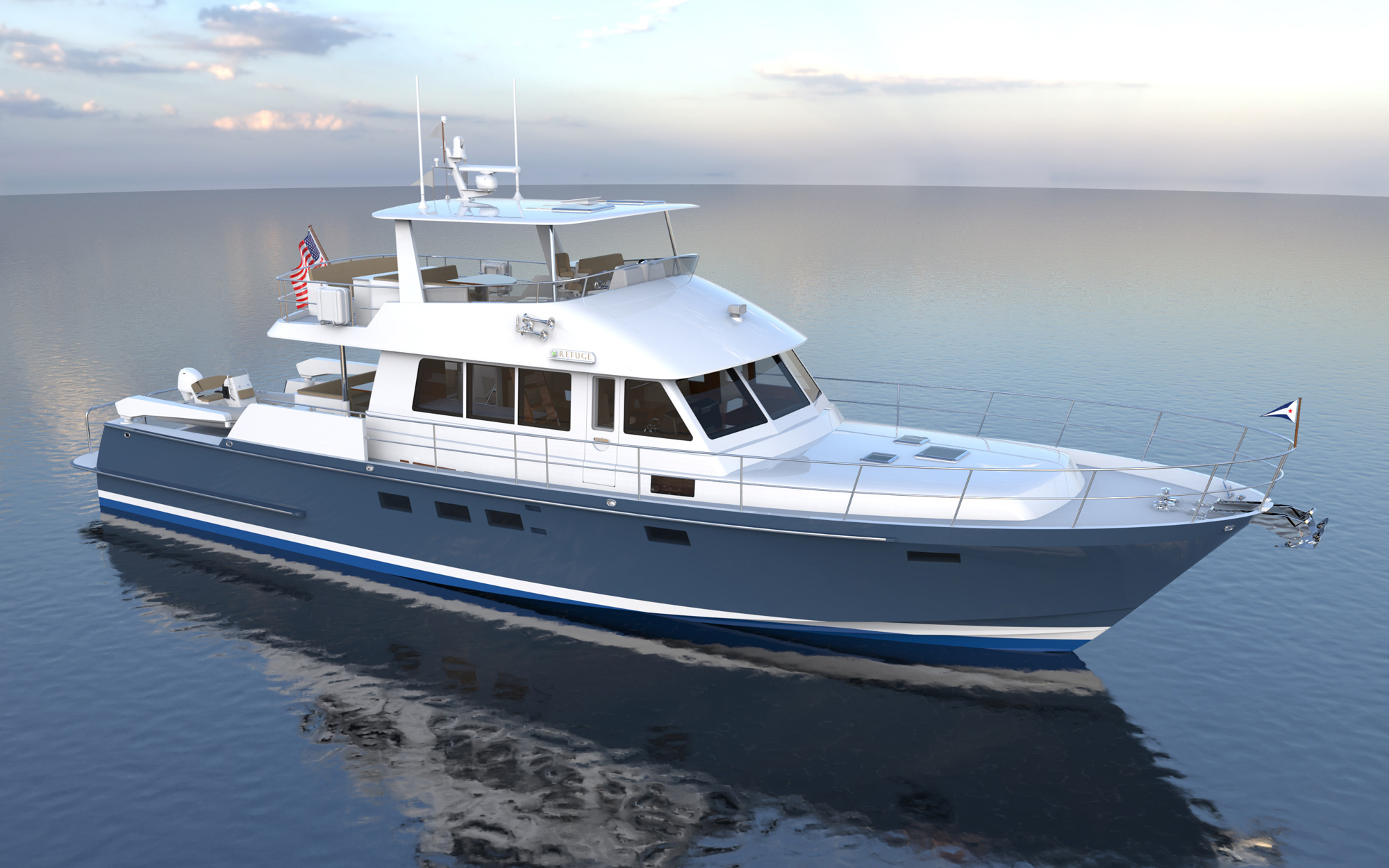
Tailored for an experienced cruising couple who demand transoceanic capability without the logistical complexities—or crew requirements—of a mega-yacht, the Hunt 70 bridges the gap between a high-performance coastal cruiser and a go-anywhere pocket explorer. Powered by twin 1,136-horsepower Caterpillar C18 diesels, the vessel marries blistering semi-displacement speeds with trans-regional fuel efficiency. Beneath its sleek, purposeful exterior lies a masterclass in spatial architecture: a vast, utility-focused aft working deck capable of housing everything from a 15-foot rigid inflatable boat (RIB) to an overland golf cart, paired with an interior layout that prioritizes domestic comfort on extended passages.
With the first hull slated for a spring 2028 launch, the Hunt 70 represents more than just a new build model; it is a clinical exploration of what modern, owner-operated voyaging can achieve when uncompromising New England craftsmanship meets legendary hull design.
Detailed Chronology of the Project
The genesis of the Hunt 70 did not happen overnight; it is the culmination of decades of evolution in American custom boatbuilding, born from iterative discussions between two powerhouse names in Maine maritime engineering.
The Conceptual Phase (Early 2024–Late 2025)
The project began when a deeply experienced cruising couple approached Lyman-Morse with a highly specific brief. They had logged thousands of offshore miles and knew precisely what they wanted—and more importantly, what current production models lacked. They required a vessel that could handle the unpredictable, heavy seas of high-latitude environments (such as Maine, the Canadian Maritimes, and Alaska) while offering the autonomy of a true expedition vessel.
Lyman-Morse turned to Ray Hunt Design, a firm globally celebrated for its deep-V hull forms and seaworthy pedigree. Over nearly two years of collaborative design iterations, naval architects and marine engineers refined the vessel’s lines. The primary objective was balancing a high-capacity toy-hauling aft deck with a refined, vibration-free, and acoustically insulated interior living environment.
Engineering and Tank-Testing (2026)
During the engineering phase, significant focus was dedicated to the structural integrity of the hull and the propulsion dynamics. Because the vessel needed to achieve high-speed transits (cruising comfortably in the mid-20-knot range) while retaining low-speed displacement efficiency for fuel-sipping long passages, the hull form underwent rigorous computational fluid dynamics (CFD) modeling. The integration of Twin Disc V-drives with the massive Caterpillar C18 powerplants required meticulous weight distribution to ensure the vessel’s trim remained optimal across varying fuel loads.
Current Status and Production Roadmap (2026–2028)
As marketing and construction announcements ramp up, Lyman-Morse’s Thomaston, Maine shipyard is preparing its facilities for the intricate composite and custom metalwork required for Hull No. 1. The shipyard has established a firm timeline leading up to the anticipated spring 2028 water launch. This timeline accounts for custom interior joinery fabrication, system integration, extensive dockside commissioning, and sea trials in the demanding waters of Casco Bay.
Supporting Context & Metrics: Architecture and Performance
To truly understand the Hunt 70, one must analyze the hard metrics and specialized engineering choices that dictate its performance envelope. This is not a floating condominium; it is a precision tool built for maritime exploration.
Hull Form and Seakeeping Pedigree
Ray Hunt Design is synonymous with the legendary deep-V hull, a configuration developed by the late C. Raymond Hunt that revolutionized how powerboats handle rough water. The Hunt 70 utilizes an evolution of this philosophy. Designed to slice cleanly through steep head seas while providing dynamic lift and stability running down-sea, the hull geometry minimizes slamming and reduces crew fatigue during grueling multi-day passages.
Propulsion and Range
At the heart of the Hunt 70’s performance profile are two heavy-duty Caterpillar C18 diesel engines, each churning out an impressive 1,136 horsepower. These powerplants drive through Twin Disc V-drives, an arrangement chosen to maximize interior accommodation space by shifting the engine room further aft without compromising the vessel’s center of gravity.
- Projected Top Speed: 28.5 knots
- Target Cruising Speed: 25 to 26 knots
- Fuel Capacity: 2,465 gallons
This substantial fuel reserve allows the yacht to undertake extended offshore passages without the constant anxiety of fuel scarcity. When throttled back to displacement speeds for long-range expedition cruising, the fuel burn drops dramatically, stretching the vessel’s operational radius significantly.
Deck Operations and Utility Architecture
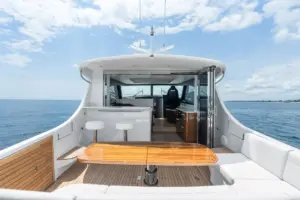
The defining visual and functional signature of the Hunt 70 is its expansive aft working deck. Eschewing the traditional, purely aesthetic cockpit found on standard luxury cruisers, this space is engineered as a functional staging area.
- Tender and Toy Capacity: The deck can effortlessly accommodate a 15-foot-5-inch RIB, an aluminum skiff for shallow-water exploration, a pair of sea kayaks, or—in a nod to shoreside mobility—a fully operational utility golf cart.
- Launch and Retrieval Systems: Twin heavy-duty hydraulic cranes are strategically positioned to handle deployment and recovery safely, even in less-than-ideal sea states, eliminating the physical strain typically associated with managing heavy tenders.
Interior Layout and Domestic Logistics
Below decks, the Hunt 70 treats its owners and guests to a layout that blends superyacht luxury with practical sea-keeping ergonomics.
- Accommodations: The full-beam owner’s suite serves as a tranquil sanctuary, complete with separate his-and-her heads to ensure privacy and comfort during long-term liveaboard cruising. A forward VIP stateroom and flexible, convertible berths provide comfortable quarters for additional family members or cruising guests.
- Culinary and Provisioning Infrastructure: Long passages require serious provisioning capability. The galley is equipped with dual commercial-grade refrigerator/freezers, a dedicated walk-in pantry for dry goods, and an innovative dumbwaiter system. This dumbwaiter connects the galley directly to the deckhouse, facilitating effortless food and gear transport between levels—a crucial detail for owners who prefer to operate without a permanent crew.
Official Statements and Industry Insights
The collaboration between Lyman-Morse and Ray Hunt Design unites two pillars of American boatbuilding excellence, both deeply rooted in maritime heritage.
Industry analysts and company stakeholders have emphasized that the Hunt 70 addresses a distinct market void. For years, experienced yachtsmen stepping out of large sailing yachts or production cruisers have found themselves forced to choose between sterile, high-maintenance megayachts or coastal weekenders that lack true offshore grit.
"The modern cruising couple is more adventurous than ever," notes an insider close to the Ray Hunt design team. "They don’t want to sit in a marina slip; they want to anchor in remote fjords, launch heavy-duty tenders, and explore unassisted. The Hunt 70 was engineered from the keel up to provide that exact brand of self-reliance, wrapped in a high-performance, aesthetically striking package."
Lyman-Morse, renowned for its ability to execute complex custom composite and aluminum builds, views the project as a natural extension of its craftsmanship ethos. "Building a vessel of this caliber requires an intimate understanding of how systems interact under offshore stress," a Lyman-Morse representative stated. "Working alongside Ray Hunt Design allows us to push boundaries, delivering a yacht that is as tough as it is sophisticated."
Future Outlook: The Evolution of the Pocket Explorer Market
As the maritime industry looks toward the remainder of the decade, the debut of the Hunt 70 in spring 2028 is expected to serve as a bellwether for the custom exploration sector.
Shifting Demographics in Long-Range Cruising
The profile of the luxury yacht owner is evolving. A younger, more active demographic of entrepreneurs and retirees is opting for hands-on, experiential cruising over passive chartering. These owners value autonomy, speed when weather windows demand it, and the rugged utility to carry specialized gear—scuba compressors, submersibles, heavy-duty tenders, and adventure equipment. The Hunt 70 is uniquely positioned to capture this growing market segment.
Technological and Environmental Considerations
While Hull No. 1 relies on the proven, robust performance of Caterpillar C18 diesels, the underlying engineering platform of the Hunt 70 has been designed with future system integrations in mind. As battery densities improve and hybrid propulsion gains traction in custom builds, hulls of this displacement and structural integrity are ideal candidates for hybrid-electric enhancements on subsequent hull iterations.
Conclusion
The Lyman-Morse and Ray Hunt Design partnership has bypassed the temptation to build just another derivative cruising yacht. Instead, they have forged an uncompromising, highly capable exploration vessel that respects the traditions of American seakeeping while embracing modern engineering prowess. As construction commences in Thomaston and the industry counts down to its 2028 debut, the Hunt 70 stands ready to redefine what is possible on a 70-foot water line—proving that true adventure requires neither excessive scale nor the sacrifice of comfort.