





Executive Overview
The global maritime industry is undergoing an unprecedented transformation. As ocean carriers deploy increasingly massive container ships, ultra-large crude carriers (ULCCs), and expansive Neo-Panamax cruise liners, the infrastructure supporting these maritime giants must evolve in tandem. Ports are deeper, channels are tighter, and the margin of error for maneuvering these multi-thousand-ton vessels has virtually vanished. In response to these heightened operational demands, ship assist and escort providers are forced to recapitalize their fleets with higher-horsepower, highly maneuverable, and environmentally compliant tonnage.
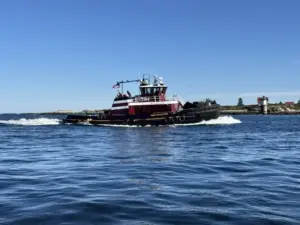
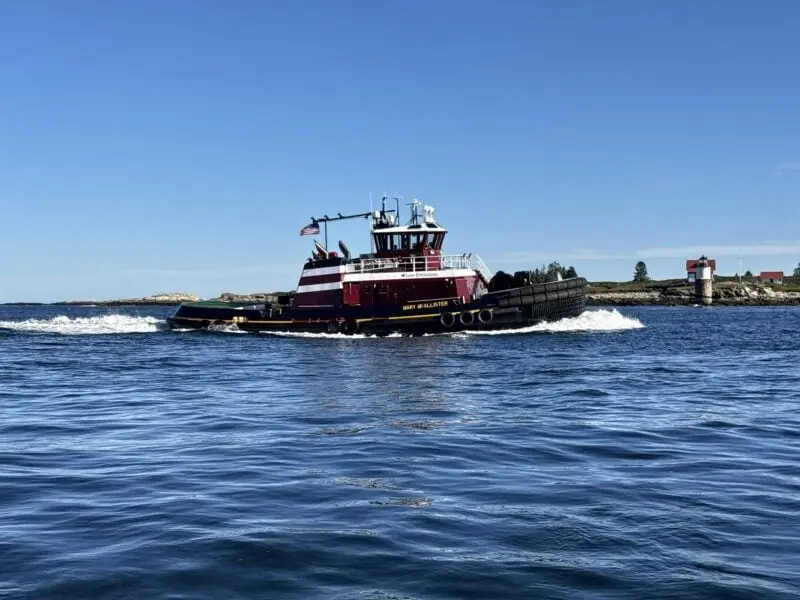
At the forefront of this domestic fleet modernization is McAllister Towing, a historic pillar of the American maritime industry. The company has officially announced the arrival of its newest vessel, the tug Mary McAllister. Built by Washburn & Doughty Associates, Inc. in East Boothbay, Maine, the Mary McAllister represents the sixth vessel in a sophisticated seven-tug series of American Bureau of Shipping (ABS) classed, 84-metric-ton bollard pull tractor tugs.
Equipped with cutting-edge Caterpillar Tier IV propulsion systems generating 6,770 horsepower, advanced firefighting capabilities (FiFi 1), and specialized escort notations, the Mary McAllister is designed to bridge the gap between heavy-duty harbor assist operations and stringent environmental stewardship.
This investigative and analytical report details the vessel’s construction, its strategic coastal transit, the technical metrics that define its operational capabilities, and its long-term economic and environmental implications for its ultimate homeport of Port Everglades, Florida.
+-----------------------------------------------------------------------------+
|                          MARY McALLISTER AT A GLANCE                        |
+-----------------------------------------------------------------------------+
| Builder:          Washburn & Doughty Associates, Inc. (Maine, USA)          |
| Series:           6th of a 7-tug customized class                           |
| Classification:   ABS: +A-1 Towing, +AMS, Fire Fighting (FiFi 1), Escort,   |
|                   Low Emissions Vessel (LEV)                                |
| Bollard Pull:     84 Metric Tons                                            |
| Installed Power:  6,770 Horsepower (CAT Tier IV Diesel Engines)             |
| Firefighting:     12,000 Gallons Per Minute (Water/Foam)                    |
| Primary Duty:     High-performance ship assist, escort, and port safety    |
| Homeport:         Port Everglades, Florida                                  |
+-----------------------------------------------------------------------------+
Detailed Chronology: From Maine Shipyard to Florida Gateway
The deployment of a modern tractor tug involves a complex sequence of design, construction, sea trials, and strategic transit. The journey of the Mary McAllister highlights both the technical robustness of the vessel and the operational agility of her crew.
Phase I: Construction and Engineering in Maine
The Mary McAllister was constructed by Washburn & Doughty Associates, Inc., a shipyard renowned for its specialization in high-performance steel commercial vessels and tugboats. Located in East Boothbay, Maine, the yard has established a long-running partnership with McAllister Towing, utilizing standardized but highly customized designs to optimize build efficiency, crew familiarity, and spare parts commonality across the fleet. The Mary is the sixth sister ship in this highly successful 84-metric-ton bollard pull series, representing years of iterative engineering refinements.
Phase II: The Shakedown and the Nor’easter
Upon completion of her shipyard trials and receiving her ABS certifications, the Mary McAllister departed the Damariscotta River just as a powerful autumn nor’easter began barreling toward the New England coast.
In maritime operations, a new vessel’s maiden voyage is critical. Rather than delaying the transit, the decision was made to utilize the storm as an authentic sea-trial environment. The Mary navigated south into Portland, Maine, seeking temporary harbor to ride out the worst of the gale. This initial passage through the rough, cold waters of the North Atlantic served as an immediate validation of her hull design, stability, and the integrity of her propulsion systems.
Phase III: Mid-Atlantic Integration in Baltimore
Following her departure from Portland, the Mary McAllister commenced her journey down the United States East Coast. Her first operational destination is the Port of Baltimore, Maryland. In Baltimore, she will join her sister vessel, the Isabel McAllister.
[Washburn & Doughty (ME)] ---> [Portland (ME)] ---> [Port of Baltimore (MD)] ---> [Port Everglades (FL)]
     (Construction)             (Storm Shelter)        (Initial Operations)             (Homeporting)
Baltimore’s maritime corridor, characterized by diverse cargo profiles including massive Roll-on/Roll-off (Ro-Ro) vehicle carriers, coal bulkers, and Neo-Panamax container vessels, represents an ideal testing ground. Here, the Mary will receive her first official commercial work orders, integrating into the local McAllister fleet to assist vessels navigating the tight channels of the Patapsco River.
Phase IV: Ultimate Deployment to Port Everglades
Once her operational integration and crew-familiarization hitch in Baltimore are complete, the Mary McAllister will transit to her permanent station at Port Everglades in Broward County, Florida. Port Everglades is one of the busiest cruise and petroleum ports in the world, requiring precise, high-horsepower tugs to handle massive cruise ships and deep-draft tankers in frequently challenging wind and current conditions.
Supporting Context & Metrics: Engineering the Modern Tractor Tug
To understand the operational significance of the Mary McAllister, one must examine the specific engineering choices and regulatory frameworks that governed her design. Every aspect of the vessel, from her propulsion to her auxiliary systems, has been optimized for safety, power, and environmental compliance.
                          +-------------------------+
                          |   Caterpillar Tier IV   |
                          |  Engines (6,770 Total HP)|
                          +------------+------------+
                                       |
                                       v
                          +-------------------------+
                          |   Selective Catalytic   |
                          |    Reduction (SCR)      |
                          +------------+------------+
                                       |
                                       v
                          +-------------------------+
                          |   ABS Low Emissions     |
                          |   Vessel Certification  |
                          +-------------------------+
Propulsion and Environmental Compliance: The Tier IV Standard
The centerpiece of the Mary McAllister’s engineering suite is her twin Caterpillar (CAT) Tier IV diesel engines, which collectively generate 6,770 horsepower.
Under the Environmental Protection Agency (EPA) and International Maritime Organization (IMO) Tier IV regulations, marine diesel engines must achieve drastic reductions in nitrogen oxides ($textNO_x$) and particulate matter (PM) compared to older Tier II or Tier III models.
- Selective Catalytic Reduction (SCR): To meet these stringent standards, the CAT engines utilize SCR technology. This process injects a urea-based Diesel Exhaust Fluid (DEF) into the exhaust stream, converting harmful $textNO_x$ emissions into harmless nitrogen gas and water vapor.
- Operational Footprint: While SCR systems require additional onboard space for DEF storage tanks and dosing units—a engineering challenge on compact tugboats—the hull design of the Mary McAllister successfully integrates these systems without sacrificing crew quarters, fuel capacity, or engine accessibility.
Understanding Bollard Pull and Maneuverability
The Mary McAllister is rated at an impressive 84 metric tons of bollard pull. Bollard pull is the conventional measure of the pulling or pushing strength of a watercraft, equivalent to the static force exerted by the vessel at zero speed.
An 84-metric-ton rating places the Mary in the upper echelon of harbor tugs, giving her the capability to safely control:
- Ultra-Large Container Vessels (ULCVs) exceeding 15,000 TEUs.
- Fully laden tankers and bulk carriers.
- Modern mega-cruise ships with high windage profiles.
As a tractor tug, the vessel utilizes omnidirectional propulsion units (typically Z-drive azimuth thrusters). Unlike conventional single or twin-screw tugs that rely on traditional rudders, Z-drives can rotate 360 degrees, directing thrust in any direction instantaneously. This provides the Mary McAllister with unparalleled maneuverability, allowing her to operate sideways, rotate on her own axis, and apply maximum braking force to a ship almost instantly.
ABS Classifications and Special Endorsements
The American Bureau of Shipping (ABS) has classed and certified the Mary McAllister with several critical notations that define her operational capabilities:
- $mathbf+A-1$ Towing: This notation indicates that the vessel has been constructed under ABS survey to meet the bureau’s highest standards for vessels intended for towing service.
- $mathbf+AMS$: Assures that the vessel’s machinery, boilers, and systems meet the rigorous safety and reliability requirements of ABS.
- Escort Service: This certification guarantees that the tug is structurally reinforced and hydrodynamically capable of performing high-speed escort operations. During escorting, a tug acts as an active steering and braking safety net for a ship transiting narrow channels at speeds up to 10–12 knots.
- Low Emissions Vessel (LEV): This endorsement recognizes the vessel’s compliance with advanced environmental standards, reflecting the integration of the CAT Tier IV engines and emissions abatement systems.
- Fire Fighting (FiFi 1): This rating denotes a highly specialized level of onboard external firefighting capability.
FiFi 1 Firefighting Capabilities: A Floating Fire Station
The Mary McAllister is not merely a towing vessel; she is also a critical emergency response asset. Her FiFi 1 classification indicates a major investment in port safety infrastructure.
+-----------------------------------------------------------------------------+
|                        FiFi 1 PERFORMANCE METRICS                           |
+-----------------------------------------------------------------------------+
| Total Pump Capacity:      12,000 Gallons Per Minute (GPM)                   |
| Delivery Systems:         High-capacity water/foam monitors                 |
| Coverage:                 Dual-purpose marine fire suppression              |
| Defensive Systems:        Water spray screen for self-protection            |
+-----------------------------------------------------------------------------+
With pumps capable of discharging 12,000 gallons of water and fire-suppressing foam per minute, the Mary can combat shipboard and dockside fires from the water. This volume of water is equivalent to the output of multiple municipal fire engines combined. Additionally, the vessel is equipped with a water spray system that envelopes the tug in a protective mist, allowing her to operate safely in close proximity to intense heat and flames.
Official Statements & Corporate Heritage: Five Generations of Maritime Stewardship
The delivery of the Mary McAllister is a testament to the enduring business model of McAllister Towing. Founded in 1864 by James McAllister, who arrived in New York from Ireland, the company has survived and thrived through major historical transitions: from sail to steam, steam to diesel, and now from conventional diesel to low-emission, high-tech propulsion.
Now in its fifth generation of family ownership and operation, McAllister Towing remains one of the oldest and most respected marine transportation firms in the United States.
                                  JAMES McALLISTER
                                   (Founded 1864)
                                         |
                                         v
                                   Generation II
                                         |
                                         v
                                  Generation III
                                         |
                                         v
                                   Generation IV
                                         |
                                         v
                                   Generation V
                           (Modern Fleet Expansion &
                             Tier IV Integration)
In releasing details about the new vessel, company leadership emphasized that the investment in the Mary McAllister is a direct response to customer needs. As shipping lines deploy larger vessels to optimize supply chain efficiencies, towing providers must proactively introduce equipment that can safely handle these ships while adhering to the highest environmental standards.
The company’s leadership highlighted that the Mary represents their continuous commitment to global trade, combining high-tech engineering, low-emission propulsion, and mission-critical firefighting capabilities. They noted that the company’s ability to remain family-owned for five generations, while consistently investing in new, American-built, state-of-the-art tugboats, remains a core source of pride.
Furthermore, the construction of the Mary McAllister at Washburn & Doughty underscores McAllister’s commitment to the domestic maritime industry and compliance with the Merchant Marine Act of 1920 (commonly known as the Jones Act). By utilizing American shipyards, American steel, and American crews, McAllister supports the domestic industrial base and ensures that critical harbor defense and logistics infrastructure remain under domestic control.
Future Outlook: The Port Everglades Paradigm and Beyond
The strategic positioning of the Mary McAllister in Port Everglades highlights the changing dynamics of Florida’s maritime trade.
Port Everglades Expansion and the Need for High-Bollard-Pull Tugs
Port Everglades is currently executing a multi-million-dollar infrastructure expansion plan, which includes:
- Deepening the navigation channels from 42 feet to 48–50 feet.
- Widening the Southport Turning Notch to accommodate up to five new Neo-Panamax container cranes.
- Increasing the frequency of transits by larger, draft-restricted cruise liners and petroleum tankers.
These physical expansions mean that vessels transiting the port will have less room to maneuver relative to their size. Strong crosswinds, tidal currents, and the close proximity of docked vessels make docking operations highly sensitive.
The introduction of the Mary McAllister, with her 84-metric-ton bollard pull and exceptional maneuverability, provides the port’s pilots and ship captains with an essential safety margin. Whether holding a massive cruise ship against a 30-knot easterly wind or guiding a loaded fuel tanker through the outer bar channel, the Mary’s presence enhances the overall safety envelope of the port.
+-----------------------------------------------------------------------------+
|                    PORT EVERGLADES OPERATIONAL MATRIX                       |
+-----------------------------------------------------------------------------+
| Port Challenge:              Increased cruise windage & draft-restricted    |
|                              petroleum tankers                              |
| McAllister Solution:         Mary McAllister (84 LT Bollard Pull,           |
|                              Z-Drive maneuverability)                       |
| Environmental Alignment:     Low Emissions Vessel (LEV) notation aligns     |
|                              with Broward County green initiatives          |
+-----------------------------------------------------------------------------+
The Broader Maritime Decarbonization Push
The maritime sector is under intense pressure to decarbonize. While alternative fuels such as hydrogen, methanol, and fully electric propulsion systems are being trialed in various parts of the world, practical and economic hurdles remain for high-power, high-endurance escort tugs.
For the foreseeable future, high-efficiency diesel-mechanical systems utilizing advanced SCR aftertreatment—such as the Tier IV setup on the Mary McAllister—represent the most reliable and immediate pathway to reducing carbon and particulate footprints without sacrificing the raw power required for emergency towing and escort operations.
Looking Ahead: The Seventh Vessel in 2027
McAllister Towing’s fleet modernization program does not end with the Mary. The company has confirmed that the seventh and final vessel of this current Washburn & Doughty series is already scheduled for delivery in 2027.
This long-term investment horizon demonstrates McAllister’s confidence in the resilience of American maritime trade and the enduring necessity of high-performance tugboats. By continuously replacing older tonnage with state-of-the-art, low-emission vessels, McAllister Towing ensures its readiness to serve the global shipping fleet, protect local harbors, and uphold its multi-generational legacy for decades to come.