






Executive Overview
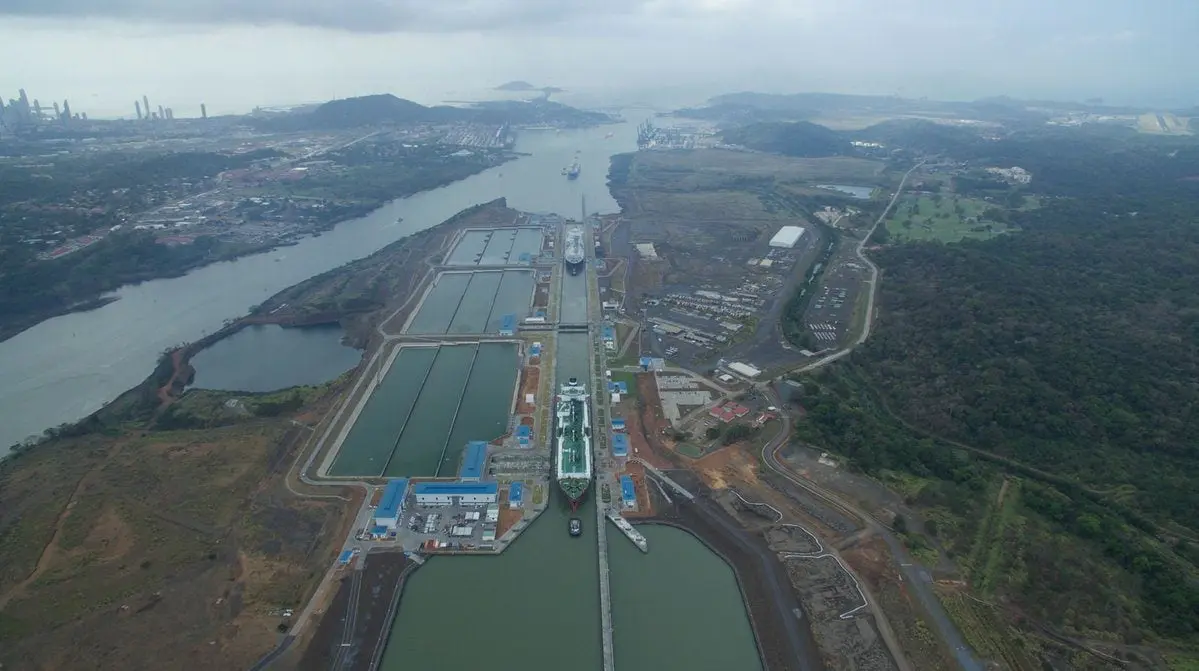
The global maritime shipping network is facing a compounding, multi-front crisis. At the center of this systemic disruption is the Panama Canal—a critical conduit handling approximately 5% of global maritime trade and 40% of all US container traffic. Today, the canal is locked in a vice grip of geopolitical instability and severe ecological volatility.
As conflict in the Middle East compromises traditional shipping lanes and leaves the security of the Strait of Hormuz unresolved, global energy flows are being aggressively rerouted. Energy transport vessels, seeking to avoid the volatile waters of the Middle East, have increasingly turned to the US Gulf Coast as an alternative loading hub, subsequently steering toward the Panama Canal to access Asian markets.
This surge in energy transit has collided head-on with a historic hydrological crisis. A looming, severe El Niño weather pattern has depleted the freshwater reservoirs that feed the canal’s lock systems. To preserve operational integrity, the Panama Canal Authority (ACP) has been forced to implement a series of aggressive draft restrictions and transit caps.
The resulting bottleneck has triggered severe congestion, with upwards of 112 vessels left stranded in mounting queues. Delays for eastbound transits are soaring toward 10 days, sparking a desperate, high-stakes bidding war for "queue-jump" slots. Daily auctions managed by the ACP have seen slot prices skyrocket from a pre-war average of $135,000 to record-breaking bids exceeding $4.6 million for a single transit.
With schedule reliability plummeting, equipment shortages intensifying, and draft limits set to tighten further, the global supply chain is bracing for a highly disruptive fourth quarter. This investigative report analyzes the chronology, metrics, and systemic implications of this escalating maritime bottleneck.
Detailed Chronology of the Crisis
[December] -----------------> [March] --------------------> [Late August] -------------> [September 3]
ACP initiates                 Queue-jump auction          Draft cut to 48ft           Draft cut to 47.5ft
water-saving prep             averages hit $385k;         (Neo-Panamax)               (Further capacity
cycle                         record $4.6M bid                                        restrictions)
The current emergency at the Panama Canal did not develop in a vacuum. Rather, it is the result of two distinct, slow-burning crises that converged in a perfect operational storm.
Phase I: The Ecological Precursor (December)
Recognizing the onset of an unusually dry season exacerbated by the warming of the Pacific Ocean, the Panama Canal Authority (ACP) quietly initiated a water-conservation preparation cycle in December. Unlike sea-level canals such as the Suez, the Panama Canal relies entirely on freshwater gravity-fed from Gatun Lake and Alajuela Lake to operate its massive lock systems. Each vessel transit drains approximately 50 million gallons of freshwater into the ocean. Anticipating that the incoming El Niño cycle would severely restrict rainfall, the ACP began adjusting its long-term transit allocations and preparing for progressive draft reductions.
Phase II: Geopolitical Realignment and the Energy Shift (Q1)
The baseline ecological strain was dramatically accelerated by geopolitical escalation in the Middle East. As drone and missile attacks compromised transit safety through the Red Sea and the Bab al-Mandab Strait, and with tensions surrounding the Strait of Hormuz remaining highly volatile, global energy markets fractured.
Fearing prolonged disruptions and soaring insurance premiums in Middle Eastern gateways, charterers redirected their focus to the US Gulf Coast. This shift transformed the US Gulf into a primary loading hub for Liquefied Natural Gas (LNG), Liquefied Petroleum Gas (LPG), and refined petroleum products destined for fast-growing markets in Northeast Asia. The natural pathway for these exports was the Panama Canal, causing an unexpected and unprecedented surge in energy tanker transits.
Phase III: The Auction Desperation and March Records
By March, the convergence of heightened energy transits and restricted canal capacity triggered a scramble for access. The standard reservation system became entirely overwhelmed, leaving unbooked vessels facing indefinite delays. To manage the backlog, the ACP capitalized on its daily "queue-jump" auction slots.
Historically, these slots traded at a premium but remained within predictable commercial boundaries. Prior to the escalation of geopolitical tensions, a slot typically commanded between $135,000 and $140,000. By March, however, the average auction price had nearly tripled to $385,000.
Desperation peaked when carriers broke the all-time transit auction record twice in a single week. In one historic transaction, an energy carrier paid an astronomical $4.6 million—excluding standard transit fees—to secure a slot for an empty oil tanker, surpassing a $4 million bid logged just days prior.
Phase IV: Deepening Congestion and Autumn Draft Reductions
As the canal entered the late summer months, the backlog solidified. The queue of vessels waiting to transit ballooned to 112, with delays of up to 10 days projected for eastbound transits.
To cope with depleting lake levels, the ACP finalized a two-tiered draft reduction schedule for its Neo-Panamax locks:
- August 26: Maximum draft slashed to 48 feet.
- September 3: Maximum draft further restricted to 47.5 feet.
These draft cuts have systematically stripped container carriers of their carrying capacity, forcing them to choose between sailing under-loaded or paying exorbitant premiums to bypass the queue.
Supporting Context & Metrics: The Mechanics of the Bottleneck
To understand the scale of the crisis, one must examine the economic and physical metrics governing canal operations.
| Metric | Pre-Crisis Baseline | Current / Peak Crisis Status | Percentage Change / Impact |
|---|---|---|---|
| Awaiting Vessels | ~30–50 vessels | 112 vessels | >120% increase in backlog |
| Eastbound Transit Delays | <24–48 hours | Up to 10 days | >400% increase in transit times |
| Standard Queue-Jump Slot Price | $135,000 – $140,000 | $385,000 (Average) | 185% increase in average cost |
| Record Queue-Jump Bid | $2.4 million (Historic) | $4.6 million (Peak) | 91% increase over prior record |
| Neo-Panamax Max Draft | 50.0 feet | 47.5 feet (Effective Sept 3) | 2.5-foot reduction (significant cargo loss) |
The Physics of the Draft Restrictions
A draft reduction from 50 feet to 47.5 feet may seem minor to the casual observer, but in the realm of ocean freight, it represents a catastrophic loss of capacity. For every foot of draft lost, a Neo-Panamax container vessel must shed approximately 300 to 400 TEUs (Twenty-Foot Equivalent Units).
A 2.5-foot reduction means a single large vessel must sacrifice up to 1,000 TEUs of cargo capacity per transit. To maintain their margins, ocean carriers are forced to implement "Panama Canal Surcharges," ranging from $300 to $500 per TEU, passing the operational cost of water scarcity directly onto cargo owners and, ultimately, consumers.
Draft Level: 50.0 ft (Standard)  [=========================================] 100% Capacity
Draft Level: 48.0 ft (Aug 26)    [=====================================----] ~92% Capacity
Draft Level: 47.5 ft (Sept 3)    [===================================------] ~88% Capacity
The "Bullwhip" Effect on Global Logistics
The disruption at the canal is sending shockwaves through the broader global supply chain network, creating a classic logistics "bullwhip" effect:
- Vessel Rotation Disruptions: Ships delayed by 10 days in Panama miss their scheduled arrival windows at East Coast US ports, causing congestion at destination berths and disrupting import schedules.
- Equipment Starvation: Delayed vessels mean delayed empty container returns. Equipment availability in manufacturing hubs throughout Asia is tightening, driving up local container leasing rates.
- Schedule Reliability Collapse: Global schedule reliability has deteriorated significantly. Carriers are forced to initiate "blank sailings" (canceled port calls) to reset their schedules, further reducing available capacity.
Official Statements & Stakeholder Perspectives
The severity of the situation is reflected in the increasingly urgent warnings from logistics operators and industry analysts.
A prominent European freight forwarder, speaking on the condition of anonymity, highlighted the systemic risk this bottleneck poses to global commerce:
"The main concern for us is any knock-on effect the congestion has on global shipping networks. If waiting times remain high, carriers may adjust schedules or capacity, and this can eventually put additional pressure on freight rates. We are seeing a fragmentation of reliability. You cannot run a just-in-time supply chain when your transit window through one of the world’s primary choke points is subject to a ten-day variance or a multi-million dollar bidding war."
The Panama Canal Authority (ACP) has defended its aggressive measures, including the slot auctions and draft restrictions, as necessary steps to prevent a complete operational shutdown. In a briefing regarding water conservation, the ACP emphasized that:
"…the preparation cycle initiated in December was designed to stretch every drop of available water through the dry season. While the auction system has drawn criticism for its pricing extremes, it remains a market-driven mechanism to allocate scarce transits to those whose supply chains demand immediate passage."
Maritime economists note that the $4.6 million bid for an empty tanker highlights the extreme volatility of the energy markets. An empty tanker rushing back to the US Gulf Coast to load a high-value LNG or refined product cargo can justify a multi-million dollar fee if the arbitrage window—the price difference between the US Gulf purchase price and the Asian delivery price—is wide enough. However, this pricing dynamic effectively crowds out lower-margin retail and agricultural cargo, forcing standard container carriers to wait in the mounting queues.
Future Outlook: A Structural Shift in Trade Routes
As the shipping industry looks toward the final quarter of the year, there is little hope for immediate relief. The convergence of climate anomalies and geopolitical friction suggests that the Panama Canal crisis is transitioning from a temporary bottleneck to a semi-permanent structural challenge.
The Looming El Niño Threat
Forecasters place the probability of a "very strong" El Niño event persisting through Q4 and into the early spring at 81%. Historically, strong El Niño patterns correlate with prolonged droughts in the Panamanian isthmus, meaning the water levels in Gatun Lake are unlikely to recover anytime soon.
If rainfall remains critically below average through the end of the wet season in November, the ACP may be forced to implement even deeper draft cuts—potentially down to 45 feet—or further reduce the daily number of authorized transits.
                     81% PROBABILITY OF "VERY STRONG" EL NIÑO
                                    │
                  ┌─────────────────┴─────────────────┐
                  ▼                                   ▼
       Prolonged Rainfall Deficit           Extended Draft Restrictions
                  │                                   │
                  ▼                                   ▼
       Lower Gatun Lake Levels             Continued Slot Scarcity
                  │                                   │
                  └─────────────────┬─────────────────┘
                                    ▼
                     PERMANENT FREIGHT RATE INFLATION
Permanent Re-routing and the Rise of Alternatives
Faced with unpredictable transit times and volatile auction fees, global logistics managers are actively redesigning their supply chains to bypass the Panama Canal entirely:
- The US West Coast and Intermodal Rail: Many retailers are diverting cargo away from US East Coast and Gulf Coast ports, returning to US West Coast gateways like Los Angeles and Long Beach. From there, goods are moved eastward via transcontinental rail. While more expensive than all-water routes, this intermodal alternative bypasses the Panama Canal bottleneck entirely.
- The Cape of Good Hope Route: For certain trade lanes, particularly those originating in South Asia and destined for the US East Coast, carriers are increasingly choosing to bypass both the Suez Canal (due to Red Sea security risks) and the Panama Canal (due to water restrictions) by sailing around the southern tip of Africa. This route adds 10 to 14 days to the journey but offers predictable transit times and avoids canal toll fees and auction costs.
Conclusion
The crisis at the Panama Canal is a stark reminder of the vulnerability of modern global trade. When geopolitical tensions in the Middle East push energy transit into the Western Hemisphere, and climate-induced water scarcity restricts the very path designed to accommodate it, the global supply chain has few places to turn.
With draft restrictions locked in at 47.5 feet and an 81% chance of a severe El Niño winter ahead, the shipping industry must prepare for a prolonged era of higher costs, reduced reliability, and structural cargo diversion. The era of cheap, predictable, and seamless global maritime transit is facing its greatest challenge yet.