








Executive Overview
The global maritime industry is currently navigating a period of unprecedented transformation. Driven by stringent environmental regulations, escalating fuel costs, and an urgent push toward decarbonization, shipowners, shipbuilders, and marine researchers are looking to optimize every aspect of vessel efficiency. At the heart of this effort is the marine propeller—a highly complex, double-curved geometric component where minor deviations in design can result in massive losses in fuel efficiency, increased noise, and destructive cavitation.
Against this backdrop of rapid technological evolution, HydroComp, Inc., a global leader in hydrodynamic software and consultancy, has officially announced the release of PropCad 2026. This latest iteration of their industry-standard software is specifically engineered to streamline and modernize the workflows of propeller designers, manufacturers, and researchers worldwide.
+-----------------------------------------------------------------------------+
|                                PROPCAD 2026                                 |
|         Bridging the Gap Between Legacy CAD and Modern Hydrodynamics        |
+-----------------------------------------------------------------------------+
                                       |
       +-------------------------------+-------------------------------+
       |                               |                               |
       v                               v                               v
[Interactive Pitch Control]   [Session Persistence]       [UI & System Modernization]
 - Draggable visual handles    - Save/Load import state    - Native table controls
 - Real-time table updates     - Eliminates rework         - Legacy 32-bit optimization
 - High-precision tuning       - Complex patch support     - Double-click 3D centering
The release of PropCad 2026 addresses a critical, long-standing bottleneck in marine engineering: the conversion of legacy 3D CAD models and physical scans into clean, parametric, and simulation-ready design data. By introducing interactive visual controls for pitch-plane extraction, robust session saving, and a modernized user interface, HydroComp aims to tighten the digital thread that connects physical propeller manufacturing with virtual hydrodynamic testing.
Detailed Chronology of PropCad’s Evolution and Technical Innovations
To understand the significance of PropCad 2026, one must look at the developmental history of propeller CAD tools. Historically, propeller design was an iterative, manual process relying heavily on 2D offsets and physical patterns. The advent of Computer-Aided Design (CAD) in the late 20th century digitized these workflows, but created a persistent divide: general-purpose CAD software lacked the specialized mathematical frameworks required to calculate complex hydrodynamic parameters, while hydrodynamic analysis tools struggled to ingest raw, non-parametric 3D models.
For decades, HydroComp’s PropCad has served as the bridge between these two worlds. The development trajectory leading to the 2026 release represents a concerted effort to eliminate manual data entry, reduce user error, and accommodate the increasingly complex geometries of modern, high-skew, variable-pitch propellers.
PropCad Evolution Timeline:
[Manual Offsets & 2D Sheets] ──> [Parametric 3D CAD Engine] ──> [Automated CAD Import] ──> [PropCad 2026: Interactive Digital Twin Calibration]
1. Interactive Pitch-Plane Control for CAD Import Tools
In previous generations of PropCad, converting an existing 3D propeller model (from STEP, IGES, or cloud-scanned STL files) into parametric data required a highly analytical, often tedious process. Engineers had to manually input numerical values to define the pitch plane—the reference plane from which local blade pitch, rake, and skew are calculated. If the initial estimate was slightly off, the extracted parameters would skew, requiring the engineer to guess-and-check their way to a correct alignment.
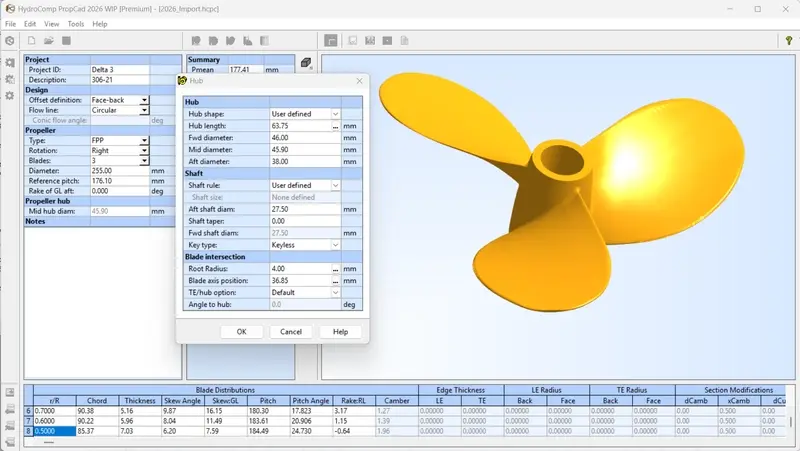
PropCad 2026 solves this structural bottleneck by introducing Interactive Pitch-Plane Control. This tool embeds dynamic graphical handles directly into the 3D graphics window.

- Visual Nose and Tail Handles: Designers can now visually identify and grab the leading edge (nose) and trailing edge (tail) of a blade section directly on the screen.
- Draggable Chordwise Pitch-Plane Line: Users can drag the pitch-plane line in real time, adjusting its orientation relative to the 3D geometry.
- Dynamic UI Highlighting: As the user manipulates these visual handles, PropCad 2026 temporarily highlights the active parameter row in the data table. This immediate feedback loop allows designers to see exactly how their physical manipulation of the model translates into mathematical design parameters.
2. Session Persistence in CAD Import Workflows
In industrial marine engineering, a propeller design is rarely finalized in a single sitting. Reverse-engineering a propeller from a physical scan or a poorly exported multi-surface CAD file is a complex task that can take hours or even days.
Prior to the 2026 release, if an engineer needed to pause their import workflow, compare different extraction methodologies, or consult with a manufacturing team, they often had to restart the CAD import configuration from scratch upon reopening the file.
PropCad 2026 introduces dedicated Save Session and Load Session commands within the CAD Import utility. This feature preserves the entire state of the import workspace, including:
- Selected surface patches and alignment matrices.
- The position and orientation of custom pitch planes.
- User-defined chordwise point distributions and custom files.
This addition prevents lost productivity, enabling engineering teams to collaborate asynchronously, review historical import choices, and safely conduct sensitivity analyses on different extraction techniques.
3. Enhancements to 3D Interaction and Viewer Stability
Modern propeller geometries, such as those used in silent naval vessels or high-speed yachts, feature extreme skew, rake, and intricate tip details. Navigating these geometries in virtual space requires fluid, highly responsive rendering.
PropCad 2026 addresses this with several key graphics engine updates:
- Double-Click Centering: Users can now double-click on any specific point of the propeller model in the main 3D viewer to instantly re-center the camera on that region, significantly accelerating the visual inspection of blade tips and hub transitions.
- Viewer Alignment and Frame Buffering: The release resolves minor alignment bugs within the display frame, ensuring that rendering scales correctly across high-resolution displays.
- Delayed 3D Refreshes: By introducing a slight delay in 3D rendering during intensive form loading, the software eliminates screen flickering and visual lag when transitioning between dialog boxes and the main workspace, resulting in a more stable and professional user experience.
4. Modernization of Core Parameter Entry and Compatibility
Beneath the visual improvements lies a structural modernization of PropCad’s codebase. HydroComp has continued migrating its legacy user interface controls to a modernized data table control framework. In PropCad 2026, this migration targets critical areas including the Hub dialog and the CAD Import utility.
Legacy Architecture                      PropCad 2026 Architecture
+---------------------------+            +---------------------------------+
|  Static UI Dialogs        |            |  Modern Data Table Control      |
|  (Separate numeric entry) |    ───>    |  (Direct, bidirectional sync)   |
+---------------------------+            +---------------------------------+
|  No visual feedback loop  |            |  Highlighted active parameter   |
+---------------------------+            +---------------------------------+
Furthermore, HydroComp has optimized startup behaviors for non-virtualized 32-bit environments. While the engineering world has largely transitioned to 64-bit systems, many manufacturing facilities, CNC shops, and legacy coordinate measuring machines (CMM) still operate on 32-bit operating systems. By maintaining robust, native compatibility with these environments, HydroComp ensures that PropCad remains accessible on the shop floor where the physical propellers are cast, machined, and inspected.
Supporting Context, Industry Challenges, and Technical Metrics
To appreciate why the enhancements in PropCad 2026 are critical, one must examine the broader challenges facing the marine industry today.
The Decarbonization Mandate and Retrofitting
The International Maritime Organization (IMO) has set ambitious targets to reduce greenhouse gas emissions from international shipping by at least 20% by 2030, and to reach net-zero by or around 2050. Under frameworks like the Energy Efficiency Existing Ship Index (EEXI) and the Carbon Intensity Indicator (CII), ship operators are under intense pressure to improve fleet efficiency.
Because a vessel’s propeller is the final link in the propulsion energy chain, retrofitting older vessels with optimized propellers is one of the most cost-effective ways to meet these new standards. However, many older vessels do not have accurate digital CAD files of their existing propellers.
+-----------------------------------------------------------------------------+
|                      THE RETROFITTING WORKFLOW PIPELINE                     |
+-----------------------------------------------------------------------------+
                                       |
                   [Physical Propeller on Existing Vessel]
                                       |
                                       v
                     [3D Laser Scanning / Point Cloud]
                                       |
                                       v
               [PropCad 2026: CAD Import & Parametric Extraction]
             * Interactive Pitch-Plane Control eliminates errors
             * Save/Load Session preserves custom distribution data
                                       |
                                       v
               [Hydrodynamic Analysis (CFD / Propeller Design)]
                                       |
                                       v
              [CNC Manufacturing / Installation of New Propeller]
Without an accurate baseline model, designing an optimized replacement is nearly impossible. PropCad 2026’s enhanced CAD Import tools directly address this market need, allowing engineers to quickly and accurately reverse-engineer physical propellers into highly precise digital twins.
The Cost of Geometric Inaccuracy
In propeller manufacturing, even microscopic deviations from the design geometry can have severe consequences:
| Parameter Deviation | Potential Consequence | Operational Impact |
|---|---|---|
| 0.5% Pitch Deviation | Localized pressure drops, leading to early-onset cavitation. | Accelerated blade erosion, increased underwater radiated noise (URN). |
| Improper Chordwise Alignment | Altered lift distribution across the blade section. | Decreased fuel efficiency, increased shaft vibration. |
| Hub-to-Blade Transition Errors | Increased drag and hub vortex generation. | Structural stress on the tail shaft, higher fuel consumption. |
By providing interactive, visually verified pitch-plane adjustments, PropCad 2026 reduces the likelihood of these geometric discrepancies passing from the design phase to the manufacturing floor.
Official Statements and Industry Perspectives
Industry analysts and hydrodynamicists have noted that the release of PropCad 2026 represents a shift in how marine software developers approach usability.
In technical documentation accompanying the release, HydroComp emphasized that user feedback was the primary driver for this version’s features:
"The focus of PropCad 2026 is to refine the day-to-day interactions of our users. Propeller design is an art as much as a science, and by giving designers direct, visual control over the mathematical parameters of their models, we are removing the friction that often exists between raw CAD geometry and actionable engineering data."
Marine manufacturing specialists have also welcomed the update. A lead engineer at a prominent European propeller foundry commented on the practical impact of the session-saving capabilities:
"In our repair and retrofitting business, we frequently scan damaged propellers to determine how much they have deformed from their original design. The ability to save and load CAD import sessions in PropCad 2026 means our technicians can pause their analysis, consult with our casting experts, and resume their work without losing any alignment data. It turns a highly stressful, continuous task into a manageable, collaborative process."
Future Outlook: The Digital Thread and Next-Generation Propulsion
Looking ahead, the role of specialized propeller CAD tools will only continue to grow. As the maritime industry explores alternative propulsion systems—such as wind-assisted ship propulsion (WASP), contra-rotating propellers, and integrated electric rim-driven thrusters—the geometric complexity of torque-producing surfaces will increase exponentially.
Furthermore, the rise of additive manufacturing (3D printing) in marine foundries is poised to revolutionize how propellers are made. Instead of casting large bronze structures using traditional sand molds, manufacturers are increasingly using robotic wire-arc additive manufacturing (WAAM) to print blades directly. This process requires incredibly tight integration between the design software, the slicing engine, and the robotic control systems.
+--------------------------------------------------------------------------+
|                       THE FUTURE PROPULSION ECOSYSTEM                    |
+--------------------------------------------------------------------------+
                                     |
      +------------------------------+------------------------------+
      |                              |                              |
      v                              v                              v
[Alternative Fuels & Hybrid]   [Additive Manufacturing]     [Autonomous Shipping]
 - Custom blade loadings        - Direct-to-print CAD export - Ultra-quiet propellers
 - Variable pitch optimization  - Multi-material geometries  - Digital twin monitoring
By modernizing its core data structure and enhancing visual manipulation tools, PropCad 2026 lays the groundwork for these future technologies. The software ensures that whether a propeller is designed for a traditional diesel container ship, a hydrogen-powered ferry, or an autonomous naval patrol vessel, the geometry can be developed, inspected, and documented with absolute precision.
With PropCad 2026, HydroComp has delivered more than just an incremental software update. They have provided the marine engineering community with a robust, intuitive, and highly stable platform that bridges the gap between historical physical assets and the digital-twin-driven future of shipping. As shipyards worldwide work to meet their 2030 decarbonization targets, the efficiency gains realized through the precise geometric control offered by PropCad 2026 will undoubtedly play a critical role in moving the global maritime fleet toward a cleaner, more sustainable horizon.