









Executive Overview
Just a thirty-minute drive from the bustling metropolis of Boston lies a living landscape that served as the crucible of American independence. Minute Man National Historical Park, spanning the historic corridor through Lexington, Lincoln, and Concord, Massachusetts, protects the hallowed grounds where the American War for Independence was ignited on April 19, 1775. Once the stage for frantic mobilization, strategic ambushes, and the literal "shot heard ’round the world," this nearly 1,000-acre park today presents a striking dual identity.
It is simultaneously a meticulously preserved open-air museum detailing the birth of a nation and a tranquil New England nature sanctuary. Visitors traversing its network of pastoral trails encounter quiet wetlands, dense deciduous forests, vernal pools, and restored 18th-century farmsteads. Managed by the National Park Service (NPS) and drawing hundreds of thousands of visitors annually, the park offers a rare synthesis of environmental conservation and historic preservation.
Far from a sterile collection of monuments, Minute Man National Historical Park operates as an accessible ecosystem where history, ecology, and recreation intersect. Whether one seeks to walk the original dirt pathways trodden by British regulars and colonial militia or simply watch the wood ducks drift across a quiet pond beneath a canopy of fiery autumn maples, the park serves as an enduring portal to the foundational moments of the United States.
Detailed Chronology: The Spark of 1775
To fully appreciate the verdant meadows and restored stone walls of Minute Man National Historical Park, one must trace the timeline back to the geopolitical tensions of the mid-18th century. The landscape preserves the precise geographical sequence of events that transformed political dissent into open armed conflict.
The Buildup to Conflict (Late 1774 – April 18, 1775)
Throughout the winter of 1774 and the spring of 1775, colonial Massachusetts was a tinderbox. The British Crown, seeking to assert control over a defiant Province of Massachusetts Bay, stationed thousands of regular troops (redcoats) in Boston. In response, local patriots established provincial congresses, amassed gunpowder, and organized volunteer militia units. Among these were the "Minute Men"—young, agile men specially chosen from the local militias to be ready for military action at a moment’s notice.
General Thomas Gage, the British military governor of Massachusetts, received secret intelligence that the colonists had stockpiled a massive cache of weapons, cannon, and ammunition in the inland town of Concord. On the night of April 18, 1775, Gage ordered an elite force of approximately 700 British regulars to march covertly under the cover of darkness to seize and destroy the military supplies.
However, the colonial intelligence network was formidable. Paul Revere, William Dawes, and other riders galloped through the Middlesex towns, alerting the countryside that the "Regulars are coming out!"

Lexington Green and the First Shots (Dawn, April 19, 1775)
The British vanguard, commanded by Major John Pitcairn, reached Lexington just before dawn on April 19. A small, outnumbered band of roughly 70 colonial minute men, led by Captain John Parker, had assembled on the Lexington Green. Parker famously instructed his men: "Stand your ground; don’t fire unless fired upon, but if they mean to have a war, let it begin here."
As the British troops advanced, an unknown shot rang out—the legendary "shot heard ’round the world." A volley of British musketry followed, leaving eight Americans dead and ten wounded. The British re-formed and continued their march toward their primary objective: Concord.
The Confrontation at North Bridge (Morning, April 19, 1775)
By the time the British column arrived in Concord around 7:00 a.m., colonial militia from Concord and surrounding towns had converged on the town. While British light infantry searched local homes and buildings for hidden stores, hundreds of armed militiamen gathered on a ridge overlooking the Concord River at the North Bridge.
Commanded by Major John Buttrick, the colonial forces—emboldened by the sight of smoke rising from the town center where British troops had burned some supplies—decided to advance. When British troops guarding the bridge fired, killing several provincials, Major Buttrick gave the order to return fire: "Fire, fellow soldiers, for God’s sake, fire!"
The resulting volley by the militia broke the British lines. Shocked by the ferocity and organization of the colonial resistance, the British detachment suffered significant casualties and began a panicked retreat toward Lexington.
The Bloody Retreat along the Battle Road (Afternoon, April 19, 1775)
What began as an orderly military expedition turned into a desperate, running gauntlet for the British forces. As the redcoats retreated along the narrow, winding road connecting Concord, Lincoln, and Lexington (today preserved as the Battle Road Trail), thousands of colonial militiamen poured in from all over New England.
Operating under decentralized guerrilla tactics, the colonial volunteers took advantage of every stone wall, thicket, and farmhouse along the route. Famous skirmish sites that now sit within the boundaries of the national historical park witnessed fierce fighting:
- Meriam’s Corner: Where the British rear guard was ambushed by accumulating colonial forces.
- Elm Brook Hill and Fiske Hill: Sites of heavy casualties as the exhausted British columns were continuously sniped from the dense woods.
- The "Bloody" Bluff: Where colonial flanking maneuvers inflicted heavy losses on the retreating redcoats.
Only the timely arrival of a relief column of 1,000 fresh British troops, led by Lord Percy with artillery, prevented the total annihilation or surrender of Gage’s forces near Lexington. The British finally limped back to the safety of Charlestown under naval gun protection by nightfall. The American Revolution had officially begun, with casualties totaling nearly 300 British soldiers and close to 100 Americans.
Supporting Context & Metrics
The transformation of this blood-soaked corridor into a national historical park was not instantaneous. It required decades of grassroots preservation, legislative action, and ecological stewardship.
Park Geography and Infrastructure
Established by an act of Congress on September 21, 1959, Minute Man National Historical Park currently encompasses approximately 970 acres across three distinct Middlesex County towns:
- Lexington: The eastern gateway, preserving Fiske Hill and the Parker’s Revenge archaeological site.
- Lincoln: The central agricultural and wooded corridor, featuring the historic Hartwell Tavern and miles of the original Battle Road.
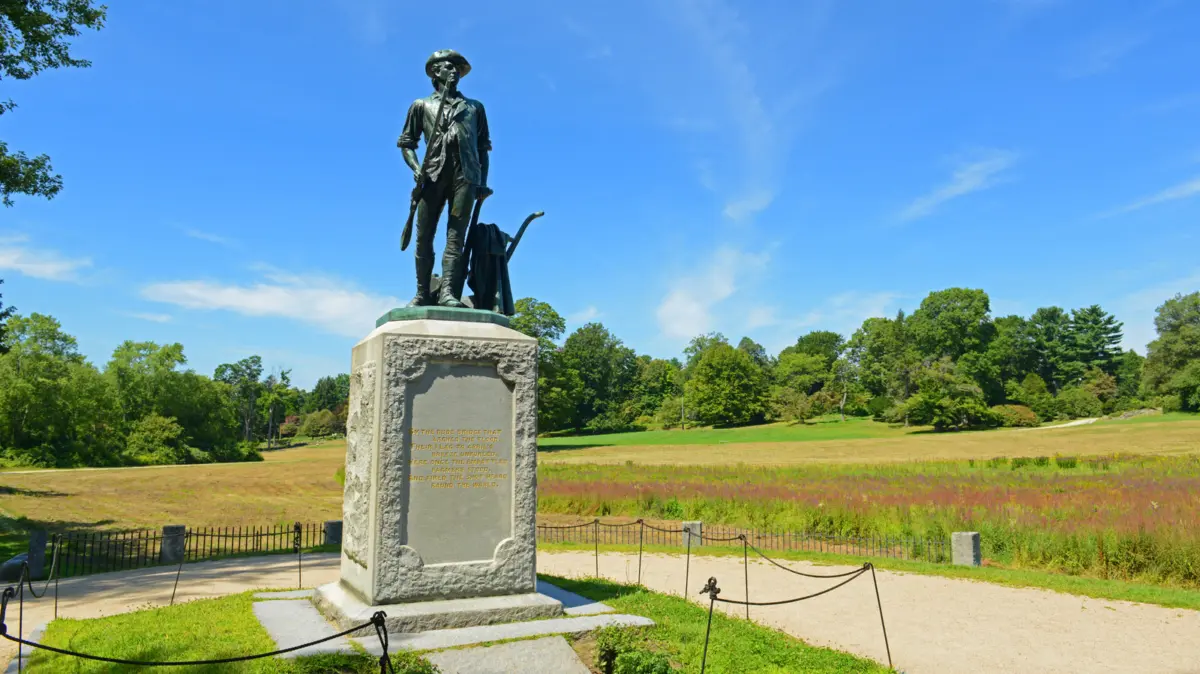
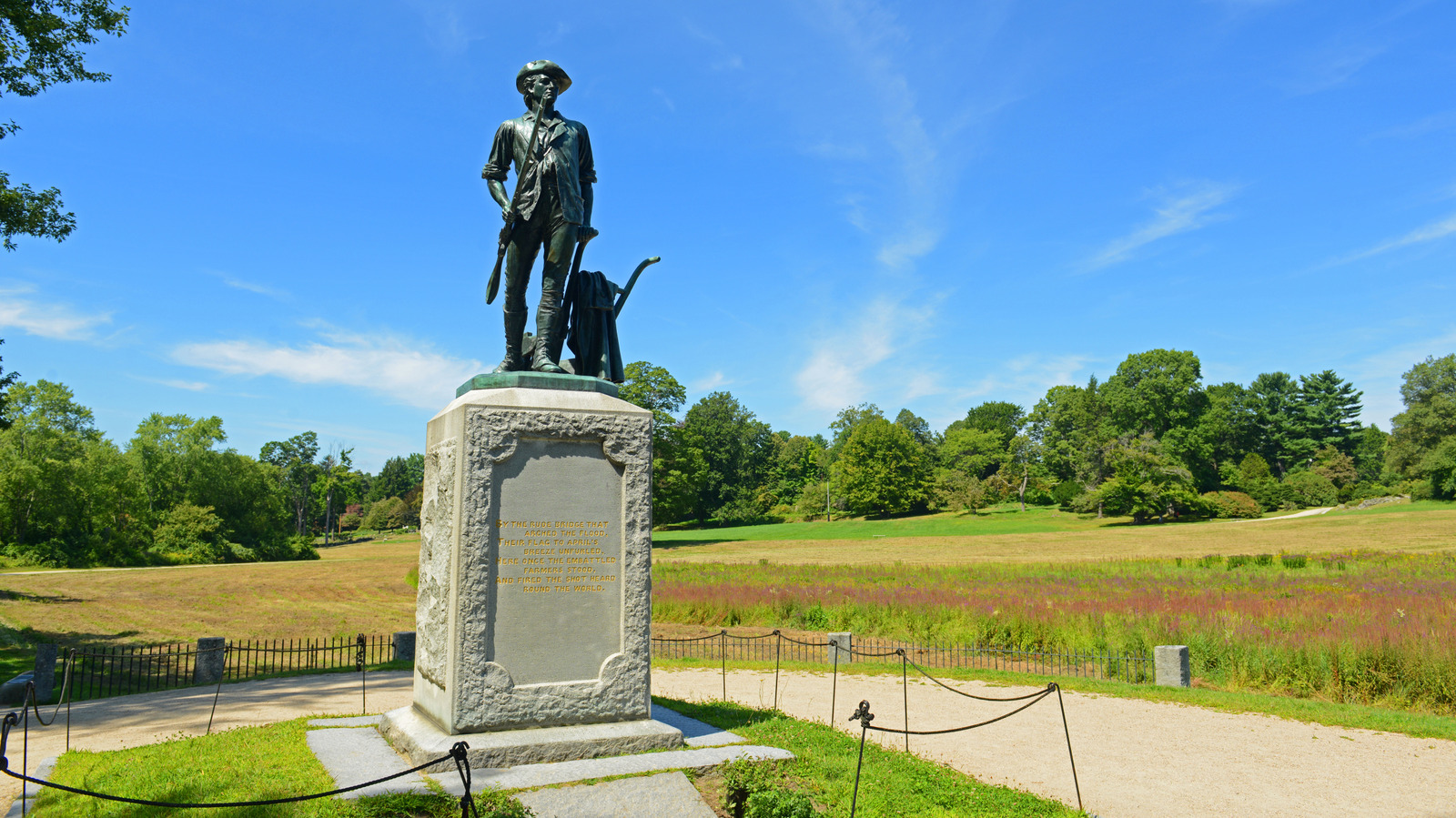
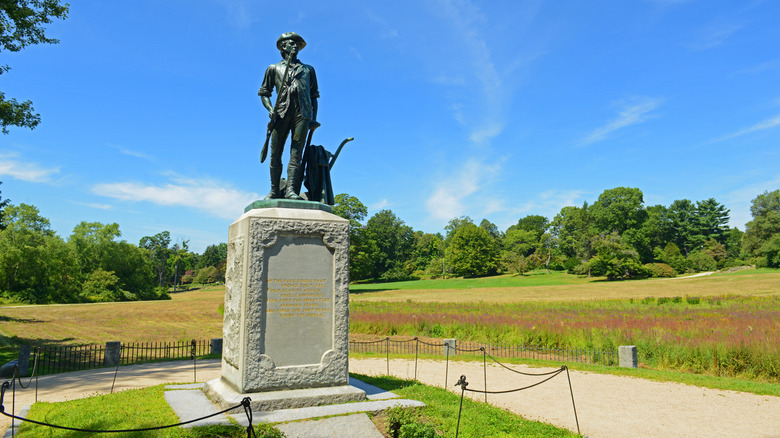
- Concord: The western anchor, containing the North Bridge, the Minuteman Statue by Daniel Chester French, and the Minute Man Visitor Center.
Ecological and Natural Metrics
While primarily commemorated for its political history, the park functions as a vital ecological oasis within a heavily developed suburban corridor:
- Forest Canopy: Approximately 50% of the park is forested, comprising classic New England hardwood species including sugar maple, red oak, white ash, and American beech.
- Trail Networks: The park features the 5.1-mile multi-use Battle Road Trail, alongside numerous connecting footpaths through restored agricultural fields and wetlands.
- Biodiversity: Home to dozens of species of migratory birds, white-tailed deer, red foxes, coyotes, and complex vernal pool ecosystems that support sensitive amphibian populations like the wood frog and spotted salamander.
Visitor Demographics and Economic Impact
According to recent National Park Service visitation data, Minute Man National Historical Park welcomes between 700,000 and 1,000,000 visitors annually. The park acts as a major economic engine for the Greater Boston tourism sector, attracting history enthusiasts, international travelers, and outdoor recreationists seeking educational day trips within an hour of downtown Boston.
Official Statements and Institutional Perspectives
The National Park Service, alongside local preservation groups such as the Friends of Minute Man National Historical Park, continually balances the dual mandates of historic preservation and natural resource management.
In an official park service management brief regarding the landscape, park superintendent Simón Lambert emphasized the unique educational mission of the site:
"Minute Man National Historical Park is often viewed through the narrow lens of a single calendar day in 1775. However, our responsibility is far broader. We preserve an entire cultural landscape—the 18th-century homes, the stone walls, the wetlands, and the working agricultural fields—that tells the story not just of the soldiers who fought here, but of the generations of farmers and families who shaped this New England environment before and after the Revolution."
Furthermore, preservation advocates have underscored the importance of protecting the park’s fragile rural viewshed from encroaching suburban sprawl. The Friends of Minute Man National Historical Park released a statement regarding ongoing archaeological and trail preservation initiatives:
"The Battle Road is not merely a hiking path; it is an open-air archive. Every archaeological excavation along Fiske Hill or the Hartwell property yields artifacts that deepen our understanding of the tactical realities faced by both the colonial militia and the British army. Maintaining the natural buffer zones around these historic sites is essential to ensuring that modern visitors can step back in time without the intrusion of modern urbanization."
Future Outlook: Preservation, Education, and Climate Resilience
As Minute Man National Historical Park looks toward the upcoming United States Semiquincentennial (250th anniversary) in 2026, the park is undergoing significant strategic planning to manage increased visitation, enhance educational accessibility, and combat environmental challenges.
250th Anniversary Preparations
The years leading up to 2025 and 2026 mark the primary commemoration window for the American Revolution. The park is collaborating with state and local entities to expand its renowned Patriots’ Day historical reenactments, which typically draw tens of thousands of spectators to the North Bridge and Battle Road. Upgrades to visitor orientation centers, digital mobile applications, and self-guided audio tours are being deployed to handle the anticipated surge in heritage tourism.
Environmental Stewardship and Climate Adaptation
Managing a nearly 1,000-acre park in the 21st century presents unique ecological hurdles. Climate change models for New England project increased frequency of intense precipitation events, which threaten the park’s historic structures, stone drainage culverts, and vernal pools.
Park resource managers have implemented targeted habitat restoration projects:
- Invasive Species Removal: Aggressive removal programs targeting non-native plants like bittersweet and buckthorn to protect native maple, oak, and wildflower populations.
- Agricultural Leasing: Continuing traditional farming leases on park-owned fields to maintain the authentic 18th-century agrarian viewshed while naturally managing meadow succession.
- Trail Hardening: Upgrading sections of the Battle Road Trail to prevent erosion and protect sensitive wetland crossings while maintaining ADA accessibility.
Conclusion
Minute Man National Historical Park stands as a testament to the complex interplay between human history and environmental preservation. What began as a desperate battlefield on a spring morning in 1775 has evolved into a sanctuary for reflection, education, and recreation. By meticulously maintaining its historic structures, protecting its diverse New England ecosystems, and engaging the public through immersive programming, the park ensures that the legacy of the Minute Men—and the ideals they fought to establish—remains vibrant for generations to come.