











Executive Overview
California is globally synonymous with elevated leisure. As the third-largest state in the U.S. and the proud birthplace of the modern theme park resort, its geographic diversity allows travelers to ski powdery alpine slopes and swim in the Pacific Ocean on the very same calendar day. From the sun-baked geothermal pools of the southern deserts to the crystalline expanse of Lake Tahoe and the sun-drenched shores of the American Riviera, the state’s hospitality sector trades heavily on a promise of restorative escape.
However, a rigorous audit of guest satisfaction metrics paints a more complicated picture. While boutique inns and luxury flagships routinely deliver on the state’s glamorous reputation, a distinct tier of officially designated "resorts" falls remarkably short of expectations. Characterized by high price points, inflated resort fees, and wide-ranging amenities, resorts carry an inherent psychological weight: guests anticipate superior service, immaculate maintenance, and a seamless environment.

When these properties falter, the resulting friction is magnified. Recent empirical data sourced from major travel platforms—including Google Maps, TripAdvisor, and Booking.com—reveals that a select group of California’s destination resorts currently lag behind industry standards, posting aggregate ratings below four stars on review platforms or falling under an 8.0 threshold on Booking.com. This investigative report examines five prominent resorts in the Golden State that are currently testing guest patience, exploring the operational breakdowns behind their declining scores and providing a methodological framework for how modern travelers can navigate these hospitality pitfalls.
Detailed Chronology: The Decline of Five California Resorts
The trajectory of a failing resort is rarely instantaneous. It is typically defined by a slow erosion of maintenance standards, staffing shortages, aggressive monetization strategies, and deferred capital improvements. Below is a detailed look at the five properties currently failing to meet traveler benchmarks across California.
1. Miracle Springs Resort & Spa (Desert Hot Springs)
Rooted in a region that became the "spa capital of the world" during the mid-20th century due to a unique convergence of hot and cold mineral aquifers, Desert Hot Springs has long served as a tranquil, low-key alternative to Palm Springs. Reopening under its current banner in 1997, the Miracle Springs Resort & Spa built its early legacy on its eight natural mineral pools and a full-service spa.

- The Current Breakdown: Despite holding a functional reputation for its aquatic amenities and the popular on-site Italian restaurant Capri, the property struggles deeply with guest accommodation standards. Current metrics show the property hovering at 3.6 stars on TripAdvisor, 7.6 on Booking.com, and 4.0 on Google Maps.
- Operational Failures: User grievances center disproportionately on room hardware. Categories such as bathroom sanitation, sleep quality, air conditioning reliability, and television/Wi-Fi functionality register exceptionally high unfavorable sentiment on Google Maps. Multiple reviews detail stained, malodorous carpets and outdated, run-down guest blocks. In more severe instances, cleanliness reports have cited pest issues, transforming what should be a healing desert oasis into an exercise in compromise.
2. The Hilton Vacation Club Lake Tahoe Resort South (Lake Tahoe)
Situated steps from the southern shore of North America’s largest alpine lake, this property boasts an enviable location near premier dining, nightlife, and the slopes of Heavenly Mountain.
- The Current Breakdown: The resort displays a fragmented digital footprint: while maintaining a 4.1-star average on Google Maps, its scores slip to 3.7 on TripAdvisor and 7.8 on Booking.com.
- Operational Failures: Beyond the architectural design flaw of the H-shaped building—which leaves the majority of rooms devoid of lake views—the primary friction point involves timeshare saturation. Guests frequently report aggressive sales pitches and persistent tour solicitations from on-site representatives, disrupting the traditional hotel experience. Furthermore, parking logistics draw heavy criticism; roughly 68% of negative Google Maps reviews cite mandatory, high-cost valet fees coupled with over-packed lots, creating an atmosphere of corporate extraction rather than vacation hospitality.
3. Town and Country Resort (San Diego)
Established in 1953 as Hotel Circle’s inaugural property and later housing San Diego’s first convention center, the Town and Country Resort underwent a significant multi-million dollar renovation in 2021 to preserve its mid-century modern charm. It remains a beloved regional fixture, even earning local accolades as a top family-friendly hotel.
- The Current Breakdown: Despite shining in its common areas—such as its expansive multi-pool complex featuring a four-story waterslide and the celebrated ARLO restaurant—the guest rooms tell a different story. The property maintains a 3.9 on Google Maps and a 7.9 on Booking.com.
- Operational Failures: Negative feedback concentrates heavily on the standard guest quarters. Reviewers routinely compare the room conditions to institutional environments, citing musty or smoke-tainted air, cramped layouts, and sluggish housekeeping response times. While the public-facing amenities buzz with energetic activity (necessitating adult-only pool retreats and earplugs), the disconnect between the vibrant, retro-chic lobby and the sub-par sleeping quarters leaves many guests feeling shortchanged.
4. Holiday Inn Resort The Lodge at Big Bear Lake (Big Bear)
Big Bear Lake serves as Southern California’s premier year-round alpine escape, offering winter skiing and summer boating just two hours from Los Angeles. Introduced in 2016 as Holiday Inn’s debut resort venture in the state, The Lodge occupies a prime geographic footprint near the lake’s south shore.
- The Current Breakdown: Among the properties evaluated, this resort registers the lowest primary lodging score on our list, sitting at a troubling 5.9 on Booking.com, alongside 3.6 on TripAdvisor and 4.0 on Google Maps.
- Operational Failures: Maintenance issues dominate guest feedback, with room quality scoring a dismal 3.3 on TripAdvisor. A recurring, critical complaint involves non-functioning air conditioning units—a make-or-break amenity during warm summer months—often unaccompanied by advance warning from management. Coupled with intermittent closures of primary amenities like the swimming pool, the property relies almost entirely on its geographic positioning to retain bookings.
5. Hilton Santa Barbara Beachfront Resort (Santa Barbara)
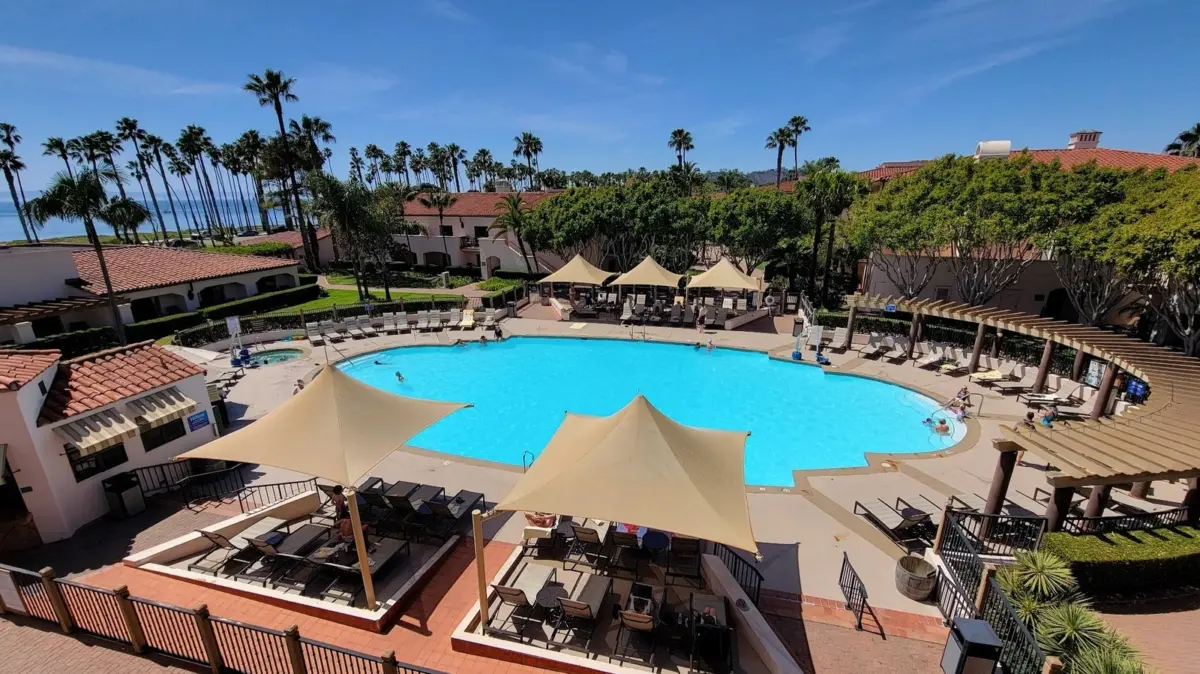
Positioned along "the American Riviera" between the Pacific Ocean and the Santa Ynez Mountains, Santa Barbara commands high expectations. Following a 2018 renovation of a 1980s-era DoubleTree property, the Hilton Santa Barbara Beachfront Resort promised an elite coastal experience backed by a premier global brand.
- The Current Breakdown: While its prime location directly across from East Beach and proximity to the trendy waterfront "Funk Zone" keeps its Google Maps score at a respectable 4.1, its true operational reality is reflected in a 3.7 on TripAdvisor and a 6.7 on Booking.com.
- Operational Failures: The core grievance among travelers is a severe value mismatch. Guests consistently report understaffed operations—manifesting as hour-long check-in lines—alongside broken elevators and unhygienic, poorly maintained bathrooms. Approximately 59% of negative Google Maps reviews cite sleep disruptions tied to ambient noise and substandard room conditions, proving that brand pedigree alone cannot insulate a property from systemic neglect.
Supporting Context & Metrics
To understand why these properties generate such polarized reviews, one must examine the baseline mechanics of the modern resort industry.
- The Definition Gap: Legally and operationally, a "resort" differs fundamentally from a "hotel." Resorts are explicitly designed to be self-contained ecosystems, offering comprehensive amenities—spas, multiple dining outlets, recreational programming, and expansive grounds—intended to keep the guest on-site. Consequently, consumers invest a higher capital outlay, inherently elevating their expectations for service recovery and physical upkeep.
- The Metrics Methodology: This investigation utilized a strict cross-platform evaluation model. Properties were analyzed exclusively if they held official resort designations and maintained sub-par digital benchmarks: less than 4.0 stars on Google Maps and TripAdvisor, or under 8.0 on Booking.com, with lower marks required across at least two of the three platforms. Furthermore, data curation prioritized reviews published within the preceding nine months to ensure the findings reflect contemporary operational realities rather than historical grievances that may have been successfully remedied.
Official Statements & Industry Response
Hospitality brands facing public scrutiny on digital review aggregators frequently deploy standardized reputation management strategies. Representatives for major corporate flags, including Hilton and IHG, often emphasize ongoing capital expenditure projects, localized staffing challenges, and enhanced guest service recovery protocols.
In statements regarding properties like the Hilton Santa Barbara Beachfront Resort and the Hilton Vacation Club Lake Tahoe Resort South, corporate representatives have reiterated commitments to brand standards, pointing to active multi-phase property enhancements aimed at updating guest room soft goods and streamlining front-desk operations. Similarly, independent and franchise operators in regions like Desert Hot Springs and Big Bear continue to lean heavily on natural locational advantages—such as geothermal mineral water access and proximity to alpine recreation—while quietly working to address chronic facilities management backlogs.
Industry analysts note, however, that corporate reassurances often clash with the realities of post-pandemic labor shortages and inflationary maintenance costs. When properties defer routine capital improvements to protect short-term yields, the physical plant degrades faster than digital marketing campaigns can manage public perception.
Future Outlook
As the California travel market continues to evolve through 2026 and beyond, consumer tolerance for inflated resort fees paired with subpar physical conditions is rapidly diminishing. Travelers are becoming increasingly discerning, utilizing multi-platform verification tools before locking in non-refundable reservations.
For the resorts highlighted in this report, the path forward requires a decisive shift from reactive damage control to proactive capital investment. Properties that fail to decouple high resort pricing from low-tier room sanitation, dysfunctional climate control systems, and aggressive timeshare tactics risk permanent brand erosion. Conversely, those willing to invest in deep infrastructural overhauls—such as modernized HVAC systems, rigorous housekeeping audits, and service-oriented staffing models—can successfully recapture their market standing.
Until such comprehensive overhauls are realized across the board, savvy travelers are advised to look beyond the alluring promotional photography of California’s resort landscapes, verify recent peer-to-peer review metrics, and carefully weigh whether a property’s geographic location justifies compromising on basic comfort.