







Executive Overview
When Ed Darmanin rolled out of Sydney on June 24, his blueprint was straightforward yet audacious: 18,000 grueling kilometers, an anti-clockwise trajectory tracing the perimeter of the Australian continent, a single electric motorcycle, and strictly zero support vehicles. What followed over the subsequent eight weeks has been a masterclass in modern electric vehicle (EV) touring—a dynamic collision of high-voltage ambition, outback logistics, mechanical failure, unexpected historical symmetry, and viral digital culture.
Far from a sanitized PR roadshow, Darmanin’s journey on his Energica Experia has been punctuated by the unyielding realities of the Australian landscape: cracked subframes on corrugated tracks, charging stations overheating under 35-degree tropical suns, stubborn livestock blocking remote highways, and transient communication dropouts in the red dust of the Kimberley. Yet, halfway through his epic lap—having recently blown past Broome with his wife Sally joining for the next leg—Darmanin’s odometer has logged over 9,000 kilometers of real-world data.
His journey has evolved far beyond a personal endurance test. It has become a rolling case study on the viability, friction points, and future evolution of long-distance electric mobility across some of the most unforgiving terrain on Earth.

Detailed Chronology: From Sydney to Broome
Section 1: The East Coast & The First Major Hurdle
The journey began with deceptive ease. Traversing the east coast from Sydney northward toward Cairns, Darmanin found the foundational charging infrastructure to be remarkably mature. Fast-charging corridors deployed at predictable intervals meant that standard DC fast chargers required minimal improvisation.
However, mechanical gremlins care little for electrical novelty. Just 1,300 kilometers into the expedition, near Biloela in Central Queensland, a routine pre-departure check revealed a loose rear subframe suffering from a fatigue break in the top rail—a potentially trip-ending failure likely exacerbated by accumulated stress from previous overloaded touring adventures.
Refusing to let structural failure halt the mission, Darmanin engineered an on-the-fly fix using local hardware stores and a bent steel brace to limp into Yeppoon for a scheduled public speaking engagement. The following morning, the local Coast Guard station transformed into a makeshift workshop. Assisted by locals Arthur Hunt and Phil Nash, Darmanin stripped the rear end of the motorcycle, shuttled the subframe to a regional welder, and reinforced it with solid steel bars along both rails. By nightfall, the bike’s structural integrity exceeded its factory specifications—a repair that has since survived thousands of kilometers of rough roads and pillion loads.

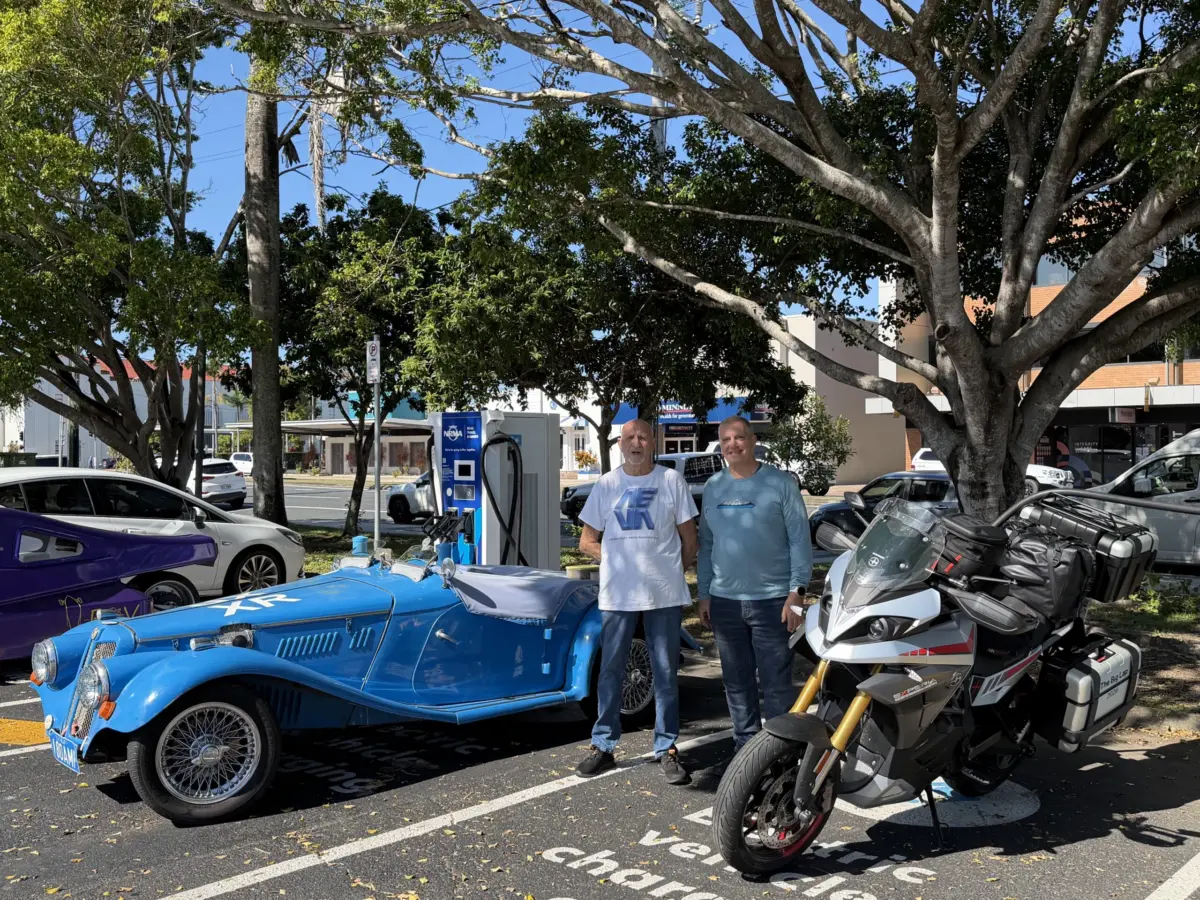
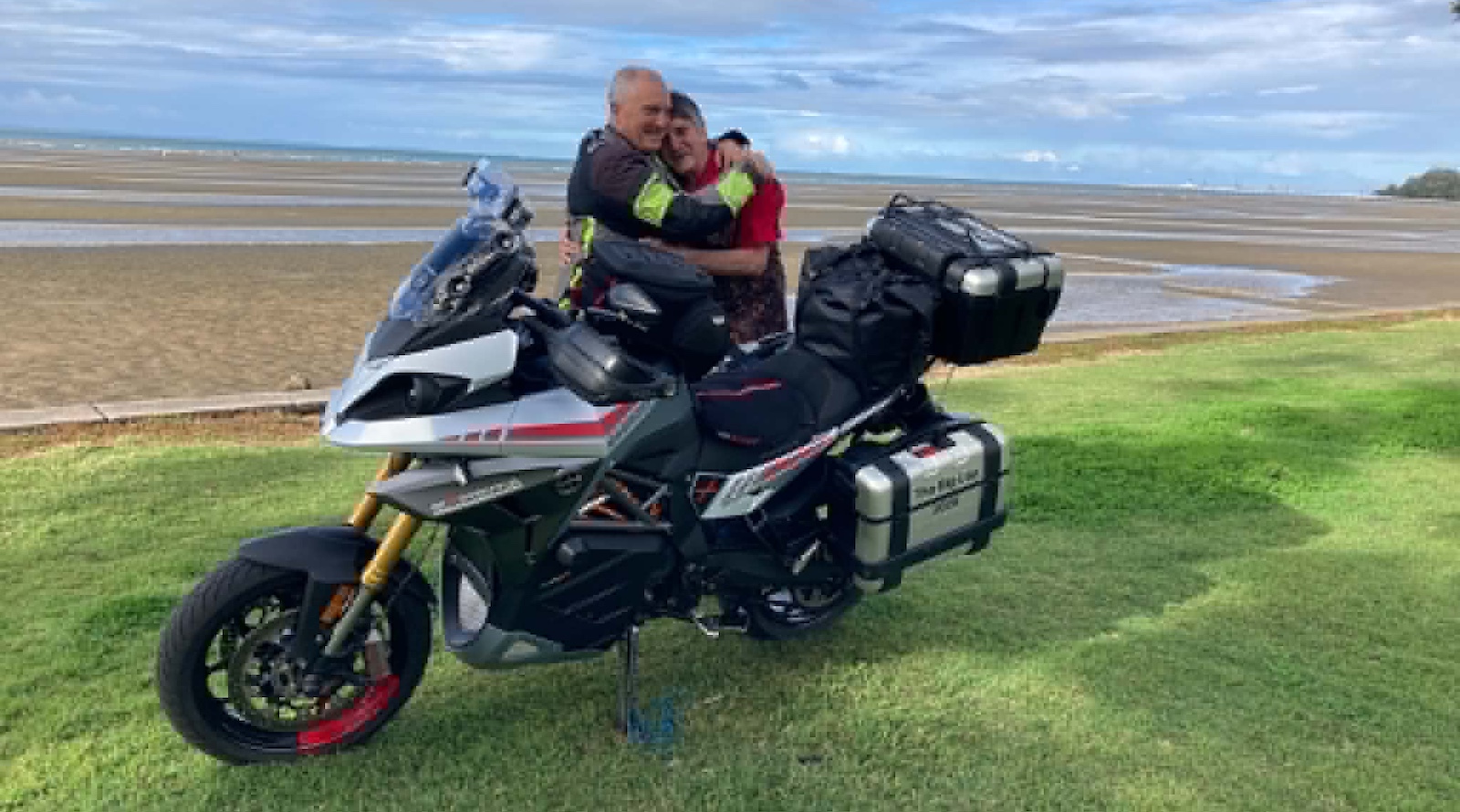
Shortly after the Yeppoon repair, during a charging stop in Mackay, Hunt orchestrated a poetic rendezvous that bridged generations of Australian EV history. Waiting at the charger was Glenn George, the visionary who, back in 2011 at the age of 67, became the first person to drive an electric vehicle around Australia in a self-converted 1950s MG. Darmanin, who will also be 67 upon completing his lap, shared a packed lunch and a conversation with George and fellow EV enthusiast Trevor Richards. Two electric pioneers, separated by fifteen years of technological evolution yet bound by the same pioneering instinct, met quietly over a charging cable in tropical Queensland.

Section 2 & 3: The Gulf Country & AC Isolation
Pushing inland from Cairns toward Mount Isa via Normanton, Darmanin entered Section 3—a punishing 1,200-kilometer stretch through the Queensland Gulf Country entirely devoid of DC fast-charging infrastructure.
Here, the expedition transitioned away from heavy-duty high-voltage networks to grassroots AC power. Every electron was harvested via caravan park power points, hotel sockets, and auxiliary hookups. At Georgetown, Darmanin and his son Evan—who joined him for a portion of the journey—plugged into a 15-amp caravan park supply and played nine holes of golf while the bike’s battery slowly replenished itself on the green.

This leg also revealed a hidden variable in EV range management: mechanical modifications. A mid-section discovery revealed that changing the front drive sprocket had caused the trip computer to under-read distance metrics. Consequently, range calculations had been operating with an uncalculated 0.5 kWh/100km safety buffer—a narrow margin that could have spelled disaster in the remote isolation of the "Never Never."
Section 4: The Top End, The Kimberley, and Thermal Management
Entering the Northern Territory and Western Australia’s Kimberley region (Section 4), Darmanin faced a combination of extreme ambient temperatures and sparse infrastructure. Cruising stretches of the Stuart Highway at open speed limits (up to 130 km/h) toward Katherine rapidly depleted the battery. Combined with 35-degree ambient heat, this pushed battery operating temperatures past optimal thresholds.
Thermal throttling quickly became a factor. At Adelaide River, the motorcycle’s Battery Management System (BMS)—acting to protect cell longevity—deliberately slowed the DC fast-charging rate, turning a routine top-up into a one-hour stationary wait.

Reliability issues with third-party networks also reared their heads. At Warnum in the Northern Territory, a Chargefox charging unit cut out five consecutive times mid-session (stopping at 42%, 50%, 70%, 80%, and finally reaching 95%). While automated phone support mistakenly blamed Darmanin’s credit card, crowd-sourced data on PlugShare confirmed that other motorists were experiencing the exact same hardware fault.
In classic outback fashion, Darmanin leaned on his professional background as a licensed electrician. At Fitzroy Crossing, he custom-built an adapter on the spot to tap directly into a three-phase industrial socket parked right beside the fuel bowsers. In Timber Creek and Willare Bridge, hotel verandas and auxiliary power points stepped in where dedicated EV hardware was absent.
Supporting Context & Metrics
The Infrastructure Evolution: Off-Grid and Solar Pioneers
While gaps remain, Darmanin’s journey highlighted a radical shift in how remote charging is being conceptualized in Australia. Two particular installations stood out as blueprints for the future of outgrid mobility:

- Victoria River (Northern Territory): An entirely off-grid solar canopy featuring two DC chargers and four CCS2 plugs, operating completely independently of local roadhouse electrical grids. Featuring modular solar generation, massive on-site battery storage, and an automated backup diesel generator that runs less than one percent of the time, it represents the gold standard for remote-area EV deployment.
- Ngumban Cliff (Kimberley, Western Australia): Situated along a brutal stretch of highway with zero civilization for 100 to 200 kilometers in either direction, this ground-mounted solar array utilizes onsite battery storage and backup generation to deliver fast charging in the middle of absolute wilderness.
Digital Footprint and the Accidental Media Phenomenon
What began as a personal test of endurance evolved into a trans-continental digital event. Darmanin’s journey has captured nearly 500,000 combined views across Facebook and Instagram, alongside features by ABC Radio, CQ Today, and international motorcycle and EV publications in Hungary, the UK, and Europe.
Ironically, the most viral content was not sweeping drone footage of pristine landscapes, but rather raw, unfiltered documentation of adversity. A 30-second selfie video shot at an offline fast charger along a 290-kilometer stretch of Western Australian highway—outlining the problem and explaining his immediate workaround—racked up over 52,000 views and scores of engaging technical discussions within hours.
Furthermore, an organic online community materialized around the trip. When internet skeptics questioned the practicality of long-distance electric motorcycle touring, independent engineers, touring veterans, and EV enthusiasts frequently stepped into comment sections to defend and explain the technical realities of the trip before Darmanin even had a chance to respond. When moderation challenges arose, Darmanin turned to AI tools like Claude AI for advice on effectively managing digital friction.

Official Statements & Reflections
Reflecting on the halfway milestone from Broome, Darmanin emphasized that the objective was never to prove that electric touring is frictionless, but rather to test its operational boundaries in real-world conditions:
"The plan was simple enough: 18,000 kilometres, anti-clockwise, one electric motorcycle, no support vehicle. What I didn’t plan for was a cracked subframe near Biloela, a Chargefox unit that cut out five times in Warnum, a string of faulty 50kW fast chargers self-limiting to 8kW, a battery too hot to charge quickly in 35-degree heat south of Darwin, or a bull standing in the middle of the Stuart Highway that wasn’t moving for anyone."
Despite these hurdles, Darmanin’s core philosophy remains unchanged:

"The trip is running exactly as planned—which is to say, nothing has gone exactly to plan, and that’s been the whole point. The technology is here. The infrastructure is here—imperfect, incomplete in places, but here and growing. The argument isn’t theoretical any more. It’s 9,000 kilometres of Australian road and counting."
Future Outlook
With the grueling expanses of the Top End and the Kimberley safely in the rearview mirror, Section 5 marks a new phase of the expedition. Joined in Broome by his wife Sally, Darmanin faces the final stretch of his monumental journey.
Ahead lies the sweeping Western Australian coastline, the formidable expanse of the Nullarbor Plain, and the final 5,000 kilometers tracking back toward the east coast.

As the Energica Experia continues to accumulate data, kilometers, and public goodwill, Darmanin’s expedition is shifting the cultural narrative surrounding electric transport in Australia. It moves the conversation away from hypothetical limitations and anchors it firmly in empirical reality. It is no longer just a "Big Lap" around a continent; as Darmanin aptly notes, it is fast becoming a modern legend of endurance—a veritable Phar Lap of the electric vehicle era.