





Executive Overview
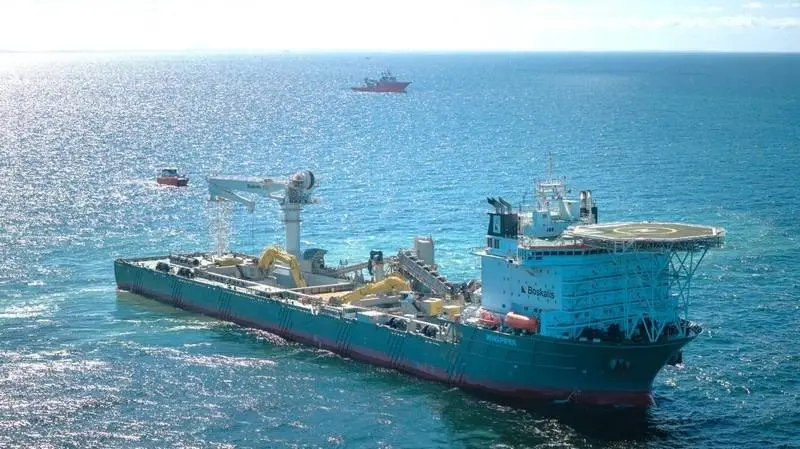
The global transition toward offshore wind energy has reached a significant operational milestone with the maiden deployment of the Windpiper, the world’s largest subsea rock installation (SRI) vessel. Owned and operated by maritime services giant Boskalis, the newly converted vessel has officially commenced its first commercial campaign in the Baltic Sea. The mission: securing and protecting the critical export cables for the Bałtyk 2 and Bałtyk 3 offshore wind farms, two of Poland’s most ambitious renewable energy infrastructure projects.
Measuring an impressive 227 meters in length and boasting a record-breaking cargo capacity of 45,500 tons, the Windpiper represents a major technological leap forward in marine engineering and subsea asset protection. The vessel’s first deployment saw it load nearly 45,000 tons of high-density rock in Norway—a volume that sets an industry record for the largest single-ship cargo transported for a subsea rock installation campaign.
Developed through a joint venture between Norwegian energy titan Equinor and Polish private power producer Polenergia, the Bałtyk 2 and Bałtyk 3 projects represent a cornerstone of Poland’s strategy to decarbonize its coal-heavy power grid. By utilizing the Windpiper’s advanced inclined fallpipe technology, the Boskalis-Van Oord consortium is ensuring that the critical transmission lines connecting these offshore powerhouses to the Polish mainland are protected against the harsh hydrodynamic conditions of the Baltic Sea, as well as anthropogenic risks such as anchor drags and commercial fishing activity.
Detailed Chronology
The deployment of the Windpiper is the culmination of a meticulously planned engineering and logistics timeline spanning nearly two years.
[Early 2023] ➔ [July 3, 2024] ➔ [Mid-July 2024] ➔ [Late July 2024] ➔ [August 2024]
Conversion     Vessel         Norway Loading   Transit to       Operations
Begins         Christening    (45,000t Rock)   Baltic Sea       Commence
1. The Conversion Phase (Early 2023 – Mid-2024)
The journey of the Windpiper began with a highly complex 18-month conversion project executed under the direct supervision of Boskalis’ in-house engineering team. To meet the growing demand for ultra-large-scale subsea rock installation in deeper waters and more challenging marine environments, Boskalis undertook the structural transformation of a large modern vessel.
Over a year and a half, the vessel was stripped down and rebuilt with reinforced structural steel, two massive specialized cargo holds, highly automated rock-handling conveyor systems, and a state-of-the-art inclined fallpipe system. The conversion also involved integrating a high-capacity moonpool and upgrading the vessel’s propulsion and positioning systems to meet stringent offshore standards.
2. Christening and Sea Trials (July 3, 2024)
On July 3, 2024, Boskalis officially christened the Windpiper in a ceremony celebrating the engineering teams, shipyard partners, and crew who realized the ambitious conversion. Following the ceremony, the vessel underwent rigorous sea trials to test its Dynamic Positioning (DP2) capabilities, automated conveyor systems, and fallpipe deployment mechanisms under real-world maritime conditions.

3. Record-Breaking Mobilization in Norway (Mid-July 2024)
With sea trials successfully completed, the Windpiper sailed to a specialized marine quarry in Norway. There, the vessel loaded nearly 45,000 tons of graded rock. This operation marked the largest single-load mobilization in the history of subsea rock installation, showcasing the vessel’s unprecedented logistical efficiency. By minimizing the number of transit cycles required between quarry ports and installation sites, the Windpiper significantly reduces the carbon footprint and overall timeline of the marine operations.
4. Transit and Commencement of Baltic Operations (Late July – August 2024)
Fully laden, the Windpiper navigated through the Danish Straits into the Baltic Sea, arriving at the Bałtyk 2 and Bałtyk 3 project sites. Upon arrival, the vessel commenced its first commercial operations, deploying its inclined fallpipe to systematically deposit rock armor over the pre-laid export cables that will carry green electricity from the offshore substations to the landfall point on the Polish coast.
Supporting Context & Technical Metrics
To appreciate the scale of the Windpiper’s deployment, it is necessary to examine both the technical specifications of this maritime giant and the broader scope of the Bałtyk 2 and Bałtyk 3 offshore wind developments.
Vessel Technical Specifications
The Windpiper has been engineered specifically to address the challenges of modern offshore wind projects, which are moving into deeper waters and utilizing larger, heavier infrastructure. Below is a detailed breakdown of the vessel’s key specifications:
| Parameter | Specification / Metric |
|---|---|
| Length Overall (LOA) | 227 meters |
| Breadth (Width) | 40 meters |
| Total Cargo Capacity | 45,500 tons (distributed across two dedicated holds) |
| Installed Power | Over 31,000 kW |
| Propulsion & Maneuverability | 7 thrusters |
| Station Keeping | Dynamic Positioning Class 2 (DP2) |
| Primary Rock Installation Systems | Inclined fallpipe & Moonpool-integrated vertical fallpipe |
The integration of seven thrusters coupled with a DP2 system allows the 227-meter-long vessel to maintain pinpoint accuracy over subsea cable trenches, even when subjected to the unpredictable currents and wind shear of the Baltic Sea. The dual-system capability—utilizing both an inclined fallpipe for shallow-to-medium depths and a moonpool-based system for deeper configurations—provides unmatched operational versatility.
The Bałtyk 2 and Bałtyk 3 Project Scale
The Bałtyk 2 and Bałtyk 3 offshore wind farms are located in the Polish exclusive economic zone of the Baltic Sea, approximately 22 to 37 kilometers from the port city of Łeba.
- Combined Capacity: 1.44 Gigawatts (GW)
- Household Equivalence: Capable of powering more than 2 million Polish homes.
- Turbine Technology: Set to utilize state-of-the-art, high-capacity wind turbines designed to maximize the Baltic’s consistent wind resources.
- The Consortium: Boskalis is executing the transport and installation of foundations and subsea cables in a joint venture partnership with Dutch maritime contractor Van Oord.
                    [ Bałtyk 2 & 3 Offshore Wind Farms ]
                                     │
                     (Inter-array cables gather power)
                                     │
                                     ▼
                        [ Offshore Substations ]
                                     │
                 (Export Cables: Protected by Windpiper)
                                     │
                                     ▼
                          [ Polish Mainland Grid ]
Subsea rock installation is a critical phase of the construction process. Without adequate protection, subsea cables are highly vulnerable to damage from shifting sands, marine currents (which cause scour), commercial fishing trawler nets, and dropped ship anchors. The Windpiper’s rock-dumping campaign ensures the long-term integrity of these high-voltage transmission lines, securing the financial and operational viability of the entire wind farm asset.
Official Statements and Industry Commentary
The deployment of the Windpiper has drawn praise from maritime experts and energy analysts, who view the vessel as a game-changer for offshore logistics.
In a statement highlighting the historic nature of the vessel’s maiden voyage, Boskalis commented on the operational efficiency achieved during the mobilization phase:
"The load of nearly 45,000 tons of rock taken on in Norway represents a record cargo for our industry. No single subsea rock installation vessel has previously carried such a large volume of rock for a single installation project. This capability drastically reduces transit times, enhances project efficiency, and underscores our commitment to driving down the cost of offshore wind infrastructure development through scale and innovation."
Industry analysts point out that the Windpiper addresses a critical bottleneck in the offshore wind supply chain. As wind farms scale up globally, the demand for specialized heavy-lift, installation, and rock-dumping vessels has severely outstripped supply. By investing in the conversion of the Windpiper, Boskalis has not only expanded its own fleet capabilities but has also provided the European offshore wind market with a vital asset capable of accelerating project timelines.
Environmental scientists and marine engineers have also noted the benefits of the Windpiper’s advanced fallpipe systems. The precision of DP2-guided inclined fallpipe installations ensures that rocks are placed exactly where needed, minimizing the footprint of the rock berm and reducing the disruption to the surrounding benthic ecosystems.
Future Outlook
The maiden voyage of the Windpiper at Bałtyk 2 and Bałtyk 3 is more than a single success story; it is a preview of the future of offshore wind installation in the Baltic Sea and beyond.
Poland’s Baltic Wind Rush
Poland has established itself as one of the most dynamic emerging markets for offshore wind in Europe. The country’s Energy Policy until 2040 (PEP2040) outlines a target of achieving 5.9 GW of offshore wind capacity by 2030, rising to as much as 11 GW by 2040.
To realize these goals, developers will require a steady supply of high-capacity maritime assets. The successful deployment of the Windpiper at Bałtyk 2 and Bałtyk 3 establishes a clear blueprint for how developers can execute large-scale subsea protection campaigns efficiently, safely, and on schedule.
Technical Evolution of Subsea Rock Installation
As the offshore wind industry transitions to deeper waters—such as those found in parts of the North Sea, the Mediterranean, and the Atlantic—the engineering requirements for asset protection will become increasingly complex. The Windpiper’s dual-mode installation capabilities (inclined fallpipe and moonpool vertical fallpipe) position it as a highly versatile asset capable of adapting to these changing environments. Future campaigns will likely see the vessel deployed on floating offshore wind projects, where subsea rock installation will be critical for anchoring systems and dynamic cable protection.
By successfully executing its record-breaking maiden project in the Baltic Sea, the Windpiper has cemented its status as a vital asset in the marine engineering landscape, proving that scale, precision, and technological innovation are the key drivers in the global march toward a clean energy future.