Executive Overview
Commercial shipping in the Middle East has entered one of its most precarious operational periods in recent history. A rapid escalation of kinetic attacks and military interdiction operations is transforming the vital waterways surrounding the Arabian Peninsula into a chaotic maritime battleground. Merchant vessels transiting the Strait of Hormuz, the Persian Gulf, and the Gulf of Oman are now caught in a dangerous crossfire between aggressive Iranian interdiction tactics and a rigorous U.S. naval blockade targeting Iranian commerce.
Over a dramatic 72-hour period, multiple commercial tankers were struck by unidentified airborne projectiles, igniting fires and causing structural damage far beyond traditional geographic flashpoints. Concurrently, United States Central Command (CENTCOM) expanded its offensive maritime operations, executing a precision air strike to disable a commercial cargo ship that attempted to run the American naval blockade after departing an Iranian port.
This convergence of state-sponsored asymmetrical strikes and military enforcement operations marks a fundamental shift in regional risk. The conflict is no longer confined to the narrow geographic bottleneck of the Strait of Hormuz; it has spilled into the broader waters of the Persian Gulf and coastal anchorages off the United Arab Emirates and Qatar. As insurance rates skyrocket and shipmasters report unauthorized military VHF transmissions directing vessel movements, international maritime commerce faces a crisis that threatens energy security, supply chain integrity, and mariner safety across global sea lines of communication.

       +-------------------------------------------------------------------+
       |                  REGIONAL MARITIME INCIDENT MAP                   |
       +-------------------------------------------------------------------+
       |                                                                   |
       |  PERSIAN GULF                                                     |
       |    * Strike off Qatar coast                                       |
       |    * GEM NO.2 struck (13 NM W of Al Jazeera, UAE)                 |
       |                                                                   |
       |  STRAIT OF HORMUZ                                                 |
       |    * Outbound Tanker #1 Struck (Port side, fire ignited)          |
       |    * Outbound Tanker #2 Struck (Port side, hull damaged)          |
       |    * VHF Spoofing/Directives reported (Ras Al Khaimah)            |
       |                                                                   |
       |  GULF OF OMAN                                                     |
       |    * Ocean Molica (Arika Sun) hit by U.S. jet (Propulsion disabled)|
       |                                                                   |
       +-------------------------------------------------------------------+
Detailed Chronology of Recent Maritime Attacks and Interdictions
The recent wave of incidents reflects a accelerating rhythm of kinetic events targeting merchant shipping across multiple maritime zones.
+------------------+----------------------------------+-----------------------------------------------+
| Date / Time      | Location                         | Incident Details                              |
+------------------+----------------------------------+-----------------------------------------------+
| Oct 7 (Mid-Week) | Offshore Qatar                   | Tanker hit by multiple projectiles            |
| Oct 9 (Friday)   | 13 NM W of Al Jazeera, UAE       | GEM NO.2 hit by projectile; fire extinguished  |
| Oct 10 (Sat) 1920| Outbound, Strait of Hormuz       | Unknown tanker struck port-side; fire ignited |
| Oct 10 (Sat)     | Gulf of Oman / Iranian Port Exit | U.S. jet disables Ocean Molica propulsion     |
| Oct 11 (Sunday)  | Outbound, Strait of Hormuz       | Second tanker struck port-side; damaged       |
+------------------+----------------------------------+-----------------------------------------------+
The Strait of Hormuz and Persian Gulf Strikes
- Mid-Week Incident (Offshore Qatar): The current escalation began in the interior of the Persian Gulf, where a commercial tanker was hit by multiple projectiles off the coast of Qatar. This attack signaled a clear geographical expansion of target zones beyond the traditional transit lanes of the Strait of Hormuz.
- Friday, October 9 (Al Jazeera, UAE): The Panama-flagged crude carrier GEM NO. 2 was struck by an airborne projectile while anchored approximately 13 nautical miles west of Al Jazeera, United Arab Emirates. The kinetic impact touched off an onboard fire. The ship’s crew managed to extinguish the flames, preventing catastrophic damage or major loss of life, but the vulnerability of anchored vessels was starkly exposed.
- Saturday, October 10 (1920 UTC – Strait of Hormuz): United Kingdom Maritime Trade Operations (UKMTO) received an emergency distress report from an outbound commercial tanker transiting the Strait of Hormuz. The vessel had been hit on its port side by an unknown projectile, triggering a localized fire on board. While the crew was reported safe, the structural integrity of the vessel and the full environmental impact were left under ongoing evaluation.
- Sunday, October 11 (Strait of Hormuz): Less than 24 hours after the Saturday attack, a second outbound tanker reported a strikingly similar incident. The vessel’s Company Security Officer (CSO) notified UKMTO that an unidentified projectile had impacted the ship’s port side. The kinetic strike inflicted structural damage on the hull, though all crew members survived without injury and no immediate oil spills were recorded.
The U.S. Military Interdiction in the Gulf of Oman
Simultaneously, U.S. forces executed direct military operations to enforce the naval blockade against Iranian trade routes:
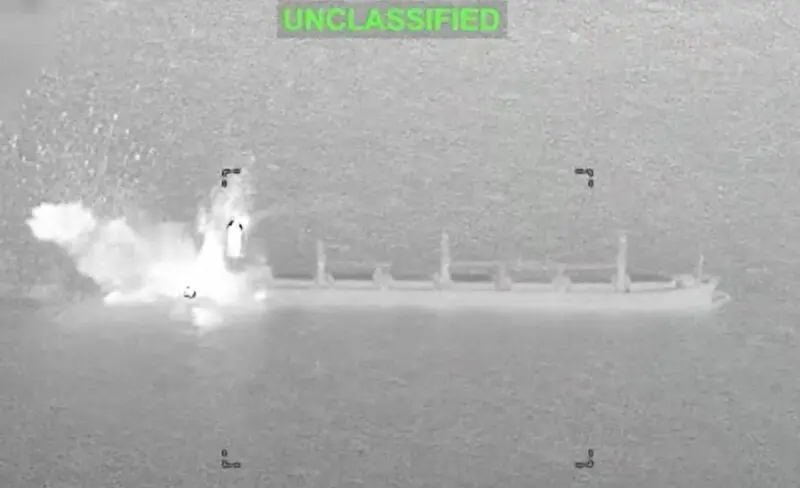
- Saturday, October 10 (Gulf of Oman): An American fighter jet deployed by U.S. Central Command executed a kinetic strike on the stern of the Panama-flagged cargo vessel Ocean Molica (also operating under the name Arika Sun).
- According to official CENTCOM releases, the Ocean Molica had departed an Iranian port and was attempting to enter international shipping lanes in the Gulf of Oman. After the vessel’s bridge team ignored repeated verbal warnings and visual signals to alter course, the U.S. aircraft delivered a precision-guided munition directly to the ship’s propulsion assembly. The strike effectively immobilized the vessel without causing casualties among the merchant crew.
          [U.S. Strike Aircraft]
                   |
                   | (Precision Munition)
                   v
        +-----------------------+
        |  Ocean Molica         |
        |  (a.k.a. Arika Sun)   |
        +-----------------------+
                   |
                   +--> [Stern / Engine Disabled]
                   +--> [Crew Safe / No Casualties]
Electronic Warfare and VHF Harassment
Alongside direct physical strikes, commercial shipmasters have encountered growing operational disruption via electronic harassment. On Saturday, October 10, several vessel commanders operating near Ras Al Khaimah, UAE, reported receiving hostile VHF radio broadcasts claiming to represent naval authorities. These transmissions ordered the merchant vessels to immediately weigh anchor and abandon their anchorages.
UKMTO issued formal security advisories regarding these unauthorized radio transmissions, warning mariners that false routing commands were being actively deployed to manipulate vessel traffic patterns in and around the choke point.

Supporting Context & Operational Metrics
The surge in attacks comes against a backdrop of deep economic sanctions, naval blockades, and a deliberate strategy by Tehran to assert control over the Strait of Hormuz—a bottleneck through which roughly 20 percent of the world’s petroleum flows.
Tehran’s Strategy of Controlled Escalation
Iranian naval forces, particularly the Islamic Revolutionary Guard Corps Navy (IRGCN), have systematically intensified threats against commercial shipping. Tehran has implemented a policy of targeting merchant ships that transit the Strait of Hormuz without explicit clearance from Iranian maritime authorities.
By employing non-attributable munitions, low-profile uncrewed aerial vehicles (UAVs), and fast-attack craft, Iranian forces can harass international shipping, drive up global energy risk premiums, and retaliate against Western economic sanctions while maintaining plausible deniability.
                         IRGC ASYMMETRIC TACTICS
                         +---------------------+
                         | Low-Profile UAVs    |
                         | Unmanned Surface    |
                         | Coastal Missiles    |
                         | VHF Spoofing        |
                         +----------+----------+
                                    |
                                    v
            +-----------------------------------------------+
            |  Targeting Unauthorized Transits              |
            |  Driving Up Global Energy Risk Premiums       |
            |  Plausible Deniability & Grey-Zone Warfare    |
            +-----------------------------------------------+
The Enforcement Campaign by U.S. Central Command
In response to Iranian regional posture and sanctioned commercial activity, Washington renewed its formal naval blockade of Iranian ports on July 14. CENTCOM’s military theater operations have yielded significant operational metrics since the July deployment:
- 4 Commercial Vessels Disabled: High-precision military strikes aimed at propulsion systems have rendered four blockade-running merchant ships motionless, including the Ocean Molica.
- 135 Merchant Vessels Intercepted: U.S. warships and naval aviation assets have forced 135 commercial vessels attempting to enter or exit Iranian ports to turn around.
- 10 IRGC Shadow Fleet Vessels Destroyed: U.S. maritime operations have targeted and destroyed 10 tankers directly tied to the IRGC’s covert illicit oil transport network.
       U.S. BLOCKADE ENFORCEMENT METRICS (Since July 14)
       +-------------------------------------------------+
       |  [4]  Commercial Vessels Disabled               |
       |  [135] Ships Turned Around / Denied Access      |
       |  [10] IRGC Shadow Fleet Tankers Destroyed       |
       +-------------------------------------------------+
The "Shadow Fleet" and Flags of Convenience
The involvement of ships like the Ocean Molica and GEM NO. 2 highlights the systemic role of the "shadow fleet"—a network of aging, obscurely owned commercial vessels utilizing Flags of Convenience (such as the Panama registry) to move sanctioned cargo.
These ships frequently alter their Automatic Identification System (AIS) transponder data, engage in risky ship-to-ship (STS) transfers in deep waters, and change vessel names (e.g., Ocean Molica / Arika Sun) to evade maritime tracking.
Economic and Logistical Fallout
The compounding security crises in the Middle East have destabilized the global maritime logistics sector:
                  MARITIME RISK & FINANCIAL IMPACT
                  +------------------------------+
                  |  War Risk Surcharges Soar    |
                  |  P&I Coverage Withdrawal     |
                  |  Extended Cape Routes        |
                  |  Oil Price Volatility        |
+------------------------------+- Surging Insurance Surcharges: Underwriters at Lloyd’s of London and global Protection and Indemnity (P&I) Clubs have vastly expanded designated High-Risk Areas (HRA). War Risk Insurance premiums for transiting the Persian Gulf and Strait of Hormuz have jumped significantly, adding hundreds of thousands of dollars to the voyage costs of a single crude carrier.
- Rerouting and Logistics Disruptions: Many blue-chip shipowners are instructing their fleets to avoid anchorages off the UAE and Qatar entirely, opting instead for deep-water loitering or delaying transit schedules. Some operators are contemplating bypassing the region altogether, rerouting vessels around the Cape of Good Hope—a maneuver that adds 10 to 14 days to voyage times and elevates global fuel consumption.
- Crewing and Human Safety: Maritime labor unions have issued alerts regarding crew safety in the Gulf, calling for enhanced war-zone bonus pay and the right for mariners to refuse sailing through high-risk zones.
Official Statements and Threat Assessments
Official agencies and military commands have issued conflicting assessments regarding sea lane security, reflecting the complex environment facing commercial operators.
United Kingdom Maritime Trade Operations (UKMTO)
UKMTO continues to serve as the primary communication bridge between military forces and civilian maritime traffic. Following the weekend’s strikes, the agency maintained an objective posture, documenting incident metrics without directly naming responsible state entities:
"UKMTO has received reports of an outbound vessel being struck on its port side by an unknown projectile causing an onboard fire. The crew is reported safe… Vessels transiting the Strait of Hormuz and surrounding waters are advised to transit with extreme caution and report any suspicious activity immediately."
U.S. Central Command (CENTCOM)
CENTCOM’s official statements present a firm, operational tone regarding blockade operations, while trying to reassure legitimate international shipping:
"On Saturday, a U.S. fighter jet successfully targeted and disabled the propulsion system of the Panama-flagged cargo vessel Ocean Molica (Arika Sun) after the crew repeatedly ignored clear maritime warnings and attempted to violate the U.S. naval blockade against Iran… U.S. forces remain dedicated to keeping the international waters of the Strait of Hormuz open to lawful global trade while dismantling the IRGC’s illegal shadow network."
Joint Maritime Information Center (JMIC)
The U.S.-led Joint Maritime Information Center released a formal threat assessment warning that attacks on commercial vessels are growing both in frequency and geographical footprint:
"Recent kinetic events demonstrate an increasing hazard environment across the Strait of Hormuz, Persian Gulf, and Gulf of Oman. Industry operators must maintain heightened vigilance, implement robust bridge watch procedures, and strictly verify radio traffic. Ships calling on sanctioned terminals accept extraordinary operational risks, including direct kinetic interdiction."
Future Outlook and Strategic Implications
The operational landscape in the Middle East has entered a complex phase defined by competing pressures:
                       STRATEGIC DILEMMA
                       +----------------+
                       |  U.S. Navy     | Enforces Blockade against Iran;
                       |                | Asserts Sea Lanes are "Open"
                       +-------+--------+
                               |
                               v
                       [Commercial Ships]  <-- Caught in the middle
                               ^
                               |
                       +-------+--------+
                       |  Iran / IRGC   | Strikes Unauthorized Traffic;
                       |                | Expands Attacks to PG & Oman
                       +----------------+
Tactical Dilemma for Commercial Operators
Shipowners face a dual-threat environment:
- Ships attempting to comply with normal international trade routes face airborne drone, missile, or projectile attacks from Iranian forces if their transit is deemed unauthorized.
- Vessels calling at Iranian ports or carrying Iranian-linked cargoes face immediate air strikes, interdiction, or hull-disabling operations by U.S. forces in international waters.
This environment presents commercial shipping companies with unprecedented operational trade-offs, where avoiding one security risk often exposes a vessel to another.
Geopolitical & Market Escalation Risks
If projectile strikes on commercial ships continue to spread into the Persian Gulf, global energy markets will experience continued volatility. Brent crude prices remain highly sensitive to disruptions along these supply lines.
Furthermore, if the IRGC Navy escalates from precision strikes on individual tankers to broader sea-denial tactics—such as offensive sea-mining or swarming attacks—the United States and its international partners may be forced to organize formal naval convoy operations, similar to Operation Earnest Will in the late 1980s.
Long-Term Regulatory and Maritime Changes
The continuous targeting of Panama-flagged and shadow-fleet carriers is likely to prompt major flag states to tighten oversight and revoke registrations for suspect vessels running military blockades.
Meanwhile, commercial operators will be required to invest in advanced passive defense systems, including hardened bridge wings, enhanced thermal imagery detection, and specialized anti-jamming GPS equipment to combat localized electronic warfare.
The waters of the Middle East remain a flashpoint where commercial shipping is inextricably linked with regional warfare. Until diplomatic channels or decisive military actions de-escalate the standoff, the Strait of Hormuz and its surrounding gulfs will remain among the world’s most perilous naval transit corridors.