











Executive Overview
As Massachusetts strives to cement its legacy as a national leader in decarbonization and clean energy adoption, a high-stakes legislative battle is unfolding on Beacon Hill. Both the Massachusetts House and Senate have passed comprehensive energy legislation—specifically bills S.3166 and H.5175—designed to modernize the state’s electrical grid, bolster reliability, and provide long-overdue financial relief to ratepayers. These progressive bills introduce a series of thoughtful structural reforms, including flexible interconnection protocols, expanded retail energy storage initiatives, and modernized residential solar permitting processes.
Yet, hidden within the broader legislative machinery is a controversial proposal that threatens to undermine these very goals: mandated fixed utility charges.
As a legislative conference committee works to reconcile the House and Senate versions of the energy bills before sending a final legislative package to Governor Maura Healey’s desk, energy analysts, consumer advocates, and clean industry stakeholders are sounding the alarm. According to a detailed data review conducted by the Solar Energy Industries Association (SEIA), shifting utility cost recovery from volumetric consumption to mandatory fixed charges will inadvertently punish the state’s most conservative energy users. Rather than promoting equity and energy affordability, fixed charges force low-use residential customers and small businesses to subsidize large energy consumers. Furthermore, this policy dilutes the financial incentives that drive investments in rooftop solar arrays, battery storage systems, and holistic residential energy efficiency.

This comprehensive report examines the mechanics of the proposed fixed-charge policy, explores its disproportionate impacts on vulnerable ratepayers, highlights the broad cross-sector coalition pushing back against the mandate, and outlines the path forward for state lawmakers and the Healey Administration.

Detailed Chronology of the Legislative Battle and Regulatory Review
The current debate over electricity rate design in Massachusetts did not materialize overnight; it represents the convergence of aggressive state climate mandates, rising consumer frustration over high utility bills, and an ongoing regulatory examination of how power delivery is funded.
The Legislative Push: S.3166 and H.5175
Throughout the legislative session, lawmakers in both chambers recognized that the traditional electrical grid is buckling under the dual weight of aging infrastructure and the rapid influx of distributed energy resources (DERs). To address these bottlenecks, the Massachusetts House and Senate advanced S.3166 and H.5175. These bills aim to fast-track clean energy deployment by cutting administrative red tape. Key provisions include:
- Flexible Interconnection: Allowing more clean energy projects to tie into the grid safely and efficiently by optimizing hosting capacity.
- Retail Storage Programs: Scaling up localized battery storage installations to flatten demand peaks and enhance community-level grid resilience.
- Streamlined Permitting: Modernizing and standardizing residential solar permitting across municipalities to reduce soft costs for homeowners and installers.
These targeted reforms align directly with Governor Maura Healey’s executive orders aimed at expanding access to affordable, reliable renewable energy and storage. However, as the bills advanced through committee reviews, late-stage amendments introduced the concept of mandatory fixed monthly charges for utility customers.

The Department of Public Utilities (DPU) Proceeding
Simultaneously, the regulatory landscape has been shifting. In late 2025, the Massachusetts Department of Public Utilities (DPU) initiated a comprehensive, statewide review of all delivery charges embedded within electric and gas utility bills. This regulatory docket was designed to evaluate the fairness, transparency, and structural integrity of how utilities recover fixed operational costs versus variable infrastructure expenses.

Rather than allowing this quasi-judicial administrative process—which boasts the specialized economic modeling, expert testimony, and evidentiary hearings necessary to weigh complex rate designs—to reach its logical conclusion, certain legislative factions have sought to short-circuit the DPU’s mandate. By attempting to codify fixed charges directly into statute, the legislature risks preempting an expert regulatory body that is uniquely equipped to balance the competing interests of utilities, low-income advocates, and clean energy developers.
Supporting Context and Metrics: The Disparate Impact of Fixed Charges
To understand why fixed utility charges are drawing fierce opposition, one must examine how utility billing mechanisms function and how structural shifts impact real-world consumer behavior.
Volumetric vs. Fixed Charges: The Mechanics of Cost Recovery
Traditionally, a significant portion of an electric utility’s delivery revenue is collected volumetrically—meaning customers pay based on the kilowatt-hours (kWh) of electricity they consume. Under this model, a household that actively conserves energy, invests in energy-efficient appliances, or generates its own power via rooftop solar panels sees a direct, proportional reduction in its monthly bill.
Fixed charges, conversely, levy a flat monthly fee on every customer regardless of how much—or how little—electricity they use. Proponents of fixed charges argue that they provide utilities with predictable revenue streams needed to maintain poles, wires, and transformers. However, economic analysts point out that imposing high fixed charges fundamentally alters the consumer value proposition.
Data-Driven Insights: SEIA’s Utility Analysis
To quantify the real-world effects of shifting costs to fixed fees, SEIA reviewed customer data from Massachusetts’ two largest investor-owned utilities: Eversource and National Grid. The findings paint a troubling picture for low-use customers and energy-conscious households.
Eversource Service Territory
Eversource provides electricity to more than 1.4 million residents across the Commonwealth. SEIA’s analysis reveals that under a fixed-charge regime:
- Households and businesses that consume the lowest volumes of electricity will experience disproportionate bill hikes. Because a larger share of the utility’s revenue requirement is locked into a mandatory flat fee, low-usage customers cannot escape the charge through conservation.
- Conversely, the state’s largest energy consumers—typically commercial entities, industrial facilities, and very large residential estates—will see net bill reductions. This occurs because their massive volumetric consumption previously absorbed a heavier share of grid maintenance costs, which are now being flattened across the entire customer base.
National Grid Service Territory
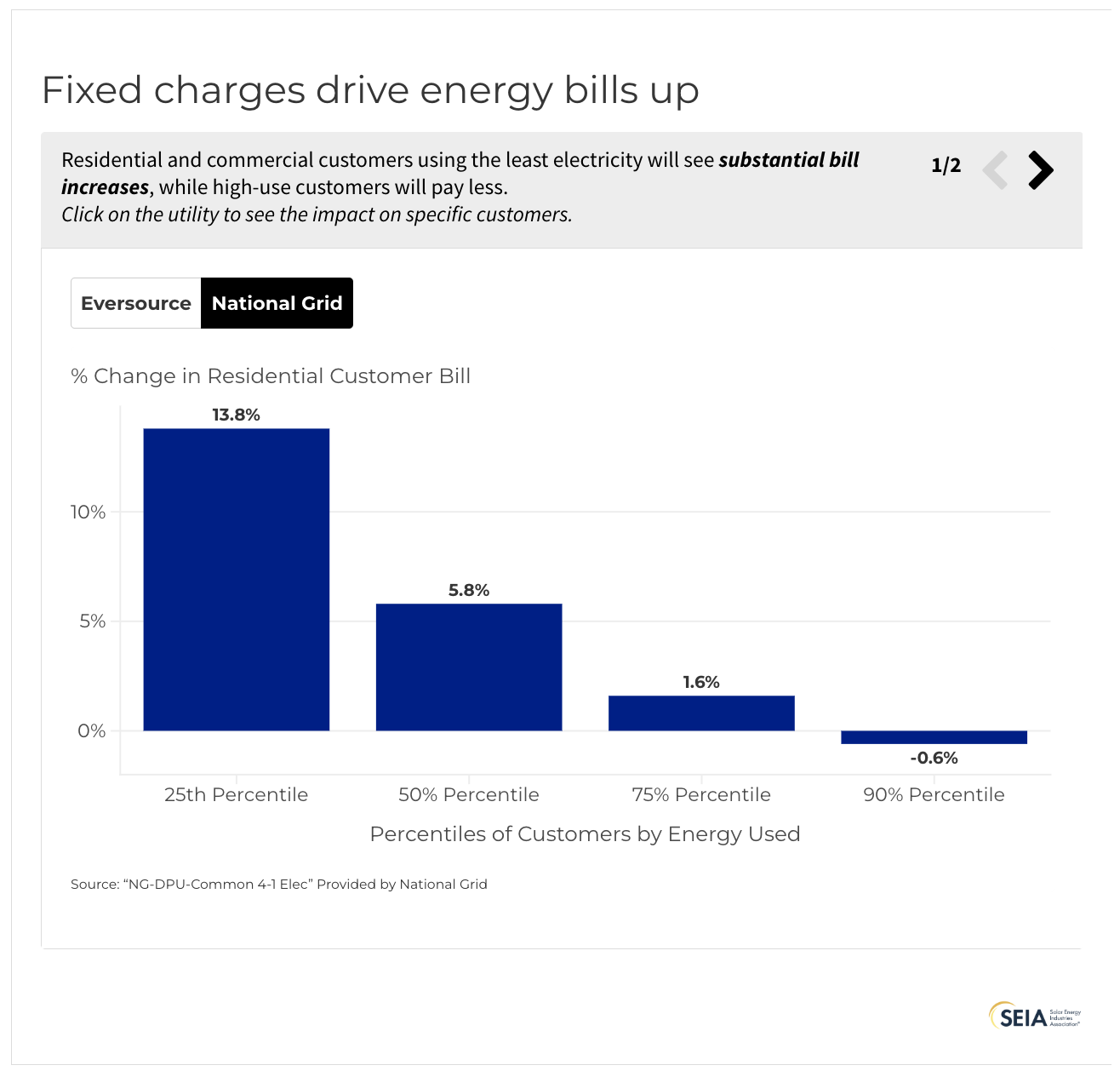
National Grid serves approximately 1.3 million residential and commercial customers in Massachusetts, mirroring Eversource’s structural dynamics. Data models show that National Grid’s residential customers who use the least amount of electricity will face estimated bill increases of 13.8%. At the same time, high-volume energy users will enjoy bill reductions, creating a perverse economic incentive where frugal, efficiency-minded consumers effectively subsidize heavy energy users.
Undermining the ROI of Clean Energy Investments
The implementation of fixed charges deals a direct blow to the financial returns of consumer clean energy investments. When a substantial portion of an electric bill is converted into a non-avoidable fixed fee:

- Diminished Savings from Conservation: Turning off lights, upgrading insulation, and adjusting thermostats yields smaller dollar-value savings because the variable portion of the bill has shrunk.
- Lower Value for Solar and Storage: Homeowners and businesses that install rooftop photovoltaic (PV) systems or battery storage rely on offsetting their volumetric consumption to pay off their capital equipment costs. When fixed charges rise, the financial benefit of generating one’s own clean energy is severely eroded, extending payback periods and dampening consumer adoption rates.
Official Statements and Cross-Sector Coalition Opposition
The push against mandatory fixed charges has united an unprecedented, diverse coalition of stakeholders across Massachusetts. Rather than representing a niche complaint from the solar industry, the opposition encompasses consumer protection advocates, low-income assistance organizations, business groups, environmental justice organizations, and clean tech developers.
Broad Public Comments in DPU Dockets
During the DPU’s delivery charge review, numerous public interest groups filed detailed comments highlighting the regressive nature of fixed fees. Low-income advocates pointed out that fixed charges hit vulnerable populations hardest. Many low-income families reside in smaller apartments or multifamily units, naturally consuming less electricity. Under a volumetric model, their bills scale down with their usage. Under a fixed-charge model, these households face an unavoidable, regressive tax on their basic housing costs, undermining state poverty-reduction and energy-equity initiatives.
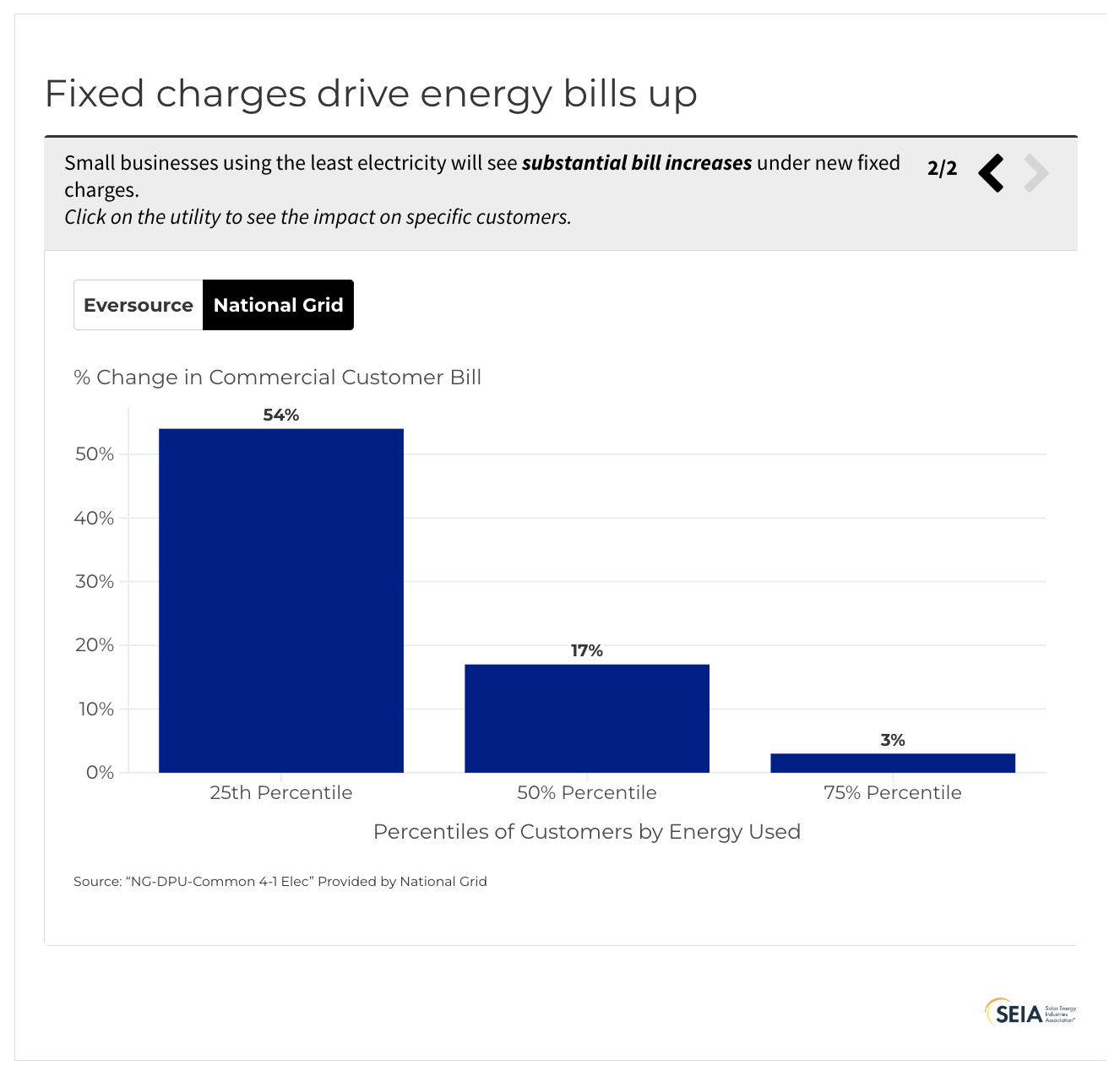
Furthermore, business groups representing small enterprises—such as local retail shops, bakeries, and professional offices that maintain modest energy footprints—argued that mandatory fixed fees increase their operating overhead without offering any pathway to cost management through energy efficiency.
Regulatory Prudence vs. Legislative Overreach
The DPU itself has adopted a cautious posture regarding fixed charges, formally noting the extreme complexity of rate design restructuring. In administrative filings, the agency emphasized that it intends to "carefully evaluate this issue" through exhaustive evidentiary proceedings before determining whether, how, and to what extent existing delivery charges should be modified.
Industry experts and policy watchdogs argue that the Massachusetts Legislature should respect the jurisdictional boundaries of its regulatory agencies. The DPU possesses the technical expertise, granular billing data, and administrative tools required to model the systemic impacts of rate changes. Forcing a statutory mandate through the legislature bypasses this rigorous scrutiny and risks codifying policy mistakes that could take years to untangle.
Future Outlook: Finding the Path to True Energy Affordability
As the legislative conference committee and the Healey Administration work toward finalizing the energy package, a clear window of opportunity exists to course-correct.
Lawmakers deserve immense credit for prioritizing energy affordability and crafting forward-thinking reforms in S.3166 and H.5175. By pairing these legislative initiatives with Governor Healey’s executive orders aimed at accelerating renewable deployment and energy storage buildout, Massachusetts has laid the groundwork for a cleaner, more resilient grid. However, letting a regressive fixed-charge mandate slip into the final text would actively sabotage these achievements.
Recommended Policy Adjustments
To secure a balanced, equitable energy future, policymakers should consider the following actionable steps:

- Amend the Final Bill: Remove any statutory language that mandates fixed utility charges, replacing it with permissive language that authorizes the DPU to evaluate rate structures through its ongoing administrative review process.
- Protect Vulnerable Ratepayers: Ensure that any future rate adjustments protect low-income and low-usage consumers from regressive cost shifts, preserving their ability to manage monthly expenses through conservation and efficiency.
- Preserve Clean Energy Incentives: Safeguard the financial viability of distributed solar and battery storage by keeping a high proportion of utility cost recovery tied to volumetric use, rewarding consumers who invest in grid-supporting technologies.
By allowing expert regulators to do their jobs and keeping energy bills tied to consumption, Massachusetts can successfully balance grid modernization with true consumer affordability, serving as a model for the rest of the nation.