









Executive Overview
Australia’s commercial logistics and freight transport sectors are hurtling toward a historic tipping point. For over 70 years, the heavy vehicle market has relied entirely on diesel fuel to power cross-country supply chains, metro deliveries, and regional distribution networks. Today, that foundational reliance is cracking under the compounding weight of geopolitical volatility, soaring pump prices, and tightening national emissions targets.
According to Tim Washington, Co-Founder and CEO of electric vehicle (EV) charging infrastructure specialist JET Charge, the conversation has officially moved past the hypothetical. In a recent press release that sent ripples through the domestic transport sector, Washington put it bluntly: "At current diesel prices, the fuel cost savings of switching a commercial fleet to electric are not marginal. They are transformational. The question for Australian fleet operators is no longer if they should electrify. It’s whether their charging infrastructure will be ready when the vehicles arrive."
To unpack these bold assertions, CleanTechnica sat down with Washington for an in-depth conversation regarding the realities of fleet electrification in Australia. The takeaway is clear: while early-stage adoption has largely centered on last-mile delivery and medium rigid trucks, a "perfect storm" of macroeconomic pressures is forcing logistics operators to fast-track long-term decarbonization strategies. With diesel creeping toward $2.60 per liter, businesses operating large fleets face a stark financial imperative. For a fleet of 100 heavy commercial vehicles, transitioning to electric alternatives could yield savings scaling up to AU$4.5 million or more.
Yet, as Washington warns, vehicle availability is no longer the primary bottleneck—infrastructure is. With corporate fleet replacement cycles compressing from standard five-year windows down to aggressive 18-month turnarounds, companies that fail to secure grid access and depot charging capabilities today risk being locked out by 2027 or 2028. As heavyweights like IKEA and Woolworths begin restructuring their supply chains, the race to electrify Australian transport is officially underway.

Detailed Chronology: From Niche Experiments to the "Perfect Storm"
To understand where Australia’s heavy vehicle market stands today, one must trace the rapid evolution of the ecosystem over the past several years. Just a half-decade ago, electric trucks were viewed by mainstream Australian logistics providers as expensive, unproven experiments suitable only for tightly controlled municipal routes. Heavy-duty semi-trailers, or prime movers, were deemed decades away from practical commercial viability down under due to range anxieties, sparse highway charging corridors, and high upfront capital expenditures.
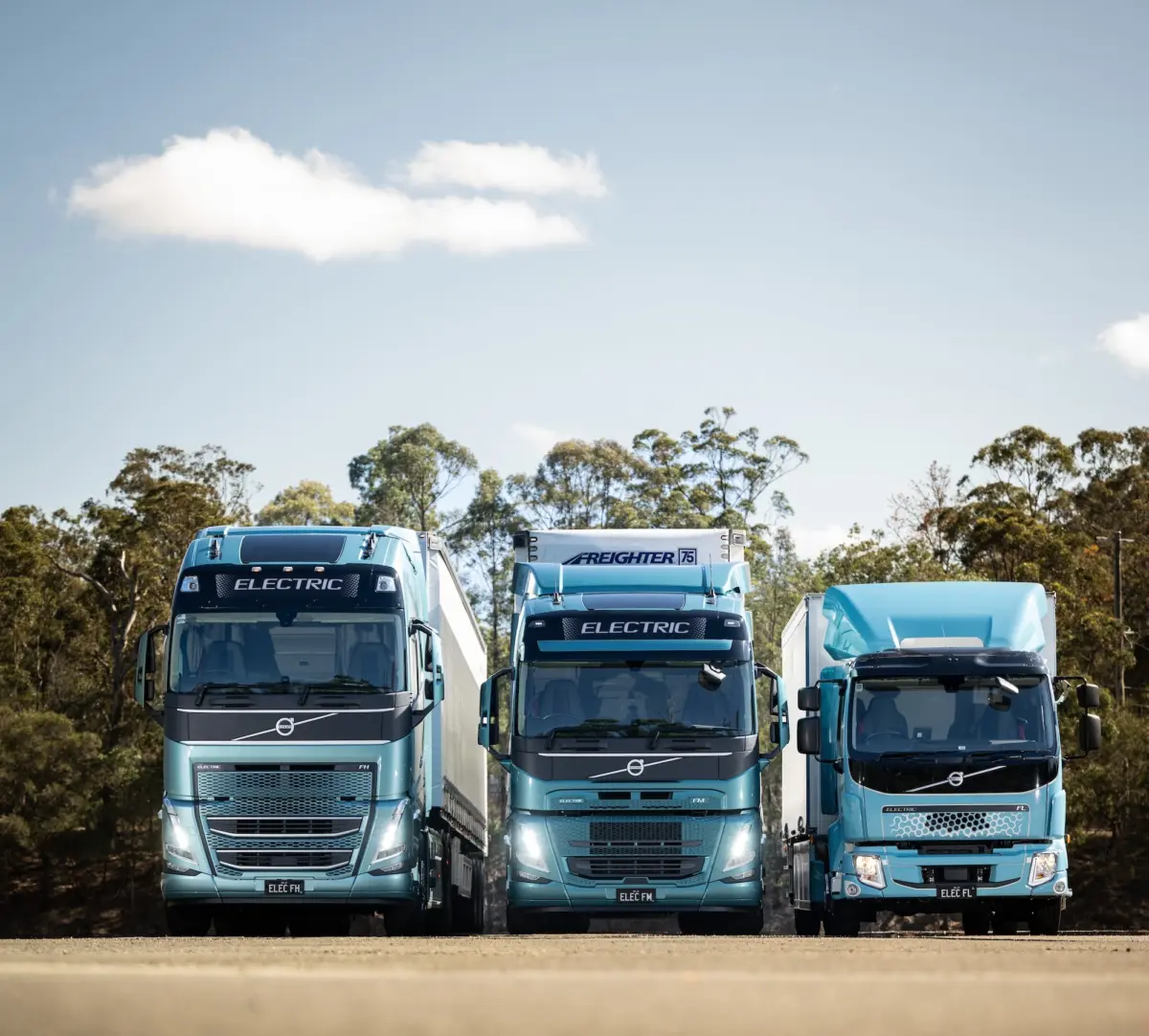
However, the past 24 to 36 months have dismantled those assumptions. Early pioneers introduced limited numbers of heavy electric trucks to Australian roads—including models from Volvo, Janus Electric, eActros, and more recently, Windrose semi-trailers touching down in Melbourne. While prime movers represent an emerging frontier rather than a majority share of active heavy fleets today, the underlying mechanics driving their adoption have shifted dramatically.
Washington describes the current landscape as a "perfect storm" of conditions. For the first time in commercial transport history, three distinct market forces are converging simultaneously:

- Unprecedented Fuel Volatility: Persistent geopolitical conflicts and supply chain disruptions have kept global oil markets unstable, directly punishing operators dependent on diesel.
- Regulatory Momentum: Government-backed transition programs and increasingly stringent national emissions targets are setting the stage for a phased phase-out of internal combustion engines in commercial segments.
- Infrastructure Maturity: Specialized providers like JET Charge have developed scalable, enterprise-grade depot and corridor charging architectures, removing the guesswork from large-scale deployments.
This convergence has compressed what used to be cautious, five-year fleet electrification roadmaps into urgent, 18-month procurement mandates. Fleet managers realize that waiting out the transition is no longer a viable risk-mitigation strategy; it is a financial liability.

Supporting Context & Metrics: The Economics of Going Electric
Skeptics of commercial vehicle electrification often point to the high initial capital outlay of electric trucks compared to their diesel counterparts. However, when examining total cost of ownership (TCO)—particularly fuel and maintenance expenditures—the financial argument for electrification becomes overwhelmingly compelling.
Fuel Costs and Volatility
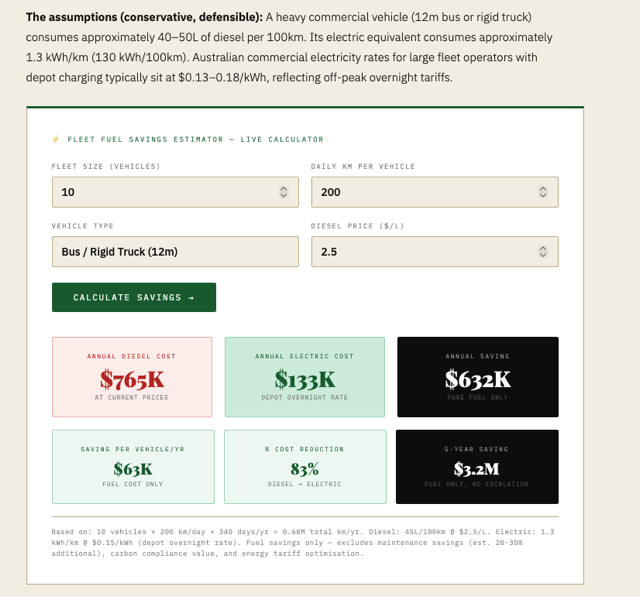
Initial calculations utilized by JET Charge’s Fleet Fuel Calculator assumed a baseline diesel cost of AU$1.90 per liter. In reality, fuel prices have since surged past AU$2.60 per liter in many parts of the country. This upward trajectory fundamentally alters the operating balance sheet of logistics firms.
Consider the mathematics of a medium-to-large freight operation. For a fleet consisting of 100 heavy vehicles, the cumulative fuel savings achieved by substituting diesel for electricity can approach or exceed AU$4.5 million over a standard operating lifecycle. For smaller fleets operating rigid trucks in urban environments, the proportional savings remain equally transformative, drastically improving profit margins in an industry historically characterized by razor-thin operational buffers.
Maintenance and Downtime Reductions
Beyond direct fuel savings, smart fleet operators are capturing immense value through reduced maintenance overhead. Internal combustion engine (ICE) semi-trailers and delivery trucks feature thousands of moving parts, requiring frequent oil changes, exhaust system maintenance, transmission repairs, and emissions-control servicing.

Electric trucks, by contrast, utilize significantly simpler powertrains with far fewer moving parts. Regenerative braking dramatically reduces brake pad wear, and the absence of internal combustion engines eliminates oil changes and exhaust after-treatment servicing. According to industry data shared by JET Charge, the payback period for commercial depot charging infrastructure is frequently measured in months rather than years, offering rapid capital recovery.
The Grid Access Bottleneck
Despite these compelling numbers, Washington issues a vital caution regarding grid capacity. As commercial enterprises rush to electrify, they will not be operating in a vacuum. Logistics companies scaling up their depot charging capacity will soon find themselves competing directly with a booming, well-funded sector of the economy: data centers.
Because power availability and grid connection approvals take considerable time, late-moving operators face the genuine prospect of being locked out of essential grid capacity through 2027 and 2028. Forward-thinking fleet operators are treating charging infrastructure as an immediate priority to secure their power allocations ahead of market congestion.
Official Statements & Case Studies: The IKEA Playbook
Theory is validated by practice, and JET Charge has already proven its deployment model through high-profile partnerships with major consumer brands. Among the most illustrative case studies in the Australian market is furniture retail giant IKEA and its collaboration with logistics partners.
De-Risking the Supply Chain: The IKEA Case Study
When IKEA Australia committed to achieving 100% zero-emission home deliveries, the primary hurdle was not vehicle availability—it was charging infrastructure. Subcontracted delivery partners, operating on tight margins, simply did not possess the balance sheets required to self-fund heavy-duty depot charging installations.
To break this deadlock, JET Charge deployed 59 commercial-grade chargers across seven strategic locations. This targeted infrastructure rollout empowered delivery partners—including ANC Delivers, Kings Transport, and All-Purpose Transport—to transition to zero-emission fleets at scale. Integrated with Chargefox billing systems for seamless cost recovery, the network now supports over 100 electric delivery vehicles operating nationwide.
The results speak for themselves: IKEA’s zero-emission delivery rate skyrocketed from a modest 5% in 2022 to an impressive 83% by October 2025.
"This is the playbook for every major Australian retailer and logistics operator," Washington emphasized. "If you move the infrastructure barrier, the transition follows. By building intelligent, fit-for-purpose infrastructure, delivery partners have the reliability they need on the road, and IKEA has the visibility to lead real emissions reductions across its supply chains."

Furthermore, JET Charge’s recent partnership with NewVolt to electrify key heavy freight corridors underscores the necessity of out-of-depot solutions. Washington notes that while private depot infrastructure must satisfy roughly 70% of total charging needs, robust regional and highway charging corridors are vital for heavy prime movers operating across state lines.
Future Outlook: Overcoming Roadblocks for a Fully Electric Economy
As Australia looks toward its 2035 emissions targets, the momentum behind commercial transport electrification is undeniable, yet several systemic roadblocks remain.
Education, Reimbursement, and Corporate Budgets
When asked about current friction points holding back wider adoption, Washington highlighted three core challenges:
- Misconceptions About Complexity: Many corporate leaders assume that installing and managing commercial EV chargers is overly complex. Education and turnkey deployment models are essential to demystifying the technology.
- Home and Out-of-Depot Reimbursement: For fleets utilizing mixed models where drivers take vehicles home, transparent reimbursement systems for power consumption are necessary. JET Charge has already developed robust software solutions to track and automate these utility reimbursements.
- Corporate Budget Allocations: Traditional corporate procurement structures often fail to earmark specific capital expenditure lines for EV charging infrastructure. Businesses must proactively bake infrastructure budgets into their capital planning cycles.
Macroeconomic Ripple Effects
The financial benefits of transitioning away from fossil fuels extend far beyond individual corporate balance sheets. In Australia, high diesel prices act as a regressive tax on the entire economy, cascading through supply chains to inflate the cost of goods, groceries, and manufacturing inputs. This supply chain friction contributes directly to broader inflationary pressures and, by extension, elevated interest rates.

Major Australian grocery chains and logistics providers have openly acknowledged the immense strain of absorbing continuous supplier cost increases. While corporations attempt to buffer consumers from these shocks, such mitigation strategies are finite. By replacing volatile diesel fuel with locally generated electricity—increasingly backed by renewable generation—the Australian logistics sector can insulate itself from international oil shocks, stabilize consumer prices, and drive down economy-wide inflation.
Conclusion
The transition of Australia’s heavy vehicle fleet from diesel to electric is no longer a speculative vision of the distant future. Propelled by staggering fuel savings, tightening regulatory frameworks, and proven deployment frameworks established by industry leaders like JET Charge, fleet electrification has arrived as an active procurement necessity.
For commercial operators, the message from the front lines of the energy transition is unambiguous: assess your fleet requirements, engage with infrastructure providers early, and secure your grid access before the heavy transport bottleneck closes. The electric highway is open, and those who move first will reap the rewards of a cleaner, more resilient, and dramatically more profitable supply chain.