









Executive Overview
As Canadian municipalities race to decarbonize their public transit fleets, the institutions advising them on multi-million-dollar capital investments are facing unprecedented scrutiny. At the center of this debate is the Canadian Urban Transit Research and Innovation Consortium (CUTRIC), an influential organization that has carved out a dominant position in shaping the nation’s transition toward zero-emission buses (ZEBs).
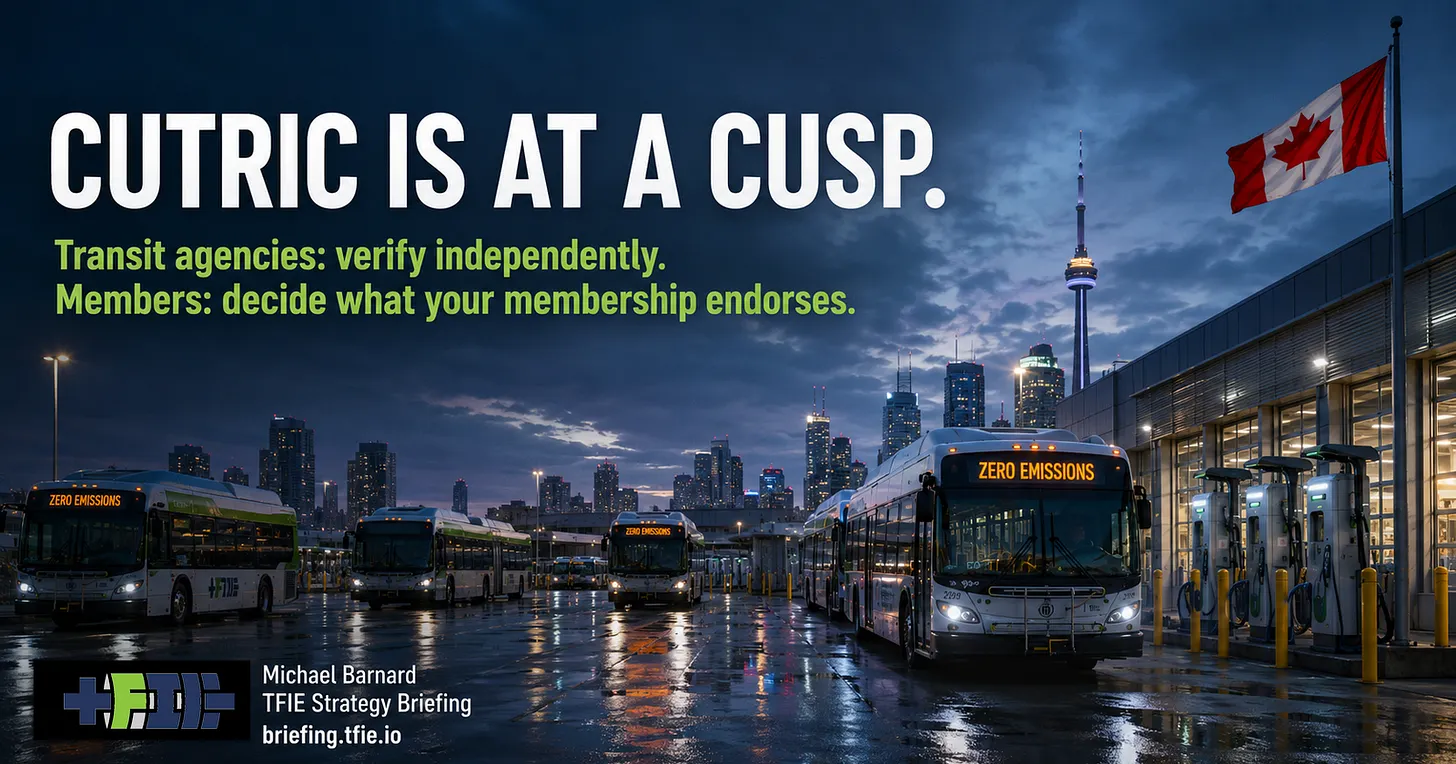
However, a growing body of strategic analysis—highlighted by recent findings from the TFIE Strategy Briefing—suggests that CUTRIC is grappling with a severe institutional conflict of interest. The core issue lies in a fundamental contradiction: can an organization dedicated to commercializing specific clean technologies and advocating for industry stakeholders simultaneously maintain the scientific neutrality required to guide independent public infrastructure investments?
For years, CUTRIC has acted as a multi-faceted powerhouse in Canada’s transit landscape, developing projects, lobbying federal and provincial governments, operating analytical databases, and providing technical consulting. While its early work—such as standardizing high-power battery-electric bus (BEB) interoperability—solved critical collective-action problems, its broader advisory footprint is increasingly problematic. Critics argue that CUTRIC functions primarily as a technology promoter rather than an objective analytical arbiter. Consequently, transit agencies are being urged to exercise rigorous, independent verification rather than relying on the presumption that CUTRIC’s recommendations are free from commercial bias.

Detailed Chronology of CUTRIC’s Rise and the Hydrogen Debate
To understand the current credibility crisis, it is necessary to examine how CUTRIC evolved into Canada’s preeminent transit-planning consultant and how its technological positions hardened over time.
The Foundation and Expansion of Influence (Late 2010s)
CUTRIC emerged during a period of intense federal focus on climate change and green infrastructure. Positioning itself as a bridge between academic researchers, municipal transit agencies, and private-sector technology vendors, the organization successfully secured substantial government funding and carved out a unique space in project design. By convening stakeholders and streamlining early-stage technology deployments, CUTRIC rapidly became a go-to resource for mid-to-large-sized transit authorities navigating unfamiliar zero-emission mandates.
The Battery-Electric Interoperability Success
One of CUTRIC’s most defensible achievements occurred in the realm of battery-electric bus charging standards. In the early days of electrification, transit agencies faced the looming threat of proprietary vendor ecosystems—where chargers from Manufacturer A might not work with buses from Manufacturer B. CUTRIC played a constructive role in driving convergence toward common high-power charging standards, addressing a genuine collective-action failure and saving the industry from chaotic infrastructure fragmentation.
The Pivot to Hydrogen and the "Essential" Claim
As battery-electric technology matured, the debate shifted toward heavy-duty route profiles. Here, CUTRIC began heavily championing hydrogen fuel-cell electric buses (FCEBs). Over successive years, the organization’s public messaging shifted from exploring hydrogen as a niche option to declaring it "essential" for difficult operating environments characterized by long daily blocks, extreme topography, heavy passenger loads, severe winter heating demands, and constrained depot spaces.

However, this assertion bypassed a rigorous comparative baseline. While individual routes undoubtedly present severe engineering challenges, declaring hydrogen "essential" requires proving that advanced direct-electric architectures—such as opportunity charging, strategic block redesign, and rapidly scaling in-motion charging technologies—cannot meet those same demands. According to transit analysts, CUTRIC’s public record lacks the robust, comprehensive comparative evaluations necessary to clear that evidentiary bar.

Supporting Context & Metrics: The Analytics of Commercialization vs. Neutrality
The root of CUTRIC’s institutional challenge stems from a mismatch in behavioral incentives.
[Commercialization Model]  ---> Asks: "How do we fund, build, and market this technology?"
[Independent Analysis]     ---> Asks: "Should this technology be used, or is an alternative better?"
An organization focused on commercialization naturally asks: What funding mechanism, partnership, or policy change will accelerate market adoption? Conversely, an independent analytical institution must possess the institutional mechanisms required to conclude that a technology should be abandoned, that a forecast was fundamentally flawed, or that public capital would be better deployed elsewhere.
The Absence of an Error-Correction Feedback Loop
In empirical science and mature engineering, forecasting errors are standard operating procedure. What separates a credible evidence institution is its feedback loop:
- Forecast generation
- Real-world deployment
- Observed performance tracking
- Forecast error identification
- Assumption revision and policy correction
CUTRIC possesses a wealth of raw data through its comprehensive zero-emission bus database, which tracks projects across various stages—from initial announcements and feasibility studies to financing, procurement, commissioning, and active service entry. This longitudinal data offers a clear window into stalled projects, pivoting procurements, and shifting municipal strategies.
Despite holding this data, CUTRIC’s public output reveals little evidence of a robust retrospective validation mechanism. When hydrogen procurement signals began to soften globally and direct-electric alternatives advanced rapidly in cost and capability, CUTRIC’s core narrative regarding the indispensability of hydrogen remained largely unchanged.
The Evolution of the Direct-Electric Alternative
The comparison between zero-emission technologies has evolved far beyond the simplistic binary of a depot-charged battery bus versus a hydrogen fuel-cell bus. Modern transit engineering utilizes a diverse toolkit:
- Managed Depot Charging: Optimized overnight charging paired with smart grid load-shifting.
- Opportunity Charging: Fast-charging on-route via overhead pantographs during scheduled layovers.
- Corridor & Shared Infrastructure: Multi-agency pooling of high-capacity charging assets.
- Conductive In-Motion Charging (IMC): Dynamic charging systems that replenish batteries while vehicles operate on designated corridors.
By treating challenging route blocks as immediate justifications for hydrogen without thoroughly stress-testing these advanced direct-electric configurations, CUTRIC risks locking transit agencies into expensive, complex fuel infrastructures that may prove economically unviable over a 12-to-15-year vehicle lifecycle.
Official Perspectives and Industry Implications
The revelations surrounding CUTRIC’s institutional positioning have triggered widespread debate among municipal transit operators, provincial policy makers, and clean-tech economists.

The Transit Agency Dilemma
For municipal transit authorities, the implications are immediate. Agencies operating under tight budgetary constraints and intense political pressure to decarbonize have historically relied on CUTRIC’s modeling as a stamp of scientific authority.
Industry experts now advise that transit boards treat CUTRIC’s analytical products as insights generated by an interested industry stakeholder rather than as definitive, neutral decrees. When planning major capital procurements, agencies are urged to independently commission or verify:
- Service and route assumptions
- Cold-weather climate performance metrics
- Fleet replacement ratios and depot space utilization
- Comprehensive lifecycle economics, including hydrogen fuel production costs versus grid electricity pricing
- The completeness of the technology comparator set
As analysts note, relying solely on the rationale that "CUTRIC says so" adds virtually no defensible evidentiary weight when justifying hundreds of millions of dollars in public expenditures to taxpayers and municipal auditors.
CUTRIC’s Strategic Choices
Observers suggest that CUTRIC stands at an institutional crossroads, facing three primary strategic pathways moving forward:
- Establish Structural Independence: Create a formally insulated analytical wing entirely separate from its commercialization and advocacy arms, complete with transparent, audited mechanisms for retrospective model validation and the active sunsetting of failed technological pathways.
- Embrace Advocacy Openly: Transition its public identity to operate explicitly as an industry-led commercialization and advocacy association. Under this model, its reports and data would be evaluated transparently alongside other market-development stakeholders.
- Maintain the Status Quo: Continue combining commercialization initiatives, government lobbying, and claims of scientific neutrality—a path that industry analysts warn will become increasingly difficult to defend as municipal scrutiny intensifies.
Future Outlook: The Next Phase of Fleet Decarbonization
As Canada moves deeper into the 2030s, the economic realities of transit fleet electrification will leave little room for technological sentimentality. The capital expenditures required to transition entire municipal fleets from diesel to zero-emission alternatives are among the largest municipal investments of this century.
The controversy surrounding CUTRIC serves as a watershed moment for the clean technology sector. It highlights a vital lesson for public infrastructure planning: commercialization advocacy and independent technical validation cannot peacefully cohabit under the same institutional roof without rigorous, transparent firewalls.
For transit agencies, the path forward demands heightened technical literacy and rigorous independent due diligence. For industry associations, it signals the end of uncritical deference and the beginning of an era where every technological claim must withstand the unyielding test of operational reality, economic efficiency, and comparative systems engineering.