







Executive Overview
In the immediate aftermath of Russia’s 2022 invasion of Ukraine, European energy markets plunged into an existential crisis. As natural gas and electricity prices skyrocketed, the continent rallied around a seemingly straightforward rallying cry: energy independence. For decades, policymakers and citizens alike had operated under the assumption that true sovereignty meant absolute self-reliance—a domestic lock on fuel supplies, power generation, and infrastructure.
However, as subsequent years have demonstrated, this knee-jerk interpretation of independence misdiagnosed the fundamental structural vulnerability of the pre-war era. Europe’s fatal flaw was not that it traded electricity and gas across national boundaries; it was that it allowed a critical, non-diversified energy supply to concentrate in the hands of a single, increasingly volatile, and weaponized counterparty.
Today, a profound paradigm shift is underway. Rather than retreating into isolationist energy autarky, nations across Europe and its immediate neighborhoods are embracing a more sophisticated, resilient model: strategic energy interdependence.
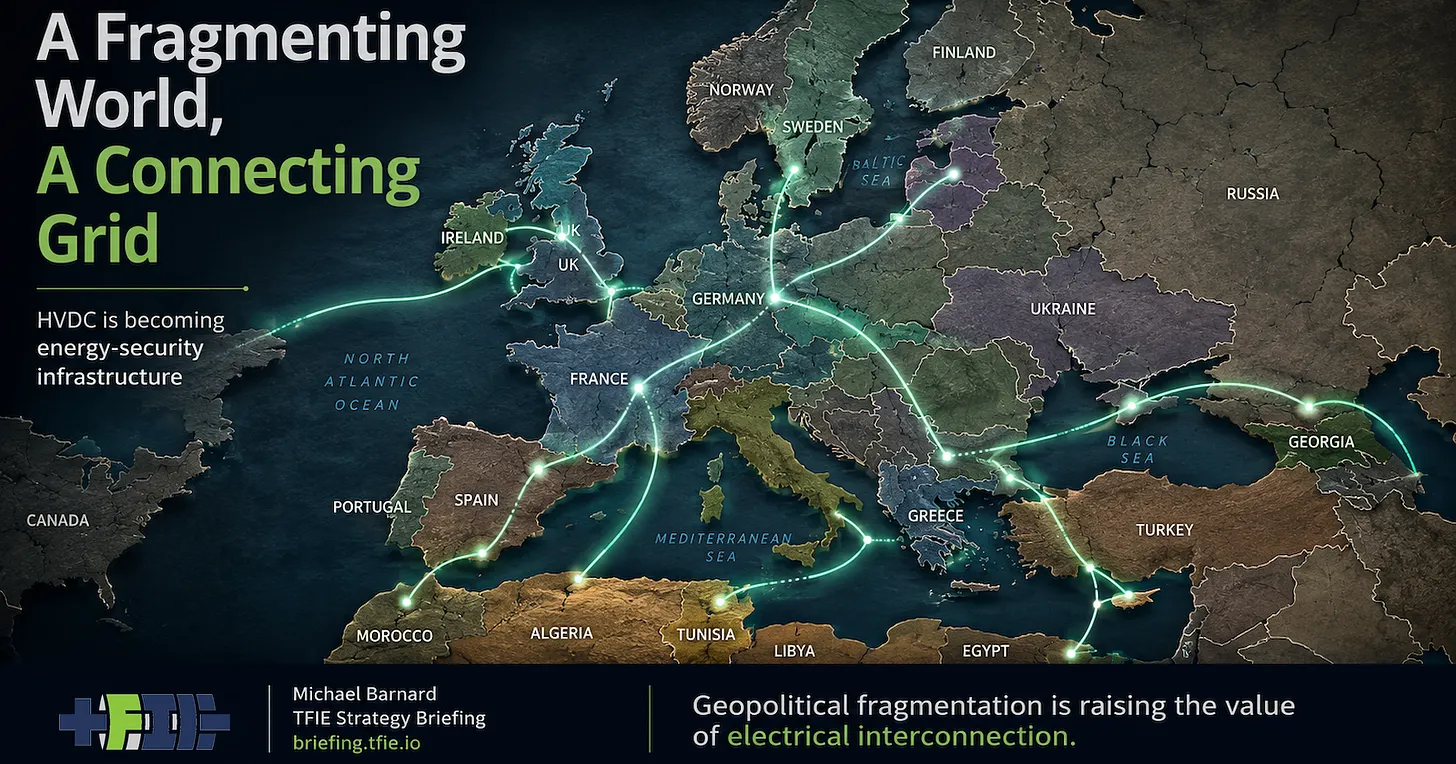
Rather than relying on continuous imports of exhaustible fossil fuels that leave economies perpetually exposed to the whims of foreign suppliers and commodity cartels, modern power networks are increasingly tied together via high-voltage direct current (HVDC) subsea and overland interconnectors. These cross-border electric links do far more than merely arbitrage wholesale electricity prices or balance regional markets. They are rapidly becoming the backbone of national security, economic resilience, and deep decarbonization.
By tying together diverse generation portfolios—spanning offshore wind corridors in the North Sea, solar arrays in Southern Europe, hydroelectric reserves in Scandinavia, and nuclear baseloads across Central Europe—interconnectors insulate nations from localized shocks. If a geopolitical crisis, a prolonged weather anomaly, or a sudden infrastructure failure hobbles one domestic system or foreign supplier, power can flow fluidly from an alternate jurisdiction.
Yet, this emerging era of interconnected grids is not without its systemic risks. Massive subsea cables can become concentration points of failure if poorly managed, and localized grid bottlenecks can strand imported electrons far from industrial demand centers. To understand how modern states are navigating this complex geopolitical and technological landscape, one must examine the macro-level data, the evolving policy frameworks, and the physical infrastructure pipelines shaping the future of global power.
Detailed Chronology: From Crisis to the Interconnector Boom
To fully appreciate the renaissance of cross-border power transmission, it is necessary to trace the historical and geopolitical milestones that transformed electrical grid architecture from a sleepy engineering discipline into a frontline instrument of statecraft.

Phase 1: The Pre-War Paradigm (Pre-2022)
For much of the late 20th and early 21st centuries, cross-border high-voltage transmission lines were conceived primarily through an economic and commercial lens. Interconnectors were built to optimize market efficiency. If power was cheap in France, it flowed to England; if wind generation surged in Denmark, it was exported to Germany to prevent curtailment.
Security of supply was treated as a secondary metric, largely taken for granted under a globalized economic consensus. Fossil fuel pipelines—most notably Nord Stream 1 and 2—served as the primary vascular system for the continent’s baseload energy needs, while electricity grids played a complementary, regional balancing role.
Phase 2: The Shock of 2022 and the Illusory Pursuit of Autarky
The geopolitical rupture of February 2022 shattered this consensus. As Moscow weaponized gas flows, sending European wholesale electricity prices to historic, economy-crushing highs, the political discourse swung violently toward decoupling.
The initial political reflex favored total national self-sufficiency. Politicians across capitals demanded domestic fossil fuel revivals, accelerated nuclear programs, and strictly insulated national power grids. For a brief window, any form of cross-border reliance was viewed with profound suspicion. Analysts warned that relying on a neighboring country for electrons carried risks parallel to relying on pipelines for gas.
Phase 3: The Realization and the 2026 Pipeline Reality (2023–2026)
As the dust settled, energy ministers and grid operators realized that absolute electrical autarky was both economically ruinous and technologically unfeasible in a renewables-dominated grid. Running a 100% renewable grid entirely on domestic resources requires massive, cost-prohibitive overbuilding of storage and generation capacity to survive multi-week lulls in wind and solar output (such as the infamous German Dunkelflaute).
By mid-2026, empirical data from infrastructure tracking agencies—such as RTE International’s global HVDC inventory—revealed an astonishing counter-trend. Rather than contracting, the pipeline of cross-border transmission projects has surged. Filtering current inventories for international schemes reveals approximately 60 major prospective cross-border links slated for development, with Europe and its immediate periphery serving as the epicenter of this activity.
A prime historical example of this resilience in action is the ongoing development of the Baltic-German PowerLink. Even as the Baltic states (Lithuania, Latvia, and Estonia) completed the complex technical feat of desynchronizing their power grids from the Russian BRELL ring and integrating with synchronous continental Europe, they did not retreat into isolation. Instead, they deepened their Western electrical ties, cementing EU Project of Common Interest (PCI) status for vital corridors that safeguard regional energy flows against hybrid warfare and geopolitical coercion.
Supporting Context & Metrics: Unpacking the HVDC Pipeline
A superficial glance at global transmission maps might suggest a uniform wave of globalization. However, a deeper dive into the metrics reveals a highly nuanced, strategic deployment of capital and engineering.
The Anatomy of the 2026 HVDC Inventory
According to specialized infrastructure assessments, the current pipeline of international high-voltage direct current projects features roughly 60 distinct cross-national schemes in various stages of maturity. These projects are not distributed evenly; they are heavily concentrated in regions facing simultaneous pressures: aggressive decarbonization targets, aging domestic infrastructure, and heightened geopolitical volatility.

| Metric / Dimension | Traditional Fossil Fuel Pipelines (e.g., Gas) | Modern HVDC Interconnectors |
|---|---|---|
| Flow Direction | Unidirectional (Producer to Consumer) | Bidirectional (Dynamic balancing) |
| Commodity Exposure | Continuous dependency on finite fuel stocks | Access to diversified generation mix (wind, solar, hydro, nuclear) |
| Systemic Risk | Complete supply cutoff halts value delivery | Loss of one link is disruptive, not fatal (if portfolio is balanced) |
| Primary Economic Driver | Long-term volumetric contracts and resource rent | Market arbitrage, flexibility sharing, and constraint management |
Why Electrons Differ From Molecules
The fundamental superiority of an electrical interconnector over a fossil fuel pipeline lies in its physics and market structure.
A gas pipeline or an LNG import terminal is fundamentally a delivery pipe for an exhaustible commodity. It delivers value only as long as physical fuel continues to flow through it. If a supplier cuts off the gas, or if global LNG spot prices spike out of reach, the importing nation is left stranded, holding generation assets that cannot produce power.
An electrical interconnector, by contrast, joins two power systems that already contain diverse arrays of generation, storage, demand-response mechanisms, and alternative cross-border connections. Electricity is inherently bidirectional. If a technical fault, weather event, or political dispute knocks out one interconnector, power can often be rerouted through alternative corridors or generated domestically using preserved reserves. Furthermore, an interconnector does not chain a nation to a single foreign commodity market; it exposes the domestic grid to a mosaic of weather systems, hydroelectric reservoirs, nuclear fleets, and solar portfolios across different sovereign jurisdictions.
Official Statements and Policy Shifts
Governments and regulatory bodies across Europe have formally codified this realization, embedding cross-border transmission directly into national security and climate compliance frameworks.
ACER: The Call for Continental Flexibility
The Agency for the Cooperation of Energy Regulators (ACER) has been unequivocal in its recent monitoring reports. ACER has formally argued that stronger, more deeply integrated cross-border interconnections are non-negotiable if Europe is to safely accelerate its renewable energy transition. In its strategic evaluations, ACER notes:
"The rapid, large-scale deployment of variable renewables calls for unprecedented cooperation among member states. Enhanced interconnection is no longer just a market optimization tool; it is the most cost-effective instrument to double the flexibility of the European power system, shave peak balancing costs, and insulate regional economies from fossil-fuel volatility."
The United Kingdom’s Clean Flexibility Roadmap
Across the English Channel, the UK government has systematically integrated interconnectors into its national security architecture. The Department for Energy Security and Net Zero’s Clean Flexibility Roadmap explicitly repositions subsea interconnectors not as peripheral commercial trading assets, but as core pillars of the national security-of-supply portfolio.
By grouping interconnectors alongside utility-scale battery storage, pumped hydro, and automated industrial demand-side response, British energy policy recognizes that resilience is achieved through a portfolio approach. As the 2026 updates to the Roadmap emphasize, the objective is to ensure that no single asset class—whether a domestic gas plant or a cross-border subsea cable—can hold the British economy hostage.
Future Outlook: The Portfolio Logic of Strategic Interdependence
As the global energy landscape careens toward 2030 and beyond, the debate over energy security has matured. The simplistic binary choice between "dependence" and "independence" has been replaced by a rigorous adherence to systemic resilience through portfolio diversification.
Mitigating Concentration Risk
To view interconnectors as a universal panacea would be a grave analytical error. A poorly engineered grid strategy can easily introduce new vulnerabilities. For instance, relying on a single, massive interconnector to supply a disproportionate share of a nation’s baseload power creates a dangerous concentration risk.
Subsea cables traverse marine environments where they are exposed to physical damage, mechanical drag from shipping anchors, seismic events, or potential state-sponsored sabotage (as dramatically highlighted by past infrastructure attacks in the Baltic Sea). Furthermore, if two neighboring countries experience identical weather patterns—such as a continent-wide stagnant anticyclone that starves both nations of wind power simultaneously—an interconnector fails to provide the necessary generation diversity.
To circumvent these vulnerabilities, modern grid planners are adopting a strict portfolio logic:
- Multiple Counterparties: Spreading exposure across three, four, or five distinct national partners rather than depending on a single bilateral corridor.
- Diverse Routing: Utilizing a mix of overland and subsea routes that bypass geopolitical chokepoints.
- Internal Reinforcement: Upgrading domestic transmission grids to ensure that power imported from an interconnector can actually reach urban and industrial demand centers without triggering internal bottlenecks.
- Balanced Domestic Capacity: Maintaining sufficient dispatchable domestic generation and long-duration energy storage as an ultimate backstop against simultaneous regional failures.
The Ultimate Metric: System Cost and Survival
Ultimately, the economic and security case for cross-border transmission is not judged by comparing one single subsea cable against one local power plant. The true comparative metric is the total cost, carbon footprint, and resilience of the entire macro-grid that would be legally and physically required if the interconnector did not exist.
Building a completely autarkic, 100% self-sufficient zero-carbon power system for every individual nation on Earth would require an astronomical, multi-trillion-dollar overbuilding of domestic batteries, hydrogen peaking plants, and wind-solar capacity. Strategic interdependence slashes these astronomical capital requirements by smoothing out regional weather imbalances and sharing flexibility pools across time zones and geographic frontiers.
The geopolitical shocks of the 2020s did not render cross-border power links obsolete. Instead, they performed a brutal stress test on global energy infrastructure, burning away the naive assumptions of frictionless globalization and revealing the enduring value of hard-nosed, diversified, and trusted cooperation. The future of energy security does not lie in the illusion of absolute autarkic independence. It lies in the robust, reciprocal, and unbreakable web of strategic interdependence.