










Executive Overview
To an observer casually tracking the global energy transition through mainstream news, trade journals, and corporate press releases, hydrogen and direct electrification often appear to be neck-and-neck competitors. Across a staggering array of sectors—ranging from heavy freight transit and public bus networks to maritime shipping, passenger vehicles, and long-duration grid storage—hydrogen is frequently presented as a viable, parallel alternative to battery-electric technology.
Yet, when analysts strip away the rhetoric and examine the underlying physical realities, a profound disconnect emerges. There is a glaring chasm between what the media talks about and what the market actually deploys.
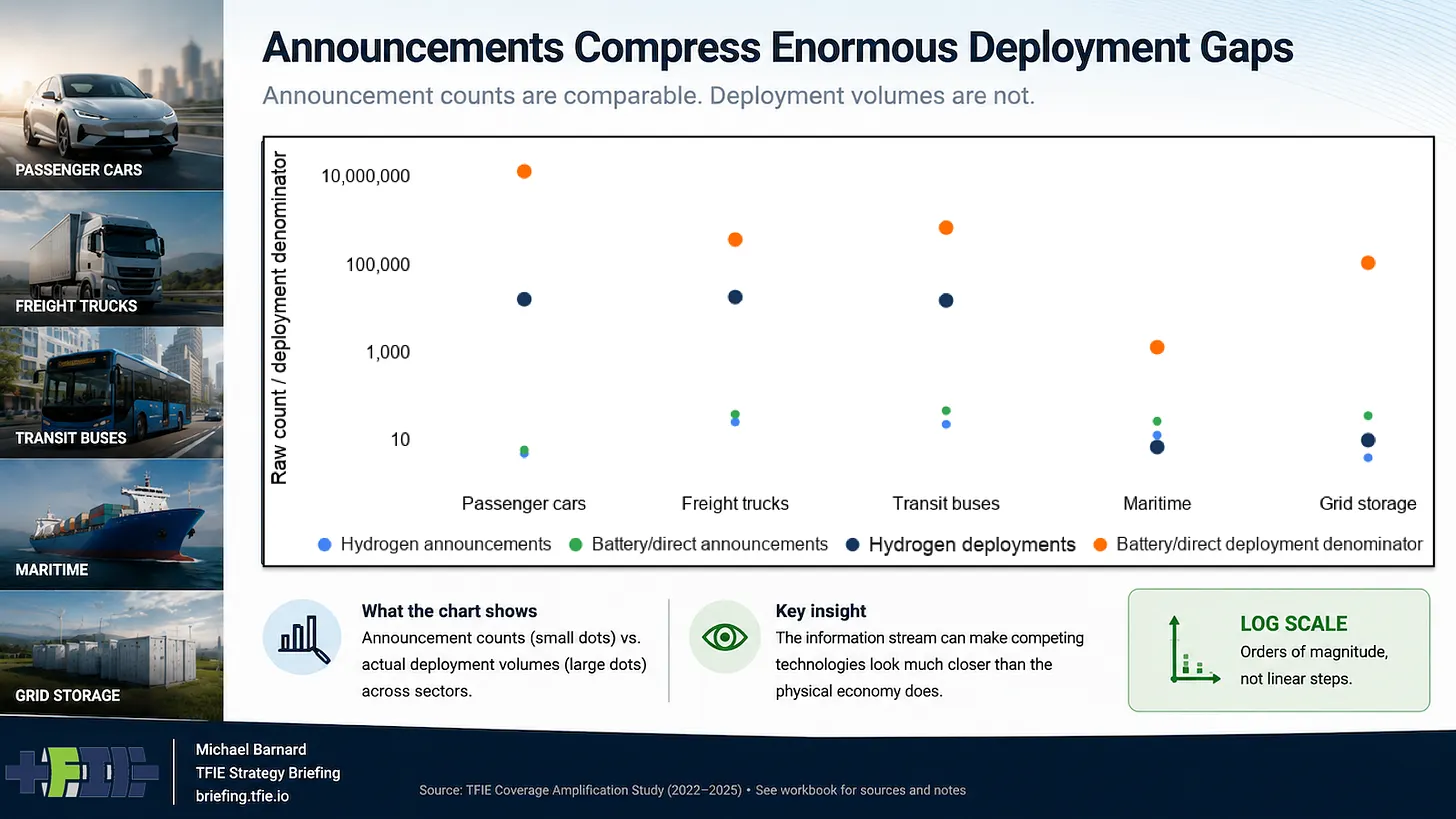
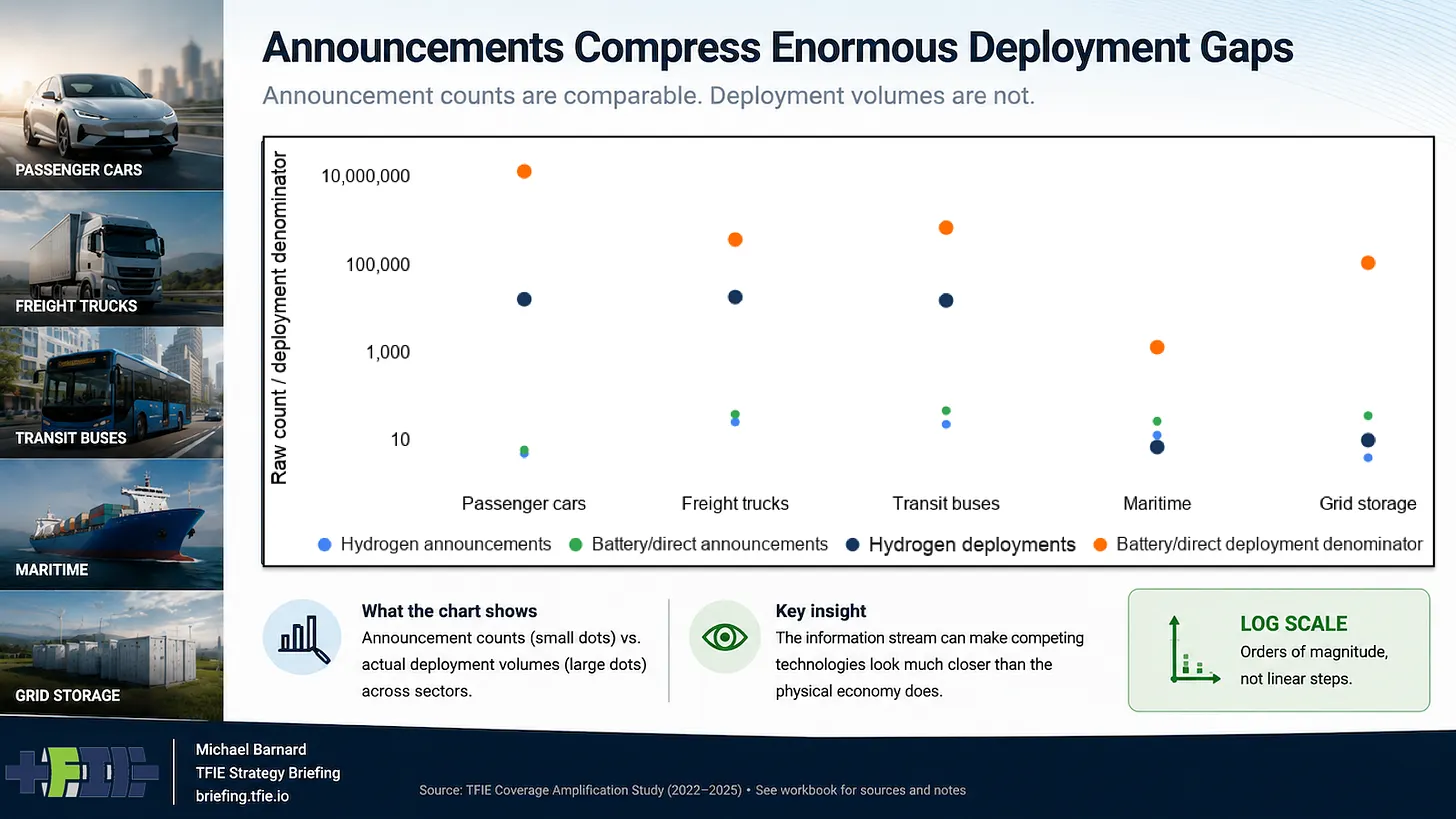
A comprehensive data analysis covering milestone registries from 2022 through 2025 reveals that the information stream surrounding hydrogen is vastly disproportionate to its actual footprint. While battery-electric technologies generate more headline mentions, the margin in the media is extraordinarily narrow compared to the chasm in physical units. In sector after sector, announcement ratios hovering between 1.5-to-1 and 9-to-1 mask actual market deployment gaps that stretch from tens to more than 10,000 times in favor of direct electrification.
This phenomenon is not necessarily the result of malicious misinformation or uncritical journalism. Instead, it is a structural quirk of how news functions versus how markets scale. As clean-energy technologies mature, widespread deployment becomes routine, unexciting, and fundamentally un-newsworthy. Conversely, the scarcity of hydrogen pilots, first-of-a-kind demonstrations, and high-profile publicity stunts ensures that they command outsized media attention. Understanding this "narrative density" is crucial for policymakers, investors, and analysts who must learn to separate market creation from media noise.
Detailed Chronology: Tracking the 2022–2025 Information Stream
To understand how this perceptual distortion occurs, researchers established a bounded register of positive clean-energy milestones occurring between 2022 and 2025. By cataloging corporate announcements, government funding awards, trade publications, and general media reports, analysts sought to quantify the "noise level" of both technological pathways.
The Baseline Information Flow
Across all monitored sectors, battery-electric technologies generated 206 positive milestone announcements during the sample period, compared to 114 for hydrogen. At first glance, a 1.8-to-1 ratio suggests that hydrogen is a major player, occupying roughly 35% of the conceptual space in the clean-energy transition conversation.
However, looking at the chronological rollout of these announcements reveals a stark divergence in what those milestones actually represent.

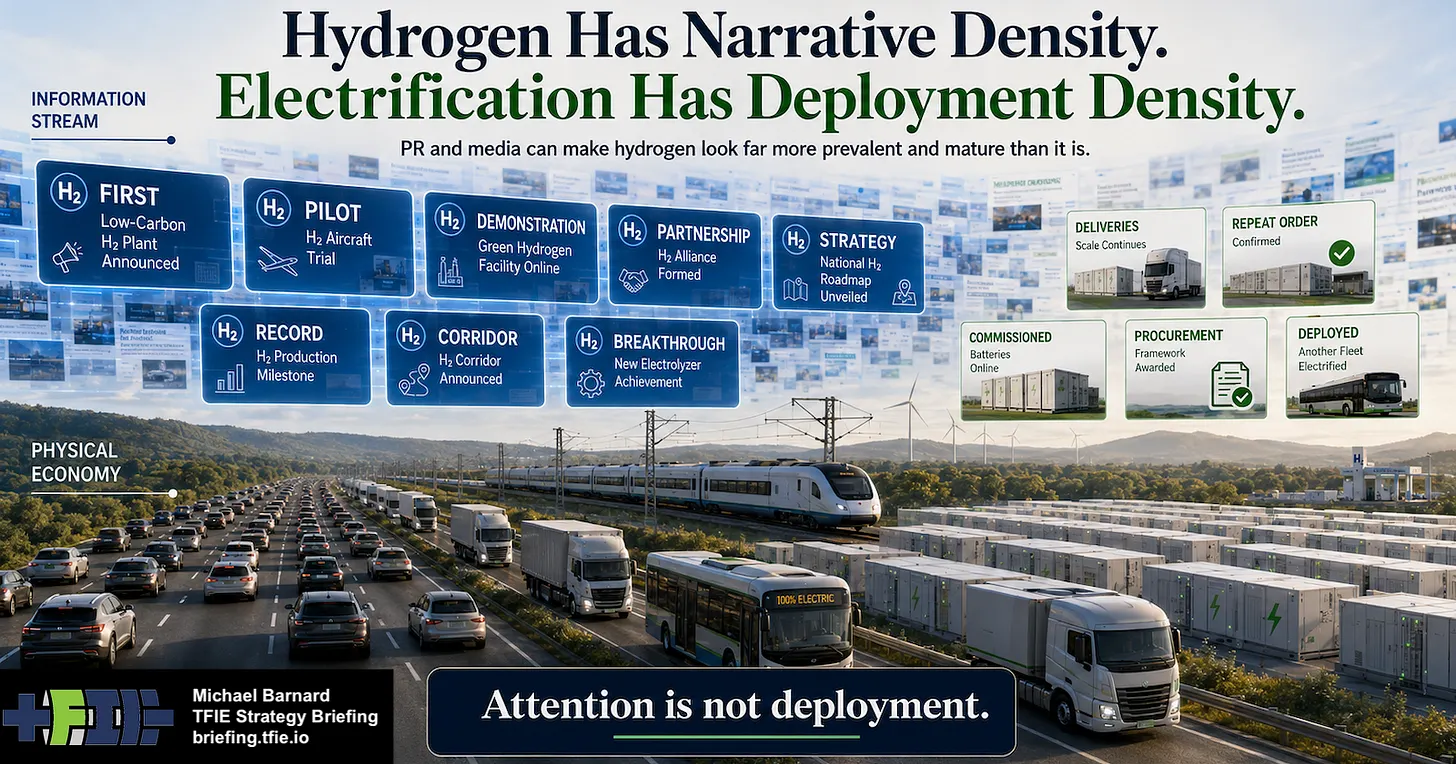
- The Battery Stream: The vast majority of battery-related announcements between 2022 and 2025 represented scaled commercial deployment, multi-year repeat procurement contracts, gigafactory expansions, and fleet-wide rollouts.
- The Hydrogen Stream: Conversely, hydrogen announcements heavily skewed toward initial pilot programs, prototype testing, government-funded feasibility studies, and single-unit demonstrations.
When mapped across individual industries, this discrepancy transforms from a minor reporting skew into an absolute distortion of market reality.
Supporting Context & Metrics: The Reality of Physical Denominators
The illusion of parity shatters completely once "physical denominators" are restored to the equation. When you compare media mentions to tangible, operating units in the field, the scale of the distortion becomes staggering.
1. Freight Trucks
In the heavy-duty freight sector, the announcement ratio between battery-electric and hydrogen milestones sits at a modest 1.5-to-1 in favor of batteries. A reader might reasonably assume a competitive race in the trucking industry.
The physical reality tells an entirely different story. By the end of 2025, China alone had deployed approximately 366,000 electric heavy trucks. In stark contrast, the global total for fuel-cell heavy trucks hovered around 18,000 units—the vast majority of which were also concentrated in select Chinese regional pilot zones. An information stream suggesting a competitive neck-and-neck race actually conceals a 20-to-1 physical deployment gap.
2. Transit Buses
Public transit reveals a parallel narrative. Milestone tracking identified 47 battery bus announcements versus 23 hydrogen bus announcements—roughly a 2-to-1 ratio.
On the ground, more than 680,000 electric buses were operating in China alone by the close of 2025, supported by rapidly growing fleets across Europe, Latin America, and North America. Globally, operating fuel-cell buses struggled to clear 15,000 units. The transit sector represents one of hydrogen’s relative success stories, yet the deployment reality remains orders of magnitude behind battery-electric alternatives.
3. Maritime Shipping
Maritime applications show an announcement ratio of roughly 2-to-1 favoring battery systems. Yet, data from maritime classification society DNV reveals an operating global fleet comprising more than 1,300 battery-equipped vessels, compared to a mere 7 hydrogen-fuelled vessels in active commercial service. Here, the narrative density of zero-emission shipping often treats hydrogen as an equal co-pilot to batteries, despite a physical ratio exceeding 180-to-1.
4. Passenger Cars and Grid Storage
Passenger vehicles and grid-scale storage push this analytical compression to its absolute limits.
- Passenger Cars: The information stream recorded 5 hydrogen milestone roots against 6 battery roots—near parity. The sales denominator for 2025, however, tells a tale of two worlds: roughly 16,000 fuel-cell passenger vehicles worldwide versus approximately 13 million battery-electric cars sold in that single year.
- Grid Storage: Information tracking identified 4 genuine hydrogen storage announcement roots compared to 36 battery storage roots—a 9-to-1 information difference. Physically, the comparison is staggering. Hydrogen managed approximately 10 MW of experimental or demonstration capacity, while global battery storage additions surpassed 108,000 MW in 2025. Measured purely by power capacity, the market scale disparity is roughly 10,800 to 1.
| Sector | Announcement Ratio (Battery vs. Hydrogen) | Physical Deployment (Battery vs. Hydrogen) | Approximate Scale Gap |
|---|---|---|---|
| Freight Trucks | ~1.5 : 1 | ~366,000 vs. ~18,000 (China) | ~20 : 1 |
| Transit Buses | ~2 : 1 | ~680,000 (China) vs. ~15,000 (Global) | ~45 : 1 |
| Maritime Shipping | ~2 : 1 | >1,300 vs. 7 (DNV Fleet Data) | ~185 : 1 |
| Passenger Cars | ~1 : 1 (5 vs. 6) | ~13 Million vs. ~16,000 (2025 Sales) | ~800 : 1 |
| Grid Storage | ~9 : 1 | ~108,000 MW vs. ~10 MW (2025) | ~10,800 : 1 |
Official Statements and Industry Insights: The Mechanics of Narrative Density
Why does this disconnect persist? The core issue is that news cycles and media ecosystems are organized around discrete events, whereas mature industrial markets are organized around cumulative scale.
A logistics firm ordering 500 battery-electric delivery vans often generates a single, easily overlooked press release. Conversely, a consortium launching a single hydrogen fuel-cell switcher train, a regional hydrogen bus pilot, or a prototype maritime vessel generates waves of publicity across trade publications, mainstream outlets, and corporate stakeholder networks.
The Scarcity Premium
Because mature technologies like lithium-ion batteries and direct-drive electric motors have become ubiquitous, routine purchases and multi-gigawatt gigafactory expansions are no longer inherently newsworthy. They are business-as-usual.
Hydrogen, by contrast, benefits from a scarcity premium. Because physical deployments are rare, every single instance of a hydrogen pilot, demonstration project, or record-breaking vehicle retains high novelty value.
A striking illustration of this dynamic is JCB’s Hydromax record-breaking vehicle. The custom-built hydrogen-combustion streamliner completed two FIA-observed runs at Bonneville, ultimately averaging 406.320 mph. Following the feat, news aggregation platforms tracked 127 distinct sources covering the record story, building upon an earlier publicity cycle that had already spawned an 88-source cluster.
The engineering achievement was genuine, but its commercial denominator remained static: one vehicle. There was no commercial fleet, no active customer utilization schedule, no proven operating economics, and no pipeline of repeat commercial procurement. What multiplied exponentially was media exposure, not underlying market evidence.

Commercial Maturity and Stage Laddering
When researchers evaluated the commercial maturity of the events in the four-year sample using a seven-stage commercialization ladder, the structural divide became even clearer:
- Battery Events: Averaged 5.97 on the commercialization scale, with roughly 82% of all tracked events representing scaled deployment, full commercial availability, or repeat procurement contracts.
- Hydrogen Events: Averaged 4.40 on the scale, with only about 40% representing scaled deployment or repeat orders. The remainder consisted of early-stage research, government-backed pilots, and proof-of-concept demonstrations.
This does not imply that hydrogen projects never achieve commercial viability. Transit buses and passenger rail systems serve as legitimate counterexamples, where repeat hydrogen procurements and meaningful operating experience have taken root in specific, highly subsidized regional markets. However, analysts stress that successful demonstrations, paid pilots, intermittent operations, and large-scale repeat procurement are fundamentally different categories of evidence. They must never be treated as commercial equivalents.
Future Outlook: Navigating the Information Stream
As the global energy transition accelerates through the late 2020s, the divergence between narrative density and physical deployment poses significant risks for capital allocation, strategic policymaking, and public discourse.
When an information stream systematically compresses massive deployment gaps into similarly sized news stories, non-experts are prone to false equivalencies. Policymakers risk misallocating finite public subsidies toward sectors where direct electrification is already commercially and logistically dominant, while investors may fall prey to hype cycles that fail to translate into long-term revenue or carbon reduction.
Recommendations for Analysts and Stakeholders
To cut through the noise, energy sector observers must adopt rigorous analytical disciplines:
- Demand Denominator Discipline: Never evaluate a technology based solely on the volume of press releases or media mentions it generates. Always ask for the physical denominator: How many units are actively operating, and who is paying for them?
- Deconstruct Commercial Maturity: Distinguish clearly between a government-funded pilot project and a self-sustaining commercial market characterized by un-subsidized repeat procurement.
- Recognize the Novelty Trap: Understand that media interest often correlates inversely with deployment maturity. The fewer units there are in the field, the easier it is for each new unit to capture disproportionate headline space.
Ultimately, hydrogen retains vital, specialized roles to play in the deep decarbonization of hard-to-abate sectors where direct electrification is thermodynamically or logistically impractical—such as green ammonia production, steel manufacturing, and specific heavy chemical feeds. However, recognizing its true place in the global energy landscape requires looking past the dazzling glare of announcements, records, and pilot projects to measure the quiet, unstoppable momentum of physical deployment on the ground.