






Executive Overview
The global maritime supply chain is facing a critical bottleneck at one of its most vital transit corridors. Just two years after enduring the most severe drought in its history, the Panama Canal is once again under siege from a rapidly strengthening El Niño climate pattern. This cyclical meteorological phenomenon threatens the delicate hydrological balance of the freshwater-dependent waterway, forcing shipping conglomerates, commodity traders, and logistics networks to brace for renewed operational disruptions.
Unlike sea-level channels such as the Suez Canal, the Panama Canal operates via an intricate, gravity-fed lock system reliant entirely on freshwater from artificial inland lakes. As rising global temperatures and shifting wind patterns deplete these reservoirs, the Panama Canal Authority (ACP) has been forced to walk back its previous assurances of uninterrupted service. The authority has instituted a series of progressive cuts to daily vessel transits, triggering a scramble for alternative routes and sparking high-stakes bidding wars for coveted passage slots.
The systemic implications of these disruptions are profound. With the canal handling approximately 5% of global maritime trade—including critical shipments of liquefied petroleum gas (LPG), liquefied natural gas (LNG), agricultural bulk, and containerized consumer goods—the current crisis threatens to ripple through the global economy. Shippers are facing a difficult choice: pay multimillion-dollar premiums at auction to bypass queues, wait weeks in congested anchorages, or undertake costly, carbon-intensive detours around the Cape of Good Hope.
As climatologists warn of a "very strong" El Niño persisting through the winter of 2026–2027, the crisis highlights the vulnerability of global trade infrastructure to climate volatility, forcing a reckoning over the long-term viability of the century-old canal.
+-----------------------------------------------------------------------------+
|                         THE PANAMA CANAL DILEMMA                            |
+-----------------------------------------------------------------------------+
|                                                                             |
|   [El Niño Warming] ---> [Weakened Winds & Rain] ---> [Reservoir Depletion] |
|                                                                |            |
|                                                                v            |
|   [Cape of Good Hope Detour] <--- [Transit Caps & Auctions] <--+            |
|   (Adds 19 Days to Transit)        (Up to $4M+ Per Slot)                    |
|                                                                             |
+-----------------------------------------------------------------------------+
Detailed Chronology of the Hydrological Crisis
To understand the current crisis, one must examine the timeline of meteorological anomalies and regulatory adjustments that have brought the Panama Canal to this juncture.
2023–2024              Early 2026             May–July 2026          Sept 2026
  |                        |                        |                    |
  v                        v                        v                    v
[Historic Drought] --> [Brief Recovery] --> [Record Heat/Low Rain] --> [New Transit Caps]
Daily transits         ACP normalizes       Smithsonian logs           Daily slots cut
cut to 22 vessels      operations           near-record dry spell      from 34 to 32
The Precedent: The 2023–2024 Drought
The current crisis is not an isolated incident but the continuation of a highly volatile climate cycle. During the 2023–2024 fiscal year, severe drought conditions forced the ACP to progressively slash daily transits from a normal average of 34 to 36 down to an unprecedented low of 22 vessels per day. This restriction choked transit capacity, leaving hundreds of vessels stranded in lengthy queues on both the Atlantic and Pacific approaches and costing the shipping industry billions of dollars in delays and diverted routes.
The Illusion of Recovery (Early 2026)
As seasonal rains temporarily returned in late 2024 and throughout 2025, the ACP gradually restored transit limits, eventually returning to a baseline average of 34 to 35 daily transits for the 2026 fiscal year (which runs from October to September). Industry analysts and shipping lines expressed cautious optimism that the worst of the crisis had passed, and the ACP initially pledged to maintain these normalized transit volumes.
The Summer Reversal (May–August 2026)
This optimism was short-lived. By May 2026, monitoring networks began recording a sharp decline in regional precipitation. The Smithsonian Tropical Research Institute’s (STRI) environmental monitoring network in Panama documented unprecedented atmospheric conditions: May, June, and July of 2026 registered some of the hottest air temperatures recorded since monitoring began.
Simultaneously, rainfall across the canal basin plummeted well below historical averages. By early August, recognizing that reservoir replenishment was failing to meet critical thresholds, the ACP officially walked back its previous pledge to maintain open transit.
The September Restrictions
In response to the rapid depletion of Gatún and Alajuela lakes, the ACP announced a phased reduction in vessel transits:
- September 4, 2026: Daily transit slots capped at 34 vessels.
- September 15, 2026: Daily transit slots further reduced to 32 vessels.
With water levels projected to drop continuously as the El Niño pattern intensifies, the shipping industry is bracing for even tighter restrictions heading into the winter.
Supporting Context & Maritime Metrics
The operational mechanics of the Panama Canal make it uniquely vulnerable to changes in local weather patterns. Understanding the scale of this vulnerability requires analyzing the physical infrastructure of the canal and the economic trade-offs now facing global shipping lines.
The Physics of Freshwater Transit
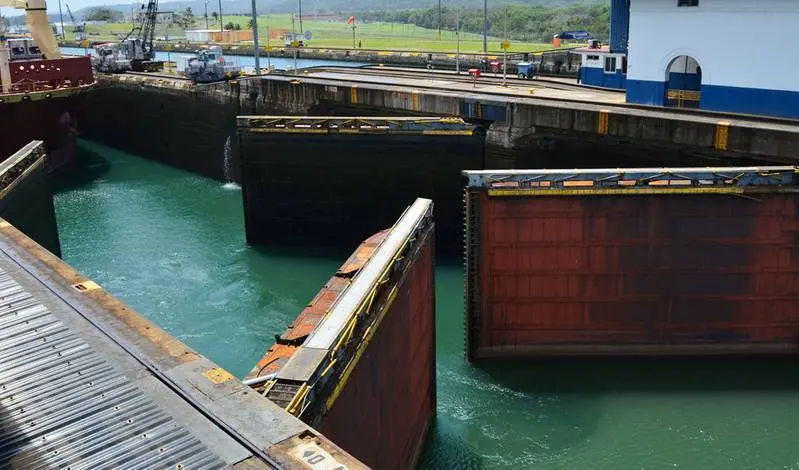
Unlike the Suez Canal, which is a sea-level ditch connecting two saltwater bodies, the Panama Canal operates as a water bridge. Ships are raised 26 meters (85 feet) above sea level to the height of Gatún Lake through a series of gravity-fed locks, and then lowered back down on the other side.
This process requires an immense volume of freshwater:
- Each transit of a single vessel flushes approximately 200 million liters (50 million gallons) of freshwater out of the lock chambers and into the oceans.
- This water is drawn directly from Gatún Lake and Alajuela Lake, reservoirs that also supply drinking water to more than half of Panama’s population, including the metropolitan area of Panama City.
When rainfall is scarce, the canal is placed in direct competition with the local population for access to freshwater, presenting a complex environmental and humanitarian challenge.
                  [Gatún Lake (26m above sea level)]
                           /
                          /
                         /
             [Gravity-Fed Locks]        [Gravity-Fed Locks]
                    |                                |
             (Atlantic Ocean)                 (Pacific Ocean)
                    ^                                ^
                    |                                |
                    +--- 200M Liters Flushed/Ship ---+
The Economics of the Queue: The Multimillion-Dollar Auction
As the ACP restricts the number of pre-booked transit slots, the remaining slots are distributed through a competitive auction system. For shipping lines carrying time-sensitive or high-value cargo, the cost of waiting in queue for weeks is economically untenable. This has led to aggressive bidding wars.
The ACP recently acknowledged that desperate shippers have paid auction premiums exceeding $1 million per transit to bypass the queue. In one extreme case, a commercial tanker reportedly paid a record $4 million premium—on top of standard transit fees—to secure a priority slot. These extraordinary costs are ultimately passed down the supply chain, contributing to inflationary pressures on consumer goods, chemicals, and energy products worldwide.
The African Detour: Cape of Good Hope vs. Panama Canal
For many vessel operators, particularly those without long-term slot packages or the capital to compete in spot auctions, the only viable alternative is to bypass the Panama Canal entirely.
For vessels sailing from the U.S. Gulf Coast (such as the energy hub of Houston, Texas) to East Asia (such as Japan or South Korea), the traditional canal route is compared against the long detour around the southern tip of Africa:
| Metric | Panama Canal Route | Cape of Good Hope Route | Variance |
|---|---|---|---|
| Transit Time (Houston to Japan) | ~26 Days | ~45 Days | +19 Days |
| Distance (Approximate) | ~9,200 Nautical Miles | ~14,500 Nautical Miles | +5,300 NM |
| Fuel Consumption (LPG Carrier) | Baseline | ~1.7x Baseline | +70% |
| Carbon Emissions | Baseline | Elevated | Significant Increase |
According to data compiled by Vortexa, approximately 50% of gas carriers heading from the U.S. to Asia chose the Cape of Good Hope over the Panama Canal in August 2026. This represents the highest share of diversions to Africa documented in over a decade, signaling a structural shift in maritime route selection.
Official Statements & Stakeholder Perspectives
The escalating crisis has drawn commentary from climate scientists, maritime analysts, and regulatory bodies, highlighting the tension between ecological limits and economic demands.
The Scientific Perspective
Climatologists emphasize that the current crisis is the direct result of atmospheric warming compounding natural climate cycles. Steven Paton, director of the physical monitoring program at the Smithsonian Tropical Research Institute (STRI) in Panama, highlighted the severity of the situation:
"Rainfall during the same period in most of Panama was well below average. Some stations are reporting record or near-record low values, particularly around the canal."
Samuel Muñoz, an associate professor of civil and environmental engineering at Northeastern University, warned of the systemic risks associated with reservoir depletion:
"When reservoirs run low, the canal authority must cut the number of ships it allows through to conserve water—a reduction that creates shipping disruptions that ripple through the global economic system."
The Regulatory Position
The Panama Canal Authority finds itself in a difficult position, balancing its role as a reliable global trade facilitator with its responsibility to protect Panama’s domestic water security. While the ACP has refrained from publishing the exact identities of the companies participating in the high-stakes transit auctions, it released a statement confirming the market-driven nature of the bidding wars:
"Some ships which transited recently have paid amounts exceeding one million dollars at auction to meet their specific market needs."
The Maritime Industry Outlook
Financial and maritime advisory firms are warning clients that the Panama Canal’s issues cannot be viewed in isolation. In a research note issued to investors, Clarksons Securities noted that the convergence of climate disruptions and geopolitical instability is creating a highly volatile environment for global shipping:
"El Niño is now emerging as a key risk for a sector already grappling with capacity constraints and geopolitical tensions in the Middle East."
This reference to the Middle East highlights the double-bind facing global trade: with the Suez Canal corridor compromised by geopolitical conflict in the Red Sea, and the Panama Canal restricted by drought, two of the world’s primary maritime shortcuts are constrained simultaneously.
Future Outlook & Long-Term Solutions
As climate models project increasingly volatile weather patterns, the long-term viability of the Panama Canal hinges on its ability to adapt. Shippers and policymakers are looking at both short-term climate forecasts and long-term infrastructural interventions.
The Near-Term Threat: A "Very Strong" El Niño
The immediate future offers little relief. In its August forecast, the Climate Prediction Center of the U.S. National Oceanic and Atmospheric Administration (NOAA) issued a stark warning:
- There is a greater than 90% probability of a "very strong" El Niño event persisting through the Northern Hemisphere fall and winter of 2026–2027.
- Historically, strong El Niño events correlate with suppressed rainfall in the Panamanian isthmus, suggesting that the water levels in Gatún and Alajuela lakes will continue to decline well into 2027.
- Further reductions in daily transits—potentially matching or exceeding the low of 22 transits seen in the 2023–24 crisis—remain a distinct possibility.
PROBABILITY OF "VERY STRONG" EL NIÑO (Winter 2026-27)
[==================================================] 90%+
The Río Indio Reservoir Proposal
Recognizing that operational adjustments alone cannot solve a structural water deficit, the ACP is advocating for a major infrastructure project: the damming of the Río Indio to create a new freshwater reservoir.
+-------------------------------------------------------------------------+
|                      RÍO INDIO RESERVOIR PROJECT                        |
+-------------------------------------------------------------------------+
|  * Est. Construction Time: 5 to 6 Years                                 |
|  * Est. Cost: $1.2 Billion+                                             |
|  * Primary Benefit: Secures canal operations & drinking water for 50 yrs |
|  * Key Obstacle: Intense local resistance & environmental concerns     |
+-------------------------------------------------------------------------+
The ACP asserts that this reservoir would:
- Secure sufficient freshwater to support canal operations for the next 50 years.
- Guarantee the drinking water supply for Panama’s rapidly growing urban population.
- Improve hydrological resilience and socio-economic conditions in surrounding rural communities.
Social and Environmental Resistance
Despite the clear economic incentives, the Río Indio project faces steep political and environmental opposition. Panama has a strong history of environmental activism; notably, widespread protests recently forced the cancellation of First Quantum Minerals’ lucrative Cobre Panama copper mine contract.
Activists and local community leaders are mobilizing against the Río Indio reservoir, arguing that:
- The project would displace thousands of rural and indigenous families living in the basin.
- Damming the river would cause irreversible ecological damage to local biodiversity.
- Alternative, less invasive options—such as utilizing water from Lake Bayano, an existing reservoir in eastern Panama—should be thoroughly exhausted before new dams are constructed.
Conclusion
The crisis at the Panama Canal is a clear example of how climate change impacts global trade. As the canal authority balances water conservation, domestic consumption, and international shipping demands, the maritime industry must adapt to a more volatile future.
Whether through expensive infrastructure projects like the Río Indio reservoir or a permanent shift toward longer, costlier shipping routes, the cost of moving goods across the globe is rising. In an era of climate instability, the historical geographic shortcuts that built modern global trade can no longer be taken for granted.