








Executive Overview
For years, advocates of the hydrogen economy have argued that the missing puzzle piece for clean energy adoption was not technology, but demand. Governments were routinely chastised for funding R&D or localized pilot projects without establishing a secure marketplace for the end product. Poland decided to break this mold. Through a coordinated industrial policy featuring public subsidies for municipal transit authorities, investments in refueling infrastructure, and capital allocations for renewable hydrogen generation, Warsaw deliberately manufactured a market.
By April 2026, the strategy appeared to be an unmitigated success on paper: Poland registered 153 hydrogen buses, with 140 actively navigating urban routes and an additional 107 under contract. This was no longer a theoretical exercise or a collection of isolated demonstration projects; it was a functioning, scaling transit paradigm.
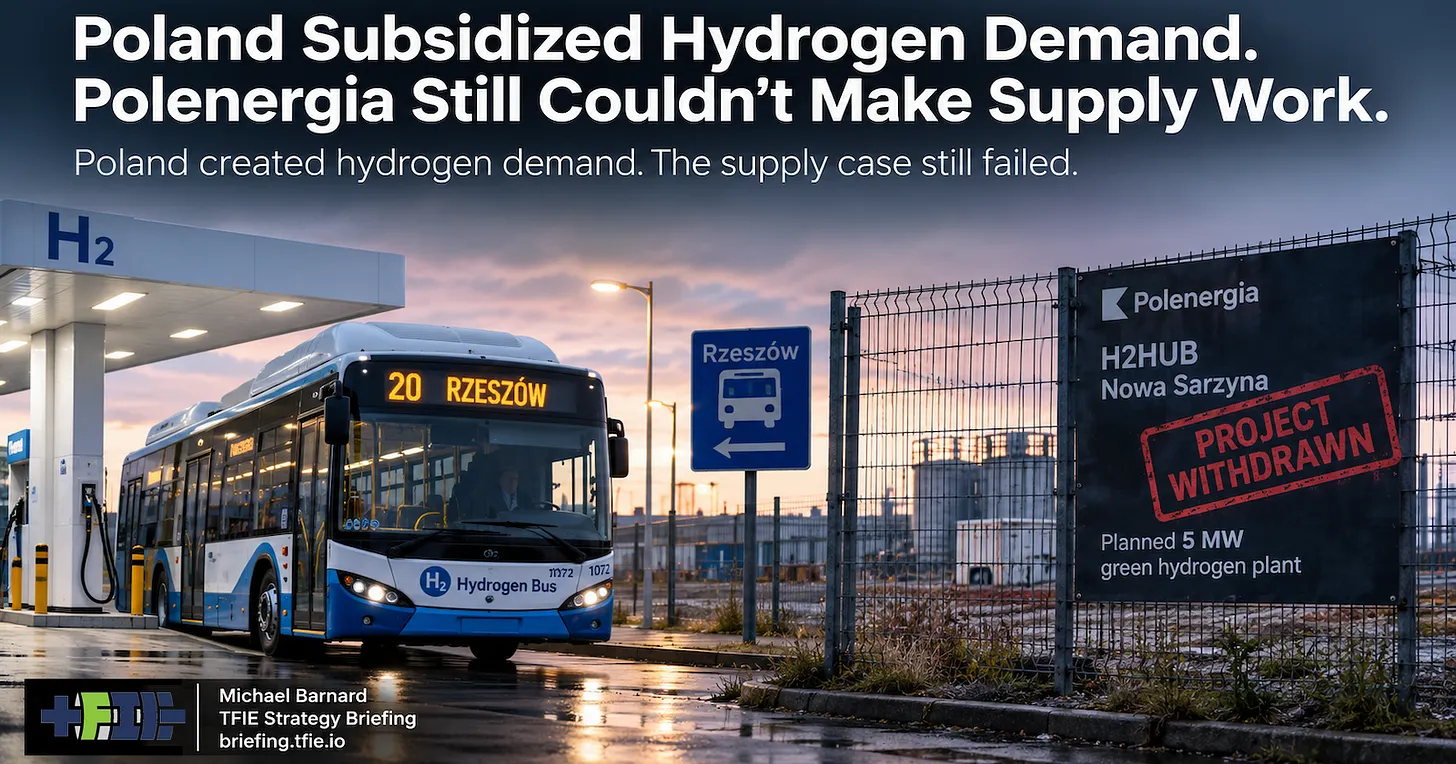
Yet, a fundamental friction point within the green energy transition soon revealed itself. Polenergia—Poland’s largest private energy group and the anchor producer meant to supply this nascent fleet—abruptly walked away from its flagship local green-hydrogen supply agreement. Despite securing building permits, clearing factory acceptance tests for its electrolyzers, and winning a lucrative municipal fuel-supply tender, the energy giant retreated from the transport hydrogen sector.

Polenergia’s retreat exposes a systemic vulnerability in top-down industrial planning: while public subsidies can successfully force-multiply vehicle demand, they do not automatically ensure that a commercially viable, resilient, and economical local supply chain will organically follow. As municipalities across Poland grapple with long-term contractual commitments for fuel-cell buses devoid of their intended local green fuel source, the nation’s hydrogen experiment offers a cautionary tale for policymakers worldwide.
Detailed Chronology: From Ambition to Abandonment
Engineering a Market from the Top Down
Poland’s strategy was rooted in classical industrial-policy logic. To build a domestic low-carbon hydrogen industry, the nation needed to solve the classic chicken-and-egg dilemma. Without refueling stations, transport operators would not buy fuel-cell buses. Without buses, energy companies would not build production facilities. Without production plants, stations would sit empty.
The Polish government intervened across every segment of this value chain simultaneously:
- The Demand Side: Municipalities were incentivized via public grants to transition their urban transit fleets away from diesel and compressed natural gas (CNG) in favor of hydrogen fuel cells.
- The Infrastructure Side: Capital expenditure support was funneled into building out a network of hydrogen refueling stations.
- The Supply Side: Financial backing was offered to renewable-hydrogen production projects to ensure that domestic facilities would be ready to feed the newly minted demand.
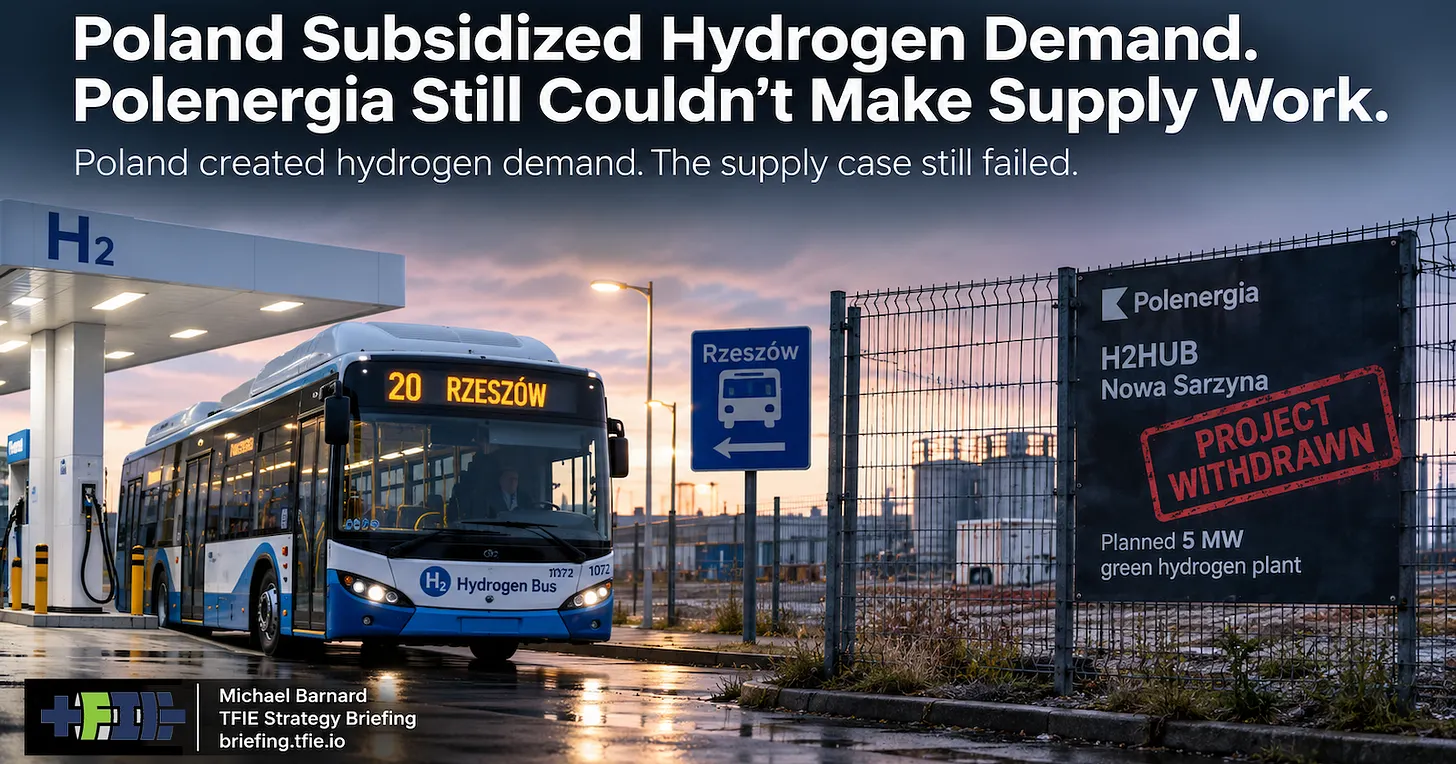
By the spring of 2026, this interventionist approach had yielded tangible fleet numbers. Cities like Rzeszów embraced the transition, laying the groundwork for a hydrogen-powered public transport network. However, the linchpin of the regional supply ecosystem—Polenergia’s Nowa Sarzyna project—began to fray under the weight of market realities.
The Rise and Fall of the Nowa Sarzyna Project
Polenergia’s involvement represents one of the most advanced attempts to commercialize green hydrogen in Central and Eastern Europe. The company’s Nowa Sarzyna initiative was far more than a conceptual drawing-board exercise. It was meticulously designed as a 5-megawatt (MW) renewable-hydrogen plant engineered to churn out approximately 500 tonnes of green hydrogen annually, complete with integrated distribution and local refueling infrastructure.
The project secured high-profile backing and advanced rapidly:
- Technology Partnerships: Hystar was contracted to supply state-of-the-art electrolyzers.
- International Financing: The International Finance Corporation (IFC) stepped in to support developmental expenditures and equipment procurement costs.
- Public Grants: Polish public funds were secured to offset the capital expenditure of the associated refueling infrastructure.
- Regulatory Milestones: By October 2024, the Nowa Sarzyna project had secured its official building permit. Crucially, all eight of its advanced electrolyzer stacks had successfully completed factory acceptance testing (FAT).
In the notoriously slow-moving green hydrogen sector, passing factory acceptance tests and securing construction permits represents the final hurdle before ground is broken. Polenergia had crossed it.
The Rzeszów Municipal Tender and the Sudden Pullback
The missing piece—the guaranteed customer—was seemingly secured in October 2024. Rzeszów’s municipal transit operator launched a procurement initiative for hydrogen to fuel 20 newly acquired fuel-cell buses. Polenergia entered the competitive tender and won, securing a 15-year fuel-supply agreement valued at approximately PLN 120 million.
All components of the industrial policy loop were ostensibly closed: government-backed demand existed, a major private energy player was at the helm, production was permitted, equipment was manufactured and tested, public subsidies were active, and a long-duration municipal customer was locked in.
Yet, just three months later, in January 2025, Polenergia executed a dramatic pivot. The company announced it could not finalize the Rzeszów agreement. While public statements cited specific legal ambiguities within the municipal tender framework alongside logistical risks regarding on-time delivery, the decision was symptomatic of a much deeper corporate reassessment.
Subsequent strategic disclosures from Polenergia outlined a deliberate, gradual withdrawal from the hydrogen transportation sector. The company pointed to persistent headwinds: the slow developmental velocity of the broader green hydrogen market, disproportionate project investment risks, and increasingly constrained financing possibilities in the clean-fuel space.
Supporting Context & Metrics: The Structural Mismatch
To understand why Polenergia walked away from a fully permitted, subsidized, and contracted multi-million-dollar project, one must examine the underlying economic and operational realities of hydrogen transit.
The Fleet vs. Fuel Disconnect
The core structural flaw in the subsidy-driven model lies in lifecycle commitment asymmetry. When a municipal transit authority utilizes government grants to purchase a fleet of hydrogen fuel-cell buses, those vehicles lock the city into a decades-long operational dependency. A bus has a multi-year service life; it must be refueled every single day, regardless of whether the regional green hydrogen ecosystem evolves, matures, or collapses.
[Public Subsidies] ---> [Municipal Bus Purchases] ---> [Locked-in Long-Term Demand]
                                                                |
                                                      (Supply Chain Break)
                                                                v
                                              [High Costs / Import Reliance / Fossil Fallback]
Public subsidies can artificially reduce the initial capital expenditure (CapEx) required to purchase a fuel-cell bus, making the technology superficially competitive with battery-electric alternatives. However, subsidies do not magically alter the operating expenditure (OpEx) of the fuel itself. Green hydrogen remains an expensive energy carrier, plagued by high conversion losses during electrolysis, complex compression and storage logistics, and high maintenance costs for refueling stations with low utilization rates.
The Industrial Reality: Where Does Hydrogen Actually Belong?
Polenergia’s retreat highlights a broader economic truth that energy analysts have increasingly emphasized: not all decarbonization sectors are created equal when it comes to hydrogen.

- Hard-to-Abate Industrial Sectors: Poland already consumes massive volumes of fossil-derived "grey" hydrogen in sectors such as petroleum refining, chemical manufacturing, and fertilizer production. These industries represent concentrated, massive, and continuous baseline demand. Replacing high-carbon hydrogen with green hydrogen in these established industrial hubs represents a genuine, scalable decarbonization task where molecules are chemically indispensable.
- Urban Transportation: Hydrogen buses occupy an entirely different strategic category. They operate in a space where a mature, highly efficient direct-electric alternative (battery-electric buses) already exists. Battery-electric transit benefits from vastly superior well-to-wheel energy efficiency, lower per-kilometer operating costs, and rapidly maturing depot-charging infrastructure. Forcing hydrogen into urban mass transit requires building an entirely novel, capital-intensive retail fuel supply chain for a fleet that could often be more cost-effectively electrified via batteries.
Official Statements & Industry Perspectives
The fallout from Polenergia’s withdrawal and Poland’s unfolding hydrogen narrative has triggered intense debate among industry leaders, financial institutions, and municipal officials.
Industry analysts tracking the Central and Eastern European energy transition have noted that Polenergia’s exit is a watershed moment. As detailed in specialized sector evaluations, the episode demonstrates that even when a company successfully navigates the administrative labyrinth of permitting, technology procurement, and long-term municipal contracting, the macro-investment case can still disintegrate under financial scrutiny.
"This was not simply a declaration that hydrogen cost too much," notes analysis from strategic energy briefings monitoring the Polish market. "Polenergia got much farther than the typical hydrogen project before it walked away. The company systematically evaluated the complete investment case—spanning regulatory friction, asset risk, and long-term capital availability—and consciously chose to reduce its exposure."
For municipalities like Rzeszów, the withdrawal of a local green hydrogen supplier created an immediate operational scramble. Once a city commits to hydrogen buses, it cannot simply park them when a local supply contract falls through. Transit operators are forced to source hydrogen from alternative, often more distant or carbon-intensive suppliers, undermining the environmental integrity and financial predictability that the original subsidies were designed to guarantee.
Future Outlook: Where Does Poland’s Hydrogen Strategy Go From Here?
As Poland navigates the post-2026 landscape of its clean energy transition, the lessons learned from the Nowa Sarzyna project and the country’s bus fleet expansion will heavily influence future policymaking.
1. A Shift Toward Industrial Clustering
Future investments in green hydrogen are likely to pivot away from retail transportation networks and toward concentrated industrial clusters. Policymakers are beginning to recognize that supporting localized, small-scale production plants tied to municipal bus fleets carries an unacceptably high commercial risk. Instead, future clean hydrogen deployment will likely focus on large-scale industrial integration—such as decarbonizing heavy chemical plants and refineries—where steady, high-volume off-takers can underwrite the massive capital costs of electrolyzer installations.
2. Re-evaluating Transit Decarbonization Portfolios
Municipalities that have already integrated hydrogen buses into their fleets will be forced to develop more resilient supply arrangements, potentially relying on regional pipeline networks or multi-source supply agreements rather than depending on a single, localized green-hydrogen producer. However, as capital expenditure budgets tighten, future urban transit procurements in Poland and across the European Union are expected to lean more heavily toward direct battery-electric solutions, reserving hydrogen trials for heavy-duty freight, rail, and maritime applications where electrification is genuinely challenging.
3. The Test for Subsidy-Driven Models
Poland’s experience serves as a live-fire stress test for the European Union’s broader alternative fuels infrastructure regulations. It proves that while governments can successfully stimulate demand through targeted subsidies and mandates, industrial ecosystems cannot be sustained by policy mandates alone. If the underlying economics of green fuel production do not achieve parity with conventional alternatives, private capital will inevitably step back—leaving public entities to manage the structural fallout of an energy transition built on fragile supply foundations.