






Executive Overview
When most travelers picture Belize, their minds instantly conjure images of the Mesoamerican Barrier Reef: translucent turquoise shallows, overwater bungalows, remote cayes, and the iconic, ink-dark ring of the Great Blue Hole. Yet, driving inland into the Cayo District reveals an entirely different ecosystem—one that trades saltwater breezes for the crisp, pine-scented air of the Mountain Pine Ridge Forest Reserve.
Covering more than 100,000 acres of protected highland terrain, this rugged interior world offers an astonishingly diverse range of landscapes. From the towering stone architecture of the ancient Maya city of Caracol and the thundering, gravity-defying cascade of Big Rock Falls to the smooth, sun-warmed granite swimming terraces of Rio On Pools, the reserve is a masterclass in natural contrast.
The timing for an inland Belize expedition has never been more compelling. As the region heads into the winter travel season, access from North America is expanding dramatically. Bolstered by five new nonstop U.S. routes—including service from Boston, Raleigh-Durham, and three key Florida gateways—alongside expanded Canadian flight options via carriers like WestJet, reaching the country is smoother than ever. This growing airlift allows international travelers to seamlessly pair Belize’s world-renowned coast with several immersive days in its wild, archaeological-rich western interior. Anchored by premier eco-sanctuaries like Blancaneaux Lodge and Gaia Riverlodge, the Mountain Pine Ridge presents a side of the Caribbean that many visitors never knew existed.
Detailed Chronology: A Journey Through the Pine Highlands
A successful expedition through the Mountain Pine Ridge requires thoughtful pacing. Because the reserve’s attractions are spread across a vast, rolling landscape of red dirt roads, pine stands, and dense river valleys, travelers must transition away from island-time relaxed schedules and embrace early morning departures.
Morning: The Deep Trek to Caracol
The deepest and most historic journey in the reserve leads to Caracol, an ancient Maya metropolis situated near the Guatemalan border. The route itself acts as a threshold, carrying motorists through miles of dense, untouched forest before the monumental stone architecture abruptly emerges from the jungle canopy.
At its historical peak, Caracol was one of the most powerful and populous urban centers in the entire Maya world, engaging in complex political alliances and rivalries with cities like Tikal. Its archaeological core features sprawling plazas, residential complexes, intricate stone carvings, and Caana (the "Sky Palace"), an enormous multi-tiered temple complex that remains one of the tallest man-made structures in Belize.
Walking the sun-drenched plazas after the long, remote drive fundamentally shifts a traveler’s perception of the region. The silence of the surrounding forest accentuates the site’s isolation, while the monumental scale of the architecture testifies to its past political dominance. Beyond the ruins and the panoramic views from the top of Caana, the most unforgettable sensory element of Caracol is acoustic: the spectacular, otherworldly shrieks of wild howler monkeys echoing through the canopy—a primal soundtrack that lingers long after departure.
Midday: Descent to Big Rock Falls
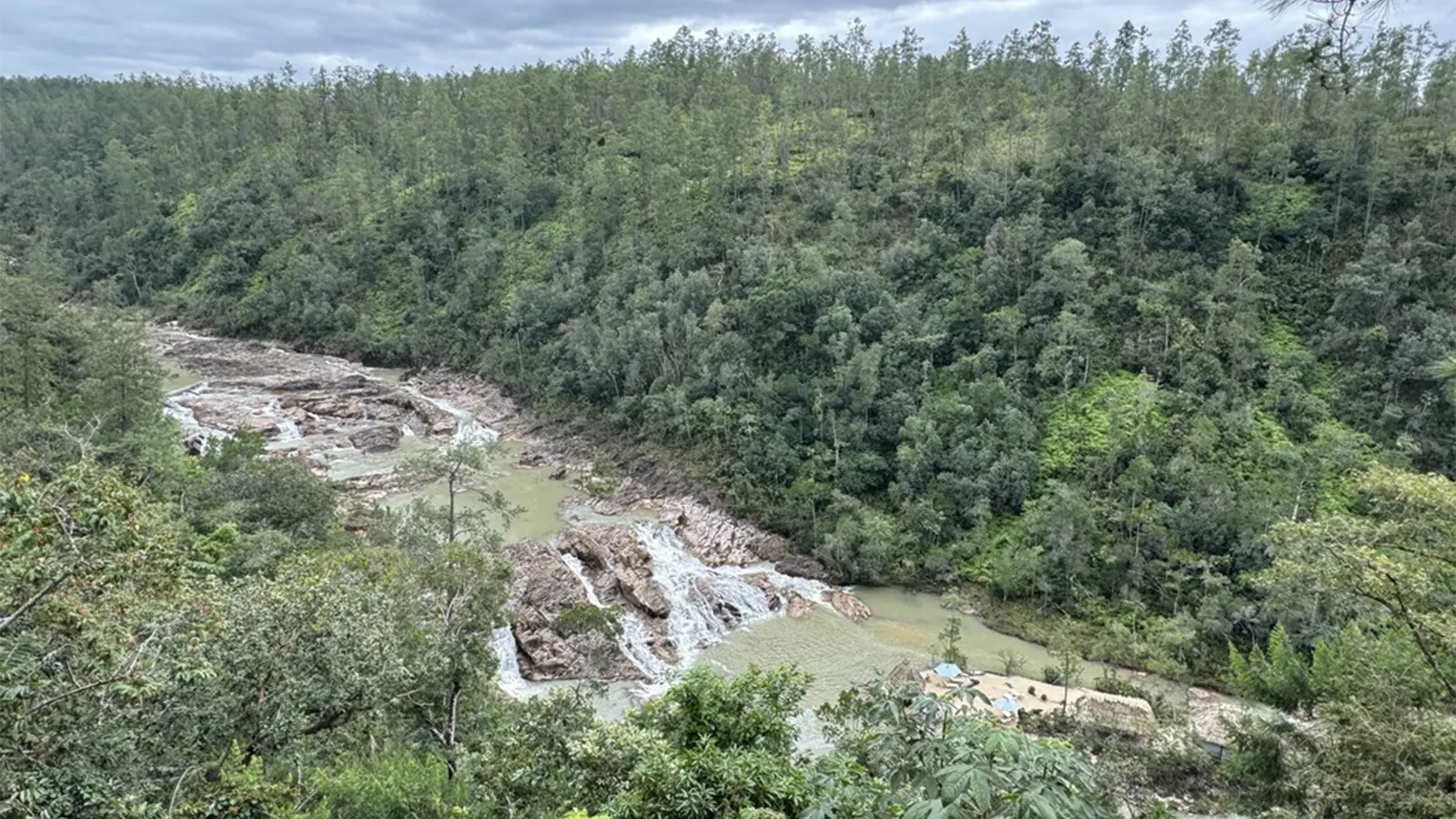
Leaving the antiquity of Caracol behind, the itinerary shifts from historical reflection to visceral natural power at Big Rock Falls. Unlike roadside lookouts, reaching this natural wonder requires a deliberate descent down a sturdy wooden staircase carved into a lush, green ravine.
As you approach, the ambient noise of the forest is steadily overtaken by the roar of water. The destination reveals itself dramatically: a massive volume of water plunges over a jagged cliff face into a deep, emerald-green pool framed by monumental granite boulders and thick tropical vegetation.
While the pool serves as one of the reserve’s premier swimming holes, water levels and currents demand respect. Visitors are advised to heed local guidance regarding current conditions and exercise caution around wet stone surfaces. Following the physical exertion of climbing the Maya ruins at Caracol, sitting beside the churning cascade offers an ideal setting to cool off and appreciate the raw, sculpted beauty of the reserve.
Afternoon: Granite Terraces and Subterranean Chambers
As the afternoon sun warms the landscape, travelers typically transition toward Rio On Pools. Here, the Rio On river takes on an entirely different character, flowing smoothly across wide, multi-tiered granite formations. Rather than plunging in a single massive drop, the water spreads across broad stone terraces, creating a collection of natural Jacuzzis, water slides, and calm swimming pockets.
Families and groups often gravitate toward this section of the reserve because the varied terrain offers something for every comfort level. Some channels move swiftly between smooth stone chutes, while others form placid, shallow pools ideal for relaxation.
Depending on the day’s schedule, an expedition can also incorporate Rio Frio Cave, one of the region’s most accessible geological anomalies. Featuring a colossal arched limestone entrance measuring some 65 feet high, the cavern allows visitors to walk completely through a subterranean world carved by the Rio Frio. Shafts of daylight pierce the gloom, illuminating massive stalactites and the cool, rushing river below, providing an impressive taste of Belize’s famous cave systems without requiring advanced spelunking gear.
Supporting Context & Metrics: Logistics, Access, and Accommodations
Exploring the Mountain Pine Ridge requires a higher degree of logistical preparation than a standard beach holiday. The interior environment demands robust planning regarding fuel, offline navigation, and vehicle capabilities.
Infrastructure and Vehicle Readiness
While road improvements have steadily increased accessibility across western Belize, travel times within the Cayo District remain variable depending on recent weather events. Unpaved forestry roads can become slick and challenging following heavy seasonal rains. Consequently:
- Vehicle Selection: A high-clearance, four-wheel-drive vehicle is strongly recommended, particularly for remote routes such as the drive to Caracol.
- Connectivity: Cellular service is intermittent or entirely absent across large swaths of the reserve. Downloading offline maps and confirming itineraries with local operators is essential.
- Guidance: First-time visitors frequently benefit from hiring a certified local guide. Professional guides not only ensure seamless navigation but also unlock the layered histories of the forest, river ecosystems, and Maya ruins that might otherwise go unnoticed.
Premier Eco-Lodges as Basecamps
Luxury and sustainability intersect harmoniously within the reserve, offering travelers world-class sanctuaries from which to launch their inland adventures:
- Blancaneaux Lodge: Founded by acclaimed filmmaker Francis Ford Coppola, this legendary luxury retreat sits directly on the banks of Privassion Creek. Featuring a collection of thatched-roof cabanas and villas, Blancaneaux operates as a secluded mountain wonderland where the surrounding reserve is the primary attraction. Coppola’s vision emphasizes organic farming, hydroelectric power, and deep integration with the landscape, making it an exceptional base for guided excursions to Caracol.
- Gaia Riverlodge: Perched dramatically above the Five Sisters Waterfalls, Gaia places aquatic immersion at the heart of the guest experience. A private hydro-powered tram descends through the forest canopy to the river level, where guests can swim directly beneath the falls. It serves as an ideal pairing for travelers prioritizing waterfalls, forest hiking, and slower-paced exploration.
- San Ignacio Gateway & Boutique Options: For travelers desiring proximity to town amenities, local dining, and cultural vibrancy, the nearby town of San Ignacio acts as an ideal portal. Boutique properties like Ka’ana Resort offer sophisticated accommodations near major archaeological sites such as Xunantunich and Cahal Pech, often providing attractive seasonal pricing variations during shoulder months.
Official Statements and Industry Insights
Tourism authorities and hospitality leaders across Belize continue to emphasize the vital economic and environmental importance of diversifying the national tourism product beyond coastal attractions.
"The Mountain Pine Ridge is the beating heart of inland Belize," notes a regional conservation liaison based in the Cayo District. "For decades, international marketing focused almost exclusively on the barrier reef and cayes. However, modern travelers are increasingly sophisticated; they want the duality of a morning exploring ancient Maya geopolitics at Caracol and an afternoon swimming in pristine, glacier-cool granite pools. Our infrastructure growth is carefully calibrated to protect these wild spaces while making them safely accessible."
Airlift expansion specialists highlight that the new winter flight schedules from the United States and Canada are specifically designed to encourage multi-region itineraries. By connecting major hubs like Boston and Raleigh-Durham directly to Philip S.W. Goldson International Airport (BIA), travelers can easily split a weeklong vacation evenly between the western jungles and the southern or northern cayes, maximizing their economic footprint across diverse local communities.
Future Outlook: Sustainable Tourism in the Cayo District
As Belize looks toward the future, the primary challenge facing the Mountain Pine Ridge Forest Reserve is balancing expanding visitor numbers with rigorous environmental conservation.
The introduction of new North American flight routes guarantees a steady influx of curious eco-tourists eager to experience the country’s interior. In response, local stakeholders, conservation NGOs, and government ministries are increasingly prioritizing sustainable tourism practices. Investments in improved road signage, eco-certified lodge operations, and community-led guide training programs are helping to safeguard the ecological integrity of the pine stands and watersheds.
Furthermore, the integration of renewable energy systems—such as Blancaneaux Lodge’s pioneering hydroelectric initiatives—sets a benchmark for off-grid hospitality in fragile ecosystems. As international travelers seek destinations that offer both authentic adventure and conscientious environmental stewardship, the Mountain Pine Ridge is uniquely positioned to shine.
Ultimately, those who venture beyond the familiar horizon of the Caribbean Sea and push deep into the pine forests discover a timeless landscape. Whether listening to the haunting calls of howler monkeys reverberating across Caracol’s ancient plazas or watching the sun set over the granite terraces of Rio On Pools, the interior of Belize proves that the nation’s greatest adventures often begin where the pavement ends.