





Executive Overview
In an era where the global maritime sector is caught in a crosscurrent of accelerating decarbonization mandates, evolving geopolitical trade routes, and tightening safety standards, shipowners and ship management companies face an unprecedented regulatory burden. To maintain compliance and ensure vessel safety, maritime professionals must routinely navigate thousands of pages of highly technical classification rules, flag state circulars, and international conventions.
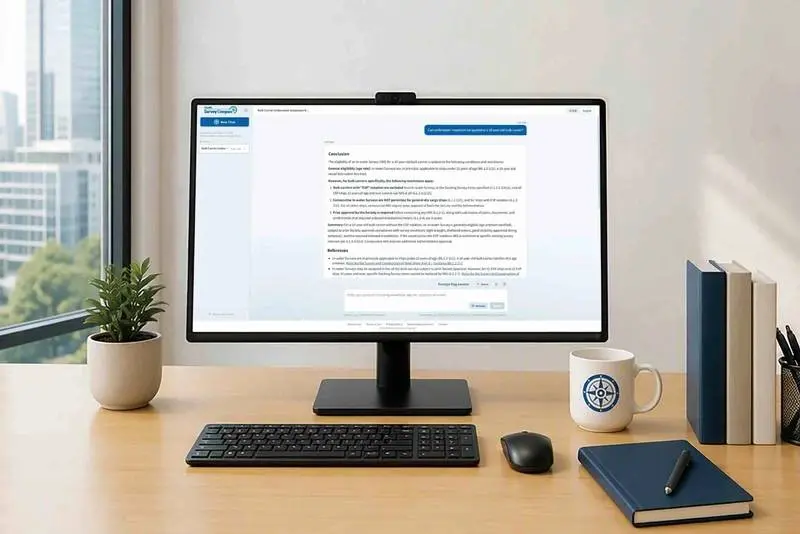
Recognizing this operational bottleneck, the leading international classification society ClassNK has officially launched “Survey Compass,” a specialized artificial intelligence assistant engineered to streamline survey-related workflows. Integrated directly into the ClassNK Customer Hub – Ship in Service – (CCH SiS) web portal, Survey Compass leverages advanced natural language processing (NLP) and Retrieval-Augmented Generation (RAG) technology. This tool allows technical superintendents, marine managers, and shipowners to query complex classification requirements using conversational prompts, receiving precise, verified answers complete with direct citations of source documentation.
This initial launch represents the foundational milestone of ClassNK’s broader, long-term vision: the creation of a comprehensive digital service platform for ships in service. By bridging the gap between vast, complex regulatory databases and the day-to-day operational needs of vessel managers, ClassNK aims to drastically reduce administrative workloads, minimize the risk of human error in compliance preparation, and accelerate decision-making across the global fleet.
Detailed Chronology: The Evolution of Maritime Compliance and the Journey to Survey Compass
The Traditional Compliance Bottleneck
For decades, the process of preparing a commercial vessel for class surveys has been heavily manual and labor-intensive. Technical superintendents and ship managers have had to manually cross-reference multiple dense, technical volumes to determine specific testing protocols, structural tolerances, and inspection intervals. A single oversight in interpreting these rules can lead to:
- Port State Control (PSC) detentions, which disrupt supply chains and damage corporate reputations.
- Unexpected drydock extensions, costing shipowners tens of thousands of dollars per day in off-hire fees.
- Insurance disputes and compliance lapses, jeopardizing the operational viability of the vessel.
As maritime regulations grew increasingly complex with the introduction of new environmental and safety frameworks, ClassNK recognized that traditional PDF-based search tools and manual indexing were no longer sufficient to meet the fast-paced demands of modern ship management.
[Traditional Rule Lookup] ──(Hours/Days)──> Manual Cross-Referencing ──> Risk of Human Error
                                                                              │
                                                                              ▼
[Survey Compass (RAG)]   ──(Seconds)───> Automated Document Search ──> Verified Citations & Decisions
The Digital Transformation Roadmap
To address this friction, ClassNK initiated a multi-phase digital transformation strategy focused on translating static regulatory text into actionable, digital-first assets.
- Phase 1: Portal Centralization: ClassNK established the ClassNK Customer Hub (CCH), creating a centralized digital gateway for shipowners to monitor their fleets’ survey statuses, certificates, and outstanding recommendations.
- Phase 2: The Beta Phase and AI Integration: Recognizing the potential of generative AI, ClassNK began piloting conversational AI models. Rather than deploying a generic, off-the-shelf Large Language Model (LLM)—which is highly prone to "hallucinations" and inaccurate interpretations of specialized engineering codes—ClassNK spent months testing a retrieval-based framework. During this closed beta phase, the development team gathered feedback from shipowners and technical superintendents to refine the AI’s natural language understanding and search accuracy.
- Phase 3: The Launch of Survey Compass: Following successful internal testing and pilot evaluations, ClassNK officially integrated Survey Compass into the CCH SiS portal. This initial release focuses on three foundational document categories:
- Part B of the Rules for the Survey and Construction of Steel Ships (the core technical standard governing hull structural integrity and survey intervals).
- Guidance for Undergoing Surveys (the operational manual explaining how and when specific inspections must be carried out).
- Technical Information (the historical and current technical circulars issued by ClassNK to address specific, emerging engineering issues).
Supporting Context & Metrics: Why RAG Technology is Critical for Maritime Safety
To understand the engineering achievement of Survey Compass, it is essential to analyze the underlying technology that distinguishes it from consumer-grade AI platforms.
The Hazard of AI Hallucinations in Safety-Critical Industries
Generic LLMs generate text by predicting the next most likely word based on patterns in their training data. While highly effective for creative writing or general business correspondence, this predictive approach is inherently dangerous for safety-critical industries like maritime engineering. An AI that hallucinates a decimal point in a steel plate thickness tolerance, or misquotes a fire-damper testing interval, could lead to catastrophic structural failures or severe regulatory penalties.
| Feature / Metric | Generic Consumer LLMs (e.g., ChatGPT) | ClassNK Survey Compass (RAG-Enabled) |
|---|---|---|
| Primary Data Source | General internet scrape (static training cutoff) | Curated, real-time ClassNK regulatory databases |
| Risk of Hallucination | Moderate to High (creates plausible-sounding but false rules) | Minimal (constrained to generate answers strictly from verified sources) |
| Auditability | Low (does not cite specific paragraphs or rule versions) | High (provides direct links to active rulebook PDFs and circulars) |
| Domain Specificity | Broad, generic language processing | Deep understanding of maritime engineering and classification terminology |
The Retrieval-Augmented Generation (RAG) Solution
Survey Compass overcomes the risk of hallucination by employing a Retrieval-Augmented Generation (RAG) architecture. When a ship manager inputs a query—such as "What are the thickness measurement requirements for the transverse watertight bulkheads of a 10-year-old bulk carrier?"—the system does not rely on pre-trained memory to generate an answer.
Instead, the process unfolds in three secure, highly controlled steps:
- Semantic Search: The AI converts the query into a mathematical vector and searches ClassNK’s proprietary, verified database to locate the exact paragraphs within Part B of the Rules for the Survey and Construction of Steel Ships and related Technical Information circulars.
- Contextual Synthesis: The AI extracts the relevant passages and feeds them as "context" into a highly secured LLM.
- Drafting and Citation: The LLM synthesizes the extracted information into a clear, natural-language response. Crucially, it attaches direct hyperlinks to the exact source documents, allowing the user to click through and verify the original text instantly.
This architecture ensures that the AI functions as an advanced, ultra-fast search-and-summarization engine, leaving the final "informed professional judgment" firmly in the hands of the human superintendent.
Official Statements and Strategic Vision
In launching the platform, ClassNK emphasized that Survey Compass is not merely a standalone software tool, but a strategic asset designed to evolve alongside the maritime industry’s changing operational landscape.
A representative from ClassNK highlighted the collaborative philosophy behind the tool’s development:
"Because information related to classification surveys and ship management is closely tied to the safe operation of vessels, a high level of accuracy and reliability is required. Survey Compass adopts a retrieval-based approach that generates answers based on relevant source documents, reducing the risk of AI-generated inaccuracies. Through this approach, it aims to serve as a trustworthy AI assistant that users can rely on with confidence."
The society also underscored that the initial release is the first milestone in a long-term roadmap:
"This initial release marks the first step toward ClassNK’s vision of a digital service platform for ships in service. ClassNK will continue to expand and enhance Survey Compass together with our customers, incorporating feedback and requests gathered through its practical use."
By positioning the customer at the center of the development loop, ClassNK ensures that future software updates will directly address the real-world operational friction points experienced by technical superintendents at sea and ashore.
Future Outlook: The Roadmap to Context-Aware, Vessel-Specific AI
As ClassNK rolls out Survey Compass to its global user base via the CCH SiS portal, the classification society is already preparing subsequent developmental phases designed to push the boundaries of maritime informatics.
┌────────────────────────────────────────┐
│  Phase 1: Core Rules & Guidance (Now)  │
│  - Part B Rules, Survey Guidance       │
└───────────────────┬────────────────────┘
                    │
                    ▼
┌────────────────────────────────────────┐
│  Phase 2: Global Frameworks (Mid-Term) │
│  - IMO Conventions (SOLAS, MARPOL)     │
│  - Flag State Circulars & Regs         │
└───────────────────┬────────────────────┘
                    │
                    ▼
┌────────────────────────────────────────┐
│ Phase 3: Vessel-Specific Context (Long)│
│  - Hull No., Age, Engine Type, History │
│  - Tailored, Predictive Survey Planning│
└────────────────────────────────────────┘
1. Expanding the Regulatory Scope
In future updates, ClassNK plans to expand the tool’s document repository far beyond internal classification rules. The AI will eventually ingest:
- International Maritime Organization (IMO) Conventions: Incorporating critical global frameworks such as SOLAS (Safety of Life at Sea), MARPOL (Prevention of Pollution from Ships), and the STCW Convention.
- Flag State Requirements: Integrating the specific national maritime laws of major registries (such as Panama, Liberia, the Marshall Islands, and Singapore). This will resolve a common pain point for ship managers, who must currently cross-reference general class rules with specific flag-state exemptions and additional mandates.
2. Transitioning to Vessel-Specific Context
The most anticipated evolution of Survey Compass is its planned integration with vessel-specific data. In future iterations, when a logged-in user asks a question, the AI will not just answer generally; it will analyze the query in the context of the user’s specific fleet.
For example, if a manager asks, "When is my next tailshaft survey due?", Survey Compass will automatically query the ClassNK database for that specific vessel’s IMO number, retrieve its hull design (e.g., single vs. twin screw, water-lubricated vs. oil-lubricated bearing systems), check its historical survey records, and deliver a tailored schedule. This level of personalized, context-aware support will transform the tool from a reactive search engine into a proactive operational planner.
3. Driving Industry-Wide Digitalization
The launch of Survey Compass aligns with a broader industry push toward "Maritime Informatics"—the application of information technology and data science to improve the safety, efficiency, and environmental sustainability of maritime transport. As shipping companies grapple with severe labor shortages, particularly among experienced onshore technical superintendents, intuitive AI tools like Survey Compass will play a vital role in bridging the skills gap. It allows junior superintendents to access decades of institutional classification knowledge in seconds, leveling the playing field and ensuring that safety standards remain uncompromised.
By successfully deploying trustworthy, RAG-enabled AI to the frontlines of ship management, ClassNK has established a new benchmark for how classification societies support the maritime industry in the digital age. Shipowners and managers can now navigate the complex regulatory seas with a faster, safer, and more reliable compass.