








Executive Overview
The global maritime supply chain has long served as the primary circulatory system of international trade, highly sensitive to both macroeconomic shifts and geopolitical friction. In the second quarter of 2026, Germany’s leading container shipping enterprise, Hapag-Lloyd, demonstrated remarkable operational resilience, navigating a complex landscape of surging consumer demand and severe geopolitical disruptions. The Hamburg-based liner group reported a stabilization in its second-quarter earnings, driven by a powerful rebound in cargo volumes from Asia and robust import demand in the United States. This demand-side recovery successfully countered a formidable $600 million in additional operational costs stemming directly from the ongoing conflict in the Middle East, most notably the blockade of the strategic Strait of Hormuz.
For the second quarter of 2026, Hapag-Lloyd posted Earnings Before Interest, Taxes, Depreciation, and Amortization (EBITDA) of $829 million. This represented a modest year-over-year increase compared to the $820 million recorded in Q2 2025, illustrating that the carrier was able to defend its operational profitability despite severe cost inflation. However, the financial toll of rerouting vessels and managing disrupted supply chains became apparent further down the balance sheet. Earnings Before Interest and Taxes (EBIT) dipped slightly to $176 million, down from $189 million in the prior-year period.
The most pronounced contraction occurred in the group’s net profit, which plummeted to $83 million from $306 million in Q2 2025—a decline that underscores the high capital intensity and escalating overhead costs currently plaguing the container shipping sector. Despite this squeeze on net margins, top-line revenue experienced a healthy expansion, climbing to $5.84 billion from $5.27 billion in the corresponding quarter of the previous year, buoyed by a 9% increase in average freight rates and higher transport volumes.
Hapag-Lloyd Q2 Financial Performance Comparison (USD)
=========================================================
Metric                 Q2 2025          Q2 2026        Change
---------------------------------------------------------
Revenue                $5.27 Billion    $5.84 Billion  +10.8%
EBITDA                 $820 Million     $829 Million   +1.1%
EBIT                   $189 Million     $176 Million   -6.9%
Group Net Profit       $306 Million     $83 Million    -72.9%
Liner Volume (TEU)     3.36 Million     3.48 Million   +3.6%
Avg. Freight Rate/TEU  $1,353           $1,475         +9.0%
=========================================================
Detailed Chronology: Navigating the Shift from Q1 Stagnation to Q2 Rebound
The Demand-Side Catalysts: Asian Exports and US Resilience
The transition from the first quarter of 2026 to the second quarter marked a pivotal operational turnaround for Hapag-Lloyd. The early months of the fiscal year were characterized by sluggish demand, lingering inventory corrections in Western economies, and fears of systemic overcapacity as a wave of newly built ultra-large container vessels (ULCVs) entered the global fleet. However, as the second quarter commenced, the macroeconomic environment shifted in favor of ocean carriers.
The primary engine of this recovery was a significant acceleration in export volumes out of major East Asian manufacturing hubs. Chinese industrial output and regional export manufacturing surged, driven by retailers in Europe and North America aggressively restocking ahead of the traditional peak season. In the United States, consumer spending remained remarkably resilient despite persistent inflationary pressures. This sustained consumer demand prompted American importers to secure ocean capacity early, fearing further supply chain disruptions later in the year.
Consequently, Hapag-Lloyd’s transported liner volumes rose to 3.48 million Twenty-Foot Equivalent Units (TEUs) in the second quarter, up from 3.36 million TEUs in Q2 2025. This volume recovery effectively absorbed a substantial portion of the carrier’s active fleet, tightening the supply-demand balance on major east-west trade lanes.
The Supply-Side Shock: Geopolitical Bottlenecks and Route Alterations
While demand was recovering, the supply side of the global shipping equation was thrown into chaos by escalating geopolitical tensions in the Middle East. The critical maritime chokepoint of the Strait of Hormuz became virtually impassable for a significant portion of Western-operated tonnage due to heightened security threats and outright blockades. For a global carrier like Hapag-Lloyd, this disruption necessitated immediate, drastic changes to vessel routing and schedule planning.
Historically, disruptions in the Red Sea and the Suez Canal had already forced carriers to reroute vessels around the Cape of Good Hope for Asia-Europe voyages. The escalation around the Strait of Hormuz in mid-2026 compounded these challenges, severely impacting trade lanes servicing the Persian Gulf and the wider Indian Ocean. Vessels were forced to undertake lengthy detours, adding thousands of nautical miles to their journeys.
These extended voyages effectively reduced global shipping capacity by keeping vessels at sea for longer periods, which in turn put upward pressure on spot freight rates. Hapag-Lloyd’s average freight rate for the quarter rose to $1,475 per TEU, up 9% from the $1,353 per TEU recorded in Q2 2025. This rate increase acted as a vital buffer, allowing the company to offset a significant portion of the massive operational surcharges incurred during this turbulent period.
Supporting Context & Metrics: Dissecting the Financials and the Geopolitical Toll
Deconstructing the $600 Million Operational Surcharge
The central narrative of Hapag-Lloyd’s Q2 2026 performance is the extraordinary cost of operating in a high-risk geopolitical environment. The company disclosed that the Middle East conflict inflicted approximately $600 million in additional, unbudgeted costs during the quarter. This "geopolitical tax" can be broken down into several distinct operational categories:
- Bunker Fuel Consumption: Rerouting vessels around the African continent instead of utilizing traditional transit routes through the Suez Canal and the Middle East Gulf added between 10 to 14 days to round-trip voyages. The sustained high-speed sailing required to maintain weekly schedule integrity under these extended routings dramatically increased fuel consumption. Bunker costs remained high throughout the quarter, compounding the financial impact of the longer distances.
- Hull and Machinery Insurance: War risk insurance premiums for vessels transiting the Middle East or operating in adjacent waters skyrocketed. For carriers maintaining services to key regional hubs, these premiums added hundreds of thousands of dollars per voyage.
- Storage and Terminal Congestion: The sudden alteration of shipping networks led to cascading bottlenecks at major transshipment ports in the Mediterranean, Asia, and the Middle East. Containers sat on terminals for extended periods, triggering substantial storage and demurrage charges.
- Inland Transportation and Feedering: To honor customer contracts and deliver cargo to landlocked or restricted destinations, Hapag-Lloyd had to rely heavily on expensive multi-modal land bridges and regional feeder services, bypassing blocked maritime corridors at a premium cost.
Liner Shipping vs. Terminal Division Performance
A closer inspection of Hapag-Lloyd’s business divisions reveals that the core liner shipping segment remained the dominant revenue generator, contributing $5.68 billion to the group’s overall $5.84 billion revenue in Q2 2026. This performance highlights the pricing power Hapag-Lloyd maintained in the container market, where spot rate volatility worked to the carrier’s advantage on specific trade lanes.
Meanwhile, Hapag-Lloyd’s terminal and infrastructure business, a relatively new strategic focus for the group, continued to expand. While still a smaller contributor to the overall bottom line, the terminal division provided a stabilizing, counter-cyclical revenue stream. By securing equity stakes in key port infrastructure globally, Hapag-Lloyd has begun to insulate itself from pure ocean freight rate volatility, though this segment was not entirely immune to the operational inefficiencies caused by delayed vessel arrivals and yard congestion.
Official Statements: Strategic Alignment and the Gemini Alliance
Executive Commentary: Focus on Cost Control
Reflecting on the quarter’s performance, Rolf Habben Jansen, Chief Executive Officer of Hapag-Lloyd, emphasized the dual nature of the current market environment—acknowledging both the strong demand recovery and the severe operational headwinds.
"We have seen a welcomed stabilization in our second-quarter earnings, driven by robust export volumes from Asia and a resilient consumer market in the United States," Habben Jansen stated. "However, the geopolitical realities in the Middle East have presented us with unprecedented operational challenges. The blockade of the Strait of Hormuz and wider regional instability have forced us to absorb roughly $600 million in additional costs to keep our customers’ cargo moving."
The CEO stressed that the company’s primary focus for the remainder of 2026 would be maintaining "strict cost discipline" across all business units.
"As we enter the second half of the year, navigating these elevated operational costs requires us to scrutinize every dollar spent. We will continue to expand our liner and terminal businesses, but we must do so with a relentless focus on operational efficiency and cost mitigation," Habben Jansen added.
Hapag-Lloyd Fleet & Container Asset Allocation (Q2 2026)
=========================================================
Asset Class                   Metric Value
---------------------------------------------------------
Active Containerships         300 Vessels
Total Vessel Capacity         2.5 Million TEU
Total Container Fleet Capacity 3.6 Million TEU
=========================================================
The Gemini Cooperation: A Shield Against Volatility
A cornerstone of Hapag-Lloyd’s long-term operational strategy is its participation in the Gemini Cooperation, a major vessel-sharing alliance alongside Denmark’s A.P. Moller-Maersk. Despite the widespread disruption to global shipping schedules, Habben Jansen highlighted that the Gemini network continued to outperform the broader market in terms of schedule reliability.
The Gemini Alliance relies on a unique "hub-and-spoke" operational model, utilizing a highly curated network of owned or controlled terminals to minimize port delays. In times of crisis, such as the current Middle East conflict, this structure allows the partners to quickly reroute mainline vessels to secure gateway ports, while using dedicated feeder networks to distribute cargo to secondary destinations.
According to Hapag-Lloyd’s leadership, this structural agility has been a key differentiator, enabling the carrier to offer more reliable departure and arrival windows than competitors relying on traditional, sprawling alliance structures that are highly vulnerable to port congestion.
Future Outlook: Upgraded Guidance, Fleet Renewal, and Structural Headwinds
Revised Guidance and the Range of Uncertainty
Despite the ongoing geopolitical turbulence and the steep drop in Q2 net profit, the strong demand environment and elevated spot freight rates experienced in the early summer prompted Hapag-Lloyd to raise its full-year 2026 financial guidance in July. The company upgraded its forecast as follows:
- Group EBITDA: Projected to reach between $2.7 billion and $3.7 billion.
- Group EBIT: Anticipated to fall within the range of $100 million to $1.1 billion.
The unusually wide range in both EBITDA and EBIT forecasts reflects the extreme volatility and unpredictability characterizing the current macroeconomic and geopolitical climate. While strong consumer demand and continued supply constraints could push earnings toward the upper end of the guidance, any sudden de-escalation of geopolitical conflicts—which would immediately release idled capacity back into the market—or a sharp downturn in global trade could quickly push earnings toward the lower bound.
     Hapag-Lloyd FY 2026 Upgraded Guidance Ranges
     =============================================

     EBITDA: $2.7 Billion ────────────────── $3.7 Billion

     EBIT:   $100 Million ───────── $1.1 Billion

     =============================================
     Note: Wide ranges reflect ongoing geopolitical volatility.
Decarbonization and Fleet Renewal Strategy
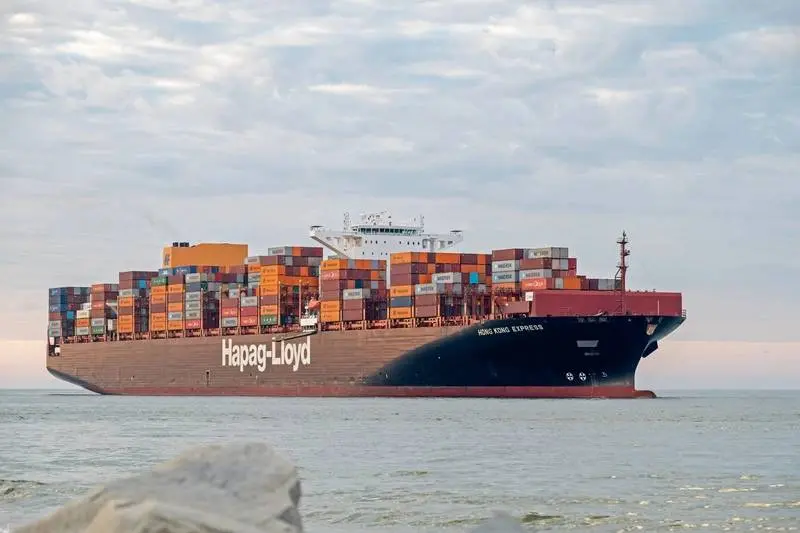
Looking beyond the immediate horizon of 2026, Hapag-Lloyd remains committed to its long-term modernization and decarbonization goals. The carrier currently operates a sophisticated fleet of 300 containerships with an aggregate transport capacity of approximately 2.5 million TEUs, complemented by a container fleet capacity of 3.6 million TEUs.
Fleet renewal is central to Hapag-Lloyd’s Strategy 2030, which aims to reduce the carbon intensity of its operations significantly. The company is actively investing in dual-fuel vessels capable of running on liquefied natural gas (LNG), bio-methane, and potentially green ammonia or methanol in the future. By replacing older, less efficient tonnage with state-of-the-art dual-fuel ships, Hapag-Lloyd aims to lower its slot costs (the cost of transporting a single TEU) while complying with increasingly stringent international environmental regulations, such as the European Union’s Emissions Trading System (EU ETS) and the International Maritime Organization’s (IMO) carbon intensity indicators.
Furthermore, these modern vessels offer superior fuel efficiency, which will serve as a permanent structural hedge against future bunker price spikes. As the maritime industry faces an era of higher operational costs—driven by both geopolitical risk and the transition to expensive green fuels—Hapag-Lloyd’s dual focus on technological innovation and disciplined cost management will determine its ability to maintain profitability in an inherently cyclical market.