









Executive Overview
Global logistics, marine engineering, and supply chain solutions provider Crowley has officially announced the launch of a new weekly container shipping service linking Port Houston directly to the critical Central American trade gateways of Santo Tomás de Castilla in Guatemala and Puerto Cortés in Honduras.
Dubbed the Gulf-Central America Express Service, this maritime connection is strategically timed to capitalize on surging trade volumes between the United States and Central America. The inaugural voyage is slated to arrive at Port Houston on September 10, with regular weekly departures scheduled for every Thursday thereafter.
Designed to streamline regional supply chains, Crowley’s deployment will utilize specialized vessels capable of carrying both dry and refrigerated (reefer) containers. The cargo mix will primarily comprise temperature-sensitive fresh produce, apparel, industrial machinery, and a vast array of consumer goods. Notably, the service will incorporate a diverse range of equipment sizes, including 53-foot containers, which are specifically engineered to maximize intermodal transport efficiency across North American highway and rail networks.
This strategic maritime lane emerges at a pivotal moment for bilateral trade. Recent economic indicators from the Inter-American Development Bank (IDB) reveal that Central American exports to the United States surged by 15.7 percent year-on-year during the opening months of 2026. This upward trajectory is largely propelled by an unyielding consumer appetite for fresh produce and nearshored apparel manufacturing. By introducing a direct, non-transshipment route, Crowley and Port Houston aim to eliminate historical logistical bottlenecks, reduce transit times, and offer unprecedented predictability for importers and exporters alike.
Detailed Chronology and Operational Mechanics
The genesis of the Gulf-Central America Express Service is the product of months of strategic planning, market analysis, and infrastructure alignment between Crowley’s maritime operations division and Port Houston’s executive leadership.
The Rollout Timeline
- Q1–Q2 2026: Market analysis highlights a growing demand for refrigerated container capacity from Central America, driven by a 15.7% spike in exports to the U.S.
- Late August 2026: Crowley finalizes vessel scheduling, terminal allocations, and intermodal rail/truck connections at Port Houston.
- September 10, 2026: The inaugural vessel of the Gulf-Central America Express Service makes its historic first call at Port Houston.
- September 17, 2026 and Onward: Transition into a reliable, high-frequency weekly Thursday departure schedule connecting Texas directly with Guatemala and Honduras.
Operational Advantages and Equipment Capabilities
At the core of the Gulf-Central America Express Service is an emphasis on transit velocity and cargo integrity. Traditional shipping routes connecting Central America to the U.S. Gulf Coast often rely on complex transshipment models, where cargo is offloaded at intermediary Caribbean or South Florida ports before being loaded onto secondary vessels or rail cars. These multi-step handoffs introduce significant risks of delay, cargo damage, and administrative friction.
Crowley’s direct routing bypasses these vulnerabilities. By connecting Port Houston, Santo Tomás de Castilla, and Puerto Cortés on a single continuous loop, the carrier ensures that time-sensitive commodities—particularly perishable agricultural goods like bananas, melons, and tropical fruits—reach consumer markets with maximum shelf life intact.

Furthermore, the integration of 53-foot containers represents a major operational coup for intermodal shippers. While standard international shipping utilizes 20-foot (TEU) and 40-foot (FEU) containers, the domestic U.S. freight market is heavily optimized for 53-foot dry vans. By offering 53-foot maritime containers, Crowley allows cargo to move seamlessly from a vessel’s hold directly onto domestic over-the-road trucking chassis or intermodal rail wells without requiring warehouse cross-docking or repacking. This capability drastically reduces handling costs, minimizes carbon footprints, and accelerates speed-to-market for major retailers and distributors.
Supporting Context & Market Metrics
The launch of Crowley’s new route does not occur in a vacuum; it is symbiotic with the explosive growth trajectory of Port Houston and broader macroeconomic shifts in international trade.
Port Houston’s Record-Breaking Momentum
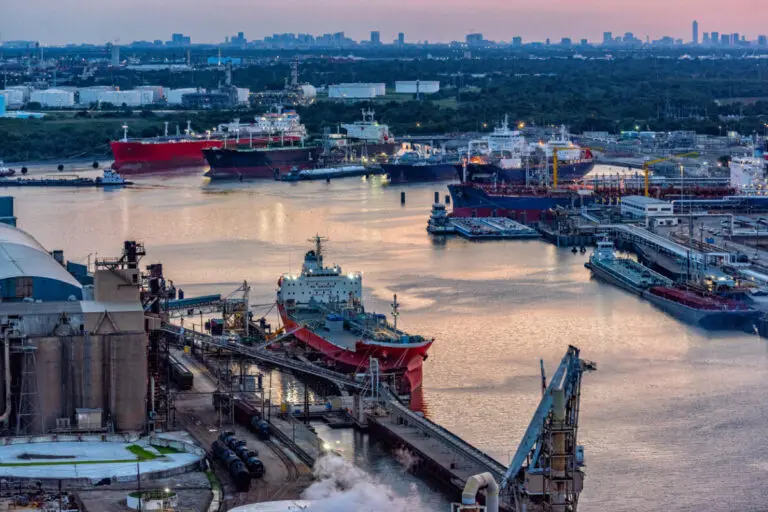
Port Houston stands as one of the preeminent economic engines of the United States. Ranking consistently among the nation’s top five container ports, the port handles approximately 75 percent of the entire U.S. Gulf container volume. This dominant market share is underpinned by world-class infrastructure, deep-water channel access, and robust modal integration.
The port enters this partnership following a series of record-shattering operational milestones. During the first half of 2026, Port Houston posted historic container volume figures, driven by continuous capital investments in terminal automation, yard expansion, and berth deepening. These enhancements ensure that the port can effortlessly accommodate the larger, more efficient vessels deployed by carriers like Crowley without inducing landside congestion.
The Central American Trade Boom
The economic rationale for the Gulf-Central America Express Service is firmly rooted in shifting global trade patterns. As multinational corporations increasingly look to nearshore their supply chains—migrating manufacturing and agricultural sourcing away from volatile Asian markets and toward Latin America—trade between Central America and the United States has accelerated dramatically.
According to data compiled by the Inter-American Development Bank, Central American economies exported 15.7 percent more goods to the U.S. in early 2026 compared to the same period in the previous year. This growth is bifurcated into two primary sectors:
- Perishable Agriculture: High-demand fresh produce requiring sophisticated cold-chain logistics.
- Nearshored Manufacturing: Textiles, apparel, and light industrial components manufactured in Guatemala and Honduras under favorable regional trade agreements.
By tapping into Port Houston’s expansive inland connectivity—including direct access to major interstate corridors (I-10, I-35, and I-45) and Class I freight railroads (Union Pacific and BNSF)—Central American exporters gain instant, frictionless access to the massive consumer markets of Texas, the American Midwest, and the West Coast.
Official Statements and Industry Perspectives
Leadership from both Crowley and Port Houston have emphasized the transformative potential of the Gulf-Central America Express Service, framing it as a critical infrastructure upgrade for North American commerce.
Crowley Leadership Insights
Claudia Kattan, Vice President for Central America, Mexico, and Panama at Crowley, underscored the strategic value of the direct connection:
"A direct Houston connection provides a reliable, efficient logistics solution for US-Central American supply chains. Shippers get faster transits, improved inventory planning and the flexibility to move fresh produce, consumer goods and other time-sensitive cargo without the delays of transshipments."
Kattan’s remarks reflect Crowley’s deep institutional pedigree in the region. The company has maintained an unbroken operational footprint in the Caribbean and Central America for more than 65 years, developing an integrated network of maritime vessels, port terminals, and inland logistics infrastructure that few competitors can rival.
Port Houston Executive Perspectives
Port Houston executives welcomed the partnership as a win-win for regional commerce, consumer pricing, and local job creation.
John Moseley, Chief Commercial Officer for Port Houston, stated:
"We are proud to welcome Crowley’s Gulf-Central America Express Service to Port Houston. This new weekly call gives shippers a direct, reliable connection to Houston and two important Central American gateways, expanding choice for customers moving refrigerated and dry cargo through Houston."
Expanding upon this sentiment, Port Houston CEO Charlie Jenkins highlighted the profound real-world impact of maritime logistics on everyday consumers and regional businesses:
"The impact of this service will extend well beyond the docks. It creates a more direct path for fresh produce and everyday goods to reach stores and families across our region, while helping Texas businesses connect with customers in Central America. That is what growth at Port Houston does: create opportunity and make the supply chains people rely on work better."
Future Outlook: Strengthening the Hemispheric Supply Chain
As global supply chains continue to evolve in response to geopolitical shifts, climate pressures, and changing consumer expectations, the sustainability and resilience of regional trade corridors will dictate commercial success.
The launch of the Gulf-Central America Express Service signals a mature, forward-looking approach to hemispheric trade. By combining Crowley’s decades-long operational expertise in Central America with Port Houston’s state-of-the-art terminal capacity, the partnership establishes a benchmark for efficiency in North-South maritime logistics.
Key Trends to Watch:
- Cold-Chain Innovation: With fresh produce imports continuing their upward trajectory, further investments in automated refrigerated rack systems and real-time IoT cargo monitoring are expected across both ports.
- Intermodal Expansion: The utilization of 53-foot containers is expected to pave the way for broader adoption of domestic-style shipping boxes in international short-sea trades, potentially reshaping equipment standards across the Gulf of Mexico.
- Nearshoring Resilience: As trade agreements and industrial policies continue to favor localized manufacturing, routes like the Gulf-Central America Express will serve as the structural backbone for resilient, multi-modal supply networks well into the next decade.
Ultimately, Crowley and Port Houston have engineered a logistics pathway that does more than simply move steel boxes across water; it knits together regional economies, protects the integrity of perishable goods, and provides businesses with the operational predictability required to thrive in a competitive global marketplace.