





HAMBURG, Germany — In a move that underscores the accelerating transition toward highly integrated, low-emission propulsion technologies in the European ferry sector, maritime engineering pioneer Everllence has signed comprehensive Long-Term Service Agreements (LTSAs) with prominent German ferry operator TT-Line.
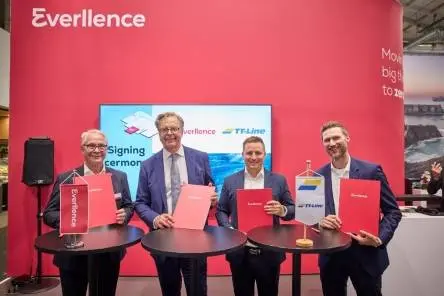
The signing ceremony, which took place on September 3, 2026, at the prestigious SMM maritime trade fair in Hamburg, represents a major milestone in the strategic partnership between the two companies. The agreements cover a total of four vessels: two state-of-the-art RoPax newbuildings currently under construction at the China Merchants Jinling Shipyard (Jiangsu), alongside two existing flagship vessels in TT-Line’s fleet, the Nils Holgersson and the Peter Pan.
By securing these long-term agreements, TT-Line aims to guarantee the operational efficiency, reliability, and environmental compliance of its key Baltic Sea assets. The Baltic Sea remains one of the world’s most stringently regulated marine environments, demanding cutting-edge technology to meet tightening European and international emissions targets.
1. Executive Overview
The maritime industry is facing unprecedented pressure to decarbonize, driven by the International Maritime Organization’s (IMO) greenhouse gas reduction strategies, the European Union’s Emissions Trading System (EU ETS), and the strictures of the FuelEU Maritime initiative. Within this challenging landscape, ferry operators are seeking long-term operational certainty. The LTSAs signed between Everllence and TT-Line at SMM 2026 provide precisely this security, bridging high-end engineering with predictive, data-driven maintenance strategies.
The scope of the agreements is twofold:
- Existing Fleet Support: Providing comprehensive maintenance, diagnostics, and lifecycle support for the Nils Holgersson and the Peter Pan. Both vessels are equipped with complex dual-fuel (DF) propulsion packages designed to minimize sulfur oxide ($SO_x$), nitrogen oxide ($NO_x$), and particulate matter emissions.
- Newbuilding Lifecycle Management: Encompassing two highly advanced RoPax newbuildings currently being constructed by China Merchants Jinling Shipyard in Jiangsu, China. These vessels, scheduled to enter service in 2030 and 2031, will feature next-generation Everllence dual-fuel engines integrated with an array of hybrid power transmission, storage, and management technologies.
By locking in these service frameworks years ahead of the newbuildings’ commercial deployment, TT-Line is mitigating operational risk, optimizing lifecycle costs, and ensuring that its fleet maintains peak thermodynamic and aerodynamic efficiency throughout its operational life.
2. Detailed Chronology
The partnership between TT-Line, China Merchants Jinling Shipyard, and Everllence has been forged over years of collaborative engineering. Understanding the timeline of this relationship is essential to grasping the significance of the SMM 2026 agreements.
+---------------------------------------------------------------------------------+
|                                CHRONOLOGY OF PARTNERSHIP                        |
+---------------------------------------------------------------------------------+
|                                                                                 |
|  2022–2023: Delivery of "Nils Holgersson" and "Peter Pan"                       |
|  • Constructed at China Merchants Jinling Shipyard.                             |
|  • Equipped with Everllence 51/60 DF engines and propulsion systems.            |
|                                                                                 |
|  Mid-2025: Keel-Laying & Contract Award for Newbuildings                        |
|  • TT-Line orders two next-generation RoPax vessels from Jiangsu yard.          |
|  • Everllence selected for fully integrated hybrid-LNG power packages.           |
|                                                                                 |
|  September 3, 2026: SMM Hamburg Signing Ceremony                                |
|  • Comprehensive LTSAs signed covering existing vessels and future newbuilds.   |
|                                                                                 |
|  2030: Commercial Debut of First Newbuild                                       |
|  • Entry into Baltic Sea service under the protection of the active LTSA.       |
|                                                                                 |
|  2031: Commercial Debut of Second Newbuild                                      |
|  • Full operational integration of the four-vessel modern green fleet.          |
|                                                                                 |
+---------------------------------------------------------------------------------+
The Foundations: Nils Holgersson and Peter Pan
The relationship entered its modern phase with the delivery of the previous generation of green vessels, Nils Holgersson and Peter Pan, in the early 2020s. Built by China Merchants Jinling Shipyard, these vessels served as pioneers for LNG-propelled RoPax transit in the Baltic. Their performance established the operational benchmark that paved the way for the 2026 service agreements.
The Next Generation: The 2030 and 2031 Newbuildings
Recognizing the need to continuously modernize to meet the EU’s "Fit for 55" legislative package, TT-Line placed orders for two additional RoPax vessels at the Jiangsu shipyard. Designed with a heavy focus on hybridization, electrification, and optimized hydrodynamics, these vessels represent the pinnacle of modern green ferry design.
The signing of the LTSAs at SMM Hamburg in September 2026 ensures that from day one of their sea trials and subsequent commercial operations in 2030 and 2031, these vessels will be monitored, maintained, and optimized directly by Everllence’s OEM experts.
3. Supporting Context & Metrics
To appreciate the scale of this agreement, it is necessary to examine the technical specifications of the machinery covered under the LTSAs. The transition from the powerplants of the Nils Holgersson generation to the upcoming 2030/2031 newbuildings highlights a clear shift toward higher power density, integration, and electrification.
Technical Fleet Comparison
| Metric / System | Existing Fleet (Nils Holgersson & Peter Pan) | Newbuildings (Scheduled 2030 & 2031) |
|---|---|---|
| Primary Engine Configuration | $2 times text6L51/60 DF + 2 times text8L51/60 DF$ | $4 times text6L49/60DF$ |
| Primary Fuel Type | LNG / Marine Gas Oil (MGO) | LNG / Bio-LNG / Synthetic LNG / MGO |
| Gearbox Configuration | Standard Propulsion Gearboxes | Twin-In-Single-Out Gearboxes |
| Propeller Technology | Everllence Propulsion Systems | Everllence Alpha Controllable Pitch Propellers (CPP) |
| Fuel Gas Supply | Conventional LNG Handling | Integrated Everllence LNG Fuel Gas Supply System (FGSS) |
| Electrical Architecture | Conventional AC Distribution | DC-Switchboard & Hybrid Power Management |
| Energy Storage | None (or auxiliary/emergency only) | Battery Energy Storage System (BESS) |
| Primary Operational Route | Germany – Sweden (Baltic Sea) | Germany – Sweden (Baltic Sea) |
Technical Deep-Dive: The Newbuilding Power Package
The two newbuildings represent a major step forward in system integration. Rather than sourcing disparate components from various suppliers, TT-Line opted for a fully integrated Everllence solution. This unified architecture maximizes thermodynamic efficiency and simplifies maintenance under the LTSA.
1. The Everllence 49/60DF Engines
The choice of the $4 times text6L49/60DF$ engine configuration represents the latest in dual-fuel medium-speed engine design. Compared to the older 51/60DF series, the 49/60DF offers:
- Improved Fuel Flexibility: Seamless switching between LNG, liquefied biomethane (bio-LNG), synthetic natural gas (SNG), and traditional distillate marine fuels.
- Reduced Methane Slip: Advanced combustion chamber geometry and electronic pilot-fuel injection systems reduce methane slip by up to 30% compared to previous generations.
- Higher Efficiency: Optimized turbocharging and variable valve timing (VVT) ensure high thermal efficiency across the entire load profile.
          [ LNG Fuel Gas Supply System (FGSS) ]
                           │
                           ▼
  [ 4 x 6L49/60DF Dual-Fuel Engines (Power Generation) ]
                           │
                           ▼
       [ Twin-In-Single-Out Propulsion Gearboxes ]
                           │
         ┌─────────────────┴─────────────────┐
         ▼                                   ▼
[ Everllence Alpha CPP ]           [ DC-Switchboard ]
                                             ▲
                                             │ (Bidirectional)
                                             ▼
                             [ Battery Energy Storage System ]
2. Hybridization and the DC-Switchboard
The inclusion of an Everllence DC-Switchboard and a Battery Energy Storage System (BESS) represents a paradigm shift for TT-Line’s Baltic operations. The DC-grid architecture allows:

- Variable Speed Engine Operation: Engines can run at their most efficient RPM regardless of electrical frequency requirements, saving fuel during low-load transits.
- Peak Shaving: The BESS absorbs load spikes, allowing the engines to operate at a steady, optimized load factor.
- Zero-Emission Port Stays: The battery system can handle hotel loads and maneuvering during port entry and departure, reducing local air and noise pollution in coastal communities.
3. Twin-In-Single-Out Gearboxes & Alpha CPP
By combining two engines into a single gearbox output driving an Everllence Alpha controllable pitch propeller, the propulsion system can run in various flexible modes. For instance, during off-peak night crossings, the vessel can run on just one or two engines at high load (optimal efficiency) rather than dragging four engines at low load (sub-optimal efficiency).
4. Official Statements
At the SMM signing ceremony in Hamburg, representatives from both companies, as well as the manufacturing shipyard, emphasized the strategic alignment of this multi-vessel agreement.
Dr. Bernhard Justus, Director of Fleet Operations at TT-Line, highlighted the long-term operational predictability provided by the contract:
"Operating in the Baltic Sea means navigating some of the strictest environmental laws in the world. To remain competitive, we must ensure our vessels operate at peak thermodynamic efficiency every single day. These Long-Term Service Agreements with Everllence give us complete transparency over our maintenance costs while ensuring that our state-of-the-art dual-fuel engines and hybrid systems receive OEM-level care. This is not just a service contract; it is an environmental and financial insurance policy."
Elena Vance, Chief Operating Officer of Everllence Marine Service, focused on the power of digital integration within the LTSAs:
"We are proud to deepen our relationship with TT-Line, a true pioneer in green ferry transit. By combining our high-efficiency 49/60DF engines with our advanced DC-Switchboards and battery systems under a single, comprehensive service framework, we can leverage real-time telemetry and predictive diagnostics. This allows us to resolve potential issues before they cause downtime, keeping TT-Line’s critical Germany-Sweden routes running smoothly and sustainably."
Wang Hui, Vice President of China Merchants Jinling Shipyard (Jiangsu), expressed pride in the continuous shipbuilding collaboration:
"The successful delivery of the Nils Holgersson and Peter Pan established a benchmark for Chinese-built green RoPax vessels. As we construct these two highly complex hybrid-propulsion newbuildings for delivery in 2030 and 2031, seeing Everllence and TT-Line secure their long-term operational future gives us immense confidence. It proves that the assets we build in Jiangsu are designed for decades of highly reliable, world-class performance."
5. Future Outlook
The signing of these LTSAs comes at a critical juncture for the European maritime industry. As the sector moves closer to the 2030 milestone—where the IMO targets a minimum 20% reduction in greenhouse gas emissions (striving for 30%) compared to 2008 levels—the pressure on ferry operators will intensify.
Positioning TT-Line for Regulatory Compliance
The Baltic Sea is designated as both a SOx Emission Control Area (SECA) and a NOx Emission Control Area (NECA). Furthermore, the upcoming FuelEU Maritime regulations will impose increasingly strict limits on the greenhouse gas intensity of energy used on board ships.
  REGULATORY DRIVERS FOR THE BALTIC RO-PAX SECTOR (2026–2035)

  ┌─────────────────────────┐     ┌─────────────────────────┐
  │      EU ETS (2024+)     │     │  FuelEU Maritime (2025+)│
  │ • Phase-in of CO2 costs │     │ • Decreasing GHG limits │
  │ • Financial penalty for │     │ • Incentivizes Bio-LNG  │
  │   inefficient operations│     │   and battery hybrid systems│
  └────────────┬────────────┘     └────────────┬────────────┘
               │                               │
               └───────────────┬───────────────┘
                               ▼
               ┌───────────────────────────────┐
               │  Everllence-TT-Line LTSA      │
               │ • Guaranteed OEM performance  │
               │ • Dynamic fuel optimization   │
               │ • Predictive maintenance      │
               └───────────────────────────────┘
By ensuring that the dual-fuel engines on all four vessels are maintained to OEM standards, the LTSAs directly support TT-Line’s compliance strategy. The ability of the 49/60DF engines to run on bio-LNG or synthetic LNG means TT-Line can gradually introduce net-zero fuels into its supply chain without requiring expensive retrofits, future-proofing the vessels against rising carbon prices.
The Shift Toward Lifecycle Partnership Models
This agreement reflects a broader, industry-wide trend: the shift away from transactional, reactive maintenance toward highly integrated, lifecycle partnerships. As marine machinery becomes more complex—incorporating batteries, power electronics, and advanced digital fuel systems—shipowners no longer have the in-house technical capacity to manage every subsystem.
Under the Everllence LTSA framework, the boundaries between the equipment manufacturer and the operator blur. Continuous data streaming from the vessels’ Power and Energy Management Systems (PEMS) to Everllence’s onshore monitoring centers will enable:
- Predictive Maintenance: Component replacements will be scheduled based on actual wear-and-tear metrics rather than arbitrary running hours, preventing catastrophic failures and reducing unnecessary spare parts consumption.
- Remote Troubleshooting: In the event of a system anomaly during transit, Everllence engineers can securely access the vessel’s DC-Switchboard and engine diagnostics remotely, providing rapid solutions without waiting for a technician to board the ship.
- Continuous Optimization: Algorithms will analyze fleet data to recommend operational adjustments, such as optimal power split configurations between the batteries and the dual-fuel engines, further driving down fuel consumption.
As the Nils Holgersson and Peter Pan continue to reliably bridge Germany and Sweden, and as the Jiangsu shipyard prepares the blocks for the 2030 and 2031 newbuildings, this landmark agreement signed at SMM 2026 stands as a blueprint for the future of sustainable, low-risk, and highly efficient short-sea shipping in Europe.