











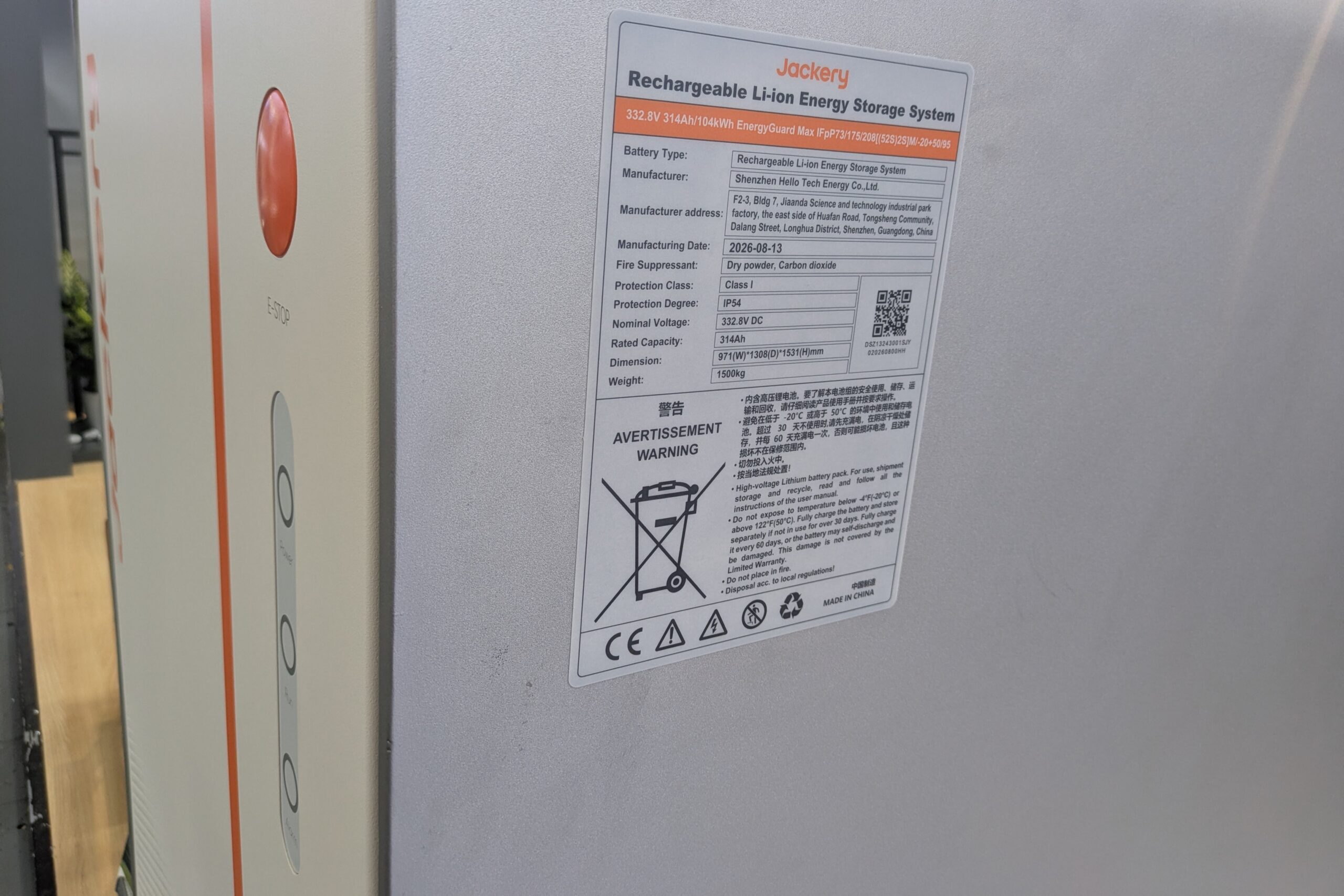
At the IFA Berlin technology exhibition, portable power pioneer Jackery captured the attention of the clean energy sector by unveiling its ambitious push into whole-home energy resilience: the EnergyGuard Max. Rather than resting on its laurels as a dominant force in portable consumer power stations and balcony solar kits, Jackery is scaling its hardware paradigm dramatically. The system pairs a massive 104 kWh Energycore battery module with the PowerVault 50 inverter, housed in heavy-duty, weather-resistant enclosures.
Weighing in at roughly 1.5 tons and operating with an enterprise-grade capacity that dwarfs standard residential backup units, the EnergyGuard Max signals a profound evolution in residential clean tech. During a conversation at the convention floor, Jackery CEO and founder Jack Sun underscored the corporate ethos driving this leap: a relentless focus on identifying structural pain points in the global energy transition—spanning resilience, grid affordability, usability, and domestic aesthetics—and engineering hardware solutions to solve them.
This article provides an in-depth exploration of the Jackery EnergyGuard Max, dissecting its technical specifications, vehicle-to-home (V2H) and vehicle-to-grid (V2G) integration potentials, European climate relevance, and economic implications. By stepping away from the constraints of legacy home storage metrics, the EnergyGuard Max raises fundamental questions about how much power modern electrified households will truly demand in the decades to come.

Detailed Chronology: The Journey to IFA Berlin and the Genesis of Industrial-Scale Home Storage
The Evolution of Jackery’s Product Ecosystem
For years, Jackery carved out an undisputed niche in the outdoor and emergency preparedness markets, offering portable power stations that democratized off-grid electricity for campers, road-trippers, and disaster-relief operations. More recently, the company targeted urban apartment dwellers with innovations like the SolarVault 3 balcony solar system. However, the unveiling of the EnergyGuard Max at IFA Berlin marks a decisive crossing of the Rubicon: Jackery is no longer just an outdoor brand or a minor residential player; it is now stepping directly into the heavyweight arena of whole-home and commercial-adjacent energy storage.

This hardware transition did not happen in a vacuum. It follows closely on the heels of the expansion of Jackery’s net-zero manufacturing facilities and advanced product-testing labs. During briefings with Jackery’s product development teams, a singular internal design philosophy emerged, driven explicitly by CEO Jack Sun: “What problem are you fixing?”
When applied to the residential sector, this question cuts through marketing hype. Typical home batteries are designed to shave peak utility rates or keep the lights on for a few hours during a brief blackout. The EnergyGuard Max, however, was conceptualized to address deeper, systemic vulnerabilities: chronic grid instability, the immense electrical load of heavily electrified modern homes, the infrastructure bottlenecks of slow utility transformer upgrades, and the looming reality of multi-EV households.
Unpacking the Hardware: Architecture and Footprint
Though the unit on display at IFA Berlin was a pre-production model, its engineering blueprints reveal a formidable piece of infrastructure.

- Physical Dimensions & Scale: Measuring 971 mm in width, 1,531 mm in height, and 1,308 mm in depth, and tipping the scales at roughly 1.5 tons, the EnergyGuard Max is not designed to blend discreetly into a tight garage corner. It requires dedicated outdoor or utility space.
- Core Chemistry & Thermal Management: At its heart lies a lithium iron phosphate (LFP) chemistry boasting a nominal capacity of 104 kWh and a 332.8 V operating voltage. Crucially, the battery incorporates liquid cooling—mirroring the thermal management systems found in modern electric vehicles. This ensures that the system can handle repeated, high-current charging and discharging cycles without accelerating degradation.
- Smart Connectivity: Following modern automotive standards, the system fully supports Over-The-Air (OTA) firmware updates, ensuring that its energy-management algorithms can be continuously optimized long after installation.
- Environmental Tolerance: With a certified operating temperature threshold dipping down to -20°C (-4°F), the EnergyGuard Max is ruggedized to withstand harsh European winters, opening up deployment across the continent (with the exception of extreme sub-arctic regions like northern Scandinavia).
Supporting Context & Metrics: Technical Specifications and Real-World Utility
To truly understand the disruptive nature of the EnergyGuard Max, one must examine the heavy-duty specifications of its companion inverter, the PowerVault 50.
PowerVault 50 Inverter Specifications
- DC Battery Input Voltage Range: 150 V to 950 V
- Max Charging/Discharging Current: 2 × 80A
- AC Input/Output Rated Power: 50 kW
- Nominal AC Voltage: 230V / 400V (3-phase balanced/unbalanced support)
- Grid Output Current: 72.2 A at 400V
- Switching Time: 10 ms (outpacing many dedicated UPS systems)
- PV Input Capacity: Supports up to 100 kWp of photovoltaic input power
Bridging the Gap: Level 3 Charging and V2G Synergy
The wide DC voltage range (150V to 950V) of the PowerVault 50 unlocks profound possibilities for electric vehicle integration. Most residential Level 2 chargers operate at modest speeds, constrained by home electrical panel limits. However, the high-voltage architecture of the PowerVault system opens the door to home-based "Level 3" DC fast-charging capabilities, theoretically capable of replenishing an EV battery in roughly an hour.
For households utilizing solar generation or accumulating off-peak electricity, this means owners can charge their EVs rapidly and on-demand, bypassing restrictive time-of-use charging schedules.
Furthermore, the system supercharges the concept of Vehicle-to-Home (V2H) and Vehicle-to-Grid (V2G) operations. While typical V2H setups draw directly from a car’s battery to power a house during an outage—often restricted by a driver’s need to maintain a reserve battery state for commuting—pairing an EV with a 104 kWh stationary home battery changes the calculus entirely.
- The "Electric Jerry Can" Model: During an extended grid failure, an EV could be driven to a functioning public fast-charger elsewhere, refueled, and driven back home to dump energy directly into the EnergyGuard Max, acting as a massive mobile energy transfer vessel.
- Load Extension: The car and the home battery can dynamically share loads, drastically extending the duration of emergency homestead survival.
Climate and Geographic Relevance in Europe
While Europe benefits from mild maritime climates along its western coasts, its geography sits at surprisingly northern latitudes. For instance, the palm-tree-lined streets of Monaco actually sit farther north than the frigid, nor’easter-battered shores of Portland, Maine.

This geographic reality introduces severe seasonal solar challenges: drastically shortened daylight hours in winter and extended multi-week stretches of dense, overcast skies. In this context, standard home batteries fall short because they lack the storage depth to bank enough solar energy during peak summer production to carry a home through the solar drought of winter. A 104 kWh reservoir shifts the paradigm, allowing households to harvest and stockpile vast amounts of renewable energy whenever it is available.
Official Statements and Industry Insights
Speaking exclusively on the convention floor, Jackery founder and CEO Jack Sun emphasized that the company’s evolution is guided by listening closely to the friction points experienced by consumers transitioning to green energy.
"Our primary directive has always been simple yet challenging: identify the pain points in the sustainable energy transition and engineer direct solutions," Sun explained. "Whether those challenges involve energy resilience in the face of failing grids, the skyrocketing costs of dynamic electricity markets, or the physical complexities of upgrading home electrical infrastructure, our teams are instructed to ask one fundamental question before building anything: What problem are you fixing?"
Product development representatives expanded on this vision, noting that while a 104 kWh battery module feels oversized by today’s typical residential standards (such as the ubiquitous 13.5 kWh Tesla Powerwall), consumer energy demands are accelerating at an unprecedented rate. Between the widespread adoption of heat pumps for home climate control, the growing saturation of residential air conditioning due to climate change, and multi-vehicle EV households, the average home energy footprint is expanding rapidly.

Safety Framework: The FortiShield System
Deploying a 1.5-ton, high-voltage battery inside or adjacent to a residential property requires immaculate safety engineering. To mitigate consumer anxiety, the EnergyGuard Max incorporates Jackery’s proprietary FortiShield Safety System, a rigorous 7-layer security framework.
The accompanying inverter protections read like an industrial substation checklist:
- DC/AC surge protection
- Insulation resistance detection
- PV string and battery input reverse polarity protection
- Ground fault monitoring
- Residual current monitoring
- AC short circuit protection
- Anti-islanding protection (preventing dangerous back-feeding into downed utility lines)
With a lightning-fast switching time of just 10 milliseconds, the system protects sensitive domestic electronics from micro-interruptions more effectively than many commercial uninterruptible power supplies (UPS).
Future Outlook: Redefining Residential Energy Architecture
Solving Infrastructure Grid Bottlenecks
Beyond emergency backup and solar self-consumption, systems of this magnitude offer a profound solution to a hidden bottleneck in the energy transition: electrical service upgrades.

In older neighborhoods, home electrical wiring and local utility transformers were installed decades ago, designed for an era of fossil-fuel heating and minimal electrical loads. Today, homeowners attempting to install heat pumps, induction stoves, and EV chargers frequently hit a brick wall. Upgrading a home’s service panel can cost thousands, while waiting for a utility company to upgrade a neighborhood transformer can lead to months or years of delays.
By utilizing a smart energy buffer like the EnergyGuard Max, homes can draw power slowly and steadily from the grid during off-peak hours (or heavily from solar during the day) and discharge at high rates to meet peak household demands. This effectively decouples peak domestic consumption from the limitations of the local utility connection.
Virtual Power Plants (VPPs) and Economics
While official pricing has not yet been finalized by Jackery, industry analysts note that while a 104 kWh system will undoubtedly command a higher upfront cost than standard smaller batteries, its cost-per-kWh ratio is projected to be significantly more favorable. During discussions at IFA Berlin, representatives confirmed that the unit would cost substantially less than the average price of a new passenger vehicle in the United States or Europe.
In markets with high retail electricity rates and volatile dynamic pricing—such as Germany—the Return on Investment (ROI) timeline shrinks dramatically when the system is integrated into a Virtual Power Plant (VPP) network. By feeding stored energy back into the grid during high-demand pricing spikes, homeowners can transform their energy storage system from a passive insurance policy into an active revenue-generating asset.

Raising Expectations: The LEAF Analogy
To contextualize the arrival of the EnergyGuard Max, one can look back at the early days of electric mobility. When the original Nissan LEAF debuted with a 24-kWh battery and a 73-mile EPA range, critics and early adopters hailed it as revolutionary. It was "enough" for a daily commute, and a 30-minute DC fast-charge was considered an acceptable inconvenience.
Yet, technology marched forward, and consumer expectations shifted. Today, that range and charging speed would be considered utterly obsolete, yet that exact technological stepping stone was vital to driving mass adoption.
Similarly, in the realm of stationary storage, a 104 kWh home battery may currently strike some observers as overkill. For a downtown urban apartment dweller, a balcony kit like Jackery’s SolarVault 3 remains the correct tool for the job. But for detached suburban homes, rural homesteads, and multi-generational properties facing an electrified future, appliances like the EnergyGuard Max preview the next frontier of residential energy independence.
By pushing the boundaries of capacity, safety, and bi-directional integration, Jackery is proving that the future of home energy storage is not just about keeping the lights on during a storm—it is about total energy autonomy.