







MANAMA, Bahrain — The strategic waters of the Middle East have plunged into a perilous new phase of maritime conflict. Following a series of high-intensity engagements, Iran’s Islamic Revolutionary Guard Corps Navy (IRGCN) has targeted multiple commercial and military vessels in the Strait of Hormuz. The strikes represent a direct retaliation for devastating U.S. military attacks on Iranian crude carriers.
This rapid escalation has effectively halted commercial transit through one of the world’s most critical energy chokepoints, pushing the United States and Iran closer to an all-out, uncontainable conflict.
Executive Overview
The Strait of Hormuz, a narrow waterway separating the Persian Gulf from the Gulf of Oman, has become the primary battleground in a six-month-old war involving the United States, Israel, and the Islamic Republic of Iran. On September 6, 2026, the IRGCN announced it had targeted three oil tankers operating along "unauthorized routes" within the strait, alongside several other vessels with links to U.S. interests. This announcement followed a highly coordinated U.S. military operation that destroyed one Iranian Suezmax tanker and disabled two other major crude carriers.
The maritime exchange has paralyzed commercial shipping. Data from maritime intelligence firms reveal that vessel traffic through the strait has slowed to a virtual standstill, threatening a severe shock to global energy supply chains.
Politically, the crisis is reverberating through Washington and Tehran. In the United States, President Donald Trump faces intense domestic blowback over rising fuel prices and U.S. service member casualties, just two months ahead of critical midterm elections. Meanwhile, Tehran has declared an end to the era of "proportionate responses," signaling that its military forces will now deploy asymmetric, overwhelming force against any perceived Western aggression.
Detailed Chronology
The latest cycle of violence began with an Iranian ballistic missile attack targeting two U.S. Navy warships patrolling the Persian Gulf. While Washington did not disclose the extent of the damage to its naval assets, U.S. Central Command (CENTCOM) responded with immediate, lethal force against Iran’s oil export infrastructure.
[IRGCN Missiles Target US Warships]
               │
               ▼
[US retaliates: Strikes 3 Iranian Tankers]
 ├── Kylo (Suezmax) - Sunk in Gulf of Oman
 ├── Stark I (Suezmax) - Disabled in Gulf of Oman
 └── Downy (VLCC) - Disabled near Kharg Island
               │
               ▼
[IRGCN Retaliatory Strike Campaign]
 ├── Targets 3 commercial tankers in Strait of Hormuz
 ├── Strikes US-linked commercial vessels
 └── Attacks US Naval Drone & Unmanned Surface Vessel (USV)
The U.S. Retaliatory Strikes
According to official CENTCOM communiqués, U.S. forces executed precision strikes against three Iranian crude tankers:
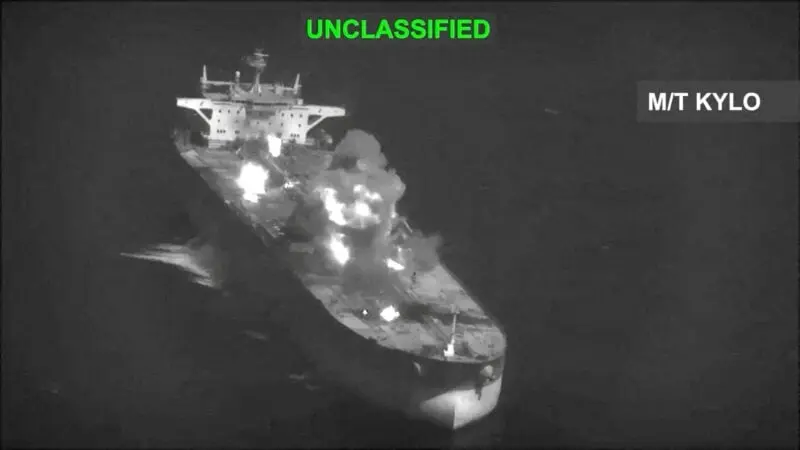
- The Kylo: A Suezmax-sized vessel patrolling the Gulf of Oman. Prior to the strike, U.S. forces warned the crew to abandon the ship. The vessel subsequently caught fire and sank. Shipping data later indicated that the Kylo was not carrying crude oil at the time, preventing a catastrophic environmental disaster.
- The Stark I: Another Suezmax-class vessel, which was disabled by U.S. strikes and remains adrift in the Gulf of Oman.
- The Downy: A Very Large Crude Carrier (VLCC) targeted and disabled in the Persian Gulf. Crucially, the Downy was struck near Kharg Island, the crown jewel of Iran’s oil export infrastructure, which handles over 90% of the country’s crude exports.
The Iranian Counter-Offensive
Hours after the sinking of the Kylo, the IRGCN launched its retaliatory campaign. Via its official Telegram channel, the IRGCN announced it had targeted three commercial tankers utilizing "unauthorized routes" through the Strait of Hormuz. The group also claimed responsibility for strikes against several other "U.S.-linked" commercial vessels.
The scope of Iran’s retaliation extended beyond commercial shipping. The IRGCN later confirmed it had intercepted and attacked a U.S. military aerial drone and an unmanned surface vessel (USV) that were allegedly attempting to breach Iranian territorial waters near the strait.
At present, independent maritime monitors have not been able to verify the extent of the damage to the targeted commercial vessels, as communication with ships in the area remains highly disrupted.
Supporting Context & Metrics
The militarization of the Strait of Hormuz has transformed a vital global trade route into an active combat zone. Under international maritime law, the strait is classified as an international highway, but Iran has increasingly sought to impose a sovereign regulatory regime over its waters, demanding that all transit receive prior authorization from Tehran.
The Maritime Blockade in Numbers
To counter Iranian influence and choke off its economic lifelines, the U.S. military has deployed significant naval and air assets to enforce a strict maritime blockade. According to data released by CENTCOM on September 6, 2026, the scale of this blockade is unprecedented:
| Metric | Quantity |
|---|---|
| Commercial Vessels Redirected | 92 |
| Vessels Disabled by U.S. Forces | 3 |
| Vessels Boarded for Inspection | 2 |
This blockade is supported by continuous aerial patrols, including U.S. Air Force F-35A Lightning II stealth fighters, which are actively monitoring the regional waters to enforce compliance and suppress Iranian coastal missile batteries.
          ┌────────────────────────────────────────┐
          │  Strait of Hormuz Traffic Comparison   │
          ├────────────────────────────────────────┤
          │ Pre-Conflict Average: ~150 ships/day   │
          │                                        │
          │ Sept 5, 2026: 1 ship (Kpler Data)      │
          └────────────────────────────────────────┘
Collapse of Shipping Volume
The immediate consequence of the conflict is the near-total shutdown of commercial shipping. Data compiled by the energy intelligence firm Kpler highlights the severity of the situation:
- During normal operations, the Strait of Hormuz sees an average of dozens of major commodity transits daily, carrying roughly 20% of the world’s petroleum liquids.
- On Saturday, September 5, only one commodity vessel successfully crossed the strait.
- Shipping insurance premiums for transit through the Persian Gulf have surged to prohibitive levels, forcing major maritime conglomerates to reroute their fleets around the Cape of Good Hope, adding weeks to transit times and millions of dollars in operational costs.
Official Statements
The rhetoric from both Washington and Tehran indicates a complete breakdown of diplomatic channels, with both sides preparing for a protracted and destructive conflict.
Tehran’s Shift to Asymmetric Warfare
Mohammad Bagher Ghalibaf, the Speaker of Iran’s Parliament and a key figure in previous, now-collapsed ceasefire negotiations, delivered a stern warning on Sunday. He made it clear that Iran has abandoned its previous policy of calculated, equivalent responses.
"The era of ‘proportionate responses’ is over. The United States must understand before it is too late that the rules of the game have changed. From now on, any aggression against Iran’s interests and security will receive a faster, heavier, and more painful response."
— Mohammad Bagher Ghalibaf, Speaker of the Iranian Parliament
This statement reflects a broader consensus within Iran’s political and military leadership that diplomatic avenues have been exhausted, and only maximum deterrence can halt the U.S.-led economic and military campaign.
Washington’s Political Divide
In Washington, the conflict has become a volatile political issue. President Donald Trump has maintained a hardline stance, asserting his desire to "strangle" the Iranian economy through military and financial pressure, even as his administration struggles to find an exit strategy.
On Friday, President Trump downplayed the severity of the conflict, in which 18 U.S. service members have died, famously referring to the ongoing skirmishes as "small potatoes."
In a similar vein, Vice President JD Vance sought to de-escalate public anxiety during a press briefing, stating that he "wouldn’t call it a war" at all, but rather a targeted maritime policing action.
However, the American electorate appears unconvinced. Public opinion polls show declining approval ratings for President Trump’s handling of the crisis. The spike in global oil prices has trickled down to American consumers in the form of soaring gasoline prices, placing the Republican party’s control of both the House of Representatives and the Senate in jeopardy ahead of the November midterm elections.
Future Outlook
The current trajectory of the U.S.-Iran conflict suggests that a diplomatic resolution is highly unlikely in the near term. The transition from proxy warfare to direct state-on-state maritime engagements has destroyed the delicate architecture of deterrence that previously governed the Persian Gulf.
Key Risks and Scenarios
                       [Current Crisis Level]
                                 │
         ┌───────────────────────┴───────────────────────┐
         ▼                                               ▼
[Scenario 1: Escalation]                        [Scenario 2: Attrition]
 ├── Direct strikes on oil ports                 ├── Persistent low-level attacks
 ├── Mine-laying in shipping lanes               ├── Prohibitive insurance rates
└── Global energy price shocks └── Long-term economic stagnation- Chokepoint Closure: If Iran resorts to offensive mine-laying or deploys its extensive inventory of anti-ship cruise missiles along the cliffs of the Musandam Peninsula, the Strait of Hormuz could be rendered entirely impassable. This would trigger an unprecedented global energy shock, with crude oil prices projected to exceed $150 per barrel.
- Infrastructure Targeting: The U.S. strike on the Downy near Kharg Island suggests that Iran’s onshore oil production and export facilities are no longer off-limits. If Iran retaliates by striking major processing facilities in neighboring Gulf states—such as Saudi Arabia’s Abqaiq plant—the regional war could expand to encompass the entire Middle East.
- Political Realignment in Washington: Should the Republican party lose its majorities in Congress in the upcoming midterms, President Trump may face intense legislative pressure to scale back the maritime blockade and seek an immediate ceasefire, potentially leaving Iran with greater leverage over regional shipping lanes.
Ultimately, the events of September 6, 2026, have demonstrated that the safety of international shipping can no longer be taken for granted. As long as the U.S. and Israel remain committed to their campaign against the Islamic Republic, and Tehran refuses to capitulate under economic strangulation, the Strait of Hormuz will remain a highly volatile flashpoint, capable of disrupting the global economy at a moment’s notice.