











Executive Overview
To the uninitiated, the low, steady rumble of a marine engine humming beneath a boat’s deck or mounted tightly to its transom sounds identical to the idle of an automobile. Both rely on internal combustion, spark plugs, pistons, and fossil fuels to generate propulsion. Yet, this mechanical kinship is deceptive. While a car engine enjoys the luxury of smooth asphalt, aerodynamic wind cooling, and intermittent loads, a marine engine operates in one of the most hostile engineering environments imaginable.
Marine powerplants must contend with aggressive saltwater corrosion, massive continuous physical resistance from water displacement, complex raw-water cooling systems, and sustained high-load operating profiles that would rapidly stress and destroy a standard automotive block. Understanding the operational architecture of a marine engine—whether an outboard, an inboard, or a complex sterndrive—is not merely an academic pursuit for mechanically minded skippers. It is an essential component of modern seamanship. Recognizing the subtle acoustic shifts, temperature fluctuations, and performance stutters of a powerhead can mean the difference between a minor preventative fix at the dock and a catastrophic, immobilizing breakdown miles offshore.
This report provides an exhaustive, authoritative examination of how marine engines function, why they fail under the duress of the marine environment, how specialized cooling and propulsion systems operate, and why proactive maintenance remains a boater’s ultimate safeguard against the unpredictable forces of open water.
Detailed Chronology: The Evolution and Mechanics of Marine Combustion
To appreciate modern marine propulsion, one must first examine the fundamental thermodynamic process that drives it. At its core, nearly every gas-powered marine engine—much like its land-bound counterpart—operates on the four-stroke internal combustion cycle.
The Four-Stroke Cycle on the Water
- The Intake Stroke: The piston moves downward within the cylinder, creating a partial vacuum that draws a precise mixture of fuel and air through the open intake valve into the combustion chamber.
- The Compression Stroke: The intake valve snaps shut as the piston travels upward, sharply compressing the air-fuel mixture into a highly volatile state.
- The Power Stroke: At precisely the right millisecond, the spark plug emits an electrical charge, igniting the compressed mixture. This controlled, violent explosion forces the piston back down with immense force, translating linear motion into rotational energy via the connecting rod and crankshaft.
- The Exhaust Stroke: Finally, the exhaust valve opens as the piston sweeps upward once more, expelling the spent combustion gases out of the cylinder and into the exhaust manifold.
This cycle repeats thousands of times per minute, spinning the crankshaft that ultimately drives the propeller. However, the operational reality of this cycle on a boat differs fundamentally from a car. When you accelerate a car on a highway, the vehicle builds momentum, and the engine eventually coasts or operates under a relatively low, intermittent load. A boat, conversely, is in a state of constant, unrelenting battle against hydrodynamic drag. Water is dense, viscous, and heavy. Consequently, a marine engine never truly coasts; it operates under a sustained, heavy-load profile from the moment the throttle is pushed forward until the ignition is killed. This sustained torque demand accelerates mechanical wear, making structural integrity, thermal management, and lubrication paramount.
Supporting Context & Metrics: Outboards, Inboards, and the Thermal Battleground
Marine propulsion systems are broadly categorized by how they are mounted and how they transfer mechanical energy to the water. Each configuration presents distinct advantages, vulnerabilities, and engineering challenges.
Outboard Engines: Self-Contained Powerhouses
Outboard motors are compact, self-contained units mounted externally on the boat’s transom. They integrate the powerhead (engine block), the driveshaft housing, the gearbox, and the propeller into a single, cohesive vertical assembly.

- The Mechanism: Combustion occurs within the powerhead at the top of the unit. The resulting rotational energy is transferred vertically down a driveshaft through the midsection to the lower unit, where a bevel gear redirects the energy horizontally, spinning the propeller to push water backward and propel the vessel forward.
- The Advantages: Because the entire engine sits outside the hull, outboards are easily accessible for routine servicing, repairs, and complete replacements. They offer exceptional maneuverability, as the entire unit pivots to steer the boat.
Inboard Engines: Heavy-Duty Torque
Inboard engines are permanently mounted inside the hull, typically sitting near the center of gravity for optimal weight distribution.
- The Mechanism: An inboard engine connects to a rigid driveshaft that exits the hull horizontally through a shaft log and a stuffing box, spinning a submerged propeller directly beneath the hull. Unlike outboards, which steer by pivoting the entire motor, inboards use a separate rudder positioned in the prop wash to direct the vessel.
- The Advantages and Demands: Inboards are the undisputed workhorses of larger cruisers, sportfishing yachts, and commercial vessels. They deliver immense low-end torque capable of pushing heavy hulls through rough seas. However, their enclosed nature introduces unique safety hazards—most notably the accumulation of explosive gasoline vapors, which makes rigorous pre-start bilge ventilation an absolute requirement.
The Marine Cooling Dilemma: Raw Water vs. Closed Systems
Perhaps the single greatest engineering divergence between automotive and marine engines lies in thermal regulation. While cars rely on a closed-loop radiator system cooled by ambient air and a mixture of water and antifreeze, most marine engines utilize the very water the boat is floating in.
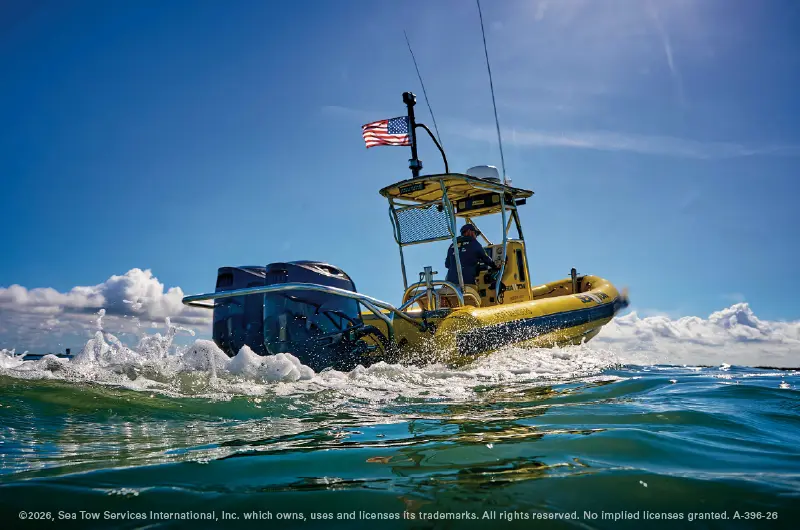
- Raw-Water Cooling: A belt-driven raw-water pump draws water from outside the hull—via a through-hull fitting or outdrive intake—and circulates it through the engine block or heat exchanger to absorb heat before expelling it out the exhaust.
- The Vulnerabilities: While remarkably efficient, raw-water systems expose the engine’s internal channels to silt, sand, plastic debris, aquatic weeds, and corrosive saltwater. A clogged intake or a worn-out rubber impeller can starve an engine of cooling water in seconds. When cooling fails, marine engines overheat with terrifying speed, leading to warped cylinder heads, blown head gaskets, and seized pistons.
Official Statements and Industry Insights on On-Water Failures
Maritime safety organizations and marine rescue professionals continually study the root causes of vessel disablement. According to operational data from premier on-water assistance networks like Sea Tow, the vast majority of calls for emergency tows are not catastrophic engine explosions or sudden structural sinkings, but rather preventable mechanical and electrical failures that leave skippers stranded.
Industry experts emphasize that the marine environment is profoundly unforgiving of deferred maintenance. A component that might endure years of neglect under the hood of a garage-kept automobile will rapidly succumb to oxidation, electrical resistance, and vibrational fatigue when subjected to the pounding of choppy seas, heavy salt fog, and relentless humidity.
"Mechanical knowledge on the water is invaluable, but it is never a substitute for proactive maintenance and professional safety nets," notes marine operations leadership. "When propulsion is lost offshore, an inconvenience escalates into a maritime hazard in a matter of minutes, particularly if wind or tide sets the vessel toward shoals, rocks, or heavy shipping lanes."
Furthermore, marine engineers point out that offshore operation dramatically amplifies baseline engine stress. Pitching, rolling, and slamming subject internal fluids, mounts, and electrical wiring harnesses to severe dynamic G-forces. Fuel sloshing in tanks can stir up dormant sediment and water condensation, instantly clogging fuel-water separators and starving the powerhead of clean fuel precisely when full power is required to clear a dangerous inlet or ride out a squall.
Future Outlook: The Intersection of Smart Marine Engineering and Boater Preparedness
As marine propulsion technology marches into the future, the design of boat engines is undergoing a quiet revolution. Modern marine powerplants are increasingly digitized, featuring sophisticated Electronic Control Units (ECUs), closed-loop fresh-water cooling systems even in smaller outboards, and advanced telemetry that streams real-time engine health data directly to multi-function displays at the helm.
The Rise of Predictive Diagnostics
Future marine engines will lean heavily on predictive diagnostics—sensors that monitor microscopic shifts in oil pressure, exhaust gas temperatures, and fuel rail pressures to warn skippers of component degradation long before a hard failure occurs. Electric and hybrid marine propulsion systems are also gaining traction in sheltered waters, offering silent operation and drastically reduced mechanical complexity, though internal combustion will remain the king of offshore range and high-load torque for decades to come.
The Imperative of Preparedness
Despite these technological leaps forward, the core reality of boating remains unchanged: electronics can fail, raw-water pumps can ingest plastic bags, and fuel can become contaminated. Technology does not eliminate risk; it manages it.
Therefore, the modern boater’s survival toolkit must bridge high-tech machinery with timeless seamanship. This entails a disciplined regimen of preventative care:
- Rigorous Winterization: Flushing raw-water systems with non-toxic antifreeze, fogging cylinders to prevent internal rust, and stabilizing fuel before extended storage.
- Spring Commissioning: Inspecting fuel lines, replacing water-separating fuel filters, checking sacrificial anodes, and testing battery health before the inaugural run of the season.
- On-Water Redundancy: Maintaining a comprehensive toolkit, carrying spare belts, fuel filters, and raw-water pump impellers, and ensuring all safety communication gear is operational.
Ultimately, understanding the mechanics of a boat engine empowers a skipper to make sound, rapid decisions when conditions deteriorate. Yet, true confidence on the water comes from recognizing the boundary between what can be fixed with a wrench in the bilge and when it is time to call for professional backup. By pairing mechanical awareness with a reliable on-water assistance membership, boaters ensure that an unexpected engine glitch remains a minor logistical hurdle rather than an emergency at sea.


