








Executive Overview
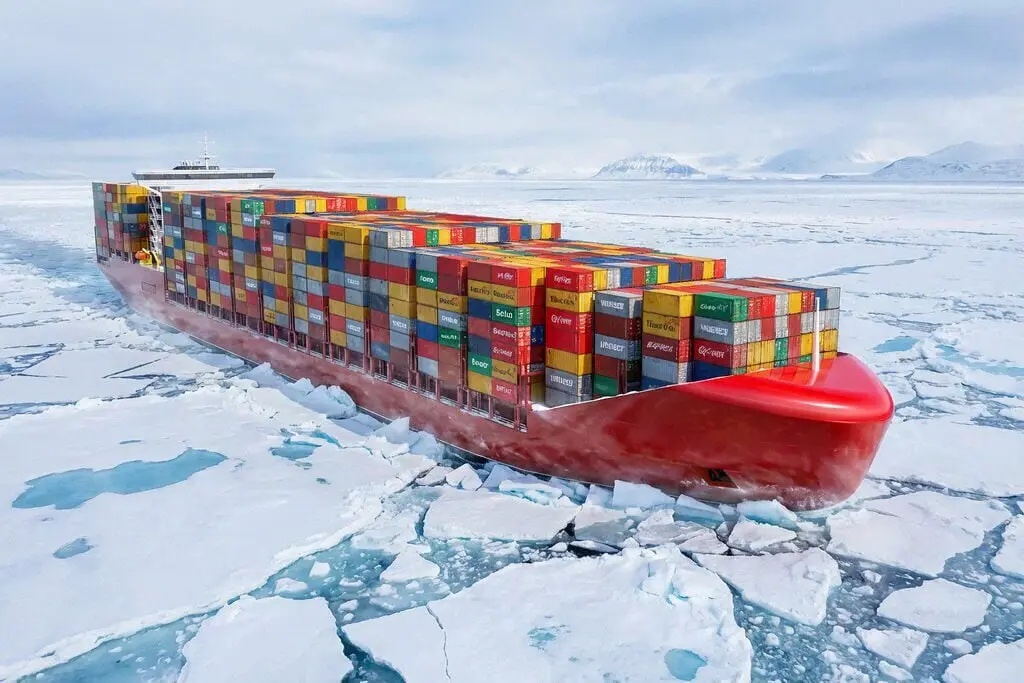
In a move that could fundamentally reshape global maritime logistics and bypass traditional geopolitical chokepoints, Russia’s state-owned nuclear energy corporation, Rosatom, and China’s rapidly expanding NewNew Shipping Line are advancing plans to construct a fleet of five specialized, ice-class container ships. These vessels, designed to navigate the treacherous waters of the Northern Sea Route (NSR), are engineered to turn what has historically been a seasonal, weather-dependent passage into a viable, year-round commercial shipping corridor.
The joint initiative represents a critical nexus of Moscow’s Arctic ambitions and Beijing’s "Polar Silk Road" strategy. As geopolitical tensions flare in traditional maritime corridors—most notably the Red Sea and the Malacca Strait—and Western sanctions continue to restrict Russia’s access to European markets, the development of an independent, ice-locked trade route has become a top priority for both nations.
Designed by Russia’s United Shipbuilding Corporation (USC), the proposed Arc7 vessels will carry over 4,800 twenty-foot equivalent units (TEUs). If successfully built and deployed, they will be the largest container ships specifically designed for the harsh Arctic environment. Operating under a newly formed joint venture, these vessels are intended to establish a secure, predictable logistics loop connecting Chinese manufacturing hubs directly with Russian ports, fundamentally altering the economics of Eurasian trade.
                  THE NORTHERN SEA ROUTE VS. TRADITIONAL ROUTE

     [ Northern Europe / St. Petersburg ]               [ East Asia / China ]
                                                              /
              ____  Northern Sea Route (NSR): ~13,000 km ____/  (Saves 10-15 Days)
                                                            /
                ___ Suez Canal Route: ~21,000 km __________/   (Subject to Chokepoints)
Detailed Chronology
The partnership between Rosatom—the designated infrastructure operator of the Northern Sea Route—and NewNew Shipping Line is the culmination of a multi-year effort to build a dedicated Arctic container fleet. Below is the chronological progression of this high-stakes maritime alliance:
2023–2024: Establishing the Strategic Foundation
Following the escalation of the conflict in Ukraine and subsequent Western sanctions on Russian shipping, Moscow sought to accelerate trade with Asian economies. In late 2024, Rosatom and NewNew Shipping Line officially established a joint venture in China named the Northern Sea Route Shipping Line. This corporate entity was tasked with managing the logistics, marketing, and operational scheduling of a dedicated Arctic container service.
June 2025: Shipyard Negotiations and Subsidy Searches
By mid-2025, Rosatom confirmed that the joint venture partners were actively vetting shipyards capable of constructing high-spec Arc7 vessels. Because Russian shipyards were heavily backlogged with domestic military and energy projects, and faced severe import restrictions on Western marine components, the partners heavily scrutinized Chinese shipyards for construction. During this period, the targeted timeline slated the first of the five Arc7 vessels to enter commercial service no later than 2027.
August 2025: Operational Milestones
While the Arc7 design progressed, NewNew Shipping Line tested the limits of existing tonnage. In August, the company’s 29,000-deadweight-ton (DWT) general cargo/container vessel, Xin Xin Hai 1, completed a historic voyage. It became the first Chinese container ship to reach Murmansk via the Northern Sea Route, carrying approximately 500 containers of automotive components and machinery from China. This voyage proved the technical viability of utilizing the NSR for high-value containerized cargo, even with lower ice-class vessels during the summer window.
September 2025: The Eastern Economic Forum Announcement
At the Eastern Economic Forum in Vladivostok, Vladimir Panov, Rosatom’s special representative for Arctic development, formally unveiled the advanced design stage of the 4,800-TEU Arc7 container ships. Panov characterized the vessels as "revolutionary" assets that would redefine polar logistics. However, despite the engineering milestones, industry analysts noted that the construction timeline had begun to slip, with no official keel-laying ceremonies announced, leaving the 2027 operational target highly uncertain.
Late 2026–2027: Intermediate Fleet Expansion
Recognizing that the custom-built Arc7 ships would require several years to construct, NewNew Shipping Line initiated a parallel fleet expansion. The company procured a separate group of six 4,800-TEU ice-class vessels. According to company schedules, four of these ships (reportedly built to a lighter Arc3 ice-class standard) are slated to enter service in October 2026 on a dedicated China–St. Petersburg loop, followed by two additional sister ships in June 2027.
+------------------+-------------------------------------------------------+
| Date             | Milestone Event                                       |
+------------------+-------------------------------------------------------+
| Late 2024        | Joint venture "Northern Sea Route Shipping Line" formed|
| June 2025        | Shipyard selection process and subsidy reviews begin  |
| August 2025      | Xin Xin Hai 1 completes historic transit to Murmansk  |
| September 2025   | Arc7 designs presented at Eastern Economic Forum      |
| October 2026     | Four intermediate 4,800-TEU vessels scheduled for NSR |
| June 2027        | Two additional intermediate vessels enter service     |
| 2027 (Target)    | Original target for first Arc7 vessel (now uncertain) |
+------------------+-------------------------------------------------------+
Technical Blueprint & Operational Metrics
To appreciate the scale of this project, one must understand the unique engineering requirements of the proposed Arc7 vessels. Operating in the Arctic requires a delicate balance of structural rigidity, specialized propulsion, and hydrodynamic efficiency.
                    ARC7 CONTAINER SHIP PROFILE

     +-----------------------------------------------------+
     |  [Cargo: 4,800+ TEU]                                |===# (Bridge)
     |                                                     |
  _--+-----------------------------------------------------+--_
 (   [Ice-Breaking Bow] <--- 1.7m Ice Capacity ---> [Propulsion]
  ______________________________________________________________/
     |<- Length: 255m ->|<- Beam: 35m ->|<- Power: 46MW ->|
Vessel Specifications
The Arc7 container ships are designed to the following specifications:
- Length Overall (LOA): 255 meters
- Beam (Width): 35 meters
- Cargo Capacity: 4,800+ Twenty-Foot Equivalent Units (TEUs)
- Power Plant: 46-Megawatt (MW) diesel-electric power plant
- Propulsion System: Two 15-MW electric propulsion motors driving fixed-pitch propellers (with azimuth capability for maneuvering in ice)
- Ice Class Rating: Russian Maritime Register of Shipping (RS) Arc7
Ice-Breaking Capabilities and Hull Design
The Arc7 ice class designates vessels capable of independent navigation in close pack first-year ice up to 1.7 meters thick during winter and spring, and up to 2.0 meters thick during summer and autumn.
The ship’s 35-meter beam is not an arbitrary figure. It was specifically selected to match the hull width of Russia’s flagship Project 22220 nuclear-powered icebreakers (such as the Arktika, Sibir, and Ural). When ice conditions in the East Siberian Sea or the Vilkitsky Strait become too severe for the container ships to navigate independently, they will slot directly behind a Project 22220 icebreaker. Because the icebreaker cuts a channel exactly 35 meters wide, the Arc7 container ship can follow safely in its wake without its hull rubbing against the frozen edges of the channel.
The Logistics Advantage: NSR vs. Suez Canal
For shipments between East Asia (e.g., Shanghai, Qingdao) and Northern Europe or Western Russia (St. Petersburg, Murmansk), the Northern Sea Route offers a significant geographical advantage:
- Distance Reduction: The NSR is approximately 13,000 kilometers long, compared to the 21,000-kilometer route via the Suez Canal. This represents a distance savings of nearly 40%.
- Transit Time: A typical transit via the Suez Canal takes between 35 to 45 days. Under optimal summer conditions, the NSR can be traversed in 18 to 25 days, saving up to 15 days of fuel, crew wages, and vessel charter costs.
- Security: The NSR is entirely within Russia’s Exclusive Economic Zone (EEZ), shielding it from geopolitical tensions in the Red Sea, piracy in the Gulf of Aden, and traffic delays in the Malacca Strait.
Official Stances & Geopolitical Alignments
The development of the Arc7 container fleet is more than a commercial shipping project; it is a geopolitical statement. The public remarks of key officials highlight the strategic weight assigned to this corridor by both Moscow and Beijing.
The Russian Perspective
Speaking at the Eastern Economic Forum, Vladimir Panov, Rosatom’s special representative for the Arctic, emphasized the transformative nature of the project:
"The Arc7 container ship project is not just an incremental step; it is a revolutionary leap for Arctic shipping. By combining Russia’s unparalleled icebreaker fleet with custom-designed commercial hulls, we are laying the groundwork for a secure, year-round maritime bridge between Asia and Europe that is entirely independent of external political pressures."
For Rosatom, the venture serves to justify the massive state expenditures poured into its nuclear icebreaker program. By securing a committed commercial partner in China, Rosatom can generate the transit fees and cargo volumes required to make the NSR economically self-sustaining.
The Chinese Perspective
While Chinese state officials maintain a more diplomatic, commerce-first tone, the actions of companies like NewNew Shipping Line align closely with Beijing’s Polar Silk Road guidelines, first formalized in a 2018 white paper. By securing alternative, non-Western-controlled trade routes, China mitigates its "Malacca Dilemma"—the vulnerability of its energy and trade supply lines to a potential naval blockade in the Indo-Pacific.
Furthermore, NewNew Shipping’s aggressive cargo target of 1.2 million tonnes of Arctic cargo during the 2027 navigation season demonstrates that Chinese manufacturers, particularly automotive and heavy machinery sectors, are actively integrating the NSR into their supply chain contingencies.
Future Outlook, Environmental Risks & Economic Viability
Despite the optimistic projections of Rosatom and NewNew Shipping, the path to year-round Arctic container shipping is fraught with technical, economic, and environmental obstacles.
                     CHALLENGES TO YEAR-ROUND TRANSIT

      [ Technical ]          [ Commercial ]         [ Environmental ]
            |                      |                        |
     Extreme Cold &          High Insurance          Black Carbon &
     Polar Darkness          Rates & Low Load         Heavy Fuel Oil
    (Instrument Only)         Factor Trials           Spill Risks
The Harsh Reality of Winter Navigation
While summer transits have become increasingly common due to receding summer ice pack levels driven by climate change, winter navigation (November to May) remains an entirely different challenge.
- Polar Darkness: For several months of the year, crews must navigate in total darkness, relying entirely on radar, satellite imagery, and searchlights.
- Extreme Cold: Temperatures regularly drop below -40°C, causing structural steel embrittlement, freezing ballast water, and rendering standard deck machinery inoperable without extensive winterization heating systems.
- Multi-Year Ice: While Arc7 hulls can handle first-year ice, encountering multi-year pressure ridges can stop even the most powerful vessels, risking costly delays or structural damage.
The Commercial Dilemma: South Korea’s Warning
A major hurdle for Arctic container shipping is the lack of "liner service" feasibility. Modern global trade relies on just-in-time logistics, where container ships stop at multiple ports along a route to drop off and pick up cargo. The NSR is a point-to-point transit route with virtually no intermediate ports of call between East Asia and Europe.
Furthermore, global shipping lines remain highly skeptical of the route’s commercial viability. A recent Arctic container ship trial voyage organized by South Korea secured just 737 TEUs of cargo—less than half of its modest target. International cargo owners are hesitant to risk high-value goods on routes with unpredictable schedules, high insurance premiums, and specialized ice-class surcharges.
Environmental Scrutiny
The prospect of increased commercial traffic in the Arctic has drawn fierce criticism from environmental organizations and marine scientists.
- Black Carbon Emissions: Heavy diesel engines operating in the Arctic emit black carbon (soot). When these dark particles settle on ice and snow, they reduce the surface albedo (reflectivity), accelerating solar heat absorption and melting.
- Spill Risks: A major maritime accident or oil spill in the remote Arctic would be catastrophic. The lack of emergency response infrastructure, cleanup equipment, and extreme distances would make containing a heavy fuel oil or diesel spill nearly impossible.
Geopolitical Friction with the West
The United States, Canada, and several European Union nations view the deepening Sino-Russian cooperation in the Arctic with growing alarm. The US military has updated its Arctic Strategy to counter what it terms the "militarization" of the NSR by Russia, and is monitoring Chinese investment in northern infrastructure.
Additionally, Western sanctions targeting Russian financial institutions and shipbuilders could complicate the financing and construction of the Arc7 fleet. If the vessels require specialized Western components—such as advanced navigation packages, marine gearboxes, or specialized steel alloys—the joint venture may face severe supply chain bottlenecks, explaining the current timeline slippages.
Conclusion
The partnership between Rosatom and NewNew Shipping Line is a high-stakes gamble on the future of global trade. If the five Arc7 container ships are successfully built and deployed, they will prove that commercial shipping can conquer one of the planet’s most hostile environments on a year-round basis. However, until these vessels are laid down in shipyards and successfully navigate the dark, frozen waters of a Siberian winter, the Northern Sea Route will remain a highly specialized, geopolitically charged alternative rather than a true competitor to the Suez Canal.