








Executive Overview
European air travel has entered uncharted and potentially turbulent waters following the expiration of a critical regulatory safety valve governing the European Union’s new Entry-Exit System (EES). On Sunday, a temporary policy provision that allowed member states to suspend or relax biometric registration checks during periods of heavy passenger demand officially lapsed. This development leaves national border authorities without a formal, legally sanctioned mechanism to bypass the system when severe bottlenecks threaten to paralyze international hubs.
The lapsing of this flexibility has triggered an immediate and aggressive response from the aviation sector. Ryanair, Europe’s largest low-cost carrier by passenger volume, has issued a scathing public condemnation of Brussels’ handling of the rollout. The airline is urgently demanding that the European Commission reinstate the emergency suspension mechanism until at least April 2027. According to carrier executives, airports, ground handlers, and border control agencies require a multi-year grace period to stabilize self-service kiosks, optimize staffing levels, and ensure system reliability before full, unyielding enforcement becomes the permanent operational standard.
The transition to automated biometric border checks—designed to register non-EU nationals traveling into the Schengen Area—was intended to modernize security and streamline immigration. However, industry stakeholders argue that the reality on the ground has fallen drastically short of these ambitions. Ryanair Chief Operating Officer Neal McMahon did not mince words on Monday, labeling the EU’s management of the EES implementation as "a shambles from start to finish." He accused European regulators of turning a blind eye to persistent warnings from airlines, airports, and travel associations who forewarned that rigid biometric processing times would exponentially increase queues.
With the safety valve now consigned to history, the aviation industry fears that upcoming peak travel periods will expose systemic vulnerabilities, stranding passengers in terminal queues and threatening the economic recovery of Europe’s tourism sector. This comprehensive report investigates the anatomy of the EES crisis, the operational realities facing European airports, the fierce war of words between low-cost carriers and Brussels regulators, and the high-stakes outlook for international travel over the coming years.
Detailed Chronology: From Concept to the Current Crisis
To understand the gravity of the current impasse, it is necessary to examine the protracted and contentious timeline of the European Union’s Entry-Exit System. Conceived years ago as part of the bloc’s broader strategy to "smarten" its external borders, the EES was engineered to replace traditional passport stamping with an automated electronic registry.
The Legislative Blueprint and Initial Delays
The legal framework for the EES was formally adopted by the European Parliament and the Council in 2017. The ambitious project aimed to record the name, travel document, fingerprints, and facial images of third-country nationals crossing the external borders of the Schengen Area for short stays.
However, the path to implementation was plagued by chronic technical delays. Originally slated to launch several years earlier, the system faced repeated setbacks driven by software integration challenges, data privacy concerns, and hardware supply chain disruptions. Member states struggled to synchronize their national border management databases with the centralized EU-wide repository managed by eu-LISA (European Union Agency for the Operational Management of Large-Scale IT Systems in the Area of Freedom, Security and Justice).

The April Launch and the Birth of the "Release Valve"
After multiple false starts, the mandatory rollout of biometric registration across the bloc finally took place in April. Recognizing that a sudden, unmitigated transition to full biometric data capture for every non-EU traveler would inevitably cause unprecedented congestion at major international airports, European regulators introduced a crucial contingency measure.
This policy—often referred to by operational planners as the "release valve"—granted national border authorities the discretionary legal authority to temporarily switch off or bypass parts of the EES during periods of exceptionally heavy passenger demand. The goal was pragmatic: prevent catastrophic terminal gridlock by allowing officers to revert to traditional, faster passport inspection methods when queues reached critical mass.
The Midnight Expiration
From its inception, the release valve was designated as a temporary bridge to help the travel ecosystem adapt to the new normal of biometric processing. However, the pre-determined legal sunset clause dictated that this emergency measure would lapse automatically.
When the clock struck midnight on Sunday, the safety valve dissolved. For the first time since the April nationwide rollout, border authorities across the Schengen zone are legally bound to enforce EES compliance without the cushion of systematic exemptions during demand surges. The immediate termination of this policy has created an operational vacuum, leaving airports exposed to sudden spikes in passenger traffic without a recognized regulatory mechanism to alleviate terminal-wide gridlock.
Supporting Context & Metrics: The Operational Realities of Biometric Borders
The core of the dispute between airlines and the European Commission lies in a fundamental disagreement over processing times, technological readiness, and human behavior at the border.
The Math of Biometric Registration
Under the EES framework, non-EU travelers—including millions of British, American, and Canadian visitors—must provide biometric data upon their initial entry into the Schengen Area. This process involves:
- Scanning the biometric passport.
- Capturing a live facial image.
- Taking four fingerprints (or verifying existing data for returning visitors).
While proponents argue that subsequent entries will be faster, the initial registration process is inherently time-consuming. Independent aviation studies and airport trials indicate that a comprehensive EES registration adds anywhere from 60 to 90 seconds per passenger compared to legacy manual passport checks.
Multiply those seconds across wide-body aircraft arriving simultaneously at major European hubs—such as Frankfurt, Paris Charles de Gaulle, Amsterdam Schiphol, Madrid-Barajas, and London-connected gateways—and the terminal mathematics become alarming. A single wide-body flight carrying 300 non-EU passengers introduces an additional 5 to 7.5 hours of cumulative processing time at the border control checkpoints.
Infrastructure Deficits and Kiosk Failures
Ryanair and other industry bodies point out that European airports are buckling under the weight of these requirements due to inadequate physical infrastructure.
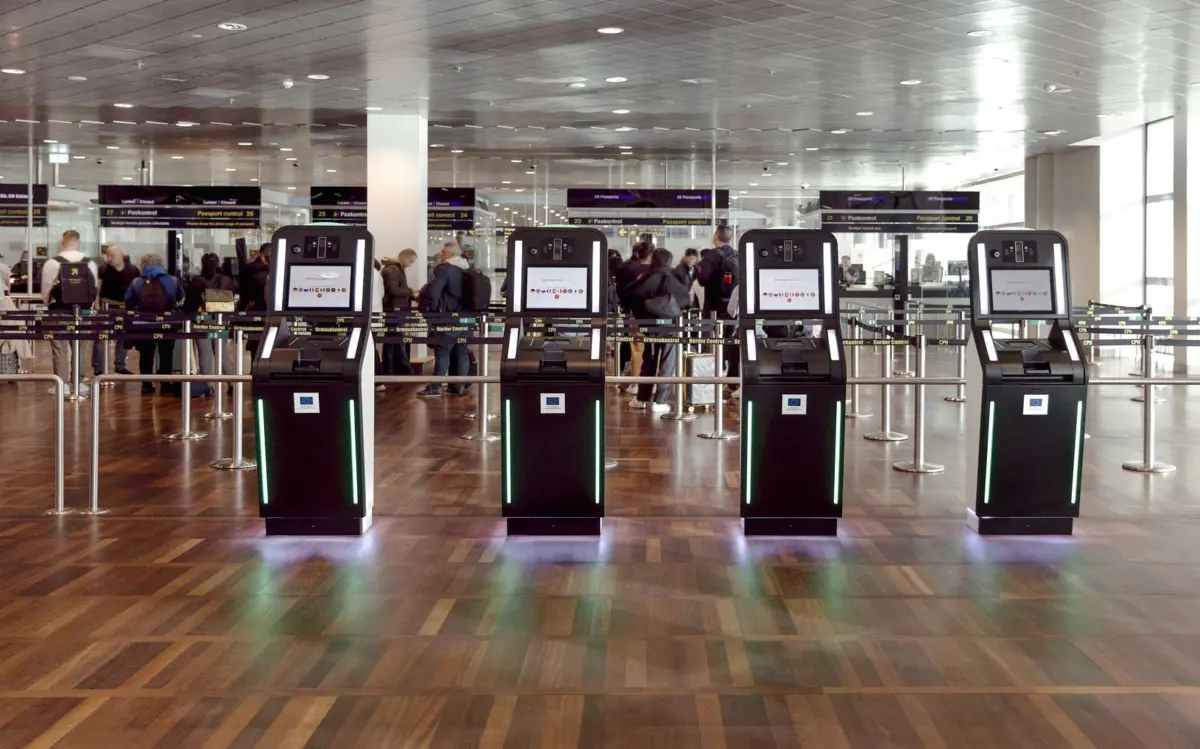
- Kiosk Bottlenecks: Self-service enrollment kiosks are frequently plagued by software glitches, hardware unresponsiveness, and confusing user interfaces for travelers unfamiliar with the system.
- Spatial Constraints: Many historical European terminal buildings lack the physical footprint required to queue hundreds of passengers waiting to use biometric registration kiosks before reaching an immigration officer.
- Staffing Shortages: Border control agencies across the continent continue to struggle with recruitment and retention, leaving immigration booths understaffed precisely when automated systems demand more human oversight to resolve scanner errors and exception cases.
Economic and Operational Toll
The downstream effects of border congestion extend far beyond frustrated travelers. When immigration queues back up into the baggage reclaim and aircraft gate areas, the entire operational chain is compromised:
- Turnaround Delays: Ground handling crews are delayed in servicing arriving aircraft.
- Secondary Flow-on Delays: Aircraft miss their scheduled departure slots, triggering a cascading wave of delays across European airspace throughout the day.
- Missed Connections: Passengers miss onward flights, forcing airlines to incur substantial compensation, accommodation, and rebooking costs.
Official Statements and Industry Backlash
The termination of the EES suspension policy has unleashed a torrent of criticism from airline executives, trade associations, and passenger rights advocates who accuse Brussels of bureaucratic disconnect from commercial realities.
Ryanair’s Frontline Assessment
In a blistering statement released on Monday, Ryanair’s Chief Operating Officer, Neal McMahon, articulated the deep-seated frustration felt throughout the low-cost carrier sector.
"The EU’s handling of EES has been a shambles from start to finish," McMahon stated bluntly. He asserted that the European Commission ignored months of empirical evidence and explicit warnings submitted by aviation working groups. According to McMahon, industry leaders repeatedly cautioned regulators that enforcing rigid biometric protocols without adequate infrastructure testing would inevitably lengthen processing times and degrade the passenger experience.
McMahon did not pull his punches regarding who ultimately bears the cost of these administrative missteps: "The EU is forcing passengers to pay the price for a failed, rushed implementation that disregards the operational realities of modern international travel."
The Demand for an Extended Grace Period
Ryanair’s formal policy position is clear and uncompromising. The airline is demanding that the European Commission act immediately to reinstate the emergency pause mechanism. Furthermore, the carrier insists that this regulatory release valve must remain active until at least April 2027.
Aviation leaders argue that a multi-year extension is the bare minimum required to allow stakeholders to:
- Overhaul Hardware: Replace malfunctioning or outdated biometric kiosks with high-speed, intuitive enrollment units.
- Upgrade Software: Implement robust algorithms capable of handling edge cases (e.g., damaged fingerprints, facial recognition anomalies) without requiring manual intervention from border guards.
- Scale Workforce: Train and deploy sufficient border security personnel to manage exception queues and maintain continuous traffic flow.
The European Commission’s Stance
To date, officials in Brussels have defended the integrity and timeline of the EES rollout. The European Commission maintains that the system is a vital cornerstone for enhancing the internal security of the Schengen Area, combating identity fraud, and identifying overstayers who violate the terms of their short-stay visas.
While acknowledging initial teething problems, EU regulators have previously argued that granting indefinite or extended suspensions undermines the harmonization of border controls across member states. From the Commission’s perspective, allowing individual countries to selectively opt-out creates uneven security standards and rewards nations that have lagged in modernizing their port infrastructure. However, with the safety valve now officially expired and mounting pressure from major carriers, Brussels faces intense political scrutiny to justify its refusal to grant a formal extension.
Future Outlook: Navigating the Biometric Crossroads
As Europe steps into a post-release-valve era, the coming months will serve as a critical stress test for the continent’s aviation ecosystem. The trajectory of international travel to and from the EU now hinges on how national authorities, airport operators, and airlines manage the friction between high-tech security mandates and high-volume passenger demand.
Scenarios for Peak Travel Periods
Industry analysts are modeling several potential scenarios for upcoming travel surges, including the winter holiday season and the vital summer peak of next year:
- Scenario A: Gridlock and Escalation. Without the release valve, localized technical glitches or sudden surges in third-country arrivals could trigger severe, multi-hour delays at major hub airports. This would likely prompt further public outcry, potential legal challenges from airlines facing regulatory penalties for delayed flights, and emergency political interventions by individual member states.
- Scenario B: Pragmatic Non-Enforcement. Recognizing the risk of catastrophic queues, some national border authorities may adopt a tacit policy of operational leniency—effectively slowing down or selectively prioritizing checks informally, despite the formal expiration of the EU release valve. While this would mitigate bottlenecks, it would create a fragmented legal landscape across the Schengen zone.
- Scenario C: Regulatory Capitulation. Under mounting pressure from industry giants like Ryanair and trade bodies such as ACI EUROPE (Airports Council International), the European Commission could bow to economic reality, introducing a revised legislative package that restores a modified version of the suspension mechanism.
The Imperative for Technological and Strategic Adaptations
Regardless of whether Brussels yields to Ryanair’s demands for an extension through April 2027, the long-term future of European travel is inextricably linked to digital transformation.
Airports and airlines are accelerating investments in pre-travel mobile enrollment applications, allowing passengers to submit their biometric credentials securely from home before arriving at the terminal. By shifting the initial data capture phase out of the airport environment, the industry hopes to reduce terminal congestion and transform border checkpoints from verification bottlenecks into rapid validation gates.
However, technology alone cannot solve a structural design flaw in regulatory enforcement. As Neal McMahon and the broader aviation sector have made abundantly clear, imposing rigid compliance deadlines without functional safety valves risks breaking the very engine that powers European tourism and economic mobility.
The coming months will determine whether the European Union possesses the regulatory agility to adapt its flagship border system to the realities of the physical world, or whether passengers will continue to pay the price for administrative inflexibility at the gates of Europe.