










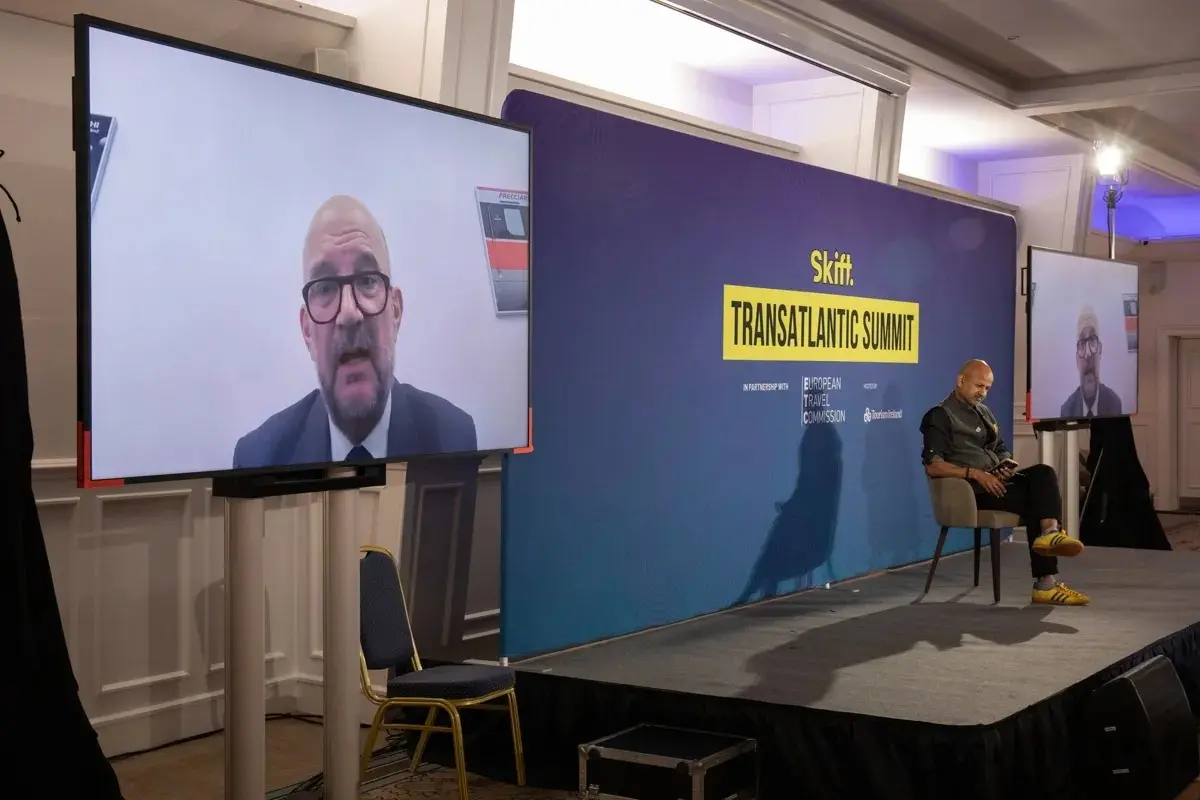
DUBLIN — As European capitals intensify their war on carbon emissions, a quiet but seismic shift is underway in how the continent moves its people. Greg O’Hara, founder and senior managing director of the travel-focused private equity giant Certares, has thrown down a definitive marker: the era of the short-haul European flight is drawing to a close, and private capital is moving aggressively to fill the void.
Speaking at the Skift Transatlantic Summit in Dublin, O’Hara revealed that Certares has poured approximately $2.3 billion into European and United Kingdom rail assets. This capital deployment is not merely an opportunistic green investment; it is a calculated, strategic bet on regulatory tailwinds that are systematically dismantling the dominance of regional aviation.
For decades, low-cost carriers and legacy airlines alike have stitched Europe together with a dense web of high-frequency, short-duration flights. Today, that model faces an existential threat from climate legislation, rail deregulation, and a fundamental realignment of institutional investment toward sustainable infrastructure.
Executive Overview: The Convergence of Regulation and Capital
The intersection of state-enforced environmental mandates and private equity liquidity is reshaping European travel logistics. At the heart of this transformation is regulatory intervention, spearheaded by France, which has effectively criminalized certain domestic flight routes where a competitive rail alternative exists.
During his keynote session, titled "Where Transatlantic Travel Capital Goes Next," O’Hara articulated a simple, immutable thesis: regulatory coercion will force millions of travelers out of the skies and onto the rails.
"We like trains because France has passed a law, and other European countries are going to pass a law that if it’s within a certain distance, you can’t fly there anymore," O’Hara told the audience via video link from Milan.
This legislative trajectory has transformed passenger rail from a subsidized, public-sector utility into a high-growth, venture-backed battleground. Certares, renowned for its blockbuster investments in travel heavyweights like American Express Global Business Travel and TripAdvisor, has positioned itself at the vanguard of this movement. By committing $2.3 billion to rail networks in the UK and continental Europe, the firm is signaling to the broader investment community that the future of intra-European transit runs on steel tracks, not jet fuel.
Detailed Chronology: From Skies to Tracks
To understand the current momentum behind European rail, it is necessary to examine the regulatory milestones and structural market shifts that have unlocked the sector for private investment.
The Legislative Catalyst: France Leads the Charge
The pivot toward rail gained irreversible legal momentum when France enacted a landmark law banning domestic flights on routes where a train journey takes less than two hours and thirty minutes. While the law includes specific exemptions—most notably for connecting international flights—its psychological and practical impact on the aviation market has been profound.
Airlines operating high-frequency domestic shuttles, such as Air France on routes between Paris and cities like Lyon, Nantes, and Bordeaux, were forced to pare back operations. Crucially, the French legislation established a regulatory template that environmental watchdogs and lawmakers across the European Union are eager to replicate.
The Deregulation of European Rail
For many years, Europe’s high-speed rail networks remained state-monopolized fortresses. National champions like France’s SNCF, Germany’s Deutsche Bahn, and Italy’s Trenitalia held absolute sway over infrastructure and rolling stock, limiting private sector participation and keeping consumer prices artificially rigid.
However, successive European Union rail packages designed to liberalize the market have systematically opened the rails to open-access operators. This regulatory opening mirrors the deregulation of European aviation in the late 20th century, which birthed the low-cost carrier boom. Today, private equity firms like Certares are capitalizing on this exact historical parallel, recognizing that open-access rail is ripe for commercial disruption, service innovation, and aggressive market-share capture.
The Certares Playbook: Challenging the Incumbents
O’Hara’s appearance at the Dublin summit underscored the ambition of Certares’ rail strategy. Speaking from the Italian offices of train manufacturer Hitachi, O’Hara highlighted the firm’s crowning European rail asset: positioning itself as the primary challenger to SNCF in France’s high-speed rail market.
Partnering with Italy’s state-owned Ferrovie dello Stato Italiane (FS Italiane)—the operator behind the highly successful Frecciarossa high-speed trains—Certares is actively building a formidable competitor to challenge the French national incumbent on its home turf. This cross-border alliance illustrates how private equity can bridge national boundaries to construct pan-European transit powerhouses, leveraging Italian operational expertise, British and European financial backing, and French market demand.
Supporting Context & Metrics: The Economics of the Modal Shift
The numbers underpinning the European rail boom reflect a structural reallocation of capital away from carbon-intensive aviation assets and toward sustainable infrastructure.
- $2.3 Billion Deployed: Certares’ aggregate investment in UK and European rail assets highlights the sheer scale of institutional capital entering the sector. Private equity is no longer viewing rail as a defensive, low-yield play; it is being treated as a high-growth infrastructure play with defensive characteristics.
- The 2.5-Hour Threshold: Under current French law, any domestic point-to-point journey where high-speed rail delivers a door-to-door or station-to-station time of under 150 minutes is legally restricted from being serviced by dedicated domestic flights.
- The High-Speed Advantage: Modern European high-speed rail operates at velocities exceeding 300 kilometers per hour (approx. 186 mph). When factoring in airport security queues, baggage drops, and out-of-town airport transfers, city-center-to-city-center rail consistently beats or matches total door-to-door travel times for journeys under 600 kilometers.
Environmental Imperatives and Corporate ESG Mandates
The regulatory push is being amplified by the corporate sector. As multinational corporations face mounting pressure to meet stringent Environmental, Social, and Governance (ESG) reporting standards, corporate travel managers are increasingly restricting short-haul flights for employees.
A company headquartered in London or Paris can no longer easily justify the Scope 3 carbon emissions generated by a 45-minute flight to a regional office when a high-speed train offers a seamless, Wi-Fi-enabled alternative with a fraction of the carbon footprint. This corporate behavioral shift provides a steady, high-yielding baseline of business travelers for private rail operators.
Official Statements and Industry Insights
The dialogue at the Skift Transatlantic Summit illuminated the strategic thinking of travel industry elites regarding the future of infrastructure.
Greg O’Hara’s commentary cut through the greenwashing often associated with corporate sustainability pledges, framing the transition as an economic inevitability driven by the state.
"So we like trains because France has passed a law, and other European countries are going to pass a law that if it’s within a certain distance, you can’t fly there anymore," O’Hara reiterated, emphasizing that private capital must follow the regulatory map laid down by Brussels and national parliaments.
Industry analysts note that O’Hara’s perspective represents a broader awakening within private equity. For decades, travel-focused funds concentrated on hospitality, aviation distribution systems (GDS), and online travel agencies (OTAs). The physical assets of transit were largely left to governments.
By stepping into high-speed rail, Certares is pioneering a hybrid model that combines the service-oriented agility of private enterprise with the essential-service reliability of public infrastructure. The partnership with Ferrovie dello Stato Italiane further demonstrates that foreign state operators are willing to collaborate with private equity to export their domestic operational expertise across European borders, breaking down national monopolies in the process.
Future Outlook: Challenges and Horizons on the Horizon
While the investment thesis for European rail is compelling, the path forward is not without structural hurdles. Private operators attempting to challenge entrenched state monopolies face significant operational friction.
Infrastructure Bottlenecks and Track Access
Unlike airlines, which can theoretically route aircraft to any airport with open slots, train operators are physically constrained by the capacity, maintenance schedules, and signaling systems of national rail networks. Securing favorable track access charges from infrastructure managers—who are often closely tied to the incumbent national operators—remains one of the most significant barriers to entry for challenger brands.
Furthermore, interoperability issues across European borders continue to frustrate seamless international rail travel. Trains must navigate different electrical voltages, signaling standards (such as the slow rollout of the European Rail Traffic Management System, or ERTMS), and varying safety certifications. Overcoming these technical divides requires massive capital expenditure on multi-system rolling stock—precisely the kind of heavy asset investment that specialized private equity funds are uniquely positioned to finance.
The Broader European Horizon
Despite these challenges, the macroeconomic and regulatory tailwinds remain firmly pointed in favor of rail. Neighboring countries are closely monitoring the French experiment. Germany, Spain, and Italy are all expanding their high-speed networks, and policymakers in Berlin and Brussels are actively discussing expanding flight restrictions modeled on the French legislation to broader regional corridors.
As decarbonization timetables tighten toward 2030 and 2050, the pressure on aviation will only intensify. For investors like Greg O’Hara and Certares, the $2.3 billion bet made today is merely the opening salvo in a decades-long transformation.
The future of European travel is rapidly uncoupling from the jet bridge and re-anchoring to the platform. As private capital pours into open-access high-speed rail, the continent is witnessing the birth of a hyper-connected, low-carbon transit network that promises to redefine mobility for generations of travelers to come.