








Executive Overview
Despite a darkening horizon of geopolitical friction, escalating trade protectionism, and severe maritime logistics disruptions, global merchandise trade has demonstrated unexpected resilience. According to the World Trade Organization’s (WTO) September release of its Goods Trade Barometer, the global momentum of goods traded across borders has strengthened. The barometer recorded a reading of 102.0, representing a notable step up from the 101.7 index reported in June. This reading places global trade expansion comfortably above the baseline medium-term trend, signaling that while the global economy faces structural headwinds, the underlying demand for physical goods remains remarkably stubborn.
This expansionary reading arrives at a highly volatile juncture for international commerce. The return of aggressive tariff regimes—most notably championed by U.S. President Donald Trump—coupled with critical maritime security crises in the Middle East has threatened to fracture established supply chains. The Strait of Hormuz, a vital chokepoint responsible for the transit of approximately one-fifth of the world’s petroleum liquids, remains highly vulnerable to regional conflict, driving up maritime insurance premiums and altering shipping routes.
Yet, the international trade system has found a powerful counterweight: the global technology boom. An unprecedented surge in capital expenditure directed toward artificial intelligence (AI) infrastructure, high-performance computing, and digital transformation has supercharged trade in electronic components. This technology-driven tailwind has effectively insulated the broader trade index from deeper contractions in more traditional, cyclical sectors like automotive manufacturing and raw materials.

However, the WTO warns against complacency. The current growth trajectory is highly unevenly distributed across geographic regions and industrial sectors. With supply chain fragmentation accelerating, the global trade body maintains that elevated geopolitical risks and unpredictable trade policy shifts continue to cast a long shadow over the medium-term outlook.
Detailed Chronology of Global Trade Flows
To understand the current state of global trade, it is necessary to trace the trajectory of trade volumes and policy shocks over the spring and summer quarters leading up to the WTO’s autumn report.
   [June Barometer: 101.7]
              │
              ▼
   [Summer Shipping Bottlenecks] ──► (Strait of Hormuz / Red Sea disruptions escalate)
              │
              ▼
   [AI & Electronics Boom] ───────► (Unprecedented surge in semiconductor shipments)
              │
              ▼
   [September Barometer: 102.0] ──► (Above-trend growth confirmed despite tariff headwinds)
The Summer Pivot: June to September
In June, the WTO’s Goods Trade Barometer stood at 101.7. At that time, the global economy was grappling with the initial shockwaves of renewed maritime disruptions in the Middle East and a cooling of post-pandemic consumer goods demand in Western economies. Many analysts predicted that trade volumes would plateau or slip toward the baseline 100 mark as shipping costs began to spike.
Throughout July and August, however, import-export dynamics shifted. While traditional manufacturing hubs in Europe, particularly Germany, continued to report sluggish industrial output, East Asian export engines—led by Taiwan, South Korea, and China—experienced a dramatic surge in outbound shipments. This surge was primarily driven by the frantic buildout of global data centers and the replenishment of technology hardware inventories in North America.
By the time the WTO compiled its September reading, this technology-driven export momentum had successfully offset the drag from weaker industrial sectors. The resulting index of 102.0 confirmed that global trade was not merely stabilizing, but actively accelerating away from its baseline trend, showcasing an adaptable, albeit bifurcated, global logistics network.
The Geopolitical and Policy Headwinds
This upward momentum occurred in direct defiance of severe policy and security disruptions:
- The Tariff Escalation: The policy landscape has been heavily influenced by the aggressive trade posture of the United States. The implementation of broad-based tariffs on an array of industrial and consumer goods has forced global manufacturers to rapidly reconfigure their supply lines. This has triggered "front-running"—a phenomenon where importers accelerate orders to beat impending tariff deadlines, temporarily inflating trade volumes while masking underlying structural weaknesses.
- The Middle East Maritime Crisis: Concurrently, military tensions in the Middle East have severely compromised key shipping lanes. The threat of conflict near the Strait of Hormuz has forced global shipping conglomerates to reroute vessels, absorb higher fuel costs, and navigate highly volatile insurance markets. This has effectively restricted shipping capacity and driven up spot freight rates across major transoceanic corridors.
Supporting Context & Metrics: Deconstructing the Barometer
The WTO’s Goods Trade Barometer is a leading composite indicator designed to provide real-time updates on the trajectory of world merchandise trade relative to recent trends. A reading of 100 represents growth in line with medium-term trends; readings above 100 indicate above-trend growth, while those below 100 signal a contraction relative to the baseline.
| Barometer Component | Current Trend Status | Primary Macro Driver |
|---|---|---|
| Electronic Components | Strongly Above Trend | AI infrastructure, semiconductor demand, hyperscaler CapEx |
| Export Orders | Moderately Above Trend | Front-running tariffs, North American inventory restocking |
| Air Freight | Above Trend | Express delivery of high-value tech, ocean-to-air cargo diversion |
| Container Shipping | At Trend / Highly Volatile | Port congestion, Red Sea bypass, elevated spot rates |
| Automotive Products | Below Trend | Sluggish European demand, high interest rates, EV transition hurdles |
| Raw Materials | Below Trend | Cooling industrial manufacturing, real estate slowdown in China |
The Tech Engine: Semiconductors and AI Infrastructure
The primary catalyst behind the barometer’s positive reading is the unprecedented global demand for electronic components. The rapid commercialization of artificial intelligence has sparked a massive capital expenditure cycle among major technology companies.
This hardware boom has transformed international trade corridors. High-end silicon wafers, advanced microprocessors, and specialized memory chips are frequently transported via air freight due to their high value-to-weight ratio and the time-sensitive nature of technology deployment cycles. This has subsequently buoyed the air freight component of the WTO barometer, compensating for slower, bulkier maritime shipping categories.
The Maritime Logistics Squeeze
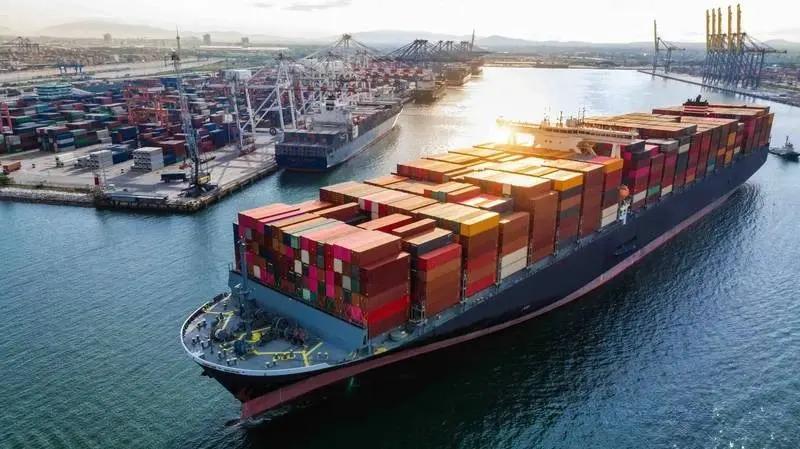
In contrast to the booming electronics sector, the container shipping and raw materials sectors are navigating highly complex operational challenges. The disruption of traditional shipping routes has forced carriers to bypass key canals and chokepoints:
- Cape of Good Hope Diversions: Many vessels traveling between Asia and Europe have opted for the longer route around the southern tip of Africa to avoid regional conflicts. This detour adds approximately 10 to 14 days to a standard voyage, consuming more fuel and effectively reducing the global supply of available container ships.
- The Strait of Hormuz Risk: As a crucial transit point for energy, any sustained friction in this channel directly impacts global energy prices. Higher bunker fuel costs immediately translate into surcharges across all cargo classes, increasing the cost of shipping everything from grain to consumer electronics.
Macroeconomic Forecasts and Divergences
The current strength in merchandise trade stands in contrast to the WTO’s cautious medium-term forecasts. Earlier in the year, the WTO projected that global merchandise trade growth would moderate to 1.9% for the current year, a sharp deceleration from the robust recovery projections of 4.6% originally anticipated for 2025.
Historical & Projected Global Trade Growth Rates:
─────────────────────────────────────────────────────────
Current Year Projection:  ███████ 1.9%
Original 2025 Forecast:   █████████████████ 4.6%
─────────────────────────────────────────────────────────
This conservative forecast reflects deep institutional concern over systemic risks. If geopolitical conflicts in energy-producing regions escalate further, a sustained spike in oil and natural gas prices could trigger a renewed wave of global inflation. This would likely force central banks to maintain higher interest rates for longer, dampening consumer demand and ultimately suppressing future trade volumes.
Official Statements and Institutional Insights
The WTO’s commentary accompanying the barometer release emphasizes both the resilience of the global trading system and the vulnerability of its current foundations.
In its official assessment, the Geneva-based trade body noted:
"The strengthening of the Goods Trade Barometer indicates that merchandise trade volumes have continued to recover. However, this positive momentum remains highly vulnerable to external shocks. Geopolitical tensions, localized conflicts, and unilateral trade policy developments continue to pose significant downside risks, clouding the medium-term outlook and complicating corporate supply chain planning."
Independent trade economists and logistics analysts share this cautious perspective, pointing to a growing division within the global trading landscape. While aggregate trade volumes appear healthy, this strength is unevenly distributed.
Large-scale exporters in the Asia-Pacific region are capturing a disproportionate share of current growth, driven by their dominance in tech supply chains. Conversely, industrial economies in Europe are struggling with high energy costs and structural challenges in their core manufacturing sectors.
Furthermore, analysts warn that the current strength in export orders may be partially artificial. The threat of sweeping tariff regimes has incentivized businesses to pull forward their import schedules. While this "tariff-dodging" behavior temporarily inflates trade metrics, it represents a borrowing of future demand, raising the risk of a sharp correction in trade volumes once new trade barriers are officially implemented.
Future Outlook
As the global economy enters the final months of the year, the trajectory of international trade will likely be determined by the balance between technological momentum and geopolitical friction.
          [Future Trade Trajectory]
                     │
         ┌───────────┴───────────┐
         ▼                       ▼
   [Upside Drivers]        [Downside Risks]
   • Persistent AI CapEx   • Broad-based Tariffs
   • Green Tech Subsidies  • Middle East Escalation
   • Supply Chain Agility  • High Capital Costs
Key Scenarios for the Coming Quarters
1. The Proliferation of Trade Barriers
The potential implementation of universal baseline tariffs by major economies remains a significant threat to global trade. If retaliatory tariff cycles are triggered, the current cross-border flow of goods could slow dramatically. Under this scenario, the temporary gains seen from front-running import orders would give way to a prolonged contraction, forcing multinational corporations to accelerate nearshoring and friendshoring strategies. This shift would likely lead to shorter, more localized supply chains at the expense of global efficiency.
2. Technological Continuity vs. Saturation
The durability of the current trade expansion depends heavily on the lifecycle of the AI infrastructure boom. If tech giants continue to invest heavily in data centers and next-generation hardware, the electronic components sector will likely remain a strong driver of trade growth. However, if the financial returns on these AI investments fail to meet market expectations, capital expenditure could cool, removing a key support from the global trade index.
3. Maritime Infrastructure Adaptability
The shipping industry has shown a high degree of adaptability in navigating geopolitical chokepoints, but this resilience is being tested. A sustained disruption in the Strait of Hormuz or prolonged detours around Africa will keep shipping costs elevated. If consumer demand in major Western markets weakens under the weight of persistent inflation, high transport costs could become unsustainable for low-margin goods, leading to a contraction in trade for non-essential consumer products.
Conclusion
The WTO’s September barometer reading of 102.0 offers encouraging evidence of the global economy’s capacity to adapt to geopolitical and policy-related disruptions. Driven by a historic technology boom, international trade has continued to expand above its baseline trend.
Yet, this resilience is built on a highly volatile foundation. With supply chains vulnerable to geopolitical friction and trade policy increasingly used as a tool of geopolitical competition, the international trading system remains in a fragile state. While the global trade engine is currently running warm, the road ahead is marked by significant structural challenges.