










By Willard Shoko
Independent Starlink Researcher and Network Consultant
Executive Overview
Zimbabwe stands at a critical juncture in its telecommunications evolution. As the nation absorbs the unprecedented influx of Low Earth Orbit (LEO) satellite internet services—spearheaded by the commercial launch of Starlink on September 6, 2024—the structural limitations of regional cross-border routing are becoming increasingly evident. While LEO constellations have successfully democratized high-speed internet access for enterprises, educational institutions, and residential consumers alike, soaring subscriber adoption has introduced predictable bandwidth bottlenecks, peak-hour throttling, and latency fluctuations.
To overcome these structural hurdles, independent telecommunications frameworks now point toward a decisive solution: the localized deployment of domestic gateway teleports, advanced Q/V band spectrum licensing, and a centralized Point of Presence (PoP) in Harare.

This comprehensive report outlines a strategic, twelve-month roadmap designed to transition Zimbabwe from relying on indirect regional gateway routing to establishing sovereign, high-capacity ground infrastructure. By anchoring Starlink’s constellations directly into Zimbabwe’s robust national fiber backbone—encompassing assets managed by Liquid Intelligent Technologies, PowerTel, Paratus, TelOne, and Dark Fibre Africa (DFA)—the country can achieve sub-20 ms domestic latencies, future-proof its enterprise bandwidth demands, and solidify its status as a key digital transit hub in Southern Africa.
Detailed Chronology: From Mazowe to LEO Constellations
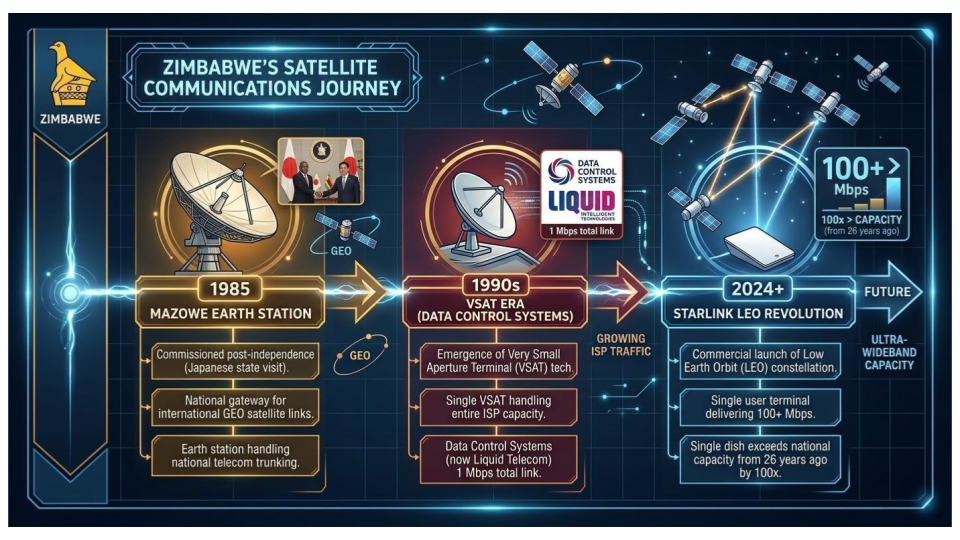
To understand the magnitude of the current shift in Zimbabwe’s telecommunications landscape, one must examine the historical trajectory of the nation’s satellite connectivity, which spans four decades of infrastructural milestones.
[1985: Mazowe Earth Station (GEO)]
       │
       ▼
[VSAT Era: Early Commercial Trunks (1 Mbps)]
       │
       ▼
[2024: Starlink Commercial Launch & Initial Scaling]
       │
       ▼
[2026+: Proposed Domestic Gateports & Harare PoP Integration]
1. The Genesis: The Mazowe Earth Station (1985)
Zimbabwe’s journey into satellite telecommunications was officially inaugurated following a state visit to Japan in the mid-1980s. This diplomatic engagement directly catalyzed the establishment of the country’s primary satellite hub at Mazowe in 1985. For years, the Mazowe Earth Station served as the nation’s solitary gateway to international telecommunications networks, operating primarily via Geostationary Earth Orbit (GEO) links. While revolutionary for its time, GEO architecture inherently suffered from high propagation delay—typically introducing latencies exceeding 600 milliseconds due to the extreme distance of satellites positioned approximately 35,786 kilometers above the Earth’s equator.

2. The VSAT Milestone and Enterprise Bandwidth Growth
As enterprise and consumer bandwidth demands began to outstrip the capabilities of legacy analog systems, Very Small Aperture Terminal (VSAT) technology emerged as the next operational milestone. Early commercial implementations in Zimbabwe relied on a single VSAT terminal to handle the entire international bandwidth load for Data Control Systems—the foundational entity that eventually evolved into Liquid Intelligent Technologies. In its infancy, this setup delivered a modest 1 Mbps aggregate trunk connection to support early corporate data requirements.

3. The LEO Revolution (2024–2026)
The stark contrast between historical capacity and modern consumption becomes apparent when examining raw data throughput. Individual domestic and enterprise users today consume far more bandwidth in a single day than the total national capacity available during the early satellite era.
The arrival of LEO constellations, most notably Starlink, has fundamentally shattered historical bandwidth ceilings. A modern enterprise dish or user terminal deployed in Harare or Bulawayo can deliver single-user throughput that exceeds Zimbabwe’s entire national bandwidth capacity from 1999 by a factor of 100. However, this massive influx of user traffic without local ground stations has created unique operational challenges.

Supporting Context & Performance Metrics
When Starlink officially went live in Zimbabwe on September 6, 2024, initial performance benchmarks were exceptionally favorable. Early adopters enjoyed high speeds and low jitter, largely because regional network loads were exceptionally light.
However, by September 2026, substantial subscriber adoption across Southern Africa introduced measurable network congestion. During peak evening hours, users experienced bandwidth throttling, and infrastructure routing inefficiencies resulted in mixed latency performance. Because current Zimbabwean traffic is backhauled through foreign ground stations—such as those in neighboring countries—packets must travel unnecessary terrestrial and satellite miles before hitting international content delivery networks (CDNs).
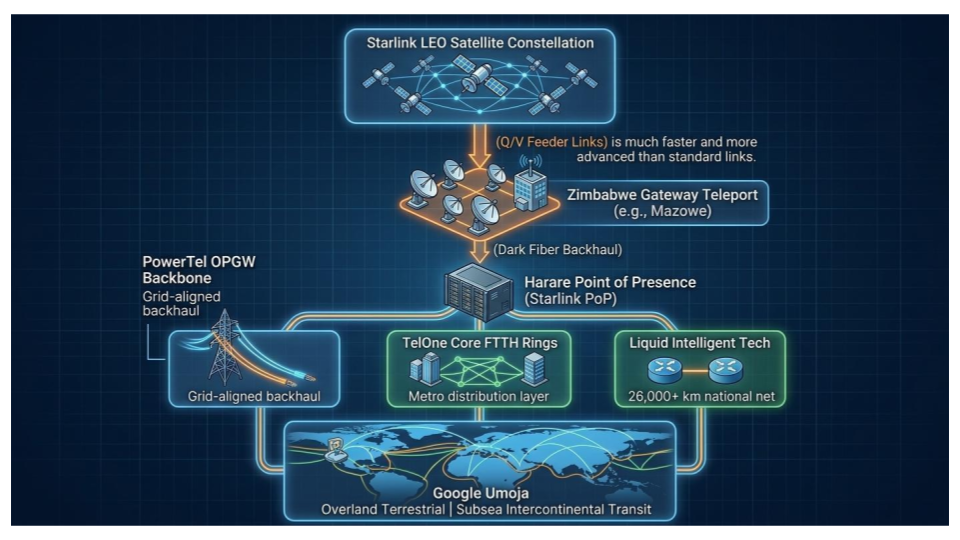
[Starlink LEO Satellite]
       │ (Space-to-Earth Link)
       ▼
[Proposed Harare Gateport / Q/V Band]
       │ (Local Terrestrial Ingress)
       ▼
[Harare Point of Presence (PoP)]
       │ (Direct Interconnect)
       ├─► [Liquid Intelligent Technologies Fiber]
       ├─► [PowerTel / Paratus DWDM Backbone]
       ├─► [TelOne Cross-Border Transit]
       ├─► [DFA Railway Servitude Fiber]
       └─► [Google Umoja Cable System]
The Solution: Localized Gateports and a Harare PoP
Deploying local ground station teleports and a domestic Point of Presence (PoP) in Harare directly addresses these performance bottlenecks. By bringing the satellite gateway physically inside Zimbabwean borders, space-to-earth traffic terminates locally. This eliminates unnecessary international hops, stabilizes peak-hour speeds, and guarantees sub-20 ms domestic latencies for local transactions, cloud computing, and real-time enterprise applications.
Technical Architecture & Spectrum Allocation
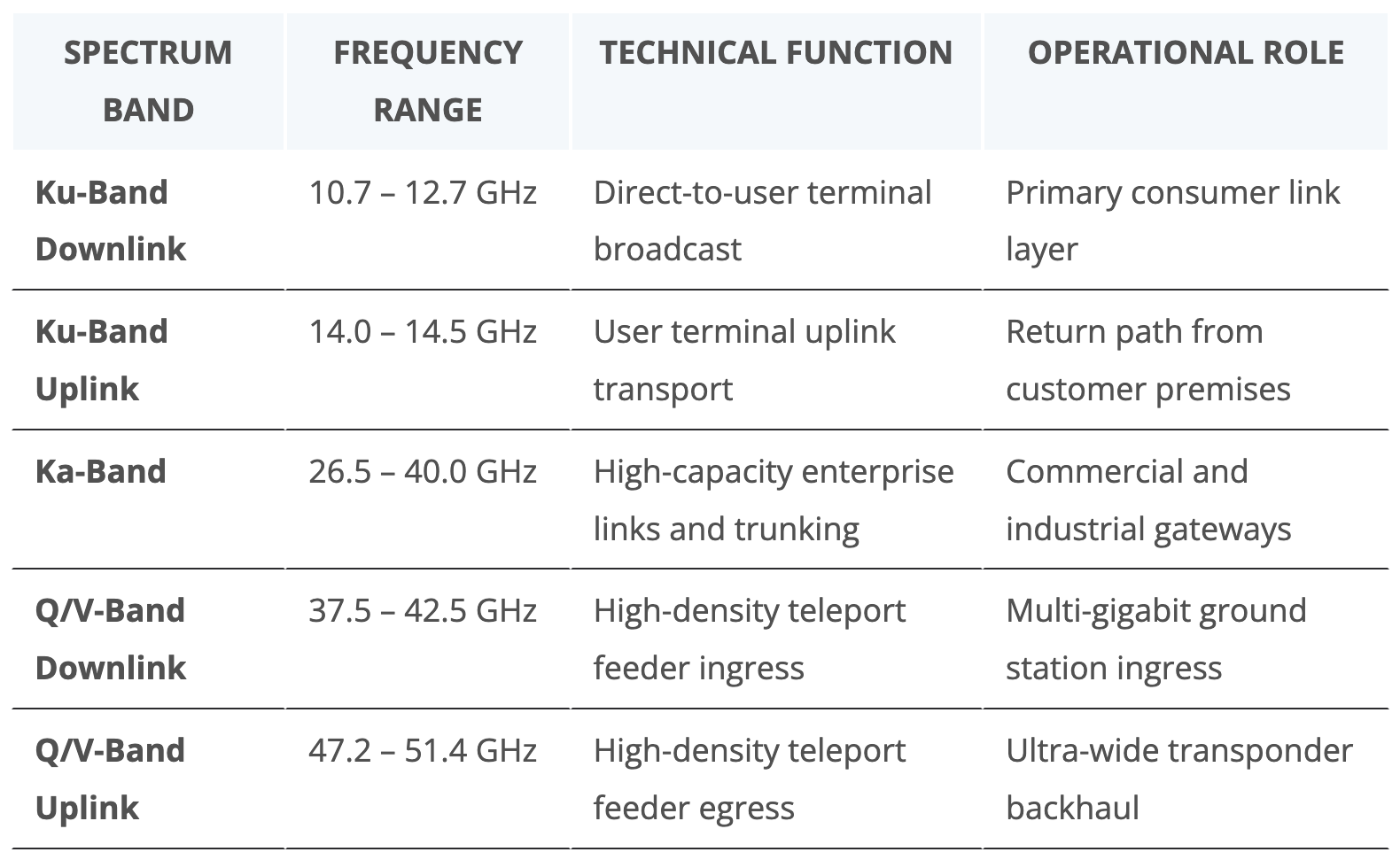
Establishing high-capacity feeder links between rapidly moving Low Earth Orbit constellations and stationary terrestrial networks requires advanced spectrum management. While traditional satellite communications rely heavily on Ku and Ka bands, the sheer density of modern LEO traffic demands ultra-high-frequency allocations in the Q/V band (typically operating between 37–50 GHz).
Q/V Band Engineering Advantages
- Massive Bandwidth Capacities: Q/V bands offer significantly wider contiguous channel allocations compared to Ku and Ka bands, allowing gateway teleports to pass multi-terabit aggregate throughput.
- Frequency Reuse: Higher frequencies enable tighter beam concentration, minimizing interference and allowing aggressive frequency reuse across regional teleports.
- Reduced Terminal Footprint: Smaller beamwidths require highly focused antenna arrays, optimizing land use at the proposed Harare gateport sites.
Spectrum Band Allocation Matrix
| Frequency Band | Uplink / Downlink Range | Primary Operational Role | Zimbabwean Integration Status |
|---|---|---|---|
| Ku-Band | 10.7–14.5 GHz | Consumer & Enterprise User Terminals (Dish-to-Satellite) | Fully deployed and operational nationwide. |
| Ka-Band | 17.5–31.0 GHz | High-density user links and secondary feeder lines | Active across regional gateway hubs. |
| Q/V-Band | 37.0–50.0 GHz | Ultra-high-capacity gateway feeder links | Proposed target for 12-month regulatory licensing. |
National Fibre Infrastructure Synergy Matrix
A domestic Starlink teleport cannot operate in a vacuum; it requires deep integration with existing terrestrial fiber infrastructure to distribute multi-terabit capacity across the country. Fortunately, Zimbabwe possesses a dense and expanding national optical fiber backbone. Connecting local Starlink teleports to a central Harare Point of Presence will leverage several foundational fiber networks:
- Liquid Intelligent Technologies Fibre Backbone: Operating over 26,000 kilometers of fiber across Zimbabwe, Liquid provides the core long-haul terrestrial routing layer. Connecting Starlink’s Harare PoP directly into Liquid’s regional cross-border network ensures resilient, high-speed transit across Southern Africa.
- PowerTel and Paratus Partnership: PowerTel and Paratus Zimbabwe formed an equal-investment Public-Private Partnership (PPP) to construct a high-capacity DWDM fiber backhaul network. This initiative launched with an active 800 Gbps link between Plumtree and Bulawayo, leveraging PowerTel’s powerline-based national infrastructure and Paratus’s continental network to deliver up to 10 Tbps in cross-border bandwidth linking Zimbabwe, Botswana, and Zambia.
- TelOne Backbone Expansions: TelOne continues to scale its backbone capacity along critical cross-border transit links—including Kazungula (Zambia/Botswana) and Beitbridge (South Africa)—driven by surging regional demand for 100G+ wavelengths.
- Dark Fibre Africa (DFA) Zimbabwe: DFA constructed a 1,500 km open-access optical fiber backbone running along national railway servitudes from Beitbridge through Bulawayo, Harare, and Mutare. Built via an $18 million partnership with BCS Group and Dandemutande, the network uses DWDM technology to deliver multi-gigabit transit capacity, providing local ISPs and mobile operators with redundant wholesale backhaul.
- Google Umoja Cable System: The newly developed Umoja cable system provides an overland terrestrial path from East Africa down through Southern Africa and across to global subsea landings. Linking the local Starlink PoP to the Umoja network establishes direct, low-latency intercontinental cloud links for enterprise clients.
Capacity Resolution Mechanisms for Harare
To ensure that the Harare Point of Presence successfully absorbs and distributes satellite capacity without experiencing congestion, several technical mechanisms must be implemented:
- Dynamic Traffic Shaping: Utilizing software-defined networking (SDN) to prioritize critical enterprise traffic during peak utilization windows.
- Anycast Routing: Implementing BGP Anycast across the Harare PoP and regional fiber partners to route user queries through the shortest, least congested network path.
- Caching and Content Delivery Integration: Collaborating with major content providers to host localized CDN nodes directly within the Harare data center ecosystem, reducing redundant transit over satellite links.
Global Benchmarks: Brazil and USA Case Studies
Zimbabwe is not charting this course alone; it can draw valuable lessons from major markets like Brazil and the United States, which have successfully navigated the deployment of LEO satellite ground infrastructure across diverse geographic terrains.
- Brazil (ANATEL Regulatory Framework): In Brazil, regulatory bodies worked proactively with Starlink to mandate local gateway installations and ground station licensing. This requirement ensured that as millions of rural and urban Brazilians adopted the service—particularly across the vast Amazon basin—national telecommunications sovereignty was maintained, and local backhaul providers shared in the economic expansion.
- United States (FCC Ground Station Licensing): The U.S. model demonstrates the importance of streamlined spectrum coordination between space agencies and terrestrial regulators. By fast-tracking Q/V band gateway applications, the FCC enabled Starlink to establish coast-to-coast gateway redundancy, neutralizing localized weather disruptions and maintaining 99.9% network uptime for enterprise clients.
Strategic Implementation Roadmap
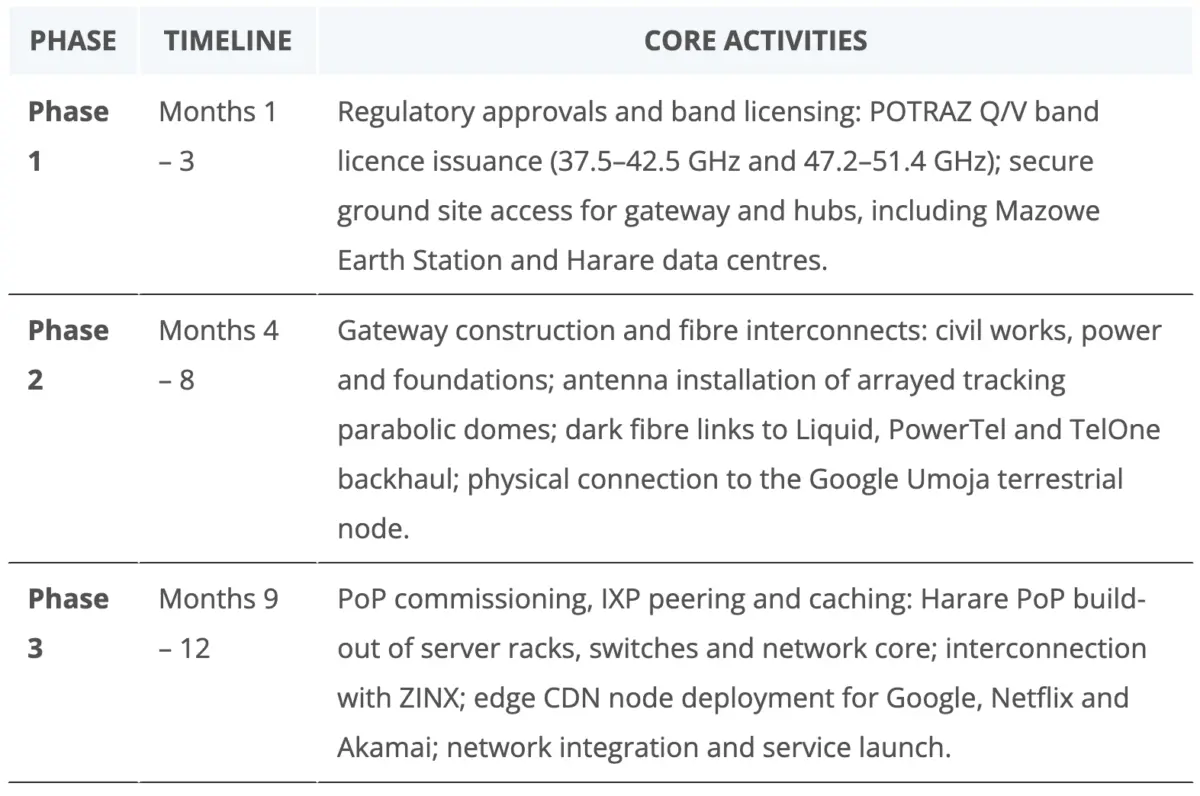
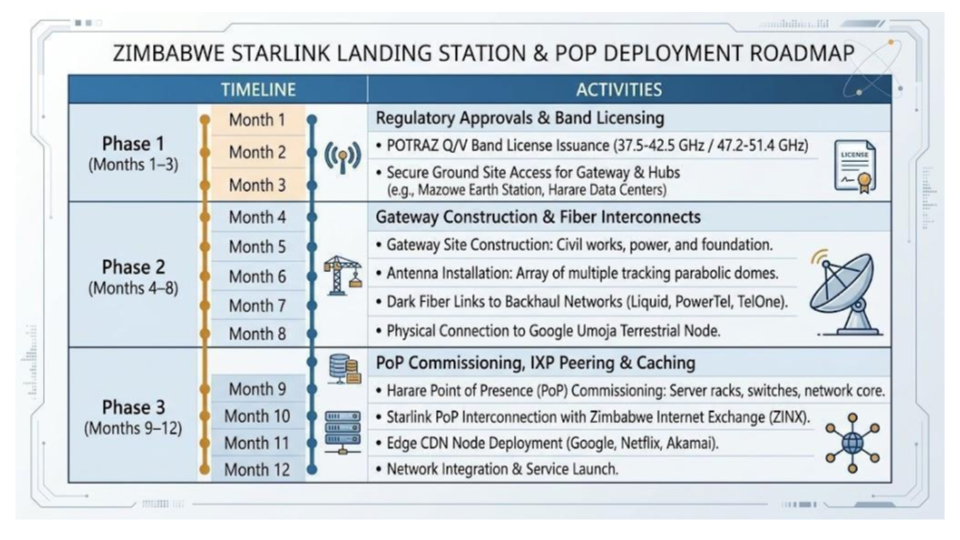
Executing this infrastructural transformation requires a disciplined, twelve-month timeline divided into three distinct operational phases:
Month 1 ──► Month 4 : Phase 1 (Regulatory Clearance & Spectrum Acquisition)
Month 5 ──► Month 8 : Phase 2 (Physical Gateway Construction & Q/V Band Setup)
Month 9 ──► Month 12: Phase 3 (PoP Commissioning & National Fiber Integration)
Phase 1: Regulatory Clearance & Spectrum Acquisition (Months 1–4)
- Engage with the Postal and Telecommunications Regulatory Authority of Zimbabwe (POTRAZ) to secure formal licensing for Q/V band gateway feeder links.
- Finalize land acquisition and zoning approvals for the primary teleport site outside Harare.
- Establish formal commercial agreements with domestic fiber anchor tenants (Liquid, PowerTel, TelOne, DFA).
Phase 2: Physical Gateway Construction & Q/V Band Setup (Months 5–8)
- Construct secure teleport facilities featuring redundant power systems (solar, grid, and diesel generator backups) to guarantee continuous operation.
- Install high-precision Q/V band tracking antennas capable of seamless handoffs across LEO satellites.
- Deploy localized ground infrastructure hardware, including baseband processors and routing switches.
Phase 3: PoP Commissioning & Service Launch (Months 9–12)
- Establish the central Harare Point of Presence (PoP) within a carrier-neutral data center facility.
- Cross-connect the Harare PoP into the national optical fiber matrix (Liquid, Paratus/PowerTel, DFA, TelOne, and Google Umoja).
- Initiate live traffic testing, optimize latency profiles, and transition regional subscriber routing over to the new domestic gateway infrastructure.
Official Statements & Industry Outlook
Industry stakeholders have increasingly emphasized the urgency of localizing satellite infrastructure. Independent technical assessments indicate that without domestic gateports, African nations risk treating high-speed satellite connectivity merely as a consumer luxury rather than foundational national infrastructure.
By executing this twelve-month roadmap, Zimbabwe has the opportunity to transform its telecommunications profile. Localized gateway teleports and a centralized Harare PoP will not only resolve current bandwidth throttling and latency spikes but also position Zimbabwe as a technologically resilient digital leader in the Southern African Development Community (SADC) region.
About the Author
Willard Shoko is an Independent Starlink Researcher and Network Consultant with over two decades of hands-on expertise in networking infrastructure and internet connectivity. Passionate about next-generation satellite technology, Willard is a key community contributor on X and Reddit, best known for his work mapping unofficial Starlink Ground Stations and Points of Presence (PoPs). His technical insights have earned recognition and reposts directly from Elon Musk and Starlink. Today, he leverages his deep network architecture expertise to design and deploy tailored internet-based solutions across the educational and private sectors. (Independent consultant; not affiliated with Starlink.)