








By Megan Bennett, Senior Manager of Digital Outreach
Published by Ocean Conservancy
Executive Overview
While the ocean often appears to the human eye as a vast, homogenous blanket of blue, it is, in reality, an extreme mosaic of thermal environments. From the needle-sharp, sub-zero brine channels of the Antarctic shelf—where temperatures plunge below freezing—to the blistering, superheated water of deep-sea hydrothermal vents surging past 660°F, the global marine environment encompasses a staggering thermal range.
Unlike human beings, who can artificially modulate their ambient environment with heating, air conditioning, and specialized apparel, marine fauna are bound entirely by the laws of biophysics. For these animals, thermoregulation—the physiological mechanisms used to maintain internal body temperature—is not merely a matter of comfort; it is the absolute dividing line between survival and systemic metabolic failure.
Over millions of years, evolution has forged breathtakingly complex biological workarounds to these environmental extremes. From "antifreeze" glycoproteins that prevent cellular crystallization in polar cod to the intricate vascular heat-exchangers of apex predators like the bluefin tuna, marine species have mastered thermal physics.
However, these evolutionary marvels are now facing an unprecedented stress test. Driven by anthropogenic greenhouse gas emissions, the global climate crisis is rapidly rewriting the planet’s marine thermal baseline. Historic marine heatwaves, intensifying hurricanes fueled by unnerving ocean surface temperatures, and catastrophic coral bleaching events demonstrate that the buffering capacity of the world’s seas is reaching its limit. Understanding how marine organisms regulate their body temperature is no longer just an academic pursuit of physiological curiosity—it is a critical lens through which we must view the future of ocean health and conservation.
Detailed Chronology of Discovery: Unlocking Nature’s Thermal Secrets
The scientific quest to understand how marine animals survive thermal extremes spans nearly a century of marine biology, transforming our understanding of how life persists in environments once thought entirely uninhabitable.
1928: The Discovery of the Pale Giants
The timeline of extreme marine biology shifted fundamentally in 1928 with the first formal documentation of Antarctic icefish (family Channichthyidae). Collected from the icy Southern Ocean, these ghostly, pale creatures stunned researchers because their blood was completely devoid of color—and, astonishingly, entirely missing red blood cells and hemoglobin. This pivotal discovery challenged the foundational biochemical paradigms of vertebrate physiology, proving that evolution could construct viable, high-performing circulatory systems without the primary oxygen-carrying proteins standard to almost all other backboned animals.
The Mid-20th Century: Mapping the "Wonderful Net"
As commercial fishing expanded following World War II, fisheries scientists turned their attention to the physiology of highly migratory pelagic predators, notably the bluefin tuna. During the mid-20th century, anatomists mapped out the rete mirabile—Latin for "wonderful net"—a dense countercurrent vascular network within the muscle tissue of these fish. This discovery shattered the long-held dogma that all fish were strictly ectothermic ("cold-blooded"), proving that regional endothermy allowed predators to maintain elevated internal temperatures in cold, deep water while preserving explosive swimming speeds.
The Late 20th Century: Hydrothermal Ecosystems Erupt
In 1977, the submersible Alvin, exploring the Galapagos Rift, made one of the most paradigm-shifting discoveries in the history of science: hydrothermal vents. Scientists discovered vibrant, thriving ecosystems rooted not in solar energy, but in chemosynthesis. Among the biological marvels hauled up and filmed were giant tubeworms (Riftia pachyptila) thriving inches away from mineral-rich fluids hot enough to melt plastic. This upended our understanding of biological temperature thresholds and introduced the world to animals uniquely adapted to extreme thermal gradients.
The Modern Era: Antifreeze Proteins and Genetic Loss
Entering the 21st century, molecular biologists cracked the genetic codes behind polar survival. Scientists isolated Antifreeze Glycoproteins (AFGPs) in Antarctic notothenioids, mapping how these proteins physically bind to nascent ice crystals to halt catastrophic cellular freezing. Most recently, in 2025, cutting-edge genomic sequencing revealed that Asian noodlefishes have completely lost their myoglobin and hemoglobin genes—mirroring the evolutionary path of Antarctic icefish through entirely separate lineages, proving that nature repeatedly finds parallel solutions to extreme environmental pressures.
Supporting Context & Metrics: The Physics and Physiology of Marine Survival
To comprehend the severity of the crisis facing marine life, one must examine the precise physiological machinery these organisms use to cheat thermal death.
1. Countercurrent Heat Exchange and Gigantothermy: The Leatherback Strategy
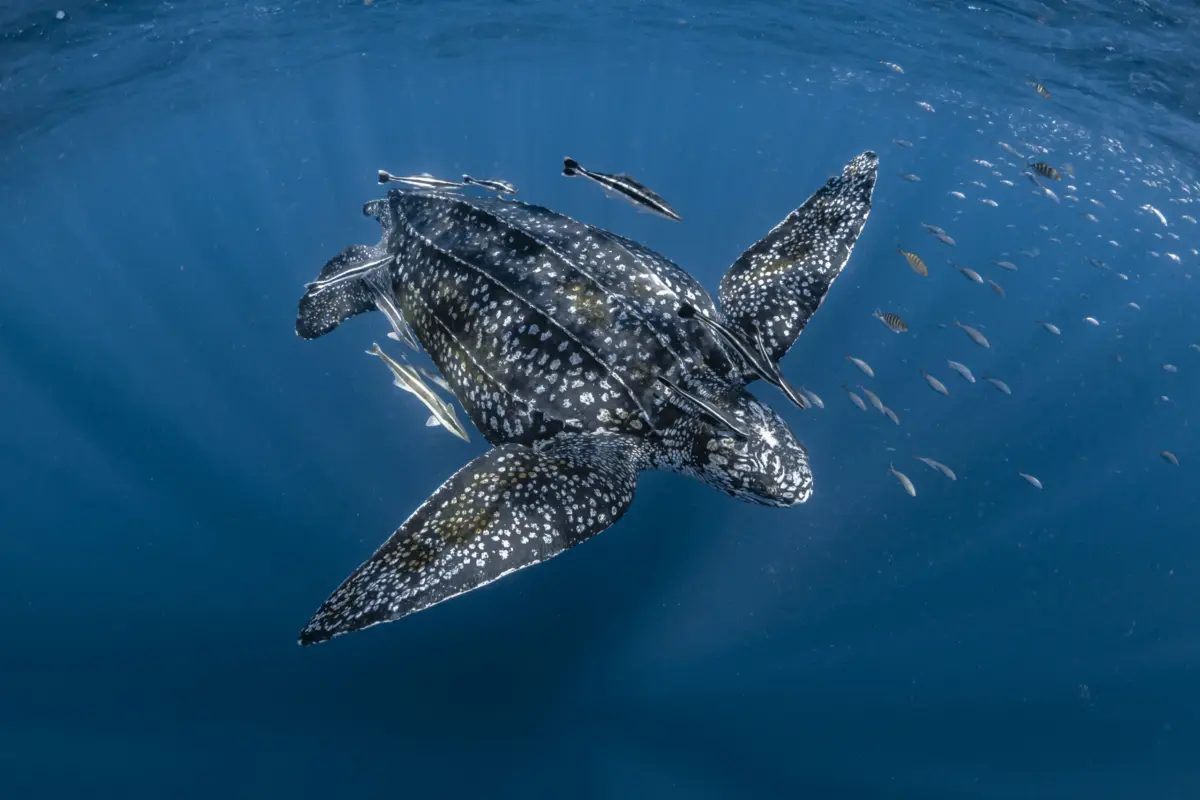
Leatherback sea turtles (Dermochelys coriacea) defy conventional reptile biology. As ectotherms, reptiles typically conform to the temperature of their surroundings. Yet leatherbacks routinely dive into near-freezing sub-polar waters to feed on sea jellies. They accomplish this dual feat through two primary mechanisms:
- Countercurrent Heat Exchange: Arteries transporting warm blood from the core run parallel to veins returning cold blood from the flippers. Heat transfers conductively from arterial blood to venous blood, warming the returning fluid before it hits the heart.
- Gigantothermy: As the largest sea turtles on Earth, their sheer mass-to-surface-area ratio minimizes heat loss. Combined with an oily, insulating fat layer and a leathery, rubbery shell, leatherbacks retain internal metabolic heat effectively, acting as physiological regulators despite lacking true internal thermogenesis.
| Organism | Thermal Strategy | Primary Adaptation Mechanism | Typical Environment |
|---|---|---|---|
| Leatherback Sea Turtle | Gigantothermy / Ectotherm | Countercurrent heat exchange, body mass, oily blubber | Tropical nesting sites to sub-polar feeding grounds |
| Bluefin Tuna | Regional Endotherm | Rete mirabile (vascular heat exchangers) | Pelagic open ocean, deep and cold water columns |
| Antarctic Icefish | Cold-Adapted Ectotherm | Lack of red blood cells; high-volume plasma circulation | Sub-zero Southern Ocean floor |
| Giant Tubeworm (Riftia) | Vent-Adapted Ectotherm | Symbiotic chemosynthesis; thermal-gradient positioning | Hydrothermal vent peripheries (near-freezing to 400°F+) |
2. The Rete Mirabile of Pelagic Predators
Bluefin tuna do not warm their entire bodies—doing so would expend prohibitive amounts of energy. Instead, they use regional endothermy. Their rete mirabile acts as a thermal trap, recovering metabolic heat generated by swimming muscles and preventing it from being lost across the gills during respiration. This localized warming keeps their eyes, brain, and swimming musculature operating at peak efficiency, granting them a devastating predatory advantage over cold, sluggish prey species in frigid northern waters.
3. Molecular Antifreeze and Hemoglobin-Free Blood
In the sub-zero waters of the Antarctic, fish face the ultimate physical threat: internal ice nucleation. If water inside a cell freezes, expanding ice crystals puncture cellular membranes, causing instant death. Antarctic notothenioids synthesize Antifreeze Glycoproteins (AFGPs) that adsorb onto the surfaces of microscopic ice crystals, inhibiting their growth.
Simultaneously, Antarctic icefish abandoned red blood cells altogether. Because cold water holds significantly more dissolved oxygen than warm water, the oxygen content in the Southern Ocean is exceptionally high. Icefish utilize their lack of viscous red blood cells to pump thin, watery plasma at high volumes through wide capillaries and enlarged hearts, achieving oxygenation entirely via cutaneous (skin and gill) diffusion.
Official Statements and Expert Perspectives
As global temperatures climb, marine biologists and conservation leaders are sounding the alarm regarding the vulnerability of these hyper-specialized thermal adaptations.
Dr. Sarah Jenkins, a senior marine ecologist specializing in polar systems, notes the precarious nature of these evolutionary traits:
"These organisms did not evolve over millions of years to handle rapid, anthropogenic climate shifts. The adaptations we marvel at—like antifreeze proteins and vascular heat exchangers—operate within strict evolutionary parameters. When the baseline temperature of the Southern Ocean or the deep-sea floor shifts even a fraction of a degree too quickly, the physiological safety margins collapse entirely."
Conservation advocates emphasize that the impacts of thermal disruption extend far beyond individual species loss, threatening entire marine food webs. Environmental policy analysts from the Ocean Conservancy point out the systemic urgency of the moment:
"The climate crisis is no longer a distant projection; it is actively altering the thermodynamic balance of our oceans. When historic marine heatwaves strike, they do not just bleach coral reefs—they overwhelm the physiological capacities of pelagic and benthic species alike. Without immediate, decisive policy intervention to curb greenhouse gas emissions, we risk unraveling ecosystems that took millions of years to stabilize."
Future Outlook: The Anthropocene Thermal Crisis
The profound evolutionary ingenuity displayed by leatherback sea turtles, bluefin tuna, Antarctic icefish, and hydrothermal vent tubeworms highlights the resilience of life on Earth. Yet, this resilience is being tested to an unprecedented degree.
As global carbon emissions continue to trap heat within the Earth’s atmosphere, the ocean absorbs more than 90% of that excess thermal energy. This continuous input is driving unprecedented marine heatwaves, expanding oxygen-minimum zones, and shifting current dynamics on a global scale. For hyper-specialized creatures engineered for extreme, albeit stable, thermal regimes, rapid environmental volatility represents an insurmountable hurdle. An icefish cannot instantly evolve hemoglobin back; a tuna cannot indefinitely expand its metabolic expenditure to counter a perpetually warming pelagic layer.
The preservation of these evolutionary wonders requires more than passive admiration—it demands aggressive, proactive planetary stewardship. Protecting the blue heart of our planet means addressing the root causes of climate change before the thermal thresholds of marine life are pushed past the point of no return.
Take Action for Our Oceans
The climate crisis is here, and its impacts on our marine ecosystems will only accelerate without immediate, collective intervention. We must urge our global leaders to enact robust policies that mitigate climate change, reduce carbon emissions, and protect vulnerable marine habitats.
Join us in calling on our elected leaders to take urgent action to mitigate climate change now.