




Executive Overview
In the ever-evolving landscape of global maritime trade, port infrastructure remains the invisible engine driving international commerce. For the United Kingdom, the Port of Dover stands as an indispensable economic juggernaut, serving as the primary maritime umbilical cord connecting the British Isles to mainland Europe. Against this backdrop of critical geopolitical and economic significance, a monumental milestone has been reached in the port’s modernization narrative.
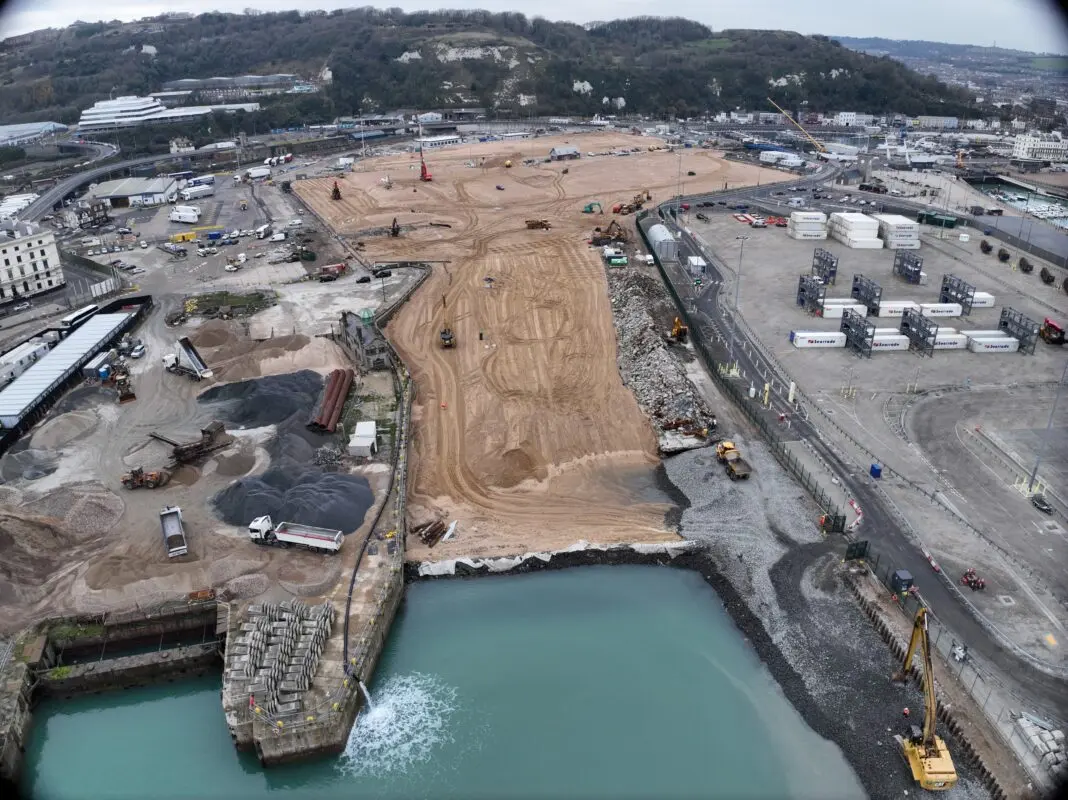
Joint venture partners McLaughlin & Harvey and Boskalis Westminster have officially announced the completion of a major land reclamation project at the Port of Dover. Valued at £53 million ($72 million), this high-stakes engineering endeavor constitutes Stage 3B of the broader Dover Western Docks Revival (DWDR) initiative. Initiated in 2024, the project was designed to fundamentally reshape the spatial geography of the port, unlocking a staggering 10 hectares of prime new port land within historically constrained maritime zones.
The successful execution of DWDR Stage 3B required the seamless convergence of specialized marine civil engineering, large-scale environmental management, and precise logistical coordination. By reclaiming land within the Wick Channel, the Tidal Basin marinas, and the Granville Dock, the project team successfully transformed underutilized wet docks and tidal areas into robust, load-bearing terrain. This newly minted real estate sits poised to redefine operational efficiency at the gateway, paving the way for future waterfront transformations and bolstering the United Kingdom’s supply chain resilience.
This article provides an in-depth, authoritative examination of the project. It explores the intricate chronology of the build, breaks down the core engineering metrics and challenges, captures official commentary from key industry leaders, and analyzes the broader economic and strategic implications for the future of European trade and maritime development.
Detailed Chronology: From Conception to Completion
The realization of Dover Western Docks Revival Stage 3B is the culmination of years of strategic planning, environmental assessment, and rigorous phased construction. While physical works accelerated significantly following the formal kickoff in 2024, the groundwork for this monumental undertaking was laid much earlier as part of the port’s long-term master planning to secure its competitive edge in the 21st century.
Phase 1: Mobilization and Marine Clearance (Early 2024)
As principal contractor, McLaughlin & Harvey mobilized teams alongside marine engineering experts Boskalis Westminster in early 2024. The initial operational phase demanded meticulous site preparation within confined and logistically sensitive marine environments. Before any infill material could be introduced, the historic fabric of the internal basins had to be systematically uninstalled.
This phase involved the comprehensive removal of marine infrastructure from within the Tidal Basin and Granville Dock. Heavy engineering teams deployed specialized floating plant and land-based cranes to extract legacy pontoons, gangways, and associated electrical and fluid marine equipment. Concurrently, the team initiated structural demolition works targeting redundant quay wall structures, most notably the North Pier and the Ferry Jetty. These demolitions were critical to opening up the spatial geometry of the basins, allowing heavy marine vessels and land-based earthmoving machinery unrestricted access to the heart of the construction zone.
Phase 2: Massive Infill and Land Reclamation (Mid-2024)
Once the internal obstructions were cleared and preparatory structural modifications were completed, the core engineering operation—land reclamation—commenced in earnest. Over the course of the project, this phase required the placement of nearly 900,000 cubic metres of carefully graded infill material.
The primary objective of this massive deposition was to elevate the existing seabed of the Wick Channel, Tidal Basin, and Granville Dock to a precise engineering grade: approximately 0.5 metres below the level of the existing surrounding quay walls. Achieving this required continuous round-the-clock coordination between marine dredging vessels supplying aggregate and heavy land-based fleets spreading, compacting, and leveling the material. Strict geotechnical monitoring was enforced throughout this phase to ensure structural stability and mitigate the risk of differential settlement across the newly formed 10-hectare expanse.
Phase 3: Infrastructure Integration and Stormwater Engineering (Late 2024 – 2025)
With the land mass successfully established, the project transitioned into its complex civil engineering and infrastructure phase. Transforming a newly filled basin into functional, heavy-duty port land requires far more than compacted earth.
During this phase, comprehensive utility networks were laid across the entire 10-hectare site, providing future developments with robust electrical, water, and telecommunications connectivity. New road infrastructure was forged to seamlessly integrate the reclaimed zone with the port’s existing internal logistics corridors.
Recognizing the heightened hydrological demands of a coastal reclaimed site, the engineering consortium executed substantial drainage works. This included the construction of a highly sophisticated, high-capacity stormwater pumping station. Designed to manage intense rainfall events and tidal fluctuations, this critical piece of municipal-grade infrastructure ensures that the newly reclaimed land remains protected against flooding and fully operational under all weather conditions.
Phase 4: Handover and Commissioning (Final Milestone)
The final chapter of the DWDR Stage 3B timeline involved rigorous quality assurance testing, environmental compliance verification, and the systematic handover of the site to the Port of Dover. By completing the works with minimal disruption to the port’s existing commercial tenants and the traveling public, the contractor consortium successfully crossed the finish line, delivering a pristine, industrial-grade canvas ready for future operational deployment.
Supporting Context & Metrics: The Engineering Blueprint of DWDR Stage 3B
To fully appreciate the magnitude of the McLaughlin & Harvey and Boskalis Westminster achievement, one must examine the raw engineering metrics and the strategic context of the Dover Western Docks Revival.
Key Project Statistics at a Glance
- Total Project Value: £53 million ($72 million USD).
- Principal Contractor: McLaughlin & Harvey.
- Marine & Dredging Partner: Boskalis Westminster.
- Commencement Year: 2024.
- Total New Land Created: 10 hectares of high-value port real estate.
- Infill Volume: Approximately 900,000 cubic metres of material.
- Target Grade Elevation: 0.5 metres below existing quay wall levels.
- Major Demolition Elements: North Pier, Ferry Jetty, legacy pontoons, and gangways.
- Key Infrastructure Installed: Comprehensive drainage networks, new roadway corridors, and a complex stormwater pumping station.
Navigating Engineering Complexity in a Living Port
The Port of Dover is not a greenfield site; it is a hyper-busy, mission-critical transport hub operating 24 hours a day, 365 days a year. Executing a £53 million heavy civil engineering project within the tight confines of working maritime basins presented extraordinary logistical hurdles.
The successful execution relied heavily on extensive temporary works. Marine stabilization systems, temporary cofferdams, and sediment control barriers were deployed to manage the interface between active port waters and the construction zone. Furthermore, the soil-improvement techniques implemented by Boskalis Westminster were vital. Reclaimed land—particularly material deposited into historic tidal basins—is notoriously susceptible to settlement. By applying advanced soil stabilization methodologies, the engineering team ensured that the bearing capacity of the 10 hectares of new land meets the rigorous structural demands required for heavy port logistics, cargo handling, and potential future warehousing or terminal superstructure.
Official Statements and Industry Perspectives
The successful delivery of a maritime infrastructure project of this scale relies on deep synergy, technical excellence, and transparent collaboration between client, contractor, and specialized partners. Leadership figures from the core participating organizations offered their reflections on the historic completion.
Seamus Devlin, Managing Director at McLaughlin & Harvey, emphasized the company’s specialized pedigree in maritime construction and the delicate balance of executing massive works within a live operational environment:
"Our history of delivering maritime and port infrastructure projects meant we were well placed to undertake this complex programme of works, and we’re delighted to have completed the project with minimal disruption to the public and tenants.
Working closely with the Port of Dover, Boskalis Westminster and other stakeholders, the project team successfully delivered significant reclamation and infrastructure works, including extensive temporary works. We are proud to have played a role in this ambitious revival project which will support the future transformation of Dover’s waterfront."
Echoing these sentiments, Paul Maurice de Jong, Managing Director at Boskalis Westminster, highlighted the power of cross-industry collaboration and the long-term strategic value unlocked for the United Kingdom:
"The successful completion of this project demonstrates the strength of collaboration between the Port of Dover, McLaughlin & Harvey and Boskalis Westminster. We are proud to have delivered the land reclamation works and associated soil-improvement that will support the port’s long-term growth and future development, helping to create new opportunities for one of the UK’s most important maritime gateways."
The collective pride expressed by both contractors underscores the engineering triumph of Stage 3B. It proves that even within the most constrained and demanding operational ecosystems, elite civil engineering can deliver transformational assets on time and without crippling existing commercial rhythms.
Future Outlook: Unlocking Dover’s Next Era of Maritime Growth
The completion of the £53 million Dover Western Docks Revival Stage 3B is far more than an exercise in moving earth and pouring concrete; it is a foundational masterstroke that fundamentally expands the strategic horizons of the Port of Dover.
Catalyzing Waterfront Transformation
With 10 hectares of newly forged, infrastructure-ready land now at its disposal, the Port of Dover possesses a blank canvas to reimagine its spatial utility. Historically, the port’s physical footprint was strictly bounded by natural geography and historical dock configurations. By reclaiming the Wick Channel, Tidal Basin marinas, and Granville Dock, the port has shattered these geographical limitations.
This newly created terrain opens up myriad possibilities for future development. Whether utilized for optimized freight staging, customs and border control infrastructure, passenger amenities, or commercial waterfront regeneration, the site provides the flexibility required to adapt to shifting trade paradigms and post-Brexit regulatory frameworks.
Reinforcing National Supply Chain Resilience
As the UK navigates an increasingly competitive and dynamic global trade environment, the efficiency of its primary ports is paramount. Dover handles a substantial percentage of the nation’s trade with continental Europe, acting as a vital lifeline for perishable goods, manufacturing components, and consumer retail.
By investing proactively in land reclamation and advanced stormwater and road infrastructure, the Port of Dover is future-proofing its operations against capacity bottlenecks. The enhanced throughput potential, combined with smoother internal logistics pathways enabled by the DWDR Stage 3B project, ensures that the port will retain its crown as the nation’s most efficient and reliable maritime gateway.
A Blueprint for Future Port Engineering
Finally, the successful execution of this project serves as an industry benchmark. The seamless partnership between McLaughlin & Harvey and Boskalis Westminster demonstrates how modern marine engineering can harmonize aggressive land creation with environmental stewardship and operational continuity. As ports across Europe and the globe face the dual pressures of climate adaptation and growing cargo volumes, the Dover model—combining precision dredging, advanced soil stabilization, and comprehensive civil infrastructure—offers a proven blueprint for success.
In summary, the completion of Stage 3B marks the dawn of an exciting new chapter for the Port of Dover. By turning water into functional, high-capacity land, the port has secured its economic vitality for generations to come, cementing its status as an enduring pillar of British and European commerce.