






By Dan Berkson, Digital Advocacy Manager | Published by Ocean Conservancy
Executive Overview
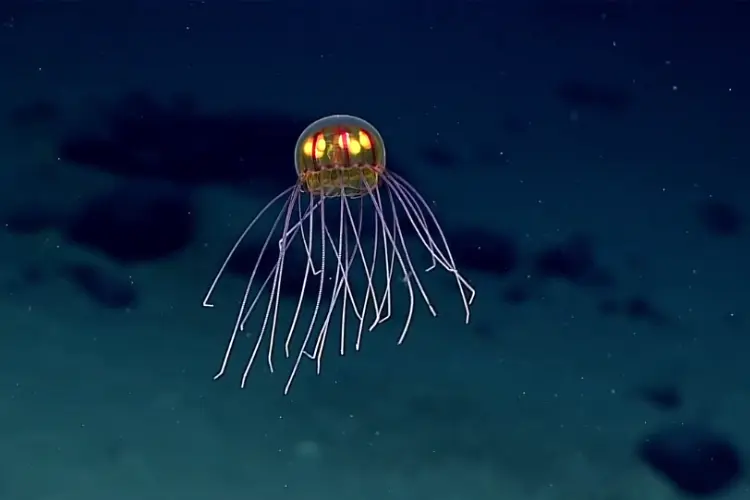
Humanity has long looked upward to the stars with a sense of wonder, mapping the craters of the moon and charting the trajectories of distant planets with pinpoint precision. Yet, we remain profoundly disconnected from a realm that sits directly beneath us in our own planetary backyard. The deep sea—the Earth’s largest and least-understood biome—remains a largely uncharted frontier. Astonishingly, scientists have visually observed less than 0.001 percent of the deep seafloor.
The reasons for this massive knowledge gap are as formidable as the environment itself. Blanketed in perpetual darkness, battered by crushing hydrostatic pressures, and locked in a deep freeze, the abyssal zone is far more difficult and expensive to access than orbital space. To put the scale of the challenge into perspective, while we possess high-resolution topographic maps of the lunar surface, roughly two-thirds of Earth’s own surface—the deep ocean floor—remains a blank canvas, covering an area roughly ten times greater than that of the moon.
Despite these extreme logistical and environmental obstacles, deep-sea exploration is more important now than ever before. As humanity faces mounting ecological pressures, climate instability, and the looming threat of industrial extraction, unlocking the secrets of the deep sea is no longer merely an academic exercise. It is an urgent planetary necessity.
Detailed Chronology: A Century of Abyssal Discovery
The journey to understand the deep ocean has been defined by human ingenuity, evolving from crude trial-and-error measurements into sophisticated, autonomous technological campaigns.
[Late 1800s] ──> [Early-Mid 1900s] ──> [1960s] ──> [1980s] ──> [Modern Era]
 HMS Challenger    Sonar & Remote      Tethered ROVs    Autonomous AUVs   Integrated Arrays
 Dredges & Trawls  Acoustic Mapping    & Submersibles   Independent Dives & Global Networks
The Pioneering Era: HMS Challenger (Late 1800s)
Before the advent of modern electronics, studying the deep sea required immense physical labor and mechanical endurance. The foundational milestone of modern oceanography arrived with the HMS Challenger expedition (1872–1876). This historic global voyage marked the first comprehensive scientific survey of the world’s oceans. Armed with heavy hemp ropes, weighted dredges, and natural-history trawls, scientists hauled up sediment samples and bizarre biological specimens from depths previously thought to be completely devoid of life. This monumental effort proved that life existed in the abyss, shattering long-held scientific dogmas and laying the structural groundwork for modern oceanography.
The Acoustic Revolution (Early to Mid-1900s)
As the 20th century progressed, the limitations of physical hauling became glaringly apparent. Exploring the vastness of the ocean one dredge at a time was agonizingly slow. The paradigm shifted from direct human observation and physical collection to indirect study driven by physics and engineering.
- Sonar Development: The invention and refinement of sonar (Sound Navigation and Ranging) allowed researchers to map the contours of the seafloor by bouncing sound waves off the underwater terrain.
- Acoustic Mapping: For the first time, scientists could visualize submarine mountain ranges (mid-ocean ridges), deep trenches, and vast abyssal plains without ever laying eyes on them directly, bypassing the crushing pressures of the water column.
The Robotic Leap: Remotely Operated Vehicles (1960s)
The 1960s ushered in a new era of mechanical intervention with the invention of Remotely Operated Vehicles (ROVs). Tethered to surface vessels by heavy armored cables carrying power and data, these maneuverable underwater robots allowed researchers to place mechanical eyes and hands into environments that would instantly crush a human diver. ROVs enabled high-definition video documentation, precise sample collection, and real-time intervention at depths that were previously unreachable.
The Autonomous Age: Autonomous Underwater Vehicles (1980s)
In the 1980s, technology took another quantum leap forward with the deployment of Autonomous Underwater Vehicles (AUVs). Unlike their tethered predecessors, AUVs are completely untethered robotic submersibles designed to operate independently based on pre-programmed mission profiles. Freed from the physical leash of a surface ship, AUVs could cruise silently across deep-sea trenches, map complex underwater geology, and gather high-resolution environmental data over vast distances with unprecedented efficiency.
Today: Integrated Technological Suites
In the modern era, oceanographers no longer rely on a single tool. Instead, they utilize an interconnected suite of technologies—including advanced ROVs, autonomous drone fleets, satellite telemetry, and fiber-optic ocean-floor sensor arrays. This multi-layered approach allows scientists to monitor the deep sea with a level of precision, continuity, and safety that was unimaginable just a few decades ago.
Supporting Context & Metrics: The Physics of the Deep
To truly appreciate why the deep ocean remains so deeply mysterious, one must examine the extreme physical parameters that define it.
Defining the Abyssal Biome
Oceanographically speaking, the deep sea begins at 200 meters (656 feet) below the surface—a threshold known scientifically as the photic or sunlight zone. Beyond this depth, sunlight is rapidly absorbed and scattered, dwindling away until it vanishes entirely. Below 1,000 meters lies the aphotic zone, a realm of pitch-black darkness where the sun has never shone. Temperatures here plunge precipitously, hovering at a near-freezing average of 4°C (39°F).
The Crushing Force of Hydrostatic Pressure
Perhaps the most punishing obstacle in deep-sea exploration is water pressure. Because water is significantly denser than air, pressure increases at an astonishing rate:
- For every 10 meters (32.8 feet) of descent, pressure increases by one atmosphere (atm), where one atmosphere is equivalent to standard air pressure at sea level.
- At a depth of just 200 meters, an exploratory vessel or organism experiences 21 atmospheres of pressure—one atmosphere from the air column above, combined with 20 atmospheres of compressed water weight pressing in from all sides.
- In the deepest trenches, such as the Mariana Trench, pressures exceed 1,000 atmospheres—enough to instantly crush unprotected steel hulls like an aluminum can.
Comparative Scale: Earth vs. Moon
| Metric | The Moon | The Deep Seafloor |
|---|---|---|
| Accessibility | Directly observable from Earth orbit; airless and waterless. | Obscured beneath miles of opaque, highly pressurized saltwater. |
| Total Surface Area | ~37.9 million square kilometers | ~361 million square kilometers (covers >2/3 of Earth’s surface) |
| Exploration Status | Mapped in extensive detail via lunar orbiters. | <0.001% visually observed by human-operated or robotic systems. |
Official Statements & Scientific Insights
The imperative to explore and protect the deep ocean has united marine biologists, oceanographers, and conservation advocates across the globe.
The Role of Ocean Observatories
Modern deep-sea science relies heavily on continuous data streams rather than isolated expeditionary snapshots. Advanced observation networks, such as the Ocean Observatories Initiative (OOI), have revolutionized how researchers study marine systems. By deploying cabled arrays of sensors across various depths and tectonic zones, the OOI tracks complex coastal environments, deep-sea ecosystems, and the massive thermohaline currents that act as the Earth’s climate engine.
"Deep-sea observation systems are our planetary life-support monitors," notes marine science coalitions. "The data gathered from these abyssal sensors allows us to track dynamic shifts in ocean chemistry, forecast catastrophic storms, monitor the health of vital global fisheries, and anticipate coastal flooding long before it impacts human populations."
The Threat of Industrial Exploitation
Even as our technological capacity to study the deep sea reaches new heights, the ecosystem faces an unprecedented, industrialized threat: deep-sea mining. Driven by the global demand for rare earth minerals and battery components, commercial entities are increasingly eyeing the abyssal plains—specifically areas rich in polymetallic nodules.
Conservation organizations, including the Ocean Conservancy, have sounded the alarm regarding the devastating ecological consequences of this emerging industry. Industrial mining operations on the seafloor involve heavy machinery scraping, dredging, and churning up delicate benthic sediments. This activity generates massive underwater sediment plumes that can travel vast distances, suffocating filter-feeding organisms, poisoning the water column with heavy metals, and causing irreversible habitat destruction across fragile, slow-growing ecosystems.
Future Outlook: Protecting the Last Frontier
The deep sea is not a distant, lifeless wasteland; it is a dynamic, interconnected biome that underpins the health of the entire planet. The currents that sweep through its canyons regulate global temperatures, its sediment sequesters vast amounts of carbon, and its biodiversity holds biomedical and ecological secrets that humanity has only just begun to decode.
Yet, as commercial pressures mount, we stand at a critical historical crossroads. We can choose to treat the deep sea as a disposable industrial zone for mineral extraction, repeating the ecological mistakes we have made on land and in shallow coastal waters—or we can choose preservation, guided by exploration, science, and rigorous conservation policy.
Take Action Now
The battle to save the deep ocean from unregulated industrial mining requires immediate, coordinated global advocacy. The Ocean Conservancy is leading the charge on the front lines of marine protection, but they cannot do it alone.
Your voice matters. You can take action today to ensure our ocean is defended before mining interests gain an irreversible foothold in the abyss. Add your name and urge your congressional representatives to enact strict legislative protections to stop deep-sea mining.
To learn more about how you can support ocean defense initiatives, visit the Ocean Conservancy Action Center.