





Executive Overview: Decarbonizing the Port-Ship Interface
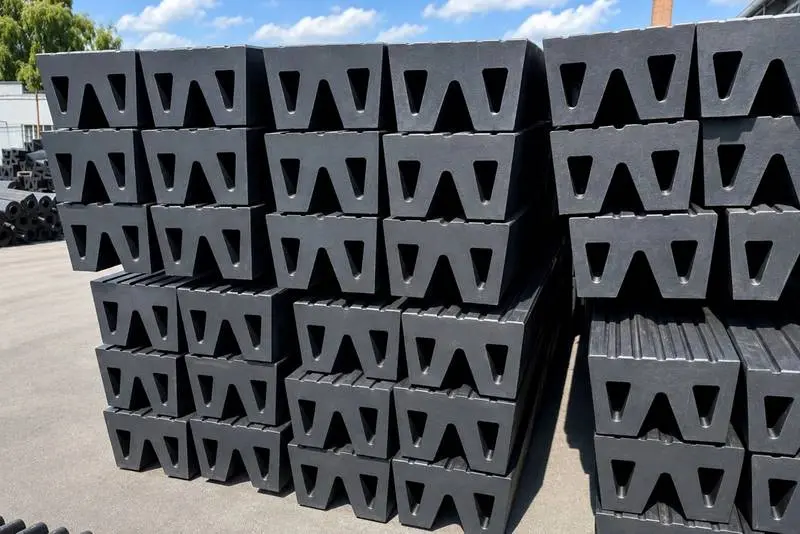
While the global maritime industry has focused its decarbonization efforts on alternative ship propulsion—such as green methanol, ammonia, and hydrogen—the carbon footprint of port infrastructure has remained a challenging blind spot. Heavy marine infrastructure relies on energy-intensive materials like steel, concrete, and industrial rubber. Among these, marine fenders—the critical protective barriers installed on docks, tugs, and workboats to absorb the kinetic energy of berthing vessels—have historically carried a high carbon debt due to their reliance on virgin, petroleum-derived rubber compounds.
A major shift in this sector was announced at the SMM Start-up Night in Hamburg. Bencros Marine Fenders, a Slovakia-based manufacturer specializing in high-performance rubber fenders, revealed that the carbon dioxide savings embedded in its recycled-content fenders have been independently verified. Under a new framework, these savings can be directly transferred to customers as certified emission reductions.
+-----------------------------------------------------------------------------+
|                       BENCROS CARBON CERTIFICATE VALUATION                  |
+-----------------------------------------------------------------------------+
|  Total Certified Saving per Ton of Fender: ~2.60 Tons of CO2e               |
|                                                                             |
|  [=========================================---------]  2.42 Tons (93%)      |
|  Scope 3, Category 1 (Direct GHG Inventory reduction)                       |
|                                                                             |
|  [===-----------------------------------------------]  0.16 Tons (7%)       |
|  Climate Contribution (Avoided Incineration)                                |
+-----------------------------------------------------------------------------+
|  Certificate Price: USD $93.13 (EUR 80) per Ton of CO2e Saved               |
+-----------------------------------------------------------------------------+
This initiative bridges the gap between industrial recycling and digital carbon markets. Operating on the registry of the specialized carbon standard Proba, Bencros will allow buyers to claim verified carbon reductions starting September 2, 2026. This development transforms marine fenders from a standard procurement expense into a strategic asset for port authorities, terminal operators, and shipping lines seeking to meet Scope 3 emissions targets.
Detailed Chronology: From Industrial Waste to Certified Carbon Assets
The development of this verified carbon-reduction framework is the result of a multi-year effort to align industrial manufacturing, circular supply chains, and third-party carbon accounting.
+-----------------------------------------------------------------------------+
|                             PROJECT TIMELINE                                |
+-----------------------------------------------------------------------------+
|  [2024 - 2025]                                                              |
|  Raw Material Aggregation:                                                  |
|  Reclaimed 5,070 tons of industrial rubber waste.                           |
|                                                                             |
|  [Mid-2025]                                                                 |
|  Methodology & Verification Audits:                                         |
|  Bureau Veritas verifies 13,112 tons of CO2e reductions under Proba.        |
|                                                                             |
|  [Late 2025]                                                                |
|  SMM Hamburg Announcement:                                                  |
|  Bencros reveals the verified transfer model & first Norwegian client.       |
|                                                                             |
|  [September 2, 2026]                                                        |
|  Official Registry Launch:                                                  |
|  First certified emission reduction certificates go live on Proba.         |
+-----------------------------------------------------------------------------+
Phase 1: Material Sourcing and Industrial Reclamation (2024–2025)
The foundation of Bencros’s circular economy model was established during an intensive collection and production phase spanning 2024 and 2025. During this period, the company established supply-chain agreements with European tire manufacturers and industrial rubber producers to divert high-grade rubber waste from landfills and incineration facilities.
In total, Bencros successfully gathered and processed 5,070 tons of rubber waste. This feedstock consisted of rejected raw rubber compounds—materials that failed strict dimensional or cosmetic tolerances during tire fabrication but retained their structural properties—blended with rubber powder derived from mechanical grinding of end-of-life tires (ELTs).
Phase 2: Methodology Development and Third-Party Verification
To convert reclaimed rubber into a tradeable carbon asset, Bencros partnered with Proba, an open-source carbon standard specializing in material-bound and product-level carbon tracking. Throughout late 2024 and early 2025, Proba’s methodology was applied to Bencros’s supply chain to calculate the exact lifecycle emissions difference between manufacturing fenders from virgin synthetic rubber versus recycled compounds.
To ensure compliance with international standards (such as ISO 14044 for Life Cycle Assessment and the GHG Protocol), Bureau Veritas was engaged as the independent, third-party verification body. Bureau Veritas audited the raw material sourcing logs, energy consumption data from Bencros’s Slovakian manufacturing facilities, and logistics data. The audit confirmed that Bencros’s circular manufacturing process achieved a net reduction of 13,112 tons of carbon dioxide equivalent (CO2e) over the two-year period.
Phase 3: The SMM Hamburg Announcement and Market Integration
With verification secured, Bencros chose the SMM Start-up Night in Hamburg—a key gathering for maritime technology and green transition executives—to announce the initiative. The company confirmed that the first batch of digital carbon certificates would officially go live on the Proba registry on September 2, 2026.
Ahead of this launch, Bencros secured its first commercial partner: a Norwegian maritime operator. This customer reserved both the physical marine fenders and the corresponding carbon certificates, establishing a precedent for green procurement in the port sector.
Supporting Context & Metrics: The Chemistry, Carbon Math, and Financials
To understand how this system works, it is necessary to examine the technical specifications of the fenders, the carbon accounting principles applied, and the pricing structure of the certificates.
+-----------------------------------------------------------------------------+
|                        CIRCULAR REVENUE REINVESTMENT                        |
+-----------------------------------------------------------------------------+
|  Certificate Sales ($93.13 / Ton CO2e)                                      |
|       │                                                                     |
|       ├──> [Industrial Waste Collection] ──> Securing reliable feedstock    |
|       │                                                                     |
|       ├──> [Mechanical Processing & Grinding] ──> Transforming ELT tires    |
|       │                                                                     |
|       ├──> [Homogenization & Quality Control] ──> Ensuring physical parity  |
|       │                                                                     |
|       └──> [Third-Party Auditing & Verification] ──> Bureau Veritas / Proba |
+-----------------------------------------------------------------------------+
The Material Composition: Reclaiming Industrial Byproducts
Standard marine fenders are typically made from virgin elastomers like Ethylene Propylene Diene Monomer (EPDM) or Natural Rubber (NR) compounds, which require energy-intensive polymerization and refining processes. Bencros replaces a significant portion of this virgin material with two primary waste streams:
- Rejected Industrial Rubber Compounds: Unvulcanized rubber scraps sourced directly from tire factories. Because this material has not undergone final curing, it can be easily blended back into new mixtures without losing its elastomeric properties.
- End-of-Life Tire (ELT) Crumb Powder: Mechanically ground ambient rubber powder derived from passenger and commercial vehicle tires.
The resulting compound is processed to ensure it meets the physical requirements of marine infrastructure. For port engineers and procurement officers, the physical product remains unchanged: it offers the same energy absorption, reaction force, and service life as a fender made entirely from virgin rubber.
Dissecting the Carbon Accounting
The core of the Bencros-Proba framework is the allocation of the 2.6 tons of CO2e saved per ton of manufactured fender. This saving is split into two distinct accounting categories to ensure compliance with the Greenhouse Gas Protocol:
                      +----------------------------------+
                      | Total Carbon Saving: 2.60 t CO2e |
                      +----------------------------------+
                                       |
                  +--------------------+--------------------+
                  |                                         |
                  v                                         v
+------------------------------------+    +------------------------------------+
|     Scope 3, Category 1 (93%)      |    |     Climate Contribution (7%)      |
|           2.42 t CO2e              |    |            0.18 t CO2e             |
+------------------------------------+    +------------------------------------+
| Directly offsets the buyer's       |    | Represents avoided emissions from  |
| purchased goods emissions inventory|    | waste incineration/landfilling     |
+------------------------------------+    +------------------------------------+
1. Scope 3, Category 1 (Purchased Goods and Services): 2.42 tons of CO2e
This portion represents the direct reduction in manufacturing emissions achieved by substituting virgin elastomers with recycled alternatives. When a port authority or shipyard purchases a Bencros fender, they can book this 2.42-ton reduction directly into their Scope 3 inventory. This lowers their reported supply-chain carbon footprint, helping them meet corporate net-zero targets.
2. Climate Contribution (Avoided Incineration): 0.18 tons of CO2e
This portion represents the emissions avoided by diverting waste rubber from municipal waste-to-energy incineration or landfilling. Because these avoided emissions occur outside the direct manufacturing boundary, they are classified separately as a "climate contribution." This distinction prevents double-counting and maintains the integrity of the buyer’s GHG inventory.
Each certificate issued is registered under the buyer’s name on the Proba registry, assigned a unique serial number, tracked back to the specific batch of reclaimed rubber, and retired upon use to prevent resale.
The Circular Economics: Direct Reinvestment of Certificate Revenue
The certificates are priced at USD $93.13 (EUR 80) per ton of CO2e saved. Unlike traditional carbon offset schemes, which often fund distant forestry or renewable energy projects, the proceeds from these certificates directly fund the local circular supply chain. The revenue is reinvested into:
- Logistics and Collection: Funding the transport of rejected rubber from manufacturing plants to Bencros’s processing facility.
- Processing and Grinding: Supporting the energy-intensive mechanical grinding required to turn end-of-life tires into fine, usable rubber powder.
- Homogenization and Quality Control: Maintaining specialized mixing equipment to ensure the recycled compound meets the performance standards of marine infrastructure.
- Auditing and Verification: Covering the costs of ongoing third-party verification by Bureau Veritas.
This financial model internalizes the environmental cost of rubber production. It allows Bencros to offer high-performance recycled fenders at price parity with virgin alternatives, using certificate sales to offset the higher operational costs of recycling.
Official Statements and Industry Impact
The launch of the Bencros certified emission reduction framework comes at a time of increasing regulatory pressure on the maritime supply chain.
+-----------------------------------------------------------------------------+
|                      REGULATORY DRIVERS OF GREEN PROCUREMENT                |
+-----------------------------------------------------------------------------+
|  EU CSRD (Corporate Sustainability Reporting Directive)                    |
|  ──> Mandates audited reporting of Scope 3 supply chain emissions.          |
|                                                                             |
|  IMO 2050 Net-Zero Strategy                                                 |
|  ──> Forces shipowners and ports to evaluate lifecycle carbon footprints.   |
|                                                                             |
|  National Green Public Procurement (GPP) Laws                               |
|  ──> Requires public tenders to weight environmental impact alongside cost. |
+-----------------------------------------------------------------------------+
Aligning with Global Regulatory Mandates
In Europe, the implementation of the Corporate Sustainability Reporting Directive (CSRD) requires large companies and listed entities to disclose their Scope 3 emissions with the same level of audit readiness as financial data. Historically, estimating emissions from port equipment was difficult due to a lack of verified manufacturer data. By providing Bureau Veritas-verified certificates, Bencros gives procurement officers the documentation needed to satisfy CSRD auditors.
Similarly, the International Maritime Organization (IMO) has tightened its decarbonization targets, aiming for net-zero GHG emissions from international shipping by or around 2050. This pressure extends to the ports and terminal operators that serve these fleets. Major ports, such as Rotterdam, Antwerp, and Singapore, are actively implementing green marine procurement policies that prioritize suppliers offering verified carbon reductions.
The Norwegian Precedent
The decision by a Norwegian maritime customer to reserve the first batch of certificates highlights Norway’s role as an early adopter of green maritime technology. Norwegian public tenders increasingly use environmental performance as a key award criterion, often weighting carbon footprint metrics at 30% or more of the total evaluation score. The ability to purchase physical equipment alongside verified, traceable Scope 3 reductions gives operators a competitive advantage in these bidding processes.
Future Outlook: Scaling the Blue Economy’s Circular Frontiers
The launch of the certified emission reduction registry on September 2, 2026, is designed as a scalable model for the wider marine equipment sector.
+-----------------------------------------------------------------------------+
|                      BENCROS 2026 PROJECTIONS & SCALING                     |
+-----------------------------------------------------------------------------+
|  Expected CO2 Savings (2026): ~5,000 Tons                                   |
|                                                                             |
|  Planned Product Line Extensions:                                           |
|  [===] Tugboat Cylindrical Fenders                                          |
|  [===] Dock Corner Protectors                                               |
|  [===] Extruded D-Fenders                                                   |
|  [===] High-Performance Cell & Cone Fenders                                 |
+-----------------------------------------------------------------------------+
Projections for 2026 and Beyond
Bencros projects that its recycling and certification program will save close to 5,000 tons of CO2 in 2026 alone. As manufacturing lines scale and raw material sourcing agreements expand to other industrial hubs in Central and Eastern Europe, the company aims to increase its annual processing capacity. This would allow it to divert more rubber waste from European landfills and incineration plants.
Expanding the Circular Product Portfolio
While initial certification efforts focus on standard cylindrical and arch fenders for ports and workboats, Bencros plans to apply this circular model to its entire product line. This includes:
- Tugboat Cylindrical Fenders: Heavy-duty, high-wear fenders mounted on the bows and sterns of harbor tugs.
- Extruded D-Fenders and Square Fenders: Commonly used for smaller workboats, quays, and pontoon protection.
- High-Performance Cell and Cone Fenders: Large, engineered systems used in major container terminals and oil and gas berths, where energy absorption requirements are highest.
By applying this verified recycling process to these larger product lines, Bencros can significantly increase the volume of reclaimed rubber used in marine infrastructure, helping to scale the project’s overall carbon savings.
A Model for Industrial Decarbonization
The collaboration between Bencros, Proba, and Bureau Veritas demonstrates how traditional manufacturing can integrate with digital carbon markets. By linking physical products directly to verified Scope 3 certificates, Bencros provides a practical path forward for industrial circularity. This approach shows that heavy maritime infrastructure can reduce its environmental impact through rigorous verification, clear carbon accounting, and a commitment to circular design.