The global maritime industry is experiencing a profound generational transition. As environmental regulations tighten, fuel costs fluctuate, and renewable energy grids expand, the recreational boating sector is gradually moving away from internal combustion engines. At the vanguard of this movement is recreational marine electrification, a market where Europe has traditionally led the charge.
However, recent strategic milestones suggest that the momentum is truly global. Rhode Island-based clean technology innovator Flux Marine has officially secured European Union (EU) certification for its flagship FM115 electric outboard motor. This regulatory approval paves the way for the company to enter the European market via a high-profile partnership with Austrian boatbuilder i-RIB.
Simultaneously, Flux Marine is reinforcing its domestic footprint. By appointing marine industry veteran Chris Ponnwitz as Senior Field Sales Manager, the company is positioning itself to capitalize on a rapidly maturing North American market. Driven by rising gasoline prices, broader consumer awareness, and surging investments in solar and wind generation capacity, the U.S. market is ripe for large-scale transformation.
This dual-pronged strategy—securing strict European compliance while supercharging North American sales channels—places Flux Marine at the epicenter of the marine decarbonization movement. This report offers a comprehensive analysis of the company’s recent achievements, the engineering philosophy behind its technology, the contrasting dynamics of the European and U.S. markets, and the future outlook for electric recreational boating.
Detailed Chronology
The journey of Flux Marine from an innovative concept to an internationally certified commercial powerhouse has been marked by rigorous engineering milestones and strategic market positioning.
The Foundation and Real-World Validation (2023–2024)
Long before securing European regulatory compliance, Flux Marine dedicated years to intensive real-world testing. Between 2023 and 2024, the company deployed beta motors across a wide array of marine environments, subjecting its technology to thousands of hours of punishing trials in both saltwater and freshwater ecosystems.
Unlike early-stage prototypes that rely strictly on controlled laboratory environments, Flux Marine’s FM115 was tested by real-world consumers. Over the past four years, the motor has logged more than 50,000 kilometers of actual use. This extensive empirical data collection not only verified the mechanical and electrical integrity of the system but also provided the compliance documentation required by international regulatory bodies.
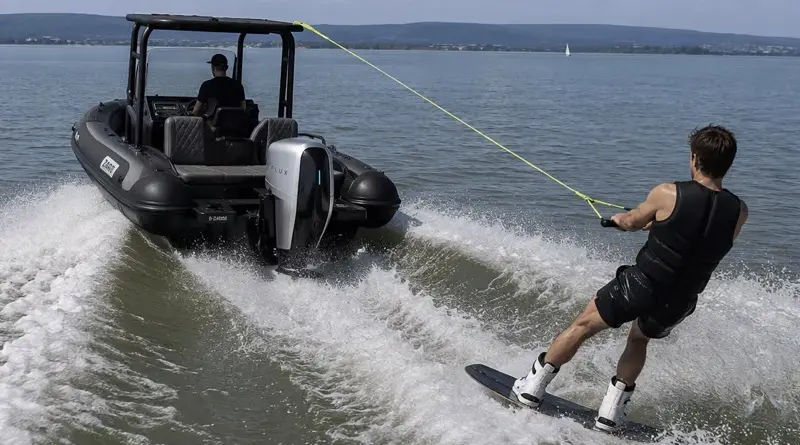
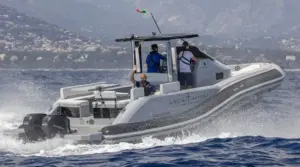
The culmination of this validation process arrived with the European introduction of the FM115. The motor made its continental debut integrated into the high-performance i-RIB-7 hull, manufactured by the esteemed Austrian boatbuilder i-RIB, founded by Thomas and Michael Salzl.
For the Salzl brothers, the appeal of the FM115 lay in its raw power, innovative engineering, and competitive positioning. However, navigating the complex regulatory compliance required to bring a foreign electric propulsion system into the German and broader European market presented a daunting hurdle. Rather than forcing boatbuilders to become electric propulsion compliance specialists, Flux Marine stepped in to manage the engineering and paperwork itself.
By handling the EU certification directly, Flux Marine removed a major barrier to entry for European boatbuilders, enabling them to offer state-of-the-art electric options without altering their core manufacturing business models.
Strengthening North American Sales Leadership
While establishing its European beachhead, Flux Marine simultaneously turned its attention to accelerating domestic growth. Recognizing that the U.S. market faces unique challenges regarding consumer awareness and hands-on product interaction, the company brought in Chris Ponnwitz as Senior Field Sales Manager.
Ponnwitz brings decades of marine propulsion experience to Flux Marine, having spent years managing gas and diesel motor sales at Mack Boring, a century-old industry distributor. Most recently, he served as Chief Commercial Officer for Mack Sustainable Energy, the company’s dedicated electric propulsion division. His mandate at Flux Marine is clear: drive revenue growth through strategic boatbuilder partnerships, expand the dealer network, and scale direct and commercial sales channels across North America.
Supporting Context & Metrics
To fully appreciate the significance of Flux Marine’s latest developments, one must examine the divergent landscapes of the European and North American recreational marine markets, as well as the technical specifications of the FM115 propulsion system.
Transatlantic Market Dynamics: Europe vs. The United States
Metric / Feature
European Market
North American Market
Market Maturity
Highly advanced; pioneering regulations dating back to the 1980s.
Emerging and rapidly growing; highly receptive to fuel-price pressures.
Regulatory Environment
Strict; fossil-fuel motors entirely banned or restricted on numerous lakes and canals.
Fragmented; federal/state incentives growing, but fewer total waterway bans.
Boating Culture
Focused on day-cruising, inland waterways, and quiet, emission-free cruising.
Diverse; heavy emphasis on offshore fishing, watersports, and high-horsepower performance.
Infrastructure
High density of shoreline charging nodes and eco-conscious marinas.
Expanding rapidly, buoyed by increased solar and wind generation capacity.
Europe stands as the world’s most advanced market for recreational marine electrification. This leadership is not accidental; it is shaped by a combination of cultural preferences and stringent environmental policies. On many iconic European waterways—such as Lake Neusiedl, the home waters of i-RIB—internal combustion engines have been strictly banned or restricted to specific operating hours for decades. Consequently, European boaters and manufacturers have long embraced electric propulsion out of regulatory necessity.
Conversely, the United States market is driven primarily by economic and environmental opportunities. As gasoline prices continue to experience volatility, boaters are increasingly looking for ways to reduce operational overhead. Furthermore, with clean energy generation capacity expanding daily through new solar and wind installations, charging an electric boat with renewable energy has never been more practical or economically attractive. However, the U.S. market has historically lagged behind Europe in consumer awareness and hands-on access to high-performance electric outboards, making targeted field education and dealership expansion critical for future growth.
Technical Deep Dive: The FM115 Propulsion System
The FM115 was designed from a blank sheet of paper, guided by a single foundational question: What would an electric marine propulsion system look like if engineers were unbound by the historical constraints of internal combustion engines?
Power and Performance: Engineered as a direct drop-in replacement for a traditional 115-horsepower (86 kW) gasoline outboard, the FM115 mounts effortlessly on a standard transom and utilizes existing steering and rigging hardware.
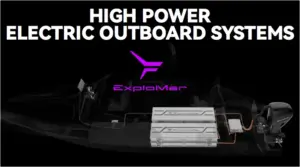
Energy Storage: The motor is paired with Flux Marine’s proprietary, submersion-proof IP67-rated 28 kWh modular battery packs. On the i-RIB-7 platform, for instance, users can select either a two-pack (56 kWh) or three-pack (84 kWh) configuration to tailor range and storage capacity to their specific boating habits.
Seamless Integration: The system integrates natively with familiar marine electronics, communicating seamlessly with Garmin chartplotter screens through a customized Flux interface.
Maintenance-Free Ownership: Because it is fully electric, the FM115 eliminates the traditional pain points of marine ownership. There is no oil to change, no impellers to replace, no carburetors to clog, and no complex winterization rituals required at the end of the season.
Official Statements
Industry leaders have been vocal about the strategic importance of these recent developments, emphasizing both the engineering triumph of the FM115 and the commercial foresight behind the company’s staffing decisions.
Ben Sorkin, Co-Founder and CEO of Flux Marine:
"Boatbuilders don’t want to become electric propulsion specialists. They want to give their customers an electric option without rebuilding their business around it. We did the engineering and the compliance for the EU paperwork, which was relatively simple because the 115 isn’t a prototype—it’s a proven system."
Chris Ponnwitz, Senior Field Sales Manager at Flux Marine:
"I’ve been following Flux Marine closely for the past few years and watching their electric outboards develop from a concept into a proven commercial option. This technology gives us a real edge, and we’re on the verge of rapid growth. I look forward to working with the passionate Flux team and giving more customers the opportunity to switch to electric propulsion."
Daylin Frantin, Co-Founder and CFO/COO of Flux Marine:
"Building out our sales organization is one of our highest priorities, and Chris’s proven track record in marine electric propulsion makes him the perfect fit for Flux Marine. Chris has spent a decade leading commercial strategy in this industry, and he’s the right person to introduce our products to customers, dealers, and marine industry partners."
Future Outlook
As Flux Marine looks toward the horizon, the convergence of EU certification and seasoned North American leadership sets the stage for exponential growth. The company’s ability to prove its technology through tens of thousands of kilometers of real-world use has dispelled lingering industry skepticism surrounding the durability and reliability of high-horsepower electric outboards.
In Europe, the partnership with i-RIB serves as a blueprint for future collaborations with other continental boatbuilders who wish to bypass the bureaucratic hurdles of marine electrification. By delivering turnkey, fully certified propulsion systems, Flux Marine lowers the barrier to entry for traditional boatyards eager to meet consumer demand for zero-emission vessels.
In North America, Chris Ponnwitz’s leadership will be instrumental in expanding Flux Marine’s footprint across dealer networks, boatbuilder alliances, and commercial channels. By representing the company at major industry events and boat shows, Ponnwitz and his team will bridge the gap between curiosity and ownership, allowing prospective buyers to experience the torque, silence, and reliability of electric boating firsthand.
Ultimately, Flux Marine is well-positioned to bridge the Atlantic gap. By mastering both regulatory compliance in stringent European markets and grassroots sales expansion in the dynamic U.S. landscape, the company is not merely participating in the future of recreational boating—it is actively steering it.