The Open Sea Class of the Monaco Energy Boat Challenge serves as the ultimate proving ground for the global electric marine industry. Unlike traditional boat shows—where the primary focus is commercial display and static public appeal—Monaco’s open-water arena is defined by rigorous competition. Here, cutting-edge marine technology companies pit their newest designs, powertrain architectures, and energy management systems directly against one another in demanding real-world environments.
The 2026 edition of the Challenge proved to be a masterclass in endurance, tactical seamanship, and advanced electrical engineering. While familiar champions emerged victorious across the event’s marquee fixtures, they did so with newly evolved platforms. Frauscher × Porsche claimed the Yacht Club de Monaco (YCM) Speed Record with a lighter, shorter variant of its performance craft, while Explomar—competing in strategic partnership with X-Tenders and XNRG—successfully defended its title in the grueling 16 Nautical Mile Open Sea Race.
This year’s victory by the Explomar-powered XNRG team was far from a repeat of a calm-water cruise. Confronted with brutal Force 4 winds, towering 1-to-2-meter waves, and unpredictable cross-wakes, the victorious carbon-fiber Rigid Inflatable Boat (RIB) demonstrated the raw viability of high-power electric propulsion under extreme offshore conditions. Sustaining an average speed of 27 knots across the 16-nautical-mile course and crossing the finish line with 40 percent of its battery capacity untouched, Explomar’s technology underscored a critical milestone: high-performance electric outboards are no longer just fair-weather novelties; they are robust, reliable endurance machines ready for the open ocean.
Detailed Chronology: Two Days of High-Stakes Maritime Competition
Day One: The YCM Speed Record and the Battle of the Straightaway
The Monaco Energy Boat Challenge is anchored by two distinct, high-profile fixtures: the YCM Speed Record and the 16 Nautical Mile Speed Race. The YCM event is a high-octane, one-kilometer straightaway sprint executed along the glittering Monaco coastline, starting just east of the Yacht Club. It is a pure test of straight-line acceleration, hull hydrodynamics, and peak power output.
On the opening day of the 2026 competition, the spotlight fell squarely on the Frauscher × Porsche collaboration. Entering a craft notably lighter and shorter than their previous year’s Fantom 850 Air—the Specter 797—the team dominated the straightaway. The Specter 797 shattered expectations by rocketing down the one-kilometer course in a blistering 38.2 seconds. This translated to an astonishing peak speed of 51.05 knots (84.95 km/h or 52.16 mph), securing the YCM Speed Record.
Hot on their heels was the XNRG-Explomar team, whose boat claimed second place in the straightaway showdown. While the YCM Speed Record captured the glamour and immediate adrenaline of the event, the true test of maritime utility loomed on the horizon. The following day’s open-sea endurance race would shift the metric of success from raw, instantaneous velocity to structural integrity, thermal endurance, and range optimization.
Day Two: Entering the "Washing Machine" – The 16 NM Open Sea Race
If the straightaway sprint is a drag race, the 16 Nautical Mile Open Sea Race from the Yacht Club de Monaco to Ventimiglia, Italy, and back is a grueling marathon. Designed to test speed and autonomy simultaneously, the offshore course immediately challenged the fleet with Mother Nature at her most cantankerous.
Competitors faced punishing Force 4 winds, generating sustained winds between 13.9 and 20.7 knots alongside chaotic 1-to-2-meter seas. The resulting wave action created severe pitching, heaving motions, and continuous propeller ventilation and re-immersion—a worst-case scenario for electric marine propulsion, which experiences violent load fluctuations and intense torque spikes under such conditions.
Gerben Boomsma, pilot for Team XNRG, described the harrowing environmental conditions encountered during the run:
"It was a little bumpy for sure, a lot rougher than last year, when it was very calm but the heat was what you had to deal with. This year it was already a bit rougher in the days before the race — even during the straightaway speed race — so we were able to look at what is the smartest way to run the boat, propeller-wise and with what RPMs to make sure that we were able to get the most efficiency and balance of speed and range."
Rather than charging blindly into the chaotic seas near the shoreline—where returning waves off the stone sea-walls create unpredictable peaks and cross-wakes known colloquially among pilots as "the washing machine"—Boomsma deployed tactical patience.
"We held back a bit at the beginning, when everyone took off," Boomsma recalled. "To look at what was happening and how the boats were behaving in the waves because it was quite serious. We were together with Frauscher-Porsche and Vita at the first buoy and we were the first ones turning at the Ventimiglia buoy, but then we decided to take a bit of a different route, so we were taking it almost like half wind, so it was a bit more comfortable. We had to travel a bit more distance, but that gave us a steadier speed, so that was basically where we pulled ahead."
Navigating this calculated detour allowed the XNRG 8.3-meter carbon-fiber RIB, powered by the ExploMar WAVE 300+, to maintain a consistent hydrodynamic profile. Crossing the finish line in 35 minutes and 24 seconds, the team successfully defended its title, finishing nearly nine minutes ahead of its closest rival, the Frauscher × Porsche Specter 797.
Supporting Context & Metrics: Engineering for Extreme Marine Environments
The success of electric propulsion in marine environments depends heavily on how systems handle variable mechanical loads. When a high-performance electric boat crashes through 2-meter swells, the sudden transition of a propeller breaking the water’s surface (ventilation) and violently slamming back into solid water (re-immersion) places extraordinary stress on the drivetrain, inverter, and energy storage systems.
Advanced Technical Adaptations
Capitalizing on telemetry data harvested during their 2025 championship run, Explomar’s engineering team collaborated closely with Captain Gerben Boomsma and Team XNRG to prepare the WAVE 300+ system specifically for the punishing Force 4 conditions at Monaco.
Torque Control Strategy: Engineers recalibrated the software algorithms to suppress destructive torque oscillations during repeated propeller ventilation and re-entry cycles, safeguarding the transmission and motor windings.
Thermal Management: Battery cooling algorithms were significantly overhauled. By optimizing thermal exchange pathways, the system successfully maintained safe operational limits, recording a maximum battery temperature well below 45°C throughout the sustained high-load ordeal.
Propeller Optimization: In partnership with official propeller manufacturer SOLAS, ExploMar custom-matched propulsion hardware to each participating hull, maximizing hydrodynamic efficiency across varying speeds and sea states.
Fleet-Wide Performance Breakdown
The winning XNRG entry was merely the tip of the spear. Explomar’s broader exhibition at the 2026 Challenge featured four distinct vessels, each pairing the company’s electric outboards with diverse Rigid Inflatable Boat platforms to demonstrate scalability:
The Champion:XNRG 8.3-meter Carbon-Fiber RIB powered by a single ExploMar WAVE 300+. Despite being 250 kilograms heavier and 0.6 meters longer than their 2025 winning entry, the boat averaged an impressive 27 knots across the 16-nautical-mile course and finished with 40 percent battery capacity remaining.
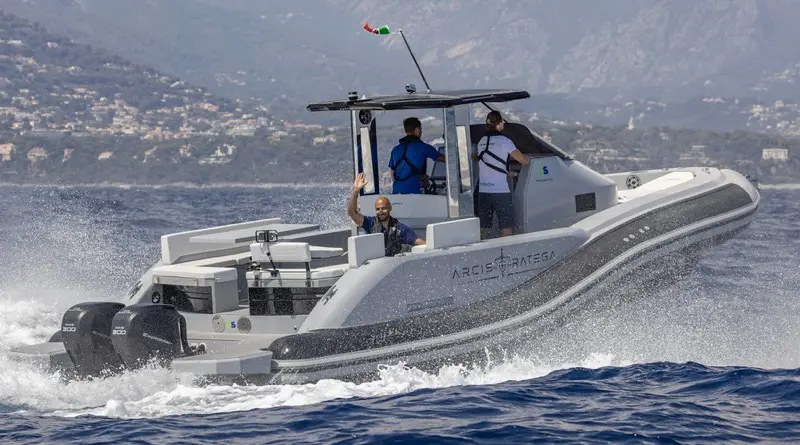
The Long-Range Innovator:AS Labruna’s "Arcistratega," a 10-meter (33-foot) RIB built on a Python 33 platform, equipped with dual WAVE 300+ outboards. Operating at a fully loaded displacement of 5.5 tonnes, this vessel achieved a top speed of 29.58 knots. Alongside Explomar’s high-capacity battery bank, the Arcistratega featured an integrated solar array and a methanol-powered fuel cell to autonomously generate electricity during overnight hours or low-solar intervals.
The Commercial Market Pioneer:Tokarex’s Gala Atlantis A500 Cruising RIB powered by the WAVE 70+. Showcasing Poland-based Tokarex’s first commercially available all-electric model for retail customers, this compact cruiser achieved a brisk 20-knot operational speed.
The European Brokerage Showcase:Yacht Technik’s ZAR Formenti RIB, a 6.5-meter (21-foot) Italian-built hull paired with the WAVE 150+ outboard, which recorded a commendable average speed of 26.06 knots.
Official Statements
The convergence of rigorous racing and advanced engineering drew praise from industry leadership on-site in Monaco. Reflecting on the hard-fought victory, Alex Dong, Founder and CEO of ExploMar, emphasized the dual nature of competitive marine trials:
"Winning this championship for the second consecutive year is both an honour and a responsibility for our entire team. Every victory is built upon countless engineering iterations, extensive sea trials, and the dedication of our partners. Looking ahead, ExploMar will continue pushing the boundaries of electric propulsion performance along with a broader electric marine ecosystem to deliver higher-performance, reliable, and smarter electrification solutions for waterways worldwide."
Pilot Gerben Boomsma echoed these sentiments, highlighting the mental and physical demands of the open-sea endurance course:
"We were really happy arriving back in Monaco because it was a serious journey I can tell you. Between the cross-wakes and the washing machine effect near the stone walls, smart throttle management and tactical navigation were just as important as raw kilowatt-hours."
Future Outlook: The Horizon of Electric Marine Mobility
The 2026 Monaco Energy Boat Challenge has firmly closed the chapter on debates regarding whether electric boats can survive harsh marine environments. By successfully navigating severe sea states, maintaining high average speeds over meaningful nautical distances, and preserving substantial energy reserves upon return, manufacturers like Explomar are validating the commercial viability of zero-emission watercraft.
The data harvested from the 2026 Open Sea Class will directly inform the next generation of consumer-facing electric outboards, battery management systems, and thermal cooling architectures. As partnerships between high-performance powertrain developers, boatbuilders, and specialized equipment suppliers continue to tighten, the transition from fossil-fuel-dependent RIBs and tenders to advanced electric alternatives is accelerating.
For recreational boaters, commercial operators, and superyacht tender fleets alike, the message from Monaco is unmistakable: the future of high-speed, long-range maritime mobility is electric, and it has already weathered the storm.