





Executive Overview
In the modern digital age, the relentless pursuit of social media engagement—often measured in likes, shares, and algorithmic visibility—has driven individuals to increasingly reckless extremes. From scaling historical monuments to staging dangerous stunts near moving traffic, the appetite for online validation appears boundless. Unfortunately, this dangerous cultural phenomenon has increasingly spilled over into the cruise industry, where travelers are risking life and limb for the ultimate vacation snapshot.
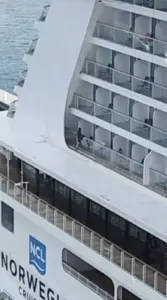
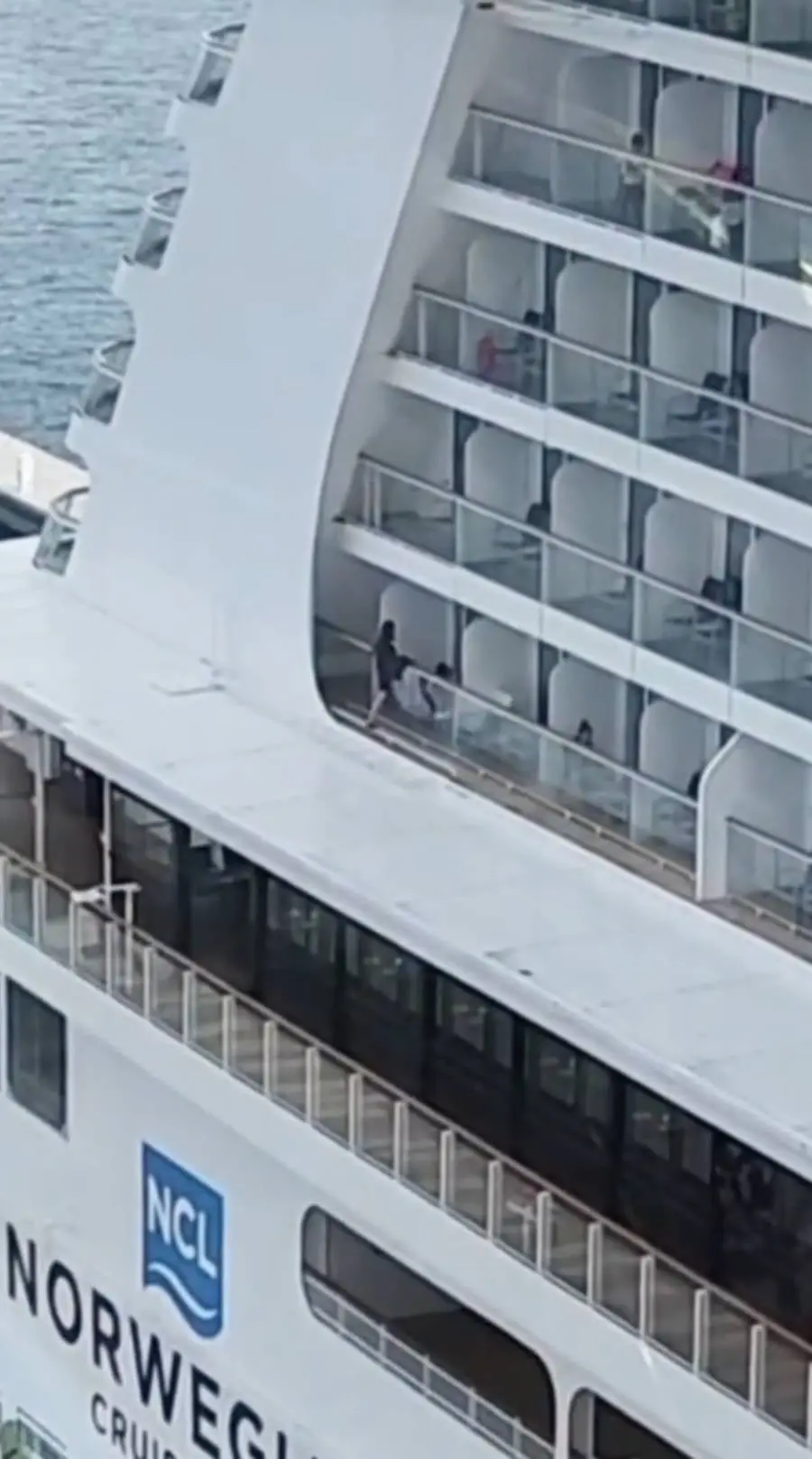
The latest alarming incident to capture the attention of the global travel community involves a guest aboard Norwegian Cruise Line’s Norwegian Getaway. In a widely circulated video posted to social media platforms such as Instagram and YouTube, an anonymous passenger is captured executing a death-defying maneuver: climbing directly over a stateroom balcony railing on Deck 9 and stepping onto a narrow, unsecured structural overhang protecting Deck 8.
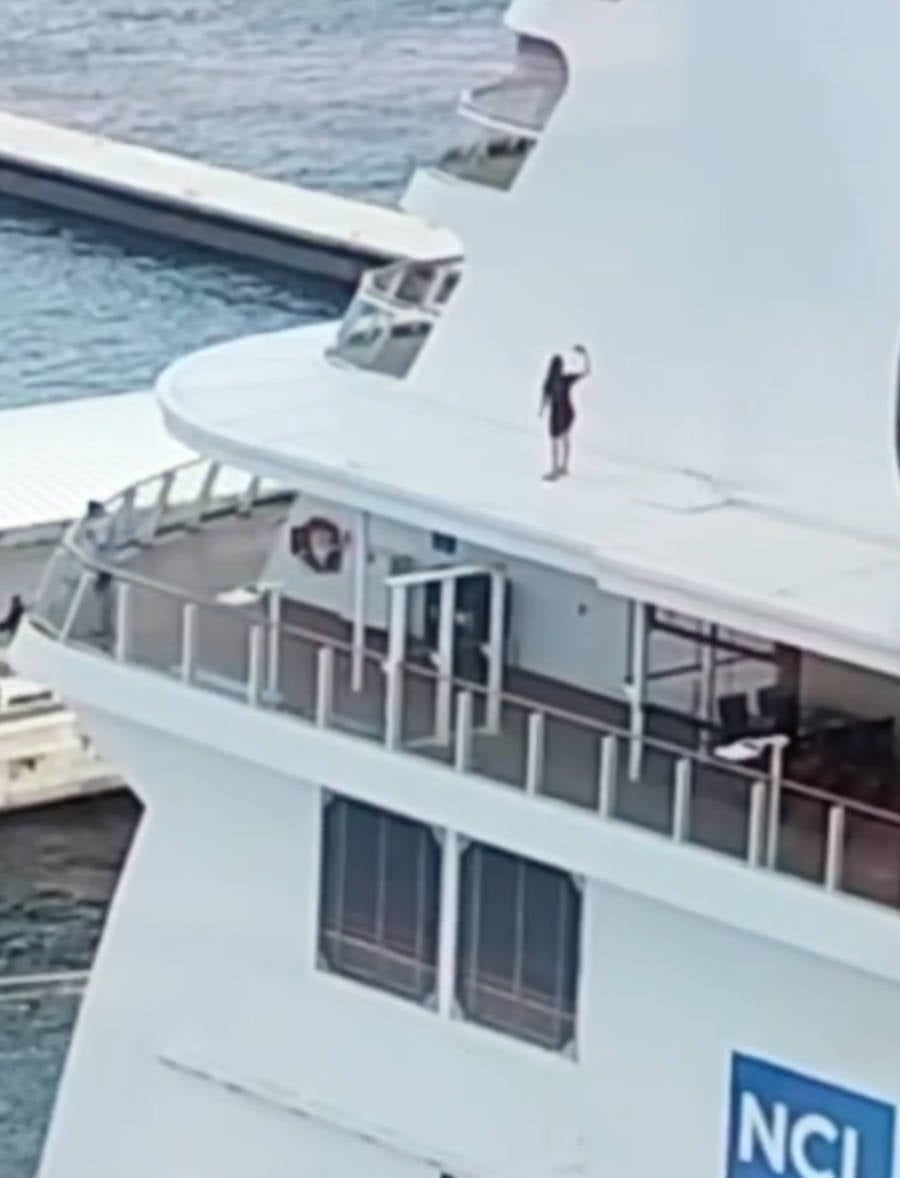
Stripped of any safety barriers, guardrails, or warning signs, this restricted zone serves as an architectural cover rather than a public walkway. Yet, for the sake of a few cell phone photographs and a striking pose, the individual casually walked along the precipice, knelt precariously close to the drop-off, and leaned against the vessel’s exterior hull.
While the video was captured by an observant onlooker from an adjacent cruise ship docked nearby in Nassau, Bahamas, the footage has reignited an urgent conversation regarding passenger safety, maritime law, and the strict zero-tolerance policies enforced by major cruise operators. As cruise lines strive to cultivate secure, family-friendly environments onboard multi-billion-dollar vessels, reckless behavior driven by vanity threatens not only the individual perpetrators but also the emergency resources and overall peace of mind of fellow travelers. This comprehensive investigative report breaks down the incident, examines the strict legal ramifications under cruise ticket contracts, contextualizes the broader industry trend of dangerous stunts at sea, and evaluates what steps cruise lines must take to combat this alarming epidemic.
Detailed Chronology of Events
The unsettling sequence of events unfolded in broad daylight while the Norwegian Getaway was docked in Nassau, the bustling capital of the Bahamas. The 3,962-guest vessel, a staple of Norwegian Cruise Line’s modern fleet, frequently calls upon Nassau as part of its regular 3- and 4-night itineraries departing from its homeport at PortMiami.
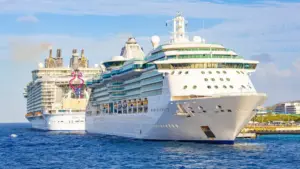
The incident was meticulously documented by an unsuspecting bystander, user @rudyhdez1962, from the vantage point of an adjacent cruise ship sharing dock space in the busy Bahamian port. On September 3, several massive mega-ships were anchored or docked in close proximity to the Norwegian Getaway, including Royal Caribbean International’s Wonder of the Seas and Jewel of the Seas, alongside Carnival Cruise Line’s Carnival Liberty. Due to the overlapping port schedules, travelers aboard neighboring vessels often have unobstructed views of adjacent ships, turning private balconies into public theaters.
According to the digital footage, the unnamed passenger initiated the high-risk stunt from a stateroom situated on Deck 9 of the Norwegian Getaway. Rather than remaining within the safety boundaries of the private balcony, the guest hoisted themselves over the glass or metal partition, dropping down onto the unprotected structural overhang designed to shield the aft sections of Deck 8 below.
This specific architectural feature is strictly off-limits to passengers and crew alike unless performing authorized maintenance with heavy-duty fall-protection gear. It features zero vertical safety railings, slick painted metal surfaces, and a sheer drop directly down to the lower decks or the open water below.
Without hesitation, the individual began navigating the narrow ledge. The video shows the passenger stopping at various points along the overhang to frame shots with a handheld cellular device. In an act of staggering hubris, the guest propped their camera against the ship’s exterior steel hull, walked several feet away to position themselves closer to the unprotected edge, and dropped to their knees to pose for a series of self-portraits.
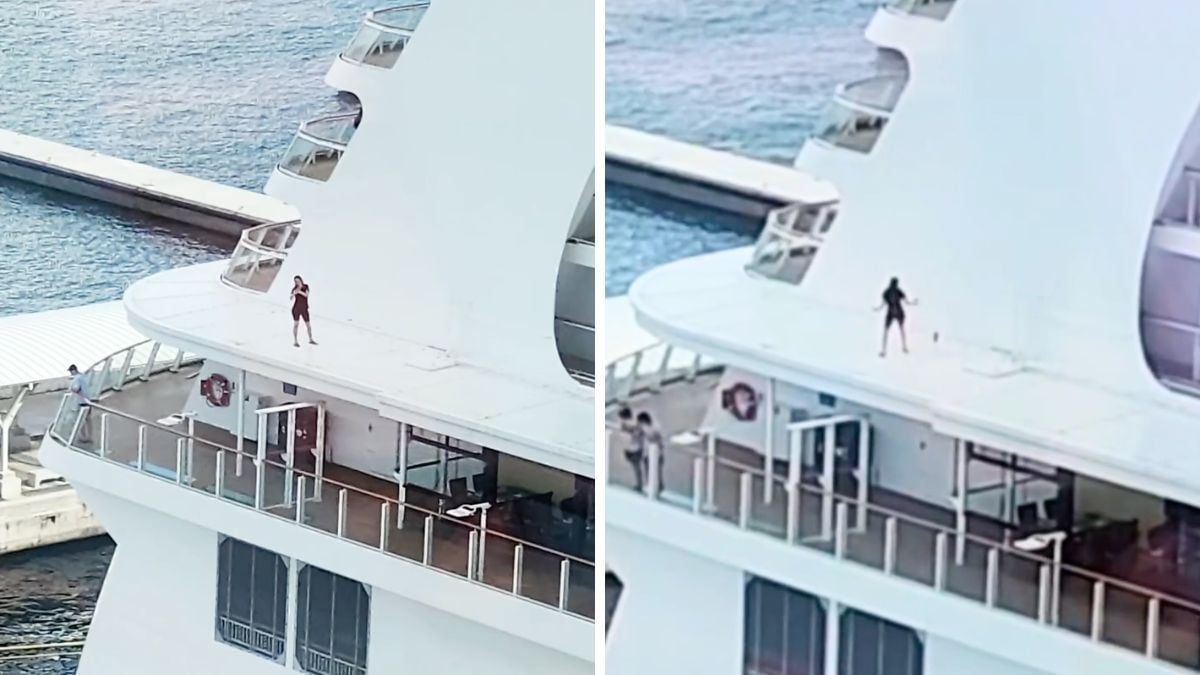
After securing the desired content, the passenger nonchalantly retraced their steps, heaved themselves back over the Deck 9 balcony railing, and re-entered the stateroom as if nothing out of the ordinary had occurred.
The footage surfaced online on Thursday, September 3, rapidly spreading across Instagram, TikTok, and YouTube Shorts. Interestingly, confusion accompanied the initial wave of social media uploads; a corresponding YouTube Short featuring the footage was tagged with the hashtag #msc, while its Spanish-language caption translated roughly to: "Passenger on an MSC cruise ship jumps into a restricted and very DANGEROUS area to take photos."
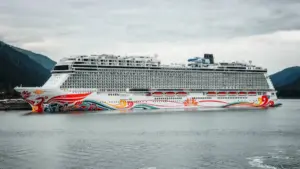
Despite the misidentification in the caption, definitive maritime identifiers proved the ship was unequivocally the Norwegian Getaway. The vessel’s iconic hull artwork—designed by renowned marine artist Peter Max—and the clearly visible ship name stenciled across the steel plates left no room for debate.
Supporting Context, Metrics, and Industry Realities
To fully understand the gravity of the Norwegian Getaway incident, one must examine the structural realities of modern cruise ships and the statistical framework governing safety at sea.
Modern mega-ships like the Norwegian Getaway—which entered service in 2014 and spans 145,655 gross tons—are floating cities engineered with thousands of safety systems, redundant navigation equipment, and rigorous security protocols. However, no amount of engineering can completely safeguard individuals who deliberately bypass physical barriers designed to protect them from their own poor judgment.
The Physics and Perils of Cruise Ship Architecture
Cruise ship balconies are meticulously engineered to comply with strict international maritime safety standards, typically requiring railings to stand at least 42 inches (approx. 1.06 meters) above the deck flooring. The spacing between vertical balusters is similarly regulated to prevent small children from slipping through. These measures are not merely aesthetic; they are life-saving boundaries meant to prevent accidental overboard incidents caused by high winds, sudden ship movements, or misjudged footing.
When a guest deliberately breaches these boundaries—as seen in the Norwegian Getaway footage—they enter an environment where the margin for error is effectively zero. A momentary lapse in concentration, a sudden gust of wind, a patch of morning dew, or a shifting metal surface could easily send an individual hurtling over the edge. At sea, man-overboard (MOB) situations carry notoriously low survival rates due to the vessel’s immense stopping distance, hydrodynamic suction, and the vastness of the open ocean.
The Viral Stunt Epidemic
This incident is far from an isolated occurrence; rather, it is part of a troubling psychological trend where online validation supersedes basic self-preservation. Over the last several years, cruise industry blogs and maritime safety forums have documented a rising number of stunts captured on video:
- October 2025: A viral video showed teenagers dangerously walking along the upper balcony railings of a Royal Caribbean vessel, sparking widespread condemnation from seasoned cruisers.
- July 2023: Young adult guests were documented sitting casually on exterior balcony railings on another major cruise line ship, oblivious to the fact that a minor lean backwards would result in a fatal fall.
The common denominator in all these incidents is the presence of a smartphone camera. The desire to capture high-engagement "clout" for platforms like Instagram Reels and TikTok has created an environment where risk assessment is completely subordinated to aesthetic appeal.
Legal Repercussions and Official Cruise Line Policy
While Norwegian Cruise Line has not issued a formal public statement regarding this specific incident, the legal and administrative framework governing guest behavior aboard their vessels leaves little ambiguity regarding the potential consequences.
The Guest Ticket Contract: A Binding Legal Agreement
When a passenger purchases a ticket and boards a ship like the Norwegian Getaway, they enter into a legally binding contract with the cruise line. Section 5(b) of the Norwegian Cruise Line Guest Ticket Contract explicitly addresses behavior that endangers personal safety or the safety of others.
According to the contract, the cruise line reserves the right to take swift, punitive action against any guest who:
- Engages in inappropriate, disruptive, or unruly behavior.
- Violates established shipboard safety rules and designated restricted area boundaries.
- Endangers their own life or the lives of fellow passengers and crew members.
Severe Penalties: Disembarkation, Fines, and Lifetime Bans
Passengers who violate these foundational safety protocols face a cascade of severe administrative and legal penalties:
- Immediate Disembarkation: Cruise security possesses the authority to confine unruly or dangerous guests to their cabins, strip them of onboard privileges, and forcibly disembark them at the next scheduled port of call—leaving the traveler responsible for all return travel expenses.
- Lifetime Cruise Bans: Major cruise lines maintain shared blacklist databases. Engaging in reckless stunts that compromise safety almost invariably results in a permanent lifetime ban from sailing with Norwegian Cruise Line, and frequently triggers cross-fleet bans across partner brands.
- Property Damage Liability: Under Section 5(h) of the NCL contract, if a guest damages any portion of the ship’s structure, coating, or equipment during their stunt—such as scratching the hull or denting structural overhangs—they are held strictly and financially liable for the total cost of repairs. Furthermore, violators can be slapped with a mandatory $500 administrative fee for breach of contract.
- Civil and Criminal Liability: Depending on the jurisdiction in which the incident occurred and the severity of the disturbance, reckless endangerment can occasionally attract the attention of local law enforcement agencies when the ship returns to its homeport.
Future Outlook: Combatting the Culture of Risk at Sea
As the cruise industry continues its robust post-pandemic expansion, welcoming tens of millions of passengers annually, cruise operators face a mounting challenge in policing behavior in an era of ubiquitous personal technology.
Enhanced Surveillance and Technological Deterrents
To curb incidents like the one witnessed on the Norwegian Getaway, cruise lines are increasingly turning to advanced surveillance technology. Modern mega-ships are blanketed with high-definition closed-circuit television (CCTV) cameras capable of monitoring public decks, promenades, and exterior zones. Increasingly, lines are integrating artificial intelligence (AI) motion-detection software designed to automatically flag unauthorized human movement in restricted exterior areas, alerting security personnel before a dangerous stunt can be completed or captured on film.
Education, Enforcement, and Culture Shifts
Technology alone, however, cannot substitute for personal accountability. Cruise lines are stepping up pre-boarding educational campaigns, utilizing app notifications, muster drills, and stateroom television programming to explicitly remind guests of the zero-tolerance policy regarding balcony safety and restricted zone access.
Furthermore, the cruising community itself plays an increasingly vital role through peer pressure and digital accountability. When fellow passengers capture and publicize reckless behavior—as @rudyhdez1962 did in this instance—it strips away the anonymity of the perpetrators and provides cruise line security teams with the undeniable evidence needed to enforce lifetime bans.
Ultimately, the message from maritime authorities and cruise operators is unequivocal: no photograph, video, or social media trend is worth a human life. As long as lines continue to strictly enforce their guest contracts and levy severe penalties against thrill-seekers, the hope is that the high cost of vanity will finally outweigh the allure of viral fame on the high seas.