







Executive Overview
On the evening of 14 August 2025, the tranquil waters of Portsmouth Harbour became the site of a devastating maritime accident that claimed two lives and left the local boating community in profound shock. The rigid inflatable boat (RIB) Peaky Blinder collided at high speed with navigation beacon 81, a stationary marker within the bustling and historically rich Hampshire waterway. The violent impact instantly ejected all three occupants—the vessel’s owner, who was at the helm, and two passengers—into the cold, unforgiving tidal currents of the harbour.
The immediate aftermath triggered a multi-agency search and rescue operation involving the RNLI, local emergency services, and marine units. While one passenger managed to survive the ordeal with minor physical injuries, the cost of the disaster quickly mounted. One passenger was pulled from the water unconscious and unresponsive; despite frantic efforts by paramedics, they were later pronounced deceased. The owner of the Peaky Blinder remained missing for nearly a week before their body was recovered from the harbour five days after the incident.
The publication of Accident Investigation Report 15/2026 brings the grim details of this tragedy back into the public eye, shedding light on the mechanics of the crash and the inherent vulnerabilities associated with high-speed leisure craft operating in congested commercial and recreational waterways. This comprehensive investigative feature examines the timeline of the disaster, the broader context of maritime safety in the United Kingdom, the systemic issues surrounding RIB operations, and the urgent recommendations issued to regulatory authorities to prevent such a catastrophe from recurring.

Detailed Chronology
The Setting: Portsmouth Harbour at Dusk
Portsmouth Harbour is one of the busiest and most complex maritime hubs in the United Kingdom. Home to a major naval base, cross-channel ferry terminals, commercial shipping, and a thriving community of leisure sailors, the harbour demands constant vigilance, precise navigation, and adherence to strict local bylaws and speed limits.
On 14 August 2025, weather conditions leading into the evening were generally favorable, though visibility was beginning to be compromised as daylight faded. The harbour presented its usual mix of commercial traffic and recreational craft. At some point prior to the incident, the Peaky Blinder—a high-performance rigid inflatable boat known for its agility and speed capabilities—got underway with three individuals on board: the owner, acting as the driver, and two passengers.
The Fatal Impact
As the evening progressed, the Peaky Blinder navigated through the harbour waters. Investigators from the Marine Accident Investigation Branch (MAIB) reconstructed the vessel’s final moments, concluding that the RIB was travelling at a significant speed when it failed to clear or negotiate a critical hazard: navigation beacon 81.
Navigation beacons are vital infrastructure designed to guide vessels safely through channels by marking shallows, wrecks, and turning points. On that evening, however, beacon 81 became the point of catastrophic failure. The Peaky Blinder allided—struck a stationary object—with the beacon.
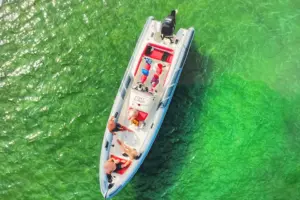
The physical forces involved in a high-speed allision with a steel and concrete structure are immense. When the bow of the RIB struck navigation beacon 81, the vessel’s forward motion was arrested instantaneously. According to the foundational laws of physics, the occupants onboard continued moving forward at the vessel’s pre-impact speed.
Ejection and Immediate Aftermath
The sudden deceleration caused the violent ejection of all three occupants from the RIB. Thrown clear of the console and seating, the driver and the two passengers were cast directly into the harbour water. Ejection in a high-speed maritime accident frequently results in severe blunt-force trauma from striking the vessel’s structure, the water’s surface, or the navigational hazard itself, compounded by the immediate risk of cold-water shock and drowning.
In the chaotic moments following the collision, emergency services were alerted. Lifeboats and rescue craft converged on the scene near navigation beacon 81. Rescuers recovered one passenger from the water in an unconscious state. Immediate first aid and advanced life support were administered, but the individual could not be revived and was subsequently declared dead.
The second passenger, incredibly, survived the collision and the subsequent immersion, sustaining only minor injuries. However, the driver—the owner of the Peaky Blinder—was nowhere to be found.
The Multi-Day Search Operation
The disappearance of the boat’s owner triggered an intensive, multi-day search and rescue (and subsequently recovery) operation across Portsmouth Harbour and its approaches. Coastguard teams, police marine units, and specialized dive teams scoured the turbid waters, examining tidal patterns and drift vectors to narrow down search zones.
For five agonizing days, family, friends, and the wider maritime community waited for news. The operation concluded when the body of the owner was finally recovered from the harbour waters, bringing formal closure to the search phase of the tragedy but deepening the mourning of those affected.

Supporting Context & Metrics
The Rise of High-Speed RIBs in Leisure Maritime
In recent years, rigid inflatable boats have surged in popularity among recreational boaters. Valued for their buoyancy, stability in rough seas, and capacity for high speeds, RIBs occupy a unique space in modern maritime recreation. They are utilized for everything from family coastal cruising to high-adrenaline sport driving.
However, this accessibility has raised serious concerns within maritime safety circles. Unlike displacement vessels or traditional displacement cruisers, modern RIBs are often powered by high-output outboard engines capable of accelerating small hulls to planing speeds in a matter of seconds. This performance profile requires a level of competency, seamanship, and situational awareness that far exceeds traditional boat handling qualifications—qualifications which are not always legally mandated for private leisure craft owners in the UK.
The Hazards of Fixed Marine Infrastructure
Navigation beacons, while essential for safe transit, represent immovable hazards in dynamic marine environments. In low light, glare, reduced visibility, or when distracted, navigating close to channel markers carries inherent risks. The MAIB and local harbour authorities frequently remind mariners to maintain a wide berth from fixed structures and to operate at safe speeds—particularly during dusk and night transitions when depth perception and contrast are severely degraded.
Regulatory Oversight and Self-Regulation
The UK maritime framework relies heavily on a combination of national legislation and local harbour master directions (General Directions). While commercial vessels are subject to rigorous safety management systems, coding, and mandatory training requirements (such as the RYA Powerboat Level 2 or Commercial endorsement schemes), private leisure boat owners operate under a much more permissive regulatory regime.
This dichotomy has long been a subject of debate among safety investigators. While mandatory licensing for leisure boat operators remains a politically sensitive topic in the UK, incidents like the Peaky Blinder allision thrust the spotlight back onto whether current training standards and personal safety equipment usage (such as kill cords and lifejackets) are genuinely sufficient to protect the public.
Official Statements
The Chief Inspector of Marine Accidents
Following the release of Accident Investigation Report 15/2026, the Chief Inspector of Marine Accidents issued a formal statement regarding the findings and the broader implications of the tragedy.
"The loss of life resulting from the allision of the Peaky Blinder with navigation beacon 81 in Portsmouth Harbour is a stark and heartbreaking reminder of the unforgiving nature of the marine environment," the statement noted. "High-performance rigid inflatable boats offer an exhilarating experience, but they demand absolute respect, continuous vigilance, and a thorough understanding of local hazards and vessel dynamics.
"Our investigation underscores the critical need for all leisure mariners to rigorously assess risks, adhere to safe operating speeds, and ensure that every person on board is properly secured and wearing appropriate safety gear at all times. The findings and subsequent recommendations within this report are designed to prompt decisive action from regulatory bodies and local authorities to enhance safety standards and prevent future tragedies in our harbours and coastal waters."
Local Authorities and Emergency Services
Representatives from the King’s Harbour Master (KHM) Portsmouth expressed their profound condolences to the families of the deceased and reiterated their commitment to harbour safety. The KHM works continuously to manage the complex traffic matrix of Portsmouth Harbour, balancing the operational needs of the Royal Navy and commercial shipping with the desires of the recreational boating community.
Emergency services involved in the initial response also emphasized the vital importance of prompt reporting, effective inter-agency coordination, and the utilization of personal flotation devices (PFDs) and engine kill cords—mechanisms designed to instantly shut down a vessel’s engine if the driver is separated from the helm.
Future Outlook
Implementing Recommendations
Accident Investigation Report 15/2026 does not merely document a tragedy; it serves as a proactive blueprint for safety reform. The report outlines specific recommendations directed at key stakeholders:
- The King’s Harbour Master Portsmouth: Recommended to review and potentially enhance local traffic management advisory notices, hazard marking visibility, and safety messaging targeted specifically at high-speed leisure craft operating within the harbour limits.
- The Secretary of State for Transport: Recommended to consider broader national policy reviews concerning leisure craft safety, operator competency frameworks, and the enhancement of safety awareness campaigns regarding the operation of high-speed open boats.
A Call to Action for the Boating Community
As the maritime sector digests the findings of Report 15/2026, the overarching message for recreational boaters is clear: complacency kills. The tragic events of 14 August 2025 in Portsmouth Harbour will long serve as a sobering touchstone in British maritime safety discussions.
Moving forward, industry associations, training providers, and regulatory bodies face a collective challenge to foster a stronger safety culture among private boat owners. By emphasizing comprehensive navigation planning, strict adherence to speed limits, proper use of safety gear, and a heightened respect for fixed marine hazards like navigation beacon 81, the maritime community can honor the memories of those lost by striving to ensure that such a devastating accident is never repeated.