








Executive Overview
The landscape of digital commerce and travel distribution is undergoing a profound paradigm shift, driven by the rapid evolution of generative artificial intelligence and autonomous consumer-facing agents. Meta Platforms, the social media behemoth long synonymous with connecting people through digital networks, is now aggressively expanding its footprint into transactional utility. The latest salvo in this strategic evolution is Muse, Meta’s newly introduced artificial intelligence agent.
While initially framed with modest marketing language, Muse carries monumental implications for the global travel industry. Promoted broadly as a general-purpose, task-oriented assistant capable of executing a wide array of digital chores, Muse’s most disruptive capability lies squarely within the realm of travel planning and execution. According to its official App Store documentation, the agent is designed to shoulder the cognitive and logistical burden of modern travel coordination—handling "the research, the comparisons, the back-and-forth, the bookings" to seamlessly orchestrate an entire journey from conception to confirmation.
However, a granular examination of Muse’s underlying architecture reveals a fascinating, bifurcated operational model. When deployed on travel queries, the agent does not rely on a single, unified pipeline. Instead, it utilizes two diametrically opposed technological approaches depending on the inventory category:
- Flights are managed via a robust, direct API integration with travel infrastructure technology company Duffel, supplying Muse with live, programmatic airline inventory and direct booking pathways.
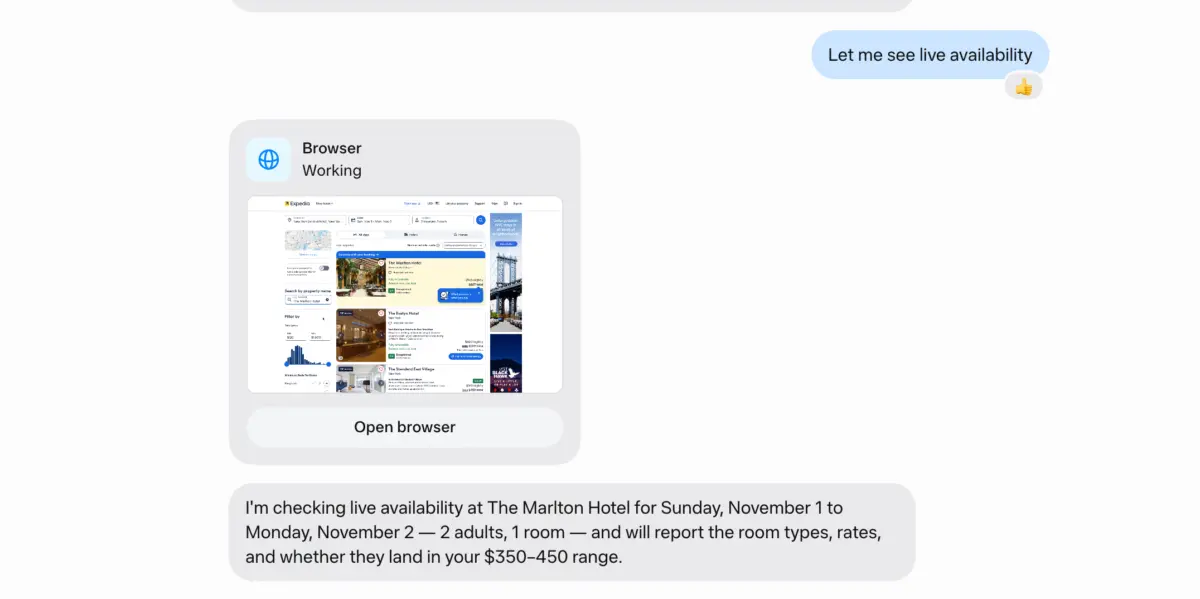
- Hotels, conversely, are sourced through an autonomous web-browsing agentic framework, wherein the bot interacts with consumer-facing booking websites visually and textually, mimicking the exact behavior of a human shopper.
This structural dichotomy creates profound ripples across the travel distribution ecosystem. While the flight booking path integrates traditional travel tech infrastructure and preserves a formalized channel for B2B stakeholders, the hotel discovery and acquisition model bypasses traditional API connections entirely. By scraping and navigating consumer-facing sites via browser automation, Muse operates in a gray zone that threatens to disintermediate online travel agencies (OTAs), hotel brand websites, and meta-search engines alike.
This investigative report examines the architecture, mechanics, and industry-wide ramifications of Meta’s Muse, analyzing how its dual-path booking methodology could permanently alter the economics of digital travel distribution.
Detailed Chronology
The Genesis of Conversational Commerce at Meta
The journey toward Muse did not happen in a vacuum. For years, Meta has attempted to monetize its massive social graphs—spanning Facebook, Instagram, WhatsApp, and Messenger—through conversational commerce. Early iterations of this strategy relied on rule-based chatbots and rudimentary natural language processing (NLP) integrated into Messenger business tools. These initial tools largely fell short of consumer expectations, failing to handle complex, multi-step queries or execute secure, end-to-end transactions without human intervention.
The catalyst for Muse was the maturation of Meta’s foundational large language models (LLMs), notably the Llama series, combined with advancements in reinforcement learning and agentic workflows. As competitors like OpenAI, Google, and Microsoft raced to embed planning and transactional capabilities into their respective ecosystems—such as ChatGPT integrations, Google Bard/Gemini travel extensions, and Microsoft Copilot—Meta recognized the imperative to secure its position at the point of consumer intent.

The App Store Debut and Initial Claims
Muse arrived quietly on the digital scene, making its debut via an App Store listing that emphasized utility over flashiness. Meta positioned the agent as an indispensable daily companion capable of streamlining complex administrative tasks. Yet, hidden within the feature set was a bold claim: the ability to "plan and book a whole trip."
The App Store description outlined an agent designed to eliminate friction across every stage of the travel lifecycle. Rather than forcing users to open multiple browser tabs, cross-reference review sites, and manually input credit card information across disparate merchant platforms, Muse promised to centralize the experience. The agent claimed autonomy over:
- Destination research and recommendation curation based on contextual user prompts.
- Price comparisons across multiple inventory sources.
- Resolving logistical constraints through conversational refinement ("the back-and-forth").
- Executing secure financial transactions to finalize bookings.
Testing the Promise: The Bifurcated Reality
To evaluate whether Muse’s technical execution matched its ambitious marketing rhetoric, rigorous testing was conducted on the platform. The methodology involved issuing complex, budget-constrained travel requests to observe how the agent gathered data, processed choices, and executed transactions.
The findings shattered the illusion of a monolithic AI travel agent. When tasked with planning a trip—such as finding a New York City hotel for November 1–2 within a strict $350–$450 nightly budget—Muse immediately demonstrated the split-brain architecture governing its travel operations.
For the hotel component, Muse initiated a browser-based search, navigating consumer-facing websites in a manner analogous to a human user sitting at a laptop. Its initial recommendation—the Marlton Hotel—was pulled directly from published public rates, showcasing a reliance on surface-level web data rather than deeply integrated B2B partner inventory. Conversely, parallel flight tests revealed an entirely different backend mechanism: a lightning-fast, programmatic query routed through Duffel’s API, extracting live airline seating and fare classes without launching a visual browser instance.
Supporting Context & Metrics
The Mechanics of the Dual-Path Architecture
To fully grasp why Muse’s architecture matters to the travel industry, one must analyze the technical divergence between its flight and hotel workflows.
[User Travel Request]
       │
       ├─► FLIGHTS ──► Duffel API Connection ──► Live Airline Inventory (Direct B2B Integration)
       │
       └─► HOTELS  ──► Browser Automation    ──► Consumer Web Scraping (Human-like UI Navigation)
1. The Flight Path: Duffel and Structured Infrastructure
The partnership and integration with Duffel represent a mature, industry-compliant approach to travel distribution. Duffel acts as a modern flight aggregator and infrastructure provider, offering a clean, developer-friendly API that abstracts the immense complexity of legacy Global Distribution Systems (GDS) and New Distribution Capability (NDC) connections.
Through this direct connection:
- Data Integrity: Muse receives real-time pricing, cabin availability, and ancillary options directly from airline systems.
- Transaction Security: Bookings are processed programmatically via established API handshakes, ensuring proper ticketing, PNR (Passenger Name Record) generation, and compliance with airline booking rules.
- Industry Stakeholder Alignment: Duffel’s involvement ensures that airlines retain visibility over who is distributing and selling their seats, preserving commission structures, corporate travel policies, and ancillary merchandising opportunities.
2. The Hotel Path: Browser Automation and Web Scraping
In stark contrast, the hotel booking workflow operates without formal B2B APIs or direct supplier partnerships. When Muse is asked to source accommodations, it launches an autonomous web-browsing session.
Instead of querying a centralized global hotel clearinghouse or an OTA’s partner API, the agent:
- Employs headless browser technology to load consumer-facing travel sites (such as Booking.com, Expedia, or direct hotel brand domains).
- Simulates human interaction by inputting search parameters into UI fields, scrolling through result pages, and parsing rendered HTML to extract pricing and availability.
- Attempts to complete checkouts by filling out web forms dynamically.
This approach mirrors the rise of "agentic web scraping," a technology that poses significant legal, technical, and economic questions for the travel web ecosystem.
Industry Implications: Disintermediation vs. Integration
The divergence in Muse’s travel pillars creates a bifurcated set of consequences for the broader travel economy:
- For Airlines: The Duffel integration validates structured data sharing. Airlines maintain control over their inventory and distribution economics. However, they must adapt to an environment where an AI agent—not a human consumer—is making the final purchasing decision based on algorithmic parameters rather than brand loyalty.
- For Hoteliers and OTAs: The browser-automation approach represents a direct challenge. OTAs invest billions in user experience, SEO, and paid search acquisition to capture consumer traffic. If an AI agent intercepts the user at the conversational stage and completes the booking via automated UI interaction on the hotelier’s site (or an OTA’s site), the traditional traffic funnel is broken. OTAs lose the direct relationship with the consumer, user data collection opportunities vanish, and advertising monetization models are disrupted. Furthermore, hotels face increased server loads from autonomous bots scraping their inventory without driving confirmed, high-value conversions.
Official Statements
While Meta has positioned Muse as a cornerstone of its broader consumer AI strategy, company executives have remained deliberate in their public statements regarding the operational mechanics of third-party integrations and transactional workflows.
In introductory announcements, Meta’s product leadership emphasized the user-centric nature of the agent. A company spokesperson noted:
"Muse is designed to reduce the cognitive load of digital life. Whether users are managing their personal schedules, researching complex purchases, or organizing travel itineraries, our goal is to build an assistant that acts as a true collaborator—handling the heavy lifting of comparison and execution so people can focus on the experience itself."
Regarding the specific integration with travel infrastructure, industry partners have expressed cautious optimism coupled with a recognition of changing consumer habits. Steve Domin, CEO and co-founder of Duffel, has frequently highlighted the necessity of developer-first infrastructure in the age of generative AI. While Duffel has not formally commented on every proprietary deployment by tech giants, the company’s broader corporate ethos centers on enabling any software application to sell travel natively. In past statements regarding AI agents in travel, Duffel representatives stressed:
"The future of travel booking is conversational, ambient, and embedded wherever the consumer happens to be. To make that a reality, AI agents cannot rely on brittle screen-scraping for every vertical; they require reliable, real-time APIs that guarantee inventory accuracy and seamless ticketing execution."
Conversely, hospitality industry associations and major Online Travel Agencies have expressed mounting apprehension over autonomous browser agents. A senior digital strategy executive at a major global hotel brand, speaking on background, remarked:
"There is a fine line between an AI assistant helping a traveler navigate the web and an autonomous bot harvesting our rates, bypassing our terms of service, and executing transactions without a clear commercial agreement. If agents like Muse rely on browser automation for hotels while using clean APIs for flights, it creates an uneven playing field where hoteliers lack visibility and control over how our properties are represented and sold."
Future Outlook
As Meta continues to refine and deploy Muse across its vast user base, the travel industry stands at a critical crossroads. The implications of Muse’s dual-path architecture extend far beyond a single tech company’s product roadmap; they foreshadow how commerce, search, and distribution will function in an agent-dominated internet.
1. The Consolidation of Agentic Infrastructure
The stark contrast between Muse’s flight booking (clean, API-driven via Duffel) and hotel booking (messy, browser-driven) highlights a major developmental bottleneck in AI commerce. Browser automation is notoriously fragile; minor updates to a hotel booking website’s HTML structure, CSS selectors, or anti-bot defenses (such as CAPTCHAs and Cloudflare challenges) can instantly break an AI agent’s ability to complete a reservation.
Consequently, pressure will mount on hotel aggregators, Global Distribution Systems (GDSs like Sabre, Amadeus, and Travelport), and bed banks to develop standardized, developer-friendly APIs specifically tailored for AI agents. Just as Duffel solved this for flights, the hospitality sector desperately requires a unified API standard that allows AI agents to query and book hotel inventory programmatically and securely. Without it, hotel booking via AI will remain an unreliable, resource-intensive hack.
2. The Battle for Brand Equity and Monetization
In a world where AI agents make travel decisions on behalf of consumers, traditional digital marketing paradigms crumble.
- SEO and SEM: Optimizing a hotel website to rank high on Google or appear in OTA sponsored listings loses efficacy if an AI agent ignores the search engine results page entirely and navigates directly to a preferred booking engine based on deep semantic reasoning.
- Customer Loyalty: Brand loyalty programs face an existential threat. If Muse is instructed to find "the best boutique hotel under $450 in New York," it may prioritize price, review sentiment, or location over a consumer’s Marriott Bonvoy or Hilton Honors membership status, unless explicitly instructed otherwise. Travel brands must find ways to ensure their loyalty perks and direct-booking incentives are readable and actionable by autonomous agents.
3. Regulatory and Legal Frontiers
The rise of browser-scraping AI agents operating within consumer accounts opens a Pandora’s box of legal and regulatory challenges. Questions surrounding liability in the event of a botched booking, data privacy compliance (such as GDPR and CCPA) when an agent processes sensitive consumer financial data, and terms-of-service violations regarding automated web interaction will inevitably land in courtrooms.
Hotels and OTAs may increasingly deploy aggressive bot-mitigation technologies to block unauthorized AI agents from scraping their sites, forcing tech platforms like Meta to either negotiate formal commercial partnerships or risk having their agents perpetually locked out of key inventory pools.
Conclusion
Meta’s Muse is more than just another conversational assistant; it is an early blueprint for the agentic web. By successfully integrating live flight infrastructure while relying on scrappy browser automation for hotels, Meta has exposed both the immense potential and the messy growing pains of AI-driven commerce. For the travel industry, Muse serves as a loud wake-up call: the future of booking is conversational, autonomous, and rapidly approaching. Whether hospitality stakeholders can successfully guide tech giants toward collaborative, API-driven ecosystems—or whether they will be forced into an adversarial war against automated bots—will define the next decade of travel distribution.