








Executive Overview
Arizona is a land defined by dramatic geographic juxtapositions. Between the towering, rust-red monolithic structures of Red Rock Country and the high-elevation, biodiverse "Sky Islands" of the southern borderlands, the Grand Canyon State houses an extraordinary mosaic of environments. To safeguard these natural wonders and preserve the complex narratives of human habitation across the centuries, the Arizona State Parks system manages a diverse portfolio of protected lands. While flagship destinations like the Grand Canyon or Slide Rock command global attention, a quieter, more contemplative class of state parks focuses on preserving the tangible artifacts of human history.
Among these historical crown jewels is McFarland State Historic Park, located in the historic desert town of Florence, Arizona. Despite holding the distinction of housing Arizona’s oldest standing frontier-era courthouse—an architectural masterpiece listed on the National Register of Historic Sites—this unassuming destination once earned the title of Arizona’s least visited state park in a comprehensive evaluation by local news organization AZ Central.
For the uninitiated traveler, this lack of congestion is not a liability, but an invitation. Far removed from the bumper-to-bumper tourist queues of more commercialized landmarks, McFarland State Historic Park offers an immersive, unhurried portal into the tumultuous birth of the Arizona Territory. Named after Ernest McFarland—a towering figure in 20th-century American jurisprudence and politics whose singular career touched the highest echelons of state and federal government—the park preserves a remarkably intact physical archive of late 19th- and mid-20th-century Southwestern life.
From its days as the judicial heart of Pinal County to its transformation into a community hospital, a World War II prisoner-of-war administrative hub, and finally a museum dedicated to preserving the legacy of the American West, McFarland State Historic Park punches well above its weight class. Combining deep historical significance with modern inclusivity—including its status as a Certified Autism Center—this underrated desert sanctuary demands a prominent place on the itinerary of any serious student of American history.
Detailed Chronology: From Adobe Frontier to Modern Historic Landmark
To fully appreciate the historical gravity of McFarland State Historic Park, one must trace its evolution through distinct chapters of southwestern history. The chronology of the property mirrors the rapid, often volatile transformation of the American frontier from an untamed expanse into an organized territorial jurisdiction.
The Territorial Genesis: 1878 and the Construction of Pinal County’s Judicial Heart
The narrative of the park’s central structure begins in the late 1870s. Founded in 1866, the town of Florence was rapidly emerging as a burgeoning agricultural and mining hub along the Gila River. By 1875, Pinal County was carved out of portions of Maricopa, Pima, and Pinal counties, necessitating an official seat of local government and a permanent temple of justice.
Construction on the courthouse commenced, culminating in its completion in 1878. Built under the supervision of early pioneers, the resulting structure was an engineering marvel for its time and place. Spanning seven distinct rooms, it stands today as the largest and oldest surviving adobe brick building from the Arizona Territorial period. Architecturally, the building is a textbook example of cultural synthesis, seamlessly blending Sonoran vernacular traditions—dictated by the searing desert climate and local material availability—with Anglo-American civic institutional design. The thick adobe walls, designed to insulate the interior against punishing desert heatwaves, created a cool, subterranean-like sanctuary for judges, lawyers, and litigants alike.
The Medical Era: Healing the Frontier
As Florence grew and administrative needs evolved, the 1878 courthouse eventually outgrew its original civic function. Recognizing the need for modern medical infrastructure in the growing Pinal County desert, the historic building underwent a radical adaptive reuse project, transitioning into the local community hospital.
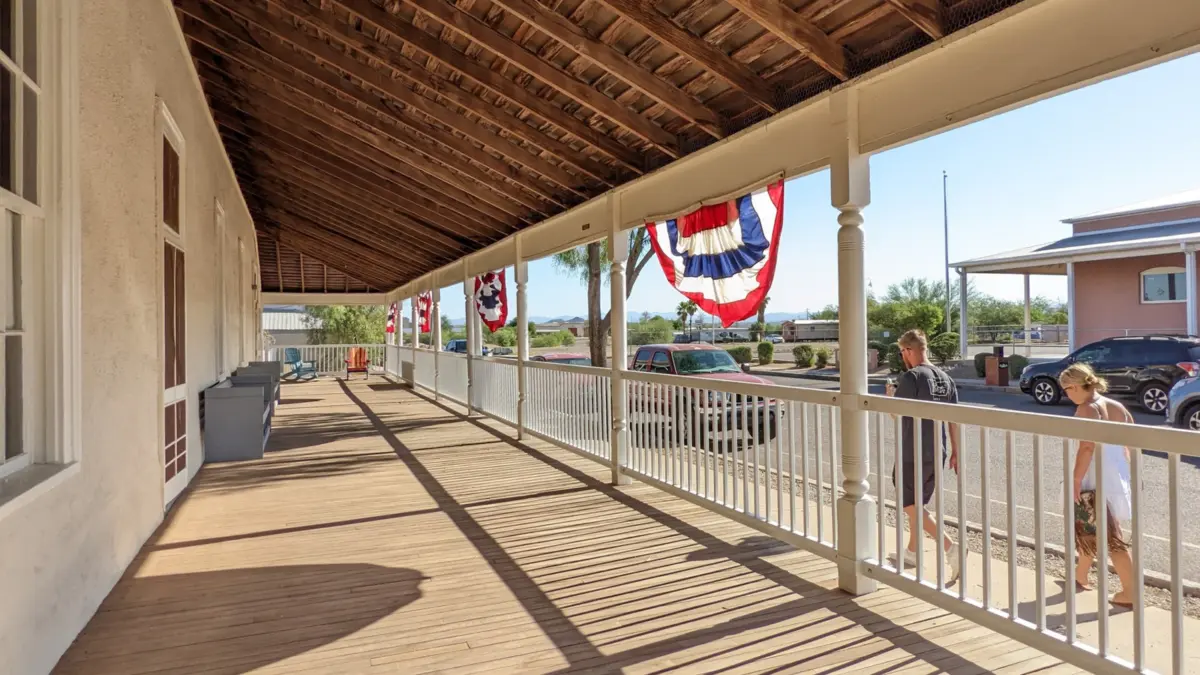
For several decades deep into the 20th century, the former chambers of justice echoed not with the gavel of the magistrate, but with the quiet footsteps of nurses and the hushed tones of recovering patients. It was during this extended medical chapter that structural modifications were integrated into the property, most notably the addition of the welcoming exterior porch—a functional architectural adaptation designed to provide shaded respite for convalescing patients. Today, dedicated museum exhibits meticulously chronicle this medical epoch, displaying authentic turn-of-the-century surgical tools, apothecary bottles, and hospital records that paint a vivid picture of healthcare delivery on the remote Arizona frontier.
Wartime Realities: The Florence POW Camp and WWII Administration
The historical footprint of McFarland State Historic Park extends far beyond local civic governance and medicine, touching upon the global theater of World War II. During the early 1940s, the broader Florence area became a critical strategic node for the United States military, most notably through the establishment of the Florence Prisoner of War Camp.
The courthouse complex and its surrounding administrative apparatus played a role in managing the complex logistical realities of housing thousands of Axis prisoners of war—primarily Italian and German soldiers—alongside subsequent facilities utilized for the internment of Japanese-Americans. Today, visitors stepping into the Florence POW Camp Exhibits room encounter a sobering, deeply researched collection of artifacts, photographs, and interpretive panels that unpack this complex, frequently overlooked chapter of the American home front.
The McFarland Rescue and the Birth of Modern State Parks
By the mid-20th century, the historic 1878 courthouse faced the perennial threat that has felled countless architectural treasures across the American West: demolition by neglect or modern urban "progress." Enter Ernest McFarland, a legal and political titan whose influence shaped modern Arizona.
McFarland’s resume is virtually unparalleled in American political history. He served as a United States Senator from Arizona, ascending to the powerful position of Senate Majority Leader during a pivotal era of mid-century legislation. He subsequently served as Governor of Arizona and ultimately as Chief Justice of the Arizona Supreme Court—making him the only known individual in the state’s history to reach the absolute summit of executive, legislative, and judicial power.
Beyond his sweeping political achievements, McFarland was a passionate preservationist and visionary. Recognizing the irreplaceable cultural value of the deteriorating 1878 Pinal County courthouse, he personally purchased the property with his own funds and spearheaded its meticulous structural restoration. Furthermore, McFarland is universally credited as the visionary architect of the Arizona State Parks system.
Upon successfully restoring the historic building, McFarland formally donated the property to the state, laying the foundational cornerstone for the museum system that visitors enjoy today. Established officially as a state historic park in 1979, the site serves as both a monument to frontier justice and an enduring testament to McFarland’s monumental civic legacy.
Supporting Context & Metrics
Understanding the operational footprint, visitor demographics, and structural dimensions of McFarland State Historic Park provides critical context for travelers and preservationists alike.
Architectural and Structural Metrics
- Construction Year: 1878 (making it Arizona’s oldest standing frontier-era courthouse).
- Architectural Classification: Listed on the National Register of Historic Sites; constructed primarily of sun-dried adobe bricks reflecting Sonoran and Anglo-American design hybrids.
- Spatial Layout: Comprises seven distinct interior rooms, housing archival collections, courtroom reconstructions, medical history galleries, and the Florence POW Camp exhibits.
- Event Capacity: The historic courtroom can be rented for private gatherings, comfortably accommodating groups of up to 40 individuals, furnished with 35 wooden chairs and a historic bench.
- Outdoor Amenities: A shaded courtyard featuring three picnic tables and an operational outdoor barbecue grill.
Geographic Accessibility and Tourism Metrics
- Proximity to Major Urban Centers: Located within an approximate one-hour drive from both Phoenix and Tucson, making it an ideal day-trip destination for urban residents seeking historical enrichment.
- Visitor Density: Historically ranked as one of the least-visited properties within the Arizona State Parks portfolio according to AZ Central tourism data, translating into an intimate, crowd-free visitor experience that allows for deep, uninterrupted engagement with exhibits.
- Accessibility and Inclusivity Metrics: Formally recognized as a Certified Autism Center, featuring tailored sensory accommodations, predictable environments, and specially trained staff to ensure a welcoming experience for neurodivergent visitors. Additionally, the park maintains a pet-friendly policy, allowing leashed dogs to accompany their owners throughout the grounds.
Official Statements & Visitor Testimonials
The historical and cultural weight of McFarland State Historic Park is best understood through the voices of those who have studied its collections, managed its preservation, and walked its wooden floors.
Archival and Preservation Perspectives
Preservationists and park historians have consistently emphasized that the park is far more than a collection of old walls; it is a primary source document built of adobe and timber. In statements regarding the park’s foundational ethos, representatives of the Arizona State Parks and Trails system have underscored the unique multi-layered history preserved within Florence:
"McFarland State Historic Park encapsulates the very arc of Arizona’s evolution. From the raw, law-and-order realities of the territorial frontier and the vital healing work of our early medical pioneers to the global conflicts of the 20th century, this single adobe structure holds the collective memory of a community that helped forge the modern American Southwest."
Visitor Impressions and Testimonials
The intimate, uncommercialized nature of the park frequently elicits glowing praise from travelers who stumble upon its historic gates. The combination of rigorous scholarship in the exhibits and the personal touch of park staff leaves a lasting impression.
One recent visitor, sharing their experience on public review platforms, noted the unexpected depth of the historical narrative:
"Anyone who loves history should make a stop here. The exhibits are very well-researched, and I highly recommend pausing to listen and learn about the vast history of this little town and the larger impact it had on Arizona and the U.S. as a whole."
Another reviewer highlighted the tactile, immersive nature of the museum spaces:
"Walking through the old courtroom and seeing the artifacts from the POW camp really brings the past to life. It’s quiet, peaceful, and you never feel rushed by massive tour groups. You can take all the time you need to absorb the stories embedded in these adobe bricks."
Future Outlook: Preservation, Inclusivity, and Community Integration
As McFarland State Historic Park looks toward the coming decades, its operational strategy centers on a delicate balance: aggressively preserving its fragile 19th-century adobe architecture while expanding educational programming and modern accessibility standards.
Architectural Conservation Challenges
Adobe structures present unique, ongoing maintenance challenges for historic preservationists. Composed of organic clay, sand, silt, and straw, adobe is exceptionally vulnerable to moisture infiltration, erosion, and seismic shifts. The park’s management team continuously monitors the structural integrity of the 1878 courthouse, employing specialized lime-based stuccos and traditional earthen repair techniques to protect the building’s structural envelope without compromising its historical authenticity. Future capital improvement initiatives will focus on advanced climate-control and monitoring systems within the interior galleries to safeguard sensitive paper archives, photographic records, and mid-century medical artifacts from environmental degradation.
Expanding Educational Outreach and the Junior Ranger Initiative
A core pillar of the park’s future outlook is the cultivation of the next generation of historians and conservationists. The expansion of interactive youth programming—most notably the Junior Ranger program—remains a top priority. By engaging children in experiential learning modules where they directly compare modern conveniences with the rigorous daily routines of Florence children in the 1860s and 1870s, the park fosters deep historical empathy.
Furthermore, upcoming educational calendars feature specialized ranger-led nature talks, desert ecology workshops, and collaborative sessions with guest geologists. These programs explore Arizona’s rich fossil record and prehistoric origins, bridging the gap between deep geological time and human history.
Setting the Standard for Accessibility
In an era where historic properties frequently struggle to comply with modern accessibility standards due to physical constraints, McFarland State Historic Park has emerged as a progressive leader. Building upon its current status as a Certified Autism Center, the park is committed to continuous staff training, sensory-friendly modifications, and the development of digital visual schedules and tactile guides. This forward-thinking approach ensures that individuals across the neurological spectrum can access and enjoy the rich heritage of the American West.
Integrating into the Greater Desert Cultural Corridor
Finally, the park’s future is deeply intertwined with the cultural revitalization of the surrounding town of Florence and the broader Pinal County historical corridor. Tourism initiatives are increasingly positioning McFarland State Historic Park as the ideal starting point for a broader regional exploration. Visitors are encouraged to pair their morning courthouse tour with an afternoon stroll through Florence’s vintage downtown district—teeming with historic Victorian and Territorial architecture—or venture deeper into southern Arizona to explore complementary historical sites like Tubac Presidio State Historic Park.
In an increasingly fast-paced world dominated by digital ephemera and fleeting digital media, McFarland State Historic Park stands as an enduring, silent anchor. By honoring the vision of Ernest McFarland and safeguarding the physical remnants of the territorial frontier, this underrated desert sanctuary ensures that the turbulent, heroic, and complex stories of Arizona’s founding will continue to resonate for generations to come.