






Executive Overview
The global maritime logistics network is experiencing unprecedented strain, characterized by a convergence of severe climate disruptions and escalating geopolitical conflicts. In a striking manifestation of this systemic stress, a commercial shipping operator recently agreed to pay a record-breaking $5.3 million in an auction simply to secure a priority transit slot through the Panama Canal.
According to sources familiar with the transaction, South Korea-based LPG distributor SK Gas Ltd. committed the historic sum to guarantee that its vessel could bypass a massive backlog and transit the waterway on September 1. This eye-watering fee, which excludes standard transit tolls, shatters the previous record of $4.6 million set earlier in the month—which was also paid by an operator managing a South Korean vessel.
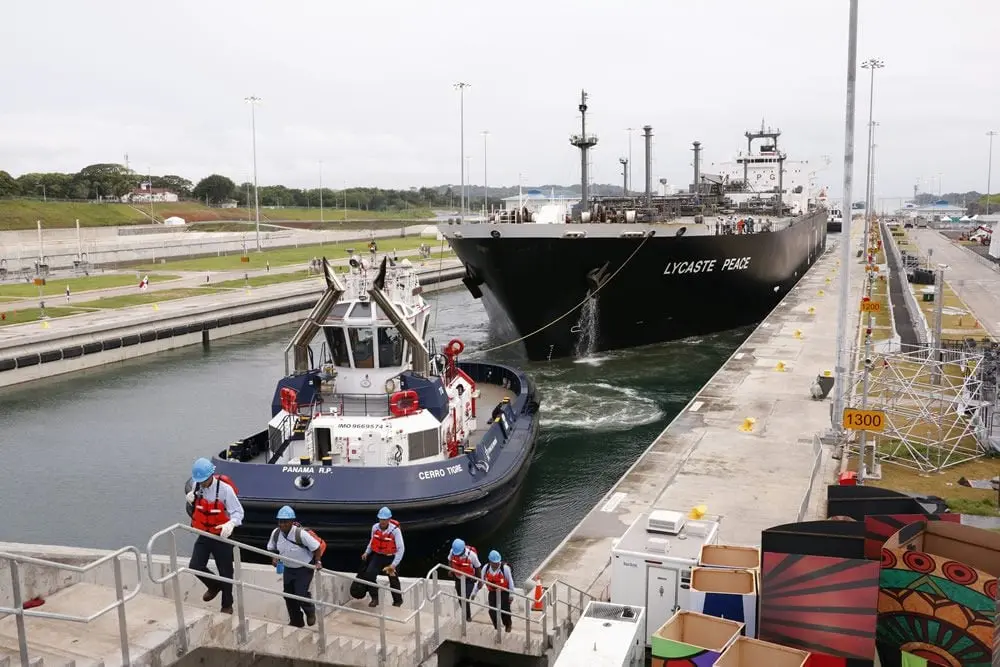
The escalating desperation of shippers to secure passage through the Central American canal highlights a double-bind currently squeezing global trade. On one hand, intensifying geopolitical instability—most notably a major war involving Iran that has severely disrupted traditional maritime routes through the Middle East and Red Sea—has forced global shipping fleets to re-route, placing a heavy premium on safe alternative channels. On the other hand, a powerful El Niño weather pattern has triggered severe drought conditions across Panama, drying up the freshwater lakes that feed the canal’s locks.
Faced with dwindling water levels, the Panama Canal Authority (ACP) has systematically slashed the number of daily vessel transits and imposed strict draft limits. The resulting bottleneck has caused wait times to swell to as long as 11 days for vessels arriving without reservations, forcing energy exporters and logistics giants to choose between multi-million-dollar auction bids, weeks of idle delays, or lengthy, fuel-consuming detours around the southern tips of Africa or South America.
Detailed Chronology of the Record-Breaking Bids
To fully comprehend the scale of the current crisis, it is necessary to trace how a routine administrative auction system transformed into an ultra-competitive, multi-million-dollar bidding war.
   [Pre-Feb Median Bid: ~$55,000]
                 │
                 ▼
   [Early August Record: $4.6 Million] (South Korean Vessel)
                 │
                 ▼
   [Late August Record: $5.3 Million] (SK Gas Ltd. / G. Spirit)
Historically, the Panama Canal Authority utilized a reservation booking system where the vast majority of slots were allocated months in advance. To accommodate vessels that arrived without bookings or needed urgent passage, the ACP maintained a secondary auction system. Prior to February, these auctions were relatively quiet affairs, with the median winning bid hovering around a modest $55,000.
However, as the dual crises of climate-induced water restrictions and geopolitical re-routing intensified throughout the year, the equilibrium between supply and demand shattered:
- The Early August Spike: By mid-summer, wait times for unbooked vessels began climbing into the double digits. In response, bidding in the daily auctions escalated rapidly. In early August, a shipper controlling a South Korean vessel set a shocking milestone by bidding $4.6 million to skip the queue. At the time, maritime analysts viewed this as an extreme, near-unrepeatable anomaly.
- The $5.3 Million Breakthrough: Within weeks, the record was broken again. During an auction conducted in late August, SK Gas Ltd. bid an unprecedented $5.3 million to lock in a northbound transit date of September 1 for the G. Spirit, a modern liquefied petroleum gas (LPG) tanker.
- Vessel Positioning: Tracking data compiled by Bloomberg indicated that as of late August, the G. Spirit was positioned on the Pacific side of the waterway, waiting to make its northbound journey toward the Atlantic basin.
This dramatic escalation represents a nearly 9,500% increase over the historical median auction price. It underscores a market in which shipping companies are no longer bidding based on marginal operational costs, but are instead pricing in the catastrophic financial penalties of missing delivery windows for high-value energy commodities.
Supporting Context: The Geopolitical and Climatological Convergence
The record-breaking bid of $5.3 million is not merely an isolated commercial transaction; it is a symptom of two powerful, compounding global crises that have effectively bottlenecked the world’s primary maritime corridors.
1. The Geopolitical Catalyst: War in the Middle East
The primary driver of the sudden surge in demand for Panama Canal transits is the geopolitical instability centered around the Middle East. The outbreak of war involving Iran has severely compromised safe passage through the Bab el-Mandeb Strait, the Red Sea, and the Suez Canal—the traditional maritime superhighway connecting Asia with Europe and the U.S. East Coast.
Fearing drone strikes, missile attacks, and ship seizures, commercial operators have largely abandoned the Red Sea route. For energy shippers carrying liquefied natural gas (LNG) and liquefied petroleum gas (LPG) from the U.S. Gulf Coast to major industrial hubs in East Asia (such as South Korea, Japan, and Taiwan), the Suez Canal is no longer a viable option.
This has funneled an overwhelming volume of global tonnage toward the Panama Canal. Because the Panama route is the most direct alternative for U.S.-to-Asia energy flows, any restriction in Panama’s capacity immediately triggers an exponential increase in shipping rates and transit premiums.
2. The Climatological Catalyst: El Niño and Panama’s Freshwater Crisis
Coinciding with this geopolitical displacement is a severe hydrological crisis in Central America. Unlike sea-level canals such as Suez, the Panama Canal relies on a gravity-fed system of locks powered entirely by freshwater from Gatun Lake and Alajuela Lake.
+------------------------------------------------------------+
|                  PANAMA CANAL WATER SYSTEM                 |
|                                                            |
|   [Gatun Lake] (Freshwater Reservoir)                      |
|        │                                                   |
|        ├──► Est. 50 Million Gallons of Freshwater lost     |
|        │    per vessel transit to the ocean.               |
|        ▼                                                   |
|   [Canal Locks] ──► [Pacific Ocean] / [Atlantic Ocean]     |
|                                                            |
|  * El Niño suppresses rainfall -> Gatun Lake level drops.  |
|  * ACP must restrict daily transits & draft limits.        |
+------------------------------------------------------------+
Each time a vessel transits the canal, approximately 50 million gallons of freshwater are flushed out of the locks and into the ocean. This system relies on Panama’s typically abundant tropical rainfall to constantly replenish the lakes.
However, the onset of a powerful El Niño weather pattern has severely suppressed rainfall across the Isthmus of Panama. The resulting drought has caused water levels in Gatun Lake to plunge toward historic lows. To prevent the lakes from drying out entirely and to preserve drinking water for the local population, the ACP has been forced to implement aggressive conservation measures:
- Draft Restrictions: The maximum draft limit for vessels passing through the larger Neopanamax locks has been progressively reduced. This forces large container ships and tankers to carry significantly less cargo to sit higher in the water, reducing shipping efficiency.
- Transit Reductions: The ACP has steadily tightened restrictions on the number of daily vessel transits allowed through the canal. In normal hydrological conditions, the canal facilitates upwards of 36 transits per day. Under the restricted regime implemented for September, that number has been slashed, leaving a long line of vessels waiting on both sides of the isthmus.
Official Positions and Industry Economics
The response from key stakeholders involved in this historic transaction highlights the sensitive and highly competitive nature of the modern energy logistics sector.
SK Gas and the Economics of LPG Arbitrage
When contacted for comment regarding the $5.3 million auction bid, SK Gas Ltd. did not immediately respond. Industry analysts point out that for an LPG distributor, the decision to pay such an exorbitant premium is rooted in cold, mathematical calculations of market arbitrage and contract penalties.
The G. Spirit is an LPG carrier designed to transport highly volatile gases. In the energy sector, delivery contracts are bound by strict "laycans"—designated windows of time during which a vessel must arrive at its destination port to load or discharge cargo. Missing a laycan can result in:
- Contract Default: The buyer has the right to cancel the contract entirely, which can cost the shipper tens of millions of dollars in lost revenue.
- Demurrage Fees: Idle vessels accumulate substantial daily demurrage charges, often exceeding $100,000 per day.
- Arbitrage Collapse: The price spread for LPG between the U.S. Gulf Coast and East Asia can fluctuate rapidly. A delay of two to three weeks can completely erase the profit margin of a multi-million-dollar cargo.
When weighed against the alternative of a 30-day detour around the Cape of Good Hope—which incurs immense extra fuel costs, crew wages, and deprives the operator of the vessel’s utility for an entire month—paying a $5.3 million premium to secure immediate passage can be the most economically rational choice.
The Panama Canal Authority’s Perspective
The Panama Canal Authority, speaking through a spokeswoman, declined to provide an official comment on the record-breaking $5.3 million price tag. However, the authority released a statement contextualizing the recent auction dynamics.
The ACP emphasized that the vast majority of vessels transiting the waterway continue to utilize the standard pre-booking reservation system, which protects operators from extreme market volatility. Nonetheless, the authority acknowledged that recent daily auction results reflect "significantly stronger demand" driven by external market pressures, resulting in bid prices that dwarf the historical baseline.
| Metric | Pre-February Baseline | Late August Peak | Percentage Increase |
|---|---|---|---|
| Median Auction Bid | ~$55,000 | $5,300,000 | ~9,536% |
| Average Wait Time (No Booking) | < 48 Hours | Up to 11 Days | ~450% |
| Daily Transit Slots | ~36 | Restrained (Varies) | Significant Reduction |
Future Outlook: Redefining Global Shipping Routes
The $5.3 million auction bid is a clear indicator that the global shipping industry is entering an era of prolonged volatility. As climate change and geopolitical fragmentation continue to challenge traditional maritime chokepoints, the economics of global trade are being fundamentally rewritten.
1. Long-Term Hydrological Viability
The reliance of the Panama Canal on freshwater makes it uniquely vulnerable to changing global weather patterns. Climate scientists warn that while El Niño cycles are cyclical, the underlying trend of rising global temperatures is likely to increase the frequency and severity of droughts in Central America.
To secure its long-term future, the ACP is exploring massive infrastructure projects, including the damming of the Indio River to create a new freshwater reservoir that could feed Gatun Lake. However, such projects will require years to design, fund, and construct, offering little relief to shippers in the immediate future.
2. Supply Chain Diversification and Nearshoring
The extreme costs associated with navigating key canals are accelerating structural shifts in how multinational corporations design their supply chains:
- Nearshoring: To avoid the risks of trans-oceanic shipping, companies are increasingly moving manufacturing facilities closer to their primary consumer markets—such as shifting production from East Asia to Mexico or Eastern Europe.
- Intermodal Land Bridges: For goods traveling from Asia to the Americas, shippers are increasingly utilizing "land bridges"—unloading cargo at West Coast ports (such as Los Angeles or Long Beach) and transporting it across the United States via rail and truck to East Coast destinations, bypassing the Panama Canal entirely.
- Alternative Maritime Corridors: Shipping companies are investing in larger, dual-fuel vessels optimized for long-haul voyages around the Cape of Good Hope, accepting longer transit times as a trade-off for predictable operational costs and zero transit-slot risk.
Conclusion
The record $5.3 million bid paid by SK Gas to secure passage through the Panama Canal is a stark reminder of the fragile state of global trade. When geopolitical conflict closes one door and climate change constricts another, the physical conduits of global commerce become premium commodities. As long as these dual pressures persist, the price of skipping the line at the world’s premier maritime shortcuts will remain a luxury reserved only for those carrying the most valuable cargoes.