









Executive Overview
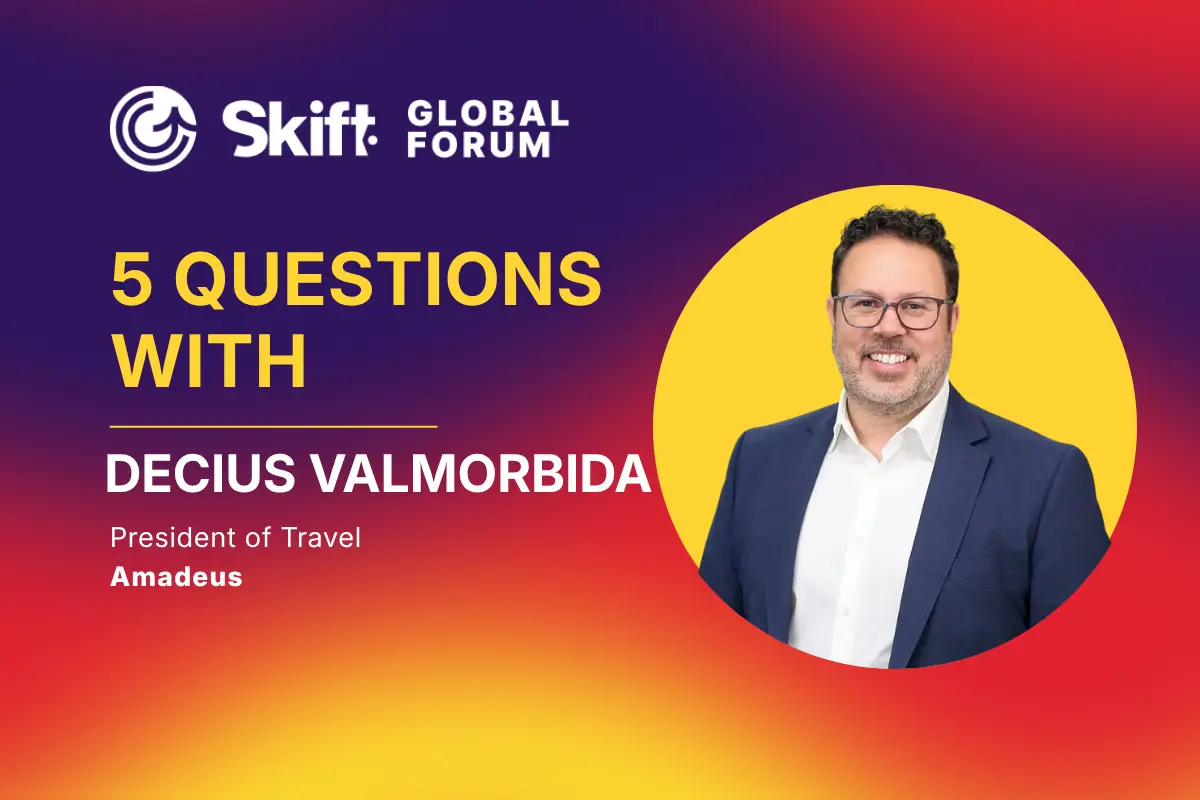
As the global travel sector approaches a complex future defined by hyper-fragmented consumer expectations and rapid technological evolution, the foundational plumbing of the industry is facing a reckoning. For four decades, Amadeus has acted as the invisible connective tissue powering the global booking ecosystem. Today, as the company prepares to celebrate its fortieth anniversary, its President of Travel, Decius Valmorbida, is sounding a strategic alarm that challenges the status quo of travel tech.
Valmorbida contends that the travel industry is suffering from a fundamental structural flaw: it competes too fiercely on closed, proprietary ecosystems while cooperating far too little on the foundational infrastructure—the "plumbing"—that makes travel actually work. In an era where travelers demand end-to-end personalization, seamless cross-channel mobility, and absolute transparency, Valmorbida argues that walled gardens ultimately diminish traveler freedom and restrict long-term value creation.
Ahead of his high-profile appearance at the Skift Global Forum in New York City (scheduled for September 22–24, 2026)—where he will share the stage with industry luminaries such as Uber’s Dara Khosrowshahi, Airbnb’s Brian Chesky, and Hilton’s Christopher Nassetta—Valmorbida sat down to outline his vision. His thesis is clear: the next decade of travel technology must pivot from short-term hype cycles to enduring, collaborative foundations centered entirely on the modern traveler.
Detailed Chronology: Four Decades of Connectivity and the Shift to Open Ecosystems
To understand the weight of Valmorbida’s current mandate, it is necessary to contextualize the historical trajectory of travel distribution and technology.
The Foundation Era (The 1980s–1990s)
When Amadeus was founded in 1987 by a consortium of European airlines, the primary objective was simple yet revolutionary: build a centralized, reliable Global Distribution System (GDS) that could bridge the gap between fragmented airline inventories and travel agents across the globe. This era was characterized by closed networks, proprietary terminal screens, and the establishment of baseline connectivity. Technology was a back-office utility designed to prevent double bookings and standardize ticketing.
The Digital Disruption (The 2000s–2010s)
The advent of the internet and the subsequent rise of Online Travel Agencies (OTAs) shattered the traditional agency-centric model. Travelers gained direct access to inventory, sparking an explosion of choice. However, this period also sowed the seeds of fragmentation. Airlines, hotels, car rental companies, and railways rushed to build their own digital channels, creating isolated silos of data and customer touchpoints. While consumers enjoyed booking online, the end-to-end journey remained stubbornly disjointed.
The Closed Ecosystem Trap (The Late 2010s–Present)
In recent years, major travel brands and tech giants alike have aggressively pursued closed ecosystems. By curating every aspect of the user journey within a single brand "wall," companies attempted to capture maximum lifetime value. Yet, Valmorbida argues this approach has hit a ceiling. When airlines, hotels, and travel sellers construct impenetrable proprietary walls, the consumer is forced to navigate a fragmented landscape of disconnected touchpoints, resulting in a degraded overall experience and stunted industry growth.
The Horizon: Open Collaboration (2026 and Beyond)
As Amadeus marks its 40th year, Valmorbida is spearheading a strategic pivot away from proprietary isolation. The modern travel journey—spanning inspiration, booking, transit, accommodation, and post-trip engagement—can no longer be efficiently managed by a single walled garden. The roadmap for the next decade requires the industry to decouple brand competition from infrastructural cooperation, establishing shared standards for identity, data exchange, and interoperability.
Supporting Context & Metrics: Navigating Hype vs. Longevity
In an industry perpetually dazzled by shiny new objects—ranging from generative artificial intelligence to blockchain-based loyalty programs—decision-making at the executive level requires rigorous discipline.
Filtering the Hype Cycle
When asked about the methodology behind capital allocation and technological investment at Amadeus, Valmorbida emphasizes a strict adherence to longevity over fleeting trends.
"As Amadeus approaches our fortieth anniversary, we’ve gained a unique perspective on transformation across the travel technology industry. We’re constantly evaluating options for the future and, when we decide where to invest, our rule of thumb is to focus on longevity, asking ourselves which of today’s innovations are likely to have the greatest long-term impact," Valmorbida explains.
This philosophy has shielded Amadeus from the trap of chasing every passing bandwagon. The company’s internal investment test relies on three core criteria:
- Strategic Alignment: Does the initiative reinforce Amadeus’s long-term capability roadmap?
- Real Customer Friction: Does it solve a genuine, tangible pain point for travelers or travel providers?
- Enduring Value: Will the technology remain relevant and foundational over the next ten to twenty years, regardless of macroeconomic volatility?
By applying this rigorous filter, Amadeus maintained consistent capital expenditure and research-and-development investment through favorable economic cycles, severe downturns, and the unprecedented disruption of the COVID-19 pandemic. Valmorbida notes that lasting competitive advantage is forged through the cumulative accumulation of robust capabilities over time, not through reactionary pivots to momentary hype.
Redefining the Customer Journey
The modern traveler’s expectations have evolved far beyond basic transactional efficiency. Today’s consumer views travel as a singular, fluid experience rather than a collection of disparate components. However, the industry’s digital architecture has struggled to keep pace.
+-------------------------------------------------------------------+
                 THE EVOLUTION OF TRAVEL ECOSYSTEMS
+-------------------------------------------------------------------+

  TRADITIONAL SILOS (Closed Ecosystems)
  [ Airline Brand ]   [ Hotel Brand ]   [ Travel Seller ]   [ Airport ]
                                             /                 /
          v                   v               v                 v
                 --> [ FRAGMENTED TRAVELER JOURNEY ] <--

  -----------------------------------------------------------------

  THE VALMORBIDA VISION (Open Ecosystems)

       [ Shared Foundations: Identity, Data Standards, APIs ]
                                 |
                                 v
                +---------------------------------+
                |   TRAVELER IN COMMAND           |
                |   - Choice                      |
                |   - Transparency                |
                |   - Control                     |
                |   - Personalization             |
                |   - Seamless Execution          |
                +---------------------------------+
                                 |
         (Providers cooperate quietly behind the scenes)
As illustrated in the framework above, the traditional model forces the traveler to navigate separate, walled-off brand environments, resulting in friction and reduced overall value. The open ecosystem model inverts this paradigm: shared technical foundations operate quietly in the background, empowering the traveler to sit at the absolute center with total control, transparency, and choice.
Official Statements & Insights: Decius Valmorbida on Trust, Retailing, and Cooperation
During his briefing ahead of the Skift Global Forum, Valmorbida expanded on the psychological and operational shifts required for the travel industry to mature. Below are the key insights extracted from his remarks regarding the future of travel tech.
On Shifting from Transactional to Experiential Relationships
The nature of the bond between travelers and service providers has undergone a structural transformation. According to Valmorbida, transactions are no longer enough to secure brand loyalty.
"The relationship between travelers and travel brands is evolving from a transactional one to an experiential one. Travelers are no longer simply purchasing a product or service; they are buying an end-to-end experience and expecting every part of that journey to work seamlessly together."
This experiential shift places immense pressure on brand promises. In a hyper-connected marketplace where alternatives are literally a swipe away, trust has emerged as the ultimate differentiator. Brands do not earn trust through marketing slickness; they earn it by flawlessly executing critical operational moments—especially when disruptions occur.
On the Retailing Transformation
The ongoing evolution of travel retailing—encompassing modern airline retailing standards like New Distribution Capability (NDC), dynamic hotel pricing models, and hyper-personalized ancillary sales—gives providers unprecedented insight into consumer behavior. However, Valmorbida warns that technological capability must be anchored in human utility.
"This is one reason why the industry’s retailing transformation is so important. It gives travel providers the opportunity to better understand traveler needs and create more relevant, personalized experiences. But technology alone isn’t enough. The real test is whether companies can use these capabilities to strengthen trust, deliver value and get those moments of truth right throughout the journey."
On the Missing Conversation: Industry-Wide Cooperation
Perhaps Valmorbida’s most provocative assertion concerns the topics the travel industry chooses to ignore. While boardrooms endlessly debate customer acquisition costs, user interfaces, and direct-booking incentives, leaders rarely discuss the unglamorous mechanics of collaboration.
"We talk a lot about choice, but we don’t talk enough about cooperation. Companies will always compete on their brands, products, and customer experience, but there are areas where the entire industry benefits from working together. If we can cooperate around shared foundations like identity, data standards, and interoperability, we can remove friction from the traveler journey while still competing where it matters."
By standardizing digital identity frameworks, harmonizing data protocols, and ensuring seamless API interoperability, the travel sector can collectively eliminate the friction that frustrates millions of passengers daily. The ultimate vision is an ecosystem that functions as a unified, frictionless one-stop shop for the consumer, even though dozens of independent corporate entities are cooperating invisibly behind the curtain.
Future Outlook: Testing the Open Thesis at Scale
As the travel industry looks toward the late 2020s, the debate between closed ecosystems and open architectures will define market winners and losers. Technology giants and super-apps will continue to tempt travelers with enclosed gardens, promising convenience in exchange for walled captivity. Meanwhile, legacy infrastructure providers, airlines, hospitality chains, and independent tech platforms face a stark strategic choice.
The upcoming Skift Global Forum in New York City (September 22–24, 2026) will serve as an essential testing ground for Valmorbida’s thesis. When industry titans like Decius Valmorbida (Amadeus), Dara Khosrowshahi (Uber), Brian Chesky (Airbnb), and Christopher Nassetta (Hilton) take the stage, the conversation will inevitably circle back to whether rival corporations can successfully abandon their territorial instincts in favor of shared plumbing.
If Valmorbida’s vision prevails, the next decade will usher in a golden age of frictionless travel—one where the consumer commands an open ecosystem supported by industry-wide cooperation. If the industry retreats into hyper-competitive silos, travelers will continue to bear the cost of fragmentation.
One thing is certain: as Amadeus enters its fifth decade of operation, the conversation around travel technology has officially shifted from how we book to how we build together.