











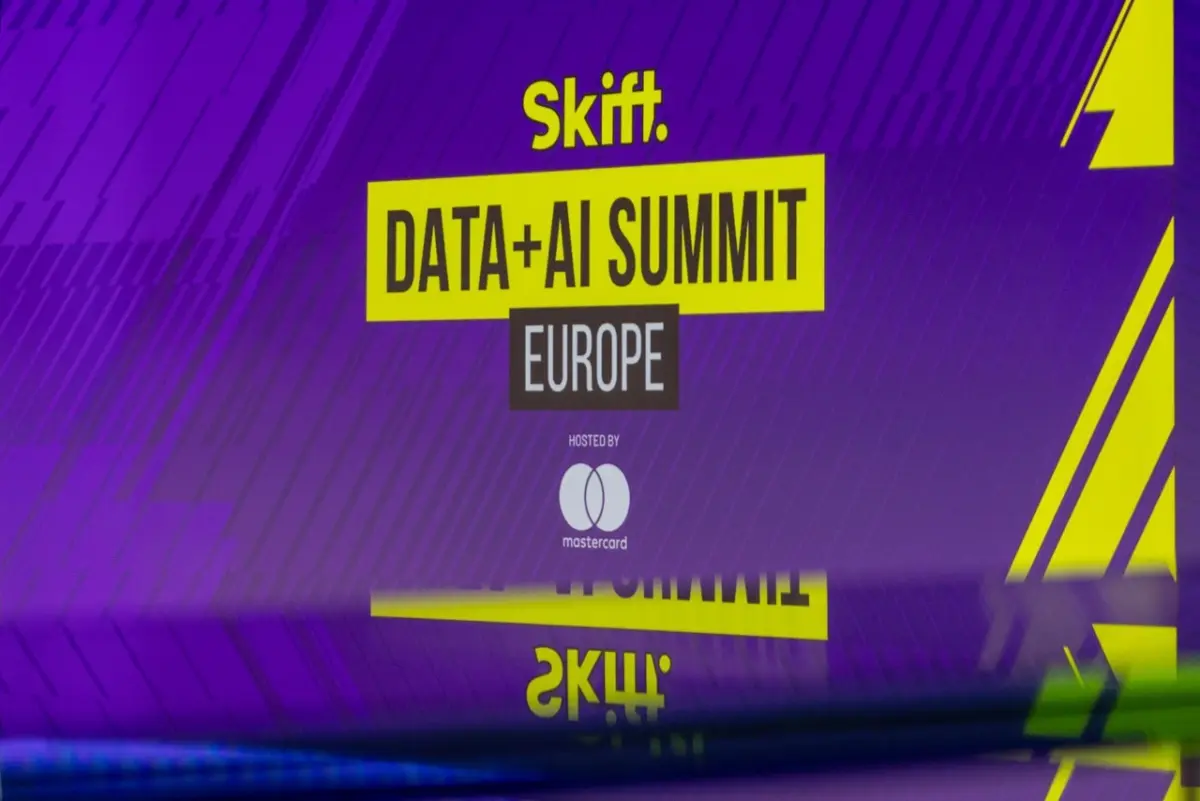
LONDON — As the autumn air settled over the British capital last week, travel industry executives, technologists, and hospitality leaders gathered at Skift’s Data + AI Summit in London to confront a paradox that is reshaping the foundational economics of European tourism.
For the past three years, the hospitality sector has been swept along by a breathless narrative of generative artificial intelligence (GenAI) transformation. Hotels have been told that conversational agents, predictive pricing algorithms, and automated concierge systems would revolutionize how they connect with travelers. But as the dust settles on the initial hype cycle, a sobering reality has taken hold.
Europe’s independent hotels—which make up approximately three-quarters of the continent’s vast accommodation sector—are facing an unprecedented existential challenge. Travelers are increasingly turning to AI-powered platforms to dream up, research, and structure their itineraries, yet very few are actually converting those conversational prompts into direct bookings. Worse still, a new "algorithmic invisibility" threatens to render small, unbranded properties entirely absent from the shortlist of recommendations generated by large language models (LLMs) and conversational search engines.
Simultaneously, the regulatory landscape is shifting beneath the industry’s feet. The implementation of the landmark European Union Artificial Intelligence Act (EU AI Act) is forcing hoteliers to formalize compliance, risk assessments, and data governance frameworks just as they try to figure out where the return on investment (ROI) actually lies.
At the London summit, the conversations moved past the abstract potential of what artificial intelligence could do. Instead, the focus locked onto what companies can prove: Who gets seen in a zero-click AI world? Who captures the final booking? And where do the underlying economics of AI actually work?
Executive Overview
The European hospitality market occupies a unique and vulnerable position in the global AI transition. Unlike the United States or parts of Asia, where branded mega-chains and massive aggregator ecosystems dominate the real estate and the digital funnel, Europe’s lodging landscape is heavily fragmented. Independent boutique hotels, family-run pensions, and historic rural properties form the cultural backbone of European tourism.
However, this fragmentation is becoming a severe structural liability in the age of algorithmic discovery. While global online travel agencies (OTAs) and multinational hotel groups possess the capital, engineering talent, and proprietary data lakes required to optimize their digital assets for AI consumption, independent hoteliers are struggling to maintain visibility.

The core dilemma manifests in two distinct ways:
- The Discovery Disconnect: Travelers increasingly rely on conversational AI tools (such as ChatGPT, Google Gemini, and specialized travel planners) to curate hyper-specific itineraries. However, because these models rely on web-scraped data, brand authority, and structured metadata—areas where independent hotels traditionally lag—smaller properties are systematically filtered out of the algorithmic conversation.
- The Monetization Mirage: While consumer-facing AI trip planning has exploded in popularity, the actual conversion rate from AI chat interface to confirmed booking remains notoriously low. Consequently, independent hotels find that the clearest, most measurable returns on AI investments are currently restricted to back-of-house operational efficiencies—such as automated housekeeping coordination, dynamic pricing engines, and multilingual guest communication—rather than top-line revenue generation.
Layered on top of these commercial pressures is the stringent regulatory framework of the European Union. The EU AI Act introduces a rigid compliance regime that categorizes AI systems by risk, demanding rigorous auditing and transparency. For an independent hotelier operating with a lean staff, navigating this legal labyrinth represents yet another hurdle to digital maturity.
Detailed Chronology: From Hype to the London Summit
To understand how the European hotel industry arrived at this crossroads, it is instructive to trace the rapid evolution of artificial intelligence within the sector over the past several years, culminating in the critical discussions held in London.
Phase 1: The Generative Boom and Unstructured Adoption (2023–2024)
When consumer-facing generative AI tools exploded into the mainstream in late 2022 and early 2023, the travel sector reacted with a mixture of euphoria and anxiety. Early experimentation was largely tactical and decentralized. Independent hoteliers experimented with generative tools to write marketing copy, translate property descriptions into multiple languages, and deploy rudimentary chatbots on their direct websites to handle frequently asked questions.
During this phase, the primary emphasis was on novelty. Hotels wanted to be seen as "tech-forward," but few possessed a coherent strategy linking AI capabilities to revenue management or direct distribution channels.
Phase 2: The Rise of Conversational Discovery and the OTA Counter-Offensive (2024–2025)
As consumers grew comfortable using AI for complex tasks, travel planning behavior underwent a structural shift. Rather than browsing static OTAs or scrolling through endless review aggregator sites, travelers began typing complex, highly contextual prompts into AI engines—such as: "Find me a design-forward, eco-certified boutique hotel in Southern Italy with reliable high-speed Wi-Fi, a quiet workspace, and proximity to cycling trails for under €250 a night."
This shift exposed a fundamental vulnerability. Traditional search engine optimization (SEO) relied on keywords, backlinks, and domain authority. AI-driven discovery, however, relies on semantic synthesis, structured data schemas (JSON-LD), and rich, contextual web footprints. Major OTAs and branded chains quickly recognized this shift, pouring billions into optimizing their inventory feeds, API integrations, and partnerships with AI tech giants. Independent hotels, constrained by legacy property management systems (PMS) and limited digital marketing budgets, fell dangerously behind.
Phase 3: The Regulatory Squeeze and the EU AI Act (2025–Early 2026)
As the commercial stakes rose, policymakers in Brussels moved to establish guardrails. The formal rollout and phased enforcement of the EU AI Act created a new operational reality for hospitality businesses operating within the bloc.
Hoteliers could no longer casually deploy third-party algorithms for guest profiling, dynamic pricing, or automated customer service without considering liability, data privacy, and transparency mandates. The regulatory burden disproportionately impacted independent operators, who lacked dedicated legal or compliance departments to vet software vendors.
Phase 4: The Skift Data + AI Summit in London (October 2026)
This multi-year trajectory converged sharply on October 6, 2026, at the Skift Data + AI Summit in London. Convening industry stakeholders, technology developers, and hospitality strategists, the summit served as a reality check for the sector.
The core takeaway from the London panels was unambiguous: the honeymoon phase of AI adoption in travel is over. The discussion pivoted away from speculative forecasts of fully autonomous travel agents and toward gritty, pragmatic questions about data plumbing, API connectivity, algorithmic visibility, and hard-earned ROI.
Supporting Context & Metrics: The Anatomy of the AI Visibility Problem
The challenges facing Europe’s independent hotels are not merely perceptual; they are substantiated by emerging market data and structural market realities.
The Fragmentation Factor
According to industry benchmarks, independent hotels account for roughly 72% to 75% of the total hotel room supply across Europe. In contrast, North America’s hotel market is heavily dominated by branded chains. This European fragmentation is both a cultural asset—preserving regional charm, unique architecture, and authentic local hospitality—and a profound digital disadvantage.
When an artificial intelligence model compiles a list of recommendations for a European destination, it frequently defaults to global brands or properties listed on major aggregators because their digital infrastructure provides clean, machine-readable data feeds. An independent hotel operating on an outdated website with fragmented booking engines remains invisible to the AI’s semantic parsing engines.
The Conversion Gap
Consumer surveys highlighted at the London summit reveal a stark disconnect between AI usage and booking behavior:
- High Intent, Low Conversion: While nearly 40% of millennial and Gen Z travelers report using generative AI tools at some stage of their trip-planning journey, less than 5% complete the actual booking transaction directly within an AI interface or through an AI-guided recommendation path without reverting to traditional OTAs or brand websites.
- The "Zero-Click" Dilemma: Similar to the evolution of Google search, where informational queries are increasingly answered directly on the search engine results page (SERP) without driving traffic to publisher websites, conversational AI provides travelers with complete itineraries, packing lists, and neighborhood guides without ever directing them to a hotel’s direct booking engine.
Operational ROI vs. Top-Line Growth
While driving direct bookings via consumer-facing AI remains an uphill battle, independent hotels are discovering undeniable value in internal, operational deployments. Measurable returns are currently concentrated in three areas:
- Dynamic Pricing and Revenue Management: AI-driven forecasting models that analyze historical demand, local weather patterns, flight data, and competitor pricing are helping small properties optimize RevPAR (Revenue Per Available Room) more effectively than static manual rules.
- Multilingual Guest Communication: Automated messaging platforms powered by LLMs allow small front-desk teams to provide 24/7, culturally nuanced communication to international travelers in their native languages, drastically reducing administrative friction.
- Back-of-House Efficiency: Predictive maintenance tools and automated housekeeping scheduling are reducing operational overhead, mitigating labor shortages that have plagued the European hospitality sector since the pandemic.
Official Statements and Industry Insights
The conversations in London reflected a maturing industry grappling with the realities of algorithmic gatekeepers.
Reflecting on the shift from speculation to accountability, a leading hospitality technology analyst noted during the summit:
"We spent the last few years asking what generative AI can dream up. Today, the conversation has entirely shifted. Hoteliers are no longer interested in science fiction; they are demanding proof of performance. If an independent hotel cannot be parsed, understood, and recommended by an AI agent, it might as well not exist in the modern digital economy. The battleground has moved from the browser tab to the API."
Addressing the structural disadvantages faced by independent operators against multinational booking giants, a European hotel association representative emphasized the urgency of collective action:
"Europe’s independent hoteliers are the custodians of our continent’s diverse tourism identity. Yet, they are currently fighting an algorithmic war with twentieth-century weapons. Without shared technology infrastructure, open data standards, and collective advocacy, we risk an environment where a handful of technology platforms and global aggregators dictate who gets to sleep in Europe’s beds."
On the regulatory front, compliance experts at the summit highlighted the dual-edged sword of the EU AI Act:
"The EU AI Act is designed to protect consumers and ensure ethical technological deployment, but for a 20-room boutique hotel in the Provencal countryside, understanding risk classifications and algorithmic transparency mandates can feel overwhelming. Hoteliers must ensure their tech vendors are fully compliant, because ignorance of the law will not shield a business from heavy regulatory penalties."
Future Outlook: How Europe’s Independents Can Fight Back
As the industry looks beyond late 2026 and toward the remainder of the decade, the path forward for Europe’s independent hotels requires a deliberate, strategic pivot. Surviving and thriving in an AI-dominated travel ecosystem will demand coordinated action across technology adoption, data standardization, and digital marketing.
1. Transitioning to Machine-Readable Infrastructure
To combat algorithmic invisibility, independent hotels must upgrade their digital foundations. This means moving beyond static website design and investing in modern Property Management Systems (PMS) and Booking Engines (BE) that support robust API integrations and structured data schemas. Hoteliers must ensure that their property attributes—ranging from sustainability certifications and accessibility features to room dimensions and exact geographic coordinates—are coded in machine-readable formats that AI models can easily ingest and verify.
2. Embracing Cooperative Technology and Consortia
Recognizing that individual independent properties lack the capital to compete with OTAs in AI optimization, regional hotel associations, marketing consortia, and independent hotel groups are pooling resources. By creating shared data pools and collective distribution platforms, independent hotels can achieve the scale necessary to negotiate with AI platform developers and ensure their inventories are featured in conversational search results.
3. Redefining the Direct Relationship Through Hyper-Personalization
Because AI-driven search engines and OTAs will increasingly commoditize standard accommodation searches, independent hotels must lean heavily into what algorithms cannot replicate: authentic, hyper-localized human experiences and emotional resonance. By deploying conversational AI ethically on their own direct channels—complying fully with the EU AI Act—hotels can create deeply personalized pre-arrival dialogues that convert hesitant browsers into loyal, direct-booking guests.
4. Navigating Regulation as a Competitive Advantage
Rather than viewing the EU AI Act solely as a bureaucratic burden, forward-thinking independent hotels are beginning to frame compliance as a mark of trust and quality. In an era where consumers are increasingly wary of algorithmic bias, "privacy-first" and "human-verified" AI policies can serve as powerful differentiators against opaque, data-harvesting global aggregators.
Conclusion
The Skift Data + AI Summit in London served as a clear wake-up call for Europe’s hospitality sector. The AI revolution in travel is no longer a distant horizon or a marketing buzzword; it is an active, competitive arena. For Europe’s independent hotels, the challenge of algorithmic invisibility is formidable, but it is not insurmountable. By closing the technical gap, embracing cooperative digital strategies, and doubling down on the irreplaceable authenticity of independent hospitality, Europe’s hoteliers can ensure they remain visible—and vibrant—in the age of AI.


