By The Global Travel Industry Desk
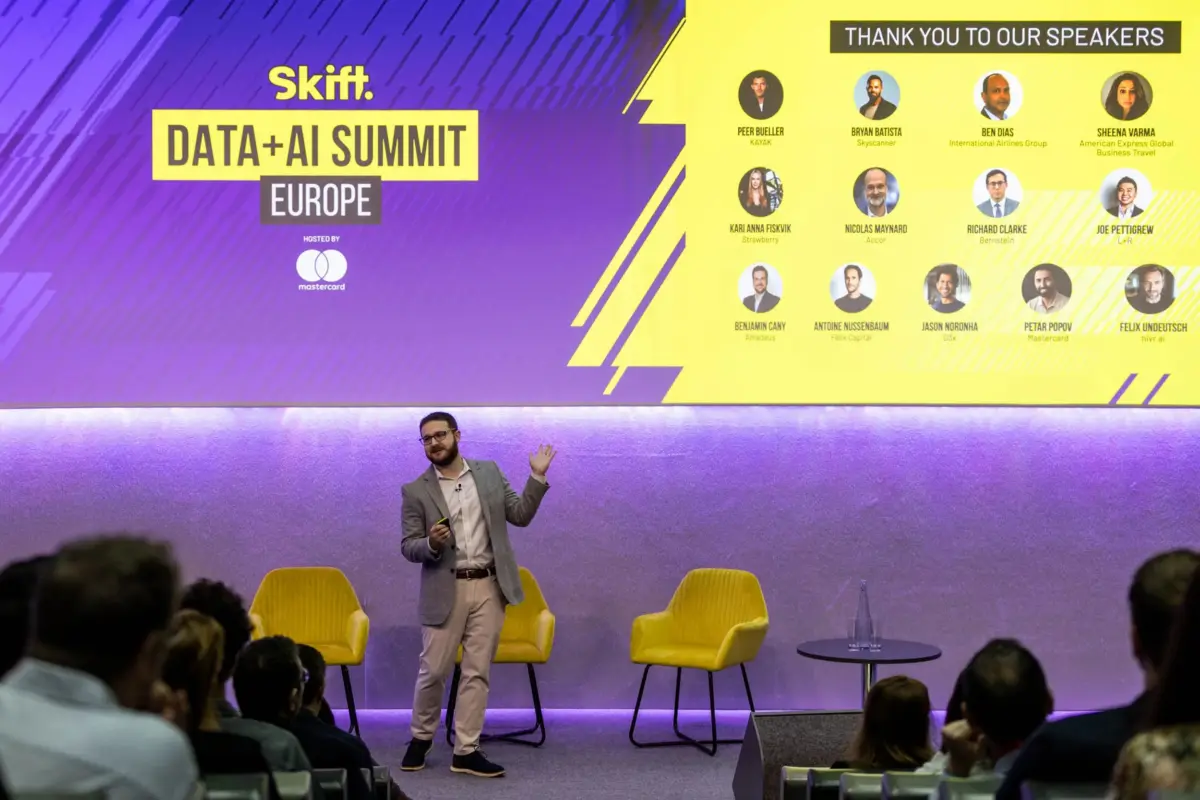
Special Report from the Skift Data + AI Summit Europe, London
Executive Overview
The global travel and hospitality sector is facing an existential reckoning, driven by the rapid, unstoppable rise of agentic artificial intelligence. Across boardrooms from London to Silicon Valley, the conversation has shifted away from experimental chatbots and passive recommendation engines toward a far more disruptive reality: autonomous agents capable of making end-to-end travel decisions, executing complex bookings, and managing itineraries on behalf of consumers without human intervention.
Platforms such as Instinct and Muse are hitting the market with unprecedented velocity, and consumer adoption curves are steepening faster than even the most aggressive technology forecasters anticipated. Yet, behind the buzzwords and high-stakes product launches lies an uncomfortable truth. While the technological capability for fully automated, agent-driven travel planning is rapidly maturing, the foundational architecture of the legacy travel industry is fundamentally unprepared for this paradigm shift.
“The agents are here,” declared Seth Borko, Skift’s Head of Research, setting a sobering tone at the recent Skift Data + AI Summit Europe in London. “Almost no one [in travel] is ready for this world.”
This report examines the core strategic dilemmas facing travel executives today. As AI labs accelerate development cycles at a pace that vastly outstrips traditional corporate planning, executives are forced to navigate a treacherous landscape defined by legacy distribution models, fragmented data sources, evolving consumer trust, and immediate capital allocation choices. The era of agentic booking is no longer a distant theoretical milestone on a futuristic roadmap—it is happening right now, and the industry’s response over the next 24 months will dictate market leadership for the next decade.
Detailed Chronology: The Road to Autonomous Travel
To understand how the travel industry arrived at the precipice of the agentic booking revolution, it is necessary to retrace the accelerated trajectory of artificial intelligence integration over the past several years.
Phase 1: The Conversational Awakening (2022–2023)
The modern AI era in travel officially commenced with the widespread democratization of Large Language Models (LLMs). Initially, travel brands viewed generative AI primarily as a customer service enhancement—a cost-saving mechanism designed to field routine inquiries, process cancellations, and offer rudimentary, rule-based destination recommendations. These early deployments were fundamentally passive; they answered questions when prompted, but lacked the programmatic authorization and API integration required to execute complex commercial transactions.

Phase 2: The Retrieval-Augmented Generation (RAG) Era (2024)
As hallucinations plagued early enterprise deployments, the travel tech ecosystem pivoted toward Retrieval-Augmented Generation (RAG). Companies invested heavily in connecting proprietary databases—covering flight schedules, hotel inventories, and local experiences—to LLM front-ends. Consumers could suddenly query complex itineraries in natural language, receiving synthesized suggestions rather than endless grids of blue links. However, the transactional loop remained broken: users still had to click out to traditional Online Travel Agencies (OTAs) or airline direct sites to input payment details and complete bookings.
Phase 3: The Genesis of Agentic Capabilities (2025)
The critical technological breakthrough arrived with the advent of "agentic" workflows. Unlike traditional models that merely predict the next token in a sentence, AI agents are engineered with autonomous reasoning loops (such as ReAct frameworks), tool-use capabilities, and memory retention. They can break down a high-level user objective—such as "Plan a two-week family vacation to Italy focusing on sustainable agritourism under a $8,000 budget"—into dozens of discrete sub-tasks. These include checking real-time seat availability, cross-referencing dietary restrictions with restaurant databases, negotiating cancellation policies, and executing secure micro-transactions via tokenized payment gateways.
Phase 4: Market Disruption and Consumer Adoption (2026 and Beyond)
Today, platforms like Instinct and Muse have transitioned from closed beta environments to mainstream consumer visibility. Propelled by frictionless user interfaces and deep ecosystem integrations, consumer adoption is accelerating faster than institutional adaptation. Travelers are increasingly bypassing traditional search engines, meta-search aggregators, and even brand-direct apps in favor of trusted personal agents that manage their entire travel lifecycle.
At the Skift Data + AI Summit Europe in London, industry stakeholders gathered to dissect this exact timeline, culminating in the unveiling of the "Five Decisions" framework—a strategic blueprint designed to help travel executives navigate capital deployment, risk management, and technological integration in an agent-dominated landscape.
Supporting Context & Metrics: The Anatomy of the Agentic Shift
The urgency driving the discourse at the Skift Data + AI Summit is grounded in hard economic data and shifting behavioral metrics. While the direct volume of fully autonomous agentic bookings remains relatively modest as a percentage of total gross bookings today, the underlying growth vectors point toward exponential market capture.
The Asymmetry of Speed
The most acute challenge facing the travel industry is the profound velocity asymmetry between AI labs and corporate travel infrastructure.
[ AI Labs / Tech Innovators ]  =======>  Accelerating at Exponential Velocity (Weeks/Months)
[ Legacy Travel Enterprises ]  --->      Hampered by Legacy Tech Stacks & Governance (Years)
While artificial intelligence laboratories are iterating on foundation models, reasoning algorithms, and API standards on a weekly basis, legacy travel enterprises—spanning global distribution systems (GDS), airline reservation systems (PSS), and hotel property management systems (PMS)—operate on multi-year software development lifecycles and highly fragmented data structures. This structural lag creates a dangerous vulnerability: by the time a traditional hotel chain or legacy airline builds an API integration designed for a 2024-era LLM, the agentic ecosystem has evolved to require entirely different protocol structures and autonomous authorization tiers.
Shifting Consumer Paradigms
Consumer behavior is migrating away from active discovery toward delegated curation. Key behavioral shifts include:
- The Death of the Search Query: Users are moving from keyword-based searches ("cheap flights to Paris") to outcome-based directives ("find me the quietest boutique hotel in Paris with high-speed fiber internet and pet-friendly policies under $300/night for next weekend").
- Brand Loyalty Disintermediation: When an AI agent makes a booking recommendation based purely on price, convenience, and user preferences, traditional brand loyalty programs risk being bypassed entirely. If Muse or Instinct selects an independent boutique property over a global chain because the boutique’s API communicated real-time room availability and seamless cancellation terms more effectively, the hotel chain’s multi-million-dollar loyalty marketing budget is instantly neutralized.
- Frictionless Multi-Vendor Orchestration: Traditional travel planning requires consumers to visit an average of 14 to 38 different digital touchpoints across OTAs, review sites, airline portals, and tourism boards. Agentic platforms consolidate this entire consumer journey into a single conversational session, collapsing the traditional marketing funnel.
Official Statements and Industry Insights
The discourse at the Skift Data + AI Summit Europe underscored the profound strategic anxiety gripping travel executives. The tension between seizing first-mover advantage and managing catastrophic integration risk was palpable across every panel and keynote.
"The agents are here. Almost no one [in travel] is ready for this world."
— Seth Borko, Head of Research, Skift
Borko’s blunt assessment captured the central paradox of the current market cycle. Travel executives universally acknowledge that agentic AI is the industry’s inevitable destination, yet operational readiness remains abysmally low. Most organizations are paralyzed by a combination of legacy debt, data silos, and regulatory uncertainty.
Expanding on this theme during the "Five Decisions" executive briefing sessions, industry leaders debated the specific operational trade-offs required to survive the transition:
- Build vs. Buy vs. Partner: Should legacy airlines and hotel conglomerates attempt to build proprietary agentic interfaces, acquire emerging AI startups, or cede the front-end user relationship entirely by plugging into third-party agent platforms like Instinct and Muse?
- Data Monetization vs. Data Protection: In an agentic world, AI models require unprecedented access to granular inventory, pricing, and guest preference data. How do travel brands protect their intellectual property and proprietary customer data from being scraped or exploited by dominant tech platforms?
- The Economics of Commission and Distribution: If an autonomous agent negotiates rates directly with a supplier on behalf of a consumer, what happens to traditional GDS fees, OTA commissions, and affiliate marketing revenue models?
- Liability and Error Resolution: When an autonomous agent makes a booking error—such as booking a non-refundable flight for the wrong month or failing to secure mandatory visa documentation—who bears legal and financial responsibility: the consumer, the AI developer, or the travel supplier?
- Human-in-the-Loop Governance: At what point in the transaction chain must a human intervene to authorize financial disbursements, and how can companies design interfaces that maintain consumer trust without reintroducing the friction that agentic AI was designed to eliminate?
Future Outlook: Navigating the Next Decade of Travel Technology
As the travel industry looks past the immediate disruptions of the mid-2020s toward the horizon of 2030, the implications of agentic booking will fundamentally redraw the competitive landscape. Survival in this new paradigm requires a complete reimagining of enterprise strategy.
1. The Rise of API-First Inventories
Travel suppliers that cling to closed, fragmented, or legacy-based booking systems will find themselves commercially invisible. To participate in the agentic economy, airlines, hotels, rail networks, and tour operators must expose their inventories through high-performance, standardized APIs capable of instantaneous machine-to-machine negotiation and booking. The currency of the future is not a glossy user interface; it is clean, structured, and accessible machine-readable data.
2. The Redefinition of Customer Relationship Management (CRM)
Traditional CRMs rely on historical purchase data and demographic segmentation to drive targeted email campaigns. In the agentic era, CRM will evolve into Agent Relationship Management (ARM). Brands will no longer market directly to the human end-consumer; instead, they will optimize their digital footprints to appeal to the preference algorithms of consumer-facing AI agents. SEO (Search Engine Optimization) will be superseded by AIO (AI Agent Optimization), where brands compete to ensure their properties, fares, and perks are preferentially selected by autonomous reasoning engines.
3. Regulatory and Legal Harmonization
Governments and regulatory bodies are already casting a wary eye on autonomous commercial transactions. Issues surrounding consumer privacy (GDPR and CCPA compliance in automated workflows), algorithmic bias in pricing, and liability for botched travel arrangements will necessitate robust new regulatory frameworks. Travel brands that proactively establish transparent, ethical AI governance policies will build a powerful competitive moat based on consumer trust.
Conclusion
The transition to agentic booking represents the most profound structural disruption the travel industry has experienced since the advent of the internet and the rise of the original online travel agencies in the late 1990s. As Seth Borko emphasized in London, the agents have arrived, and the window for passive observation has slammed shut. For travel executives, the mandate is clear: abandon legacy complacency, overhaul technological infrastructure, and prepare for a future where the ultimate customer is no longer human.